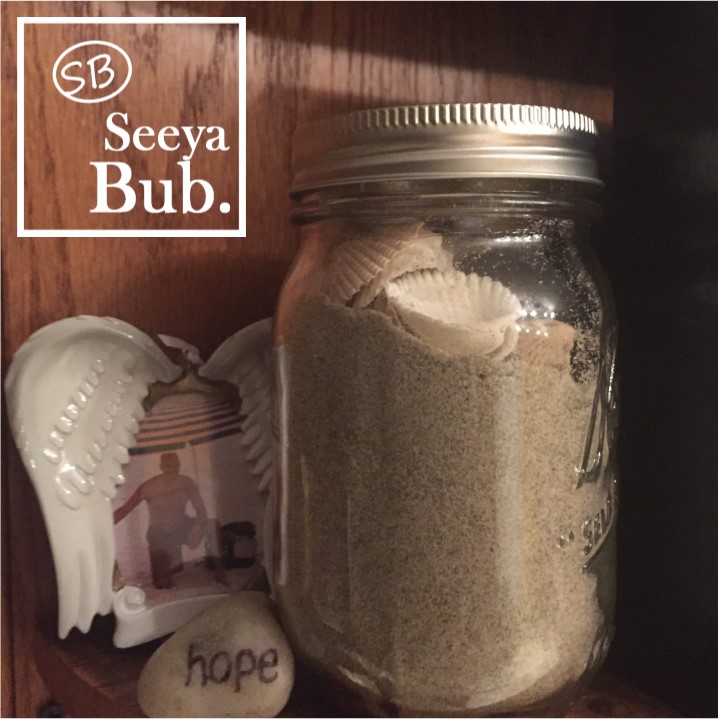
A Jar of Sand

I opened my desk drawer at work and pulled out a jar of sand.

To the outsider looking in, the jar is nothing special. It’s a simple mason jar filled with gray sand. On top of the sand, there rests a handful of seashells. The seashells range in color, shape, and size.

But to me, that jar is a truly cherished possession. A gesture of love and compassion. Something that means more to me than most people would ever know. This unsuspecting jar of sand was a treasure that helped me get through some of the most difficult emotional obstacles of my life.

And it came from a student I’ll never forget.


Swimming trunks? Check. Sunscreen? Check. Shades? Check.

I ran through the list as I had done so many times before, as my family geared up for our summer vacation to Gulf Shores, Alabama. Mom, Dad, and I were heading down to the beach for a week. We hadn’t been in a few years as a family, so we were all looking forward to the opportunity to get away for a week and soak up the sun in our favorite seaside haven.

It was July of 2013.

In a week or so, my family would be leaving for our beach vacation, and we couldn’t be more excited. We all needed a break from the everyday routines we had established, and in my family nothing was more peaceful than parking a chair in the sand along the coast and staring out into the endless waves.

We were anticipating so many great times together in Gulf Shores, and we were also anticipating a very long and very uncomfortable ride in the truck. My Dad’s truck may have comfortably sat four riders, but that was without luggage. But even a family of three should have been able to fit in the truck somewhat-comfortably with plenty of luggage to last throughout the week.

Not my family. Specifically, not my Mom. Although Dad and I were pretty efficient packers, Mom always believed that we should bring anything and everything that we would possibly need or want during that week—and to be safe we should probably bring two of them.

The night leading up to our departure was always interesting, as Dad would try to solve the most complex game of Tetris he had ever encountered—piecing all of our luggage into the back of the truck without obstructing his view out of the rear window. I would always help my Dad as he put the luggage into the vehicle we were driving, and we would both shake our heads and bite our lips when we saw how much stuff we had packed. Dad would typically find at least one thing to grow endlessly frustrated about that my Mom had packed.

“Becky, do we really need to take a gallon sized plastic pitcher with us?” he would yell through the door.

“What am I going to make lemonade in if we don’t?” she would yell back.

Dad would turn around, mumble under his breath about how there were pitchers in the condo kitchen that she could probably use, and then he would do what any good husband would do. He put the pitcher back in the truck and packed it anyway.

But this summer, Dad had his new truck. In an effort to make us all a little more comfortable, he was scouring the Web for a new cap or toolbox he could put in the bed of his truck so we could store all of the luggage in there instead of cramming everything into the cab. Each night, Dad would spend some time looking at the newest name-brand contraptions that would turn the bed of his truck into the premium luggage hauler for our nearly 700 mile drive. He would slowly read things on the Internet, pondering reviews and printing out possible solutions.

He did this all the way up until the night before his death. I would like to think that my Dad was looking forward to that trip. I have no idea whether the suicidal thoughts he would feel the next day had already invaded his mind, but it’s very hard to imagine that my Dad would have been looking at options to increase his packing capacity had he not envisioned going to the beach.

What a great trip it would have been. Dad absolutely loved the beach. We had spent so many summer vacations sitting shore-side in chairs under umbrellas soaking in the sun and admiring what we thought was God’s most beautiful creation. My Dad always seemed to be at peace at the beach. He would lay calmly on a beach towel in the sand as the sun beat down on his back. He would dig holes and build sand sculptures. He would swim out as far as he possibly could into the ocean while my Mom looked on nervously from her chair.

But he was never isolated at the beach. He and my Mom would take long walks along the shore, talking and looking at the sea gulls as they flew by. He and I would toss a baseball back and forth until our arms got tired or we overheated, and then we would jump into the waves and toss a ball there instead. And Dad, always the chatterbox, would make friends with the strangers who had set up camp near us on the beach. He would get to know people from all over the country and learn about their lives. If he met them early on in the trip, he would be sure to get to say hello to them every day of the trip.

Dad just seemed so happy at the beach. It was his little slice of heaven on earth. And I often wonder if he’d still be sitting here next to me today had that trip been a week or so earlier. I can’t help but imagine…


Instead of spending that week on the beach, it was more than a month after my Dad’s death and I was sitting in my office chair at Miami University Middletown, staring aimlessly at my computer and pondering my new life. My work days, when I could actually get the strength to go in, were full of daydreaming, pondering, and distraction. I would try to commit my mind to projects and tasks before the start of the semester, but it was nearly impossible. I could only seem to think about my Dad and how desperately I missed him.

Mom and I hadn’t seriously entertained the idea of going on vacation without Dad after his funeral, even though many people had encouraged us to go anyway as a way to escape the reality of our new life. We both knew that it was just too early to go on a family vacation when we felt like our family wasn’t whole. Going to the beach without Dad was just too much for us to take on so soon. So, we stayed home and eventually tried to get back to normal life—or our new normal. I knew I couldn’t go so soon, and seriously wondered whether I would ever be able to go back again without him.

As I sat at my desk one afternoon trying not to cry, I heard a knock at my office door. It was Gillian Maxfield, one of my campus tour guides and a student I had grown to adore during her time at Miami.

“Hi there, Gillian,” I said, pronouncing her name with a hard “G” (like Gilligan), an inside joke between she and I that traced back to the first time I met her. I had read her name off of a roster of campus tour guides shortly after I took over the role at Miami, and when I pronounced her name the way I did, everyone laughed as she corrected me.

“It’s Gillian! Like with a ‘J’!” she laughed.

“But it doesn’t have a ‘J’,” I said with a look of mock confusion on my face. Honestly, I had never seen that name spelled that way! “It has a ‘G.’ Therefore, I’ll call you Gill-ee-en.

Everyone laughed, including Gillian, and for as long as I worked at Miami I nearly always pronounced her name that way.

Gillian was the type of student that every educator dreams of—resilient, willing to take chances, and always appreciative of the opportunities she was given in life. Gillian came to Miami with a healthy dose of nervousness towards college, but she immediately started to embrace leadership opportunities all across the campus. She started participating in the wealth of student activities that were offered, and eventually joined the student organization that planned all of them. She held a campus job as an administrative assistant in the Dean of Students’ office. She was a dynamic student leader for the new student orientation programs held at the campus. And she became one of my most reliable, dependable, and engaging campus tour guides during her time there—not to mention a favorite for many of the families who came to explore.

Gillian always seemed a little nervous when she started giving tours on a regular basis after I began supervising the tour guides, but she was courageous and took every opportunity she could to improve her communication skills. She did it with great success, because her tour groups would always return from their stroll around campus with big smiles on their faces and plenty of compliments for their guide.

“Gillian was absolutely tremendous! She did a great job!” This was a common refrain from the visitors who would come to our campus. Gillian, always humble and never boasting, would smile, blush, and laugh nervously. She never failed to disappoint.

Seeing Gillian stand in my office doorway shortly after my return to work after Dad’s death was so comforting. She walked around my desk as I rose from my chair.

“I am so sorry to hear about your Dad, Tyler,” she said as she gave me a hug. “I know this must be a very difficult time for you.”

Her words were filled with compassion and generosity. She was always so genuine, and I appreciated this most. We both sat down and talked about how kind and supportive everyone had been during my return, and how I was slowly but surely learning to cope with a new world that my Dad was absent from.

Then, Gillian gave me one of the most genuine memories from that difficult chapter of my life that I still hold near and dear to my heart to this day. Gillian reached into her bag and pulled out a mason jar, handing it to me across the desk.

“I know that you weren’t able to go the beach this summer,” Gillian said, “and I know how much you were looking forward to going with your Mom and Dad. I wanted to bring you some sand and seashells from one of my family vacations as a way for you to remember the good times you had with your Dad at the beach.”
Jar of Sand

I looked at the mason jar as tears filled my eyes. I got up from my desk again, giving Gillian another hug as I attempted (unsuccessfully) not to break down. We sat back down as I turned the jar around in my hand, appreciating the beauty of the seashells and sand in front of me. Gillian was right—having that jar in my hand did bring back so many wonderful memories of the times that my family and I had spent together on the beach. I shared some of those stories with Gillian, and she sat in my office helping me grieve in ways that she never even knew. We talked for a while, and she let me express my feelings with the patience and maturity of someone far beyond her years. As we neared the end of our conversation, I got up to give her another hug as she left the office.

“Thank you, Gillian,” I said, pronouncing her name correctly for the first time in many years. “You have no idea how much this means to me.”


Just a few weeks ago, I was looking at that same jar of sand, yet again with tears in my eyes but for a very different reason.

I sat the jar down on the table, and walked out of my house in a black suit and shirt. After a short drive, I walked into the funeral home. I was there to attend Gillian’s funeral.

Gillian MaxfieldHealth complications had taken her too soon. We hadn’t seen each other in a few years after I left the job at the Middletown Campus, a fact that I now felt very guilty about. It’s so easy to say that we will all stay in touch when jobs or other circumstances change, and I hate that time makes these promises so difficult to maintain.

I used to have such difficulty attending funerals, but being on the receiving end of one changes everything. Thousands of people came out to show their love and support for my Dad during his funeral, and it made my Mom and I feel so loved and cared for. Ever since then, I’ve learned how wonderful it can feel to have people attend a funeral and tell stories about their loved ones.

I went for Gillian, but I also went for her family. Before approaching the casket, I had a chance to share the story of the jar of sand with Gillian’s heartbroken parents, once again with tears in my eyes. I told them how that gesture of love had warmed my heart and helped me survive the most difficult loss of my life. I told them how proud I was of all Gillian had done at Miami.

“I’ve kept that jar in my desk ever since that day,” I told them. “Every now and then, I pull it out and think about that day when she came to my office and gave it to me. She is the type of student every educator dreams of. Thank you for sharing her with all of us.” We discussed all of the memories we both shared of her, and Gillian’s Dad even remembered the day she had gathered the materials for the jar. We smiled together through tears—a reflection of a life well lived.

We hugged, and I approached her casket, preparing to say my respects one last time. Although her body was in front of me, I could only see the Gillian in my memories, full of life and flashing that familiar smile that had warmed so many hearts on our campus during her time there.

“Thank you, Gillian, for the jar of sand,” I said to her in my final goodbyes. “Thank you for being you.”

That jar of sand will always be one of my most treasured possession—not because of the shells and sand it contains, but because of the love it represents. More than I could ever express to her in person, Gillian went out of her way to help me grieve. But when I attended the funeral that day, everyone had their own “jar of sand” story about Gillian. We could all recollect moments when Gillian had touched our hearts so deeply in completely extraordinary ways.

I hope I can be more like Gillian as I go through this life. I hope I can exude the same zest for life she showed each and every day. Tragedy is inevitable, and I hope that in someone else’s moment of distress I can provide a “jar of sand” for them. I will never, ever forget how much that loving gesture strengthened my courage and resolve to deal with tragedy, and I’ll always be grateful for Gillian—a student who, just like a seashell, was truly one of a kind.

dad-and-seagulls-with-seeya-bub-logoDad, I often envy the fact that you are meeting so many wonderful people who are in Heaven, and I hope you’ve had an opportunity to meet Gillian. She helped me remember all the wonderful moments you and I had shared together with Mom and our family at the beach. She was one of God’s angels here on Earth who helped me cope with your loss, and I have no doubt that you are thanking her in person for that jar of sand she gave me. Thank you for giving me so many great memories. Until we can share all of those memories again together, seeya Bub.

“So, encourage each other and build each other up…” 1 Thessalonians 5:11 (NIV)

More Than Four Wheels (Part 2)

*Last week, I told you about one of my favorite memories of my Dad: the day of my college graduation party when he gave me a car as a graduation gift. Check out Part 1 of More Than Four Wheels here before you read on!

When you’re fresh out of college and you’re driving around in a nearly-new car gifted to you by your parents, you drive with an extra sense of caution because of the sentimentality of the vehicle. When you park in a lot, you park a little bit further (and at least three miles away from the nearest cart corral at any Wal-Mart). You take a little extra time at a stop sign. You drive even slower on a snowy day. You drive with a purpose, because it was purpose that gave you the vehicle you drive.

But even the most careful driving style leaves a car vulnerable to the wear and tear of the open road. Math is math, and miles add up. Engine parts give out. And no matter where you park at Wal-Mart, a cart from a careless shopper is almost guaranteed to bang into your bumper causing a disproportionate amount of damage (just another reason not to shop at Wal-Mart, I guess…)

In the blink of an eye, and definitely before I was ready to let go, my precious Envoy started to see the effect of both age and my rather aggressive driving style. For those of you who knew my Dad, you knew he was a tried and true parishioner in the Church of Offensive Driving. He had passed on this impatience, frustration, and love of the accelerator to his son. God bless him.

Over the years I had toyed with the idea of selling my Envoy, but I learned to deal with the occasional vehicle repair or failure on the side of the road. I was willing to put up with a slightly dirty interior, the minor rip in the leather interior, or the all too frequent inability of the air conditioner to actually condition the air.

And then, in the summer of 2013, my Dad passed away.

In that moment, in spite of the Envoy’s miles, scratches, or lack of reliability, I knew that I never wanted to let that car go. Along with many of my other physical possessions that my Dad had given me throughout the years, the Envoy became a tangible and lasting testament of my Dad’s love. Every time I got into it, I would think of him. My mind would go back to the day when he gave me that car as a gift for my college graduation. All I had to do was look at the Envoy and I could see him standing in the driveway again equipped with a camera and a huge smile. I can remember the feel of the hug he gave me. I can picture him tossing me the keys, and I can relive that first drive as a proud new car owner. To let go of the Envoy would be like letting go of all those memories and special moments. I couldn’t bring myself to do it.

When Dad Gave Me My Car

But at some point, you don’t have the choice to get a new car—you’re forced to, and I feared that day was approaching. Without my Dad to help me change the oil and take care of minor repairs, the Envoy started to become quite a financial burden. Every three months I seemed to be on the receiving end of a four-figure bill from the auto shop.

I slowly watched the odometer creep up and up the more I drove. 140,000. 150,000. 175,000. And I remembered taking a picture of the odometer when it hit 190,000 miles. I had made so many great memories putting those miles on the meter, but now when I thought about the impending problems that would be associated with increased mileage, I wished I would have taken my friends up on their offers to drive to dinner a few more times than I had.

I pledged that I was going to drive the Envoy until I couldn’t drive it anymore. It was a senseless decision fueled by love and memory, but it was something I felt that I needed to do to hold onto my Dad. I prayed that I could at least get the Envoy to 200,000 miles. I didn’t know what I would do with the Envoy once she sputtered across the finish line, but I would find a way to preserve her memory…and my Dad’s in turn.

But as soon as I started formulating this game plan, I heard a noise. No, not the voice of God or the trumpeting of an angelic chorus. It was a knocking from one of the rear wheels. This was a new one. I had heard many, many noises over the years from this particular vehicle. The squealing of brake pads. The hissing of parts unknown under the hood. And I swear, for all the great things my Envoy offered, I went through more squeaky serpentine belts than any care owner I knew. There are few things more embarrassing and annoying than puttering down the road as people turn their heads to look at your car because it sounds like a small woodlands creature is being tortured underneath your hood. If I ever did sell the car, the perfect customer would need to be an elderly person with severe hearing complications.

I pulled into my parking spot at work, worried and terrified that the knocking noise was something severe. Something I wouldn’t be able to repair. Something that my Dad would have been able to fix had he been here to help me. But he wasn’t.

And neither was his truck. The truck that I should have bought but didn’t…


My Dad was a truck man. It’s as simple and plain as that.

In fact, for my entire life my Dad drove trucks. It all started with a blue pick-up that I remembered from my childhood. And then a 1992 gray GMC Sierra with a single bench seat, manual windows and locks, an air conditioner that wasn’t very reliable, and a built-to-last gray toolbox in the bed. That Sierra became my very first ride when I turned 16. I drove it for one year in high school, and I had more problems with it than I would have thought any single vehicle could have in its entire lifetime. But I drove it and envied my Dad as he cruised around in his new, sleek Silverado.

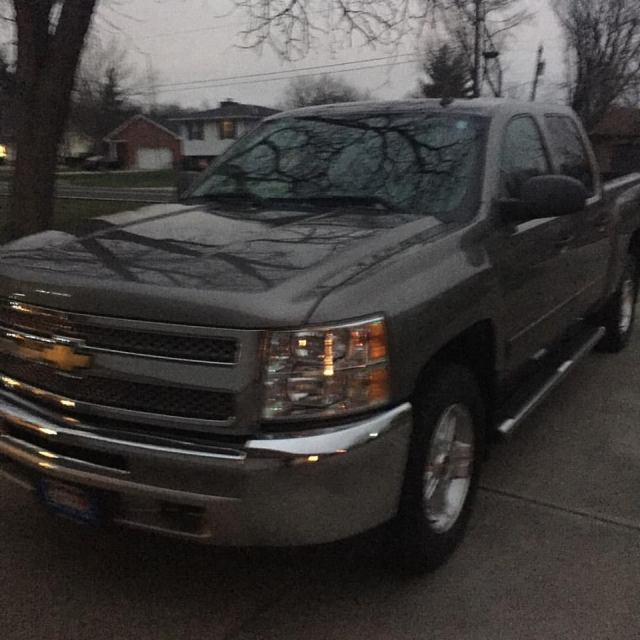
Yes, a Silverado. The envy of any Chevrolet man with a desire to own their own “most dependable, longest-lasting full-size pickups on the road” (Chevrolet’s words…and probably my Dad’s too). The dark grey Silverado he chose blew my mind on the day he brought it home. It was a four-door truck, which I had rarely seen. The leather interior was spotless. The truck ran smoother than any vehicle I had ever been in—especially at high speeds. And I knew that because my Dad loved high speeds. He would take me out on backroads near our home, and my Dad and I came from the same school of thought in regards to speed limits. (Sorry, Mom.) Speed limits are merely suggestions. This truck allowed us to test that out.

Dad drove that truck for a long time, putting many miles and many memories into it. Aside from a few minor problems, it was a great vehicle. But not as great as the one he would buy next.

In 2012, unbeknownst to my Mom and me, Dad started to shop around for a new ride—and boy did he find a good one. Dad always bought his trucks from Rose Chevrolet (now Rose Automotive), a local family-owned dealer with a tremendous reputation. He liked the dealership owner, Ed Larkin, and Dad always tried to buy things from people he liked.

Ed called my Dad in 2012 with a surprise. He had an almost new 2012 Chevy Silverado on the lot, and he knew my Dad would just love it. And he was right—Dad absolutely adored it, probably drooling a bit the first time he saw it. It was a lighter gray than his previous truck, but much, much newer. The previous driver had bought it, and after adding only about 1,000 miles to it, decided he wasn’t happy with it and wanted something else. His loss was my Dad’s gain, and Dad left Rose Automotive that day as a happy man in a new truck. He came home with a big smile on his face. I’m sure that smile faded a bit when he and my Mom had to have a “discussion” about his proclivity for expensive things, but Dad eventually charmed her into accepting the purchase. It only took one ride in the truck to realize why he bought it. It was spotless, beautiful, sleek, and perfect. And Dad was really happy.


I was sitting in the driver’s seat of that parked truck, alone and feeling very different from the first day I had sat in it.

My Dad wasn’t there to drive that truck anymore.

We had just had Dad’s funeral a few days earlier, and I was coming to terms with the face that he would never drive this truck again. His work-worn hands would never again feel that steering wheel. His heavy foot would never use that accelerator to defy another speed limit. His 20 ounce bottles of Mountain Dew would never rest in that cup holder ever again. His favorite country albums would never blare through the speakers with the windows down on a warm summer afternoon as he rode home from work.

He would never drive it again…but I could still feel him there.

When I sat in the seat of that truck, I could hear that familiar laugh of his. I could see that same familiar smile. I could feel his presence there with me.

I just sat in his truck in my parent’s driveway, slowly running my fingers over the same buttons and switches that he had once touched. I flipped through the loose items he had accumulated in the middle console: pens, scratchpads, hand sanitizer, the floss picks that he often drove my Mom and I crazy with as we drove home from dinner. I laughed at the memories, and I was upset that they were now only memories.

My Dad had worked so very, very hard to get that truck. Weekend shifts. Overtime calls. Side jobs. Whatever it was, my Dad had always taken extra opportunities to earn money to provide for our family. Thanks to the hard work of both of my parents, we had always led a comfortable life. Not extravagant, but comfortable.

I was mad and I felt robbed because this truck was, finally, my Dad’s opportunity to be extravagant. And he had only been able to enjoy it for a few months. I’m sure those few months were great for him, but Dad deserved years, maybe decades, of driving around in this truck. He would have taken care of it like it was his own child. He would have changed the oil before it needed it. He would have spent weekends performing routine and preventative maintenance to make sure that his truck would look newer and newer as it grew older and older. Dad deserved this truck. He deserved more than what he got. It was the first time I felt angry after Dad’s death. But I wasn’t angry at Dad. As much as I hate to admit it, I think I was angry at God for taking him away from all of us too soon. He had so much more life ahead of him, and so many more miles to drive.

I knew that I would only be able to sit in his truck and get angry for a little while longer, because my Mom had a tough but inevitable decision ahead of her. Dad had just purchased the truck a few months earlier, and we knew regardless of the emotional connection to it, there was no way we could keep it. The payments were just too high, and my Mom and I couldn’t let our hearts outweigh the reality of dollars and cents.

Although we had tried. Mom had asked me if I wanted to buy the truck, saying how much my Dad would have wanted me to have it. I knew she was right, but I also knew that even with a “family discount” there was no way I could afford it. Working in education is rewarding, but not so much on the “monetary reward” side of the scale. Working in an entry-level job and attending graduate school simultaneously while paying for my own house was too much some months. I couldn’t add a truck payment on top of that, even though my heart told me I should. My Mom knew the answer, but she needed to ask—for me and for her. My heart broke, but I knew what she would have to do.

We would have to sell my Dad’s truck. And I would always regret not buying it.


A few weeks later, my Mom called me in tears, which wasn’t unusual at this point in our lives. She would call me crying some days, and I would call her crying on others. But this one was different.

“Ty, I wanted to call you and let you know that Ed found someone to buy your Dad’s truck.”

It hit me like a ton of bricks, but I tried not to let it show because I didn’t want my Mom to be any more upset than she already was. I knew that I needed to be strong for her. I knew that this was just as difficult for her as it was for me. I knew that she was hurting, suffering, and having a hard time letting go of the pieces of my Dad’s life. Letting go of his truck made this all too real, all too final.

We talked for a little while through tears about how much Dad had loved that truck and how it wasn’t fair that he didn’t get to enjoy it more than he did. We talked about how much we missed him, and how we would give anything to see him pull into the driveway in that gray Silverado one last time.

Mom asked me if I wanted to see the truck again, one last time, before the new owner bought it from the dealership.

“I can’t. I just can’t.”

She understood. And just like that, my Dad’s truck was gone.


Two years down the road, I had put many, many more miles on the Envoy that my Dad had given me. With every thousand miles there came new, nerve-inducing noises. Knocks in the rear wheel wells. A haunting creak when you opened the door. Every day, I prayed that my plan to drive the Envoy “until the wheels fall off” wouldn’t involve them literally being blown off by an explosion.

I hated to admit it, but I didn’t know how much longer I would be able to hold onto the Envoy. I was starting to think I needed to cut my losses. I should get a couple thousand bucks out of it before I had to turn it in for scrap metal and parts. Each and every morning, I would say a quick prayer on my way out to the garage, and then I’d gamble. I’d turn the key in the ignition and pray that it started—and that there were no new noises. Some mornings I won, and other mornings I lost terribly. And, just like a casino, my wallet felt considerably lighter every time I lost.

But no matter how much it cost, how could I just let this car go? It was a gift from my Dad. It was a piece of him. And I had had to let so many pieces of him go over the past two years. Letting go of another one, especially one this significant, would hurt too much. I wasn’t prepared for the pain. I wasn’t prepared to say goodbye.

I prayed, a lot. I asked God for guidance. I told him that He knew the ins and outs better than anyone. I asked Him to give me the wisdom to make the right decision.

And one night, randomly, I was at the gym and I decided to send a text message that would change everything.

I was fortunate that a previous coworker happened to be a relative of Ed Larkin, the owner of Rose Automotive where my Dad had purchased all of his vehicles. Ed had been kind enough to sell the truck for my Mom after Dad had died, and he had also made sure that she received any of the profits that were made on the sale. He was one of a kind, and I knew that if I needed to buy a truck, Ed had earned my loyalty.

So, I sent the text to my old coworker, Karen, and explained the situation. “Karen, I think it might be time to sell my vehicle, and I’m hoping you can get Ed to help me. I’m having a really hard time thinking about selling my Envoy because it was a gift from my Dad, but I know that it’s time to start looking. I would love to get a truck, but I’ve never bought a car before and I don’t really know what I’m doing. My Dad always used to help me with this kind of stuff. Can you have Ed get in touch with me?”

Karen, always helpful, certainly agreed and said she would send Ed a text message and let him know all about the situation. I was shocked when I looked down at my phone about fifteen minutes later and saw her name on an inbound call.

Karen and I quickly exchanged hellos, and then we exchanged one of the most heartfelt conversations I’ve ever had in my entire life.

“Tyler, I really can’t believe this, but the person who bought your Dad’s truck returned it to the lot today,” she said. “He traded it in because he just wanted something new and it’s in spectacular shape. I talked to Ed, and he said the truck is yours if you want to buy it.”

Right there, in the middle of the gym, I fell onto my knees and started to cry. I couldn’t believe it. My Dad’s truck. It was coming home.

Karen was still on the phone, and said “Ed didn’t know how you would feel about it, and he completely understands if it’s too emotional for you…”

“I want it,” I interjected. “I’ll be at the lot tomorrow morning.”


“Mom,” I said, sitting on a bench at LA Fitness a few moments later, “You’re not going to believe this.”

“What’s going on?” she said nervously through the phone.

“I don’t even know how to tell you this, but the person who bought Dad’s truck traded it in today. Ed wants to know if I want to buy it.”

My Mom’s voice broke. “What?” and she started to cry. We couldn’t even talk to one another. We just sat on the phone, tears falling on both ends of the line.

“Ty, your Dad wants you to have this truck,” she said.

We just sat on the phone and cried together for a long while before she could ask me questions. And before I knew it, our conversation had steered from the truck to the reason that it had such sentimental value for us.

“I miss him so much, Ty,” my Mom said, a heartbroken wife opening up to her son.

“I do too, Mom.” And with that, I knew I had to buy the truck and bring it home.


I pulled into the lot at Rose Automotive the next morning, and although it was a gloomy day outside, my heart was full and bright. I was excited, but I was also nervous. I didn’t know how I would react. Would I be excited to see the truck again? Would it have changed too drastically to remind me of my Dad? Would it be too emotional for me to even drive it?

I didn’t have much time to collect my thoughts, because when I pulled in I saw it right away. And the tears immediately began to fall.

There it was. My Dad’s truck. Just as I had remembered it, but absent its familiar driver. I tried to contain both my excitement and my raw emotion, but was unsuccessful holding in either one.

Ed Larkin, the owner of Rose Automotive, was there to meet me with a smile and a handshake. “Ed, I just can’t believe this,” I said to him through budding tears.

“Tyler, I’m the one who can’t believe it,” Ed responded, as shell shocked as I was to be standing in front of the truck again. “The last person who owned it took tremendous care of it, and it looks just as good as the day we sold it to him. I was contemplating whether or not to call you and tell you that your Dad’s truck was back if you wanted it, and that’s the exact moment that Karen called me and told me you were looking for a car.

“I’m not just saying this as a car dealer trying to sell a vehicle, but Tyler there’s someone bigger at work here in this,” Ed said.

“I couldn’t agree more,” I responded.

And just as my Dad had done many times before, Ed tossed me the keys to the Silverado and told me to take it for a spin. I hopped in, drove away, and although he wasn’t there, I could feel Dad in the passenger seat with me.


It’s been a little over a year since that day, and I’m fortunate that my test drive didn’t end on that day. I’ve been driving my Dad’s truck since December 2015, and owning his truck is one of the greatest honors of my life.

Dad's Truck

I was fortunate that in my Dad’s absence, God positioned so many people in my life to help make this dream come true. He put Karen there to help connect me with Ed. He put Ed there, an honest and caring individual, to think more about the emotional value of the truck than its monetary worth. He put my Mom there to encourage me to buy it and help me with the down-payment. He put her there to encourage me and love me, and although it always feels a little emptier than either one of us would like, we ride together in that truck frequently and remember the happy days we shared with Dad in it. I was thankful to have my friend, Chris, to consult with when I thought the truck might be out of my price range. I remember Chris telling me “Don’t let a little extra money on the payment steal this away. This is your Dad’s truck, and you’ll find a way to make it happen.” God put all these wonderful people in my life to make sure that my Dad’s truck came home with me. And it’s been bringing me home every day ever since.

I know that God doesn’t always concern Himself with material things, but I know that He concerns Himself with things of the heart. God was able to use this material thing, a truck, to provide me with another connection to and memory of my Dad. He was able to use a truck as more than just four wheels. He was able to use that truck to help me grieve—and ultimately draw closer to Him.

I feel like I was able to hold on to a very important piece of my Dad by buying his truck—and not just any piece, but one of the most valuable and most memorable. My Dad loved his truck. He loved all the trucks he drove over the years. He took care of them and maintained them. He kept them clean and often criticized me when I hadn’t been to the car wash in weeks (or likely months). To my Dad, the truck was a symbol of pride. It said something about his character.

Anyone who drives a truck knows that you instantly become very popular with any of your friends who are moving or who need to haul heavy items or landscaping supplies. It’s fitting that my Dad drove a truck because he was always, always willing to lend a helping hand to anyone who needed it. My Dad would frequently sacrifice his personal time to help other people, from hauling items around town in his truck to extensive home repairs. It makes so much sense that my Dad always drove vehicles that would allow him to help other people, because my Dad truly had a servant’s heart.

When I sit behind the wheel of that truck, I can feel my Dad there with me. My mind flashes back to a happier day—the day my Dad brought that truck home and the first time he let me drive it. I remember that he let me drive as he sat in the passenger seat, probably anxious that his son was behind the wheel of a very new (and very expensive Silverado). Always trusting, however, Dad and I rode around in the truck for a few minutes, rolling down the windows on a cool Fall day, letting the sunshine and the open road renew our spirits.

2015Holidays-298

Although he isn’t here anymore, I still see him in that passenger seat every time I look over. I can picture it as clear as any real passenger that’s ever been in that seat. I can envision him with his harm hanging out the window. I can see him bobbing his head and thumping his thumb against the door to his favorite country song as it plays through the speakers. I can see him running his hand over his bald head after a hard day at work. I can see him leaning the seat back to relax his work-worn muscles. I can see him grabbing a bottle of Mountain Dew from the cup holder and taking a big swig on a hot summer day.

But more than anything, I see that smile of his. I see him smiling at the fact that his boy is driving his truck again, the way it should be. I see him proud that the truck found its way home.

And occasionally, I’ll see him in that passenger seat when he turns his head towards me and says, “Nice ride, huh Bub?”

“The greatest, Dad,” I’ll respond with love. “The absolute best.”

Dad, I don’t think I could ever accurately describe the joy I felt in my heart when I heard that your truck was back at the car lot and for sale. I had been so anxious about getting rid of my Envoy, and I couldn’t have dreamed for a blessing as miraculous and perfect as the one God provided. I try to make you proud and honor your memory each and every day, but I think your truck is a daily reminder of that call. You’ll be happy to know that the interior is still spotless, and I wash the truck weekly—just like you taught me. I take care of that truck because, although the title might have my name on it, I know that it’s really still yours. You gave it to me, Dad. Just like you and Mom gave me the Envoy at graduation, you gifted me another car—but this time you did it from Heaven. I can’t wait for the day when I can hug you and thank you in person. Every mile I add on that truck is one mile that I’m closer to seeing you again. But until that day, I’ll take good care of the Silverado. And until that day, seeya Bub.

P.S. You’ll be happy to know the Silverado is still out there breaking speed limits, in your honor…

“So with you: Now is your time of grief, but I will see you again and you will rejoice, and no one will take away your joy.” John 16:22 (NIV)

More Than Four Wheels (Part 1)

My best friend Chris and I stood over the opened hood of my 1998 GMC Envoy pretending to know what we were looking at. We knew for sure that the car wouldn’t start…and that was about the extent of our mechanical assessment.

Chris and I were just graduating from Miami, and this night was a rarity for us—we had actually been invited to a party and we had girls to go with us. Those same girls were now sitting impatiently in the backseat of a GMC Envoy that was parked on Bishop Street in Oxford and had no plans of moving from that particular location any time soon.

“I think we’ve almost got it fixed,” I yelled as I poked my head out from underneath the hood, flashing my best smile to our damsels in distress. Both girls smiled and laughed, probably knowing that I was using a liberal application of the word “almost”.

“I have no idea what I’m looking at here,” I said to Chris as we peered over the engine. I probably also added a few additional “adjectives” to help capture my emotions towards the vehicle, the car my Dad had bought for me during my senior year in high school. When he had bought it, I was super excited to have a car with a leather interior, a CD player, heated seats, and a sunroof. Four years and lots of driving, however, had gotten the best of the Silver Bullet. She was exhausted from the over 160,000 miles she had earned. The victim of my Dad’s attempts at numerous repairs had gotten the best of her. And now she was refusing to do the one thing I needed her to do: to start.

So Chris and I did what any college boys trying to impress a couple girls would have done. We took off our button downs, bent over the engine in white t-shirts and jeans, and started banging unmercifully on any piece of the engine that looked like it needed to be hit.

And when that didn’t work, we called my Dad.

Dad had received dozens of these calls over the years. “Dad, I went to get in the car after work and it won’t start.” “Dad, I have to be to class in 15 minutes and my car won’t start.” “Dad, I’m stuck in the middle of Route 4 and my car just died and there is an angry mob with pitchforks and torches ready to flip this hunk of junk if I can’t get it going. I might join them.” He always had a solution, usually something completely outside of my technical understanding of motor vehicles, but more times than not he could tell me what I needed to do to get the car moving, at least temporarily until we could get it to the shop.

But on this night, our call would be different. Memorable, and different.

I dialed his number and told him the story. “Dad, Chris and I and some friends are stuck in Oxford because my car won’t start.”

And then, he did the unthinkable.

He laughed.

“Did you hear me?!” I said, ready to explode. “I said my car won’t start! We are stuck. I don’t know what to do.”

“Well, I don’t know. Do you have the hood open?” he replied.

“Yes, Dad, of course we do.”

“Have you tried banging around on the engine yet?” he said.

“ARE YOU SERIOUS RIGHT NOW?! DAD!”

He laughed even harder. I, on the other hand, found myself within moments of violating a handful of the Ten Commandments in a single response.

“It’s a Friday night. Hang out in Oxford for a bit, try to start it again, and if it doesn’t work you’ll find a way to get home,” he said. “Maybe this is why you don’t get invited to parties that often,” he said in between his maniacal fits of chuckling.

I closed my phone, looked at Chris, and gave the only response I could possibly drum up that would explain the conversation I had just had.

“I think my Dad is on drugs.”

So, Chris and I regrouped and came up with a new plan. We would bang on the engine even harder than we had done the last time, and then we would start feeling around for parts that had popped loose and we would jam them back into the spots where we guessed they probably belonged.

And, miraculously, the car started.

Sometimes, a little dumb luck and advice from your Dad goes a long way.


“I can’t believe you were just going to leave us stranded up there!” I yelled at my Dad after getting home much later than I had originally planned. “You know I’ve got a big day tomorrow, and you were no help at all!”

Dad just sat in his recliner, smiling from ear to ear. He had stayed downstairs watching television, probably falling asleep in the recliner and waking up once he heard me come through the door. I swear I saw popsicle sticks laying on the side table. The audacity! Your only son is stranded and you have the nerve to eat popsicles?!

“You got home alright, didn’t you? Did you bang on it like I told you?” he smirked.

Yes-I-banged-on-it-like-you-told-me-to. And it worked, but that’s not the point!”

“Is the point that you want to thank me for giving you such great mechanical advice?” he said, with that all-familiar smugness of a Father knowing he has his son cornered in an argument he can’t win.

I turned around, face beat red, ears burning, and said “I can’t talk to you when you act like this.”

“We will fix it tomorrow,” he yelled up the stairs. I ignored him and went into my room, slamming the door in an all-to-predictable move for an angry son.

As I stormed up the stairs, I could still hear him laughing to himself in the chair. That laugh would infuriate me more than anything. I was half-tempted to tell him I hitchhiked home with a drug dealer just to see if it would get him to stop laughing.


I hadn’t lied to my Dad when I told him that the next day was a big one. Maybe more busy than big, but jam-packed nonetheless. It was a hot day in the early summer of 2009, and I had classically overcommitted myself yet again. I was scheduled to referee two soccer games in the morning. Then, I had a brief break in the middle of the day before I needed to leave and announce a post-season baseball game. After that, I would have to scurry back home, clean up, and leave again because that night promised to be a special night.

My college graduation party. My Mom and Dad had worked really, really hard to put together a beautiful graduation party for me to celebrate the end of my time as a student at Miami. They had rented out the athletic center at a local school that my Dad had helped to construct. My Mom had ordered a ton of food from my favorite Greek restaurant in town, and had also cooked many more items for everyone to enjoy. They had each set up tables, decorated, set up cornhole boards, hired a DJ, ordered a cake, and done just about everything they could to make this an amazingly special night. They had invited hundreds of our friends, family, and neighbors to come to the party, and I was beyond excited to see everyone.

I got home from the morning soccer games on that Saturday—sweaty, smelly, and overly exhausted. I hopped in the shower, put on some fresh clothes after, and hit the bed for what I hoped would be a brief and refreshing nap. And as soon as I did, I was disrupted.

“Ty,” my Mom said from the bottom of the stairs, “we need you to come outside for a minute. There’s someone here who wants to see you and say hi.”

I immediately felt annoyed. I was tired, and wanted a nap more than anything to prepare for the rest of the day.

“Okay, Mom,” I said. I got up, dragging, and made my way down the staircase.

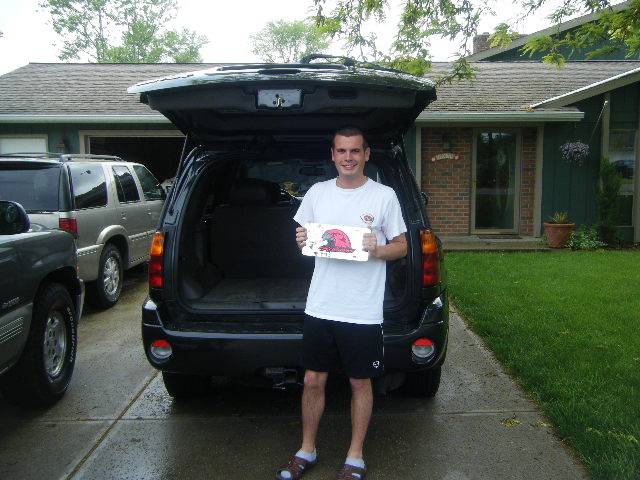
As I made my way down the staircase, I saw a really sharp black SUV parked in our driveway. I tried to look out the windows in the hopes that I might recognize who it was, but I had no idea. This being my graduation party, I figured it was probably some long lost relative that my Mom and Dad wanted me to meet. Whoever it was, he/she drove a really nice car. I made my way through the foyer, opened the front door, and stood there with a look of shock on my face as I saw who was waiting in the driveway.

It was my Dad, standing next to the black SUV, with a camera in his hand—pointed directly at me.

“Happy graduation, Bub!”

When Dad Gave Me My Car Surprise

When the reality of what was happening actually set in, I completely broke down. I started crying, and I turned around and hugged my Mom, who stood in the doorway right behind me.

“We love you, Ty,” she said. “Happy graduation!”

“Mom, you guys shouldn’t have done this,” I responded, tears already forming.

“Ty, your Dad really wanted to do this for you,” she said.

I ran out into the driveway, and threw myself into my Dad’s arms. He put his camera down and hugged me really tight—I can still feel that hug. “Happy graduation, bub. You’ve made us all really proud, and you deserve this.”

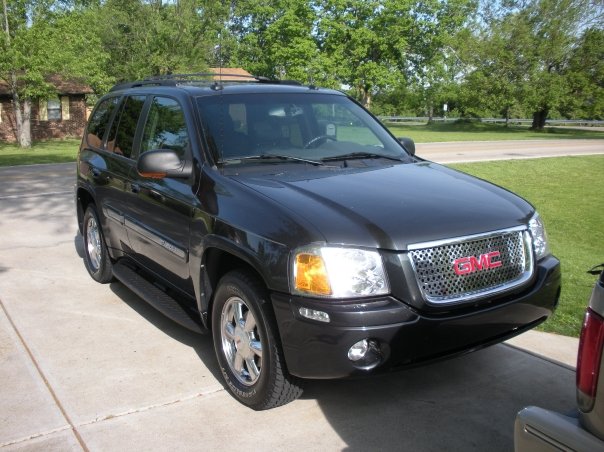
I opened the doors of the new car—my new car–another Envoy, but much sleeker, newer, and reliable than the one I had previously had. It was absolutely beautiful, and it looked brand new. It had everything I wanted in a car. I just couldn’t believe it was actually mine.

Envoy New

Dad had gone the extra mile, as he did with everything in life. He had driven all the way up to Oxford and bought Miami University license plate frames, window decals, and some of my very first Miami “Alumni” items that I ever owned. We walked around the car, checking everything out from top to bottom. The engine grill was mesh and really made the car pop. There wasn’t a scratch to be found on it. The interior was spotless.

When Dad Gave Me My Car

“Want to take it for a quick spin?” Dad said. He tossed me the keys, and of course, he had added a Miami RedHawks key chain to them.

I hopped in the driver’s seat as Dad climbed into the passenger seat and Mom hopped in the back row. I began to drive down the road, shaking my head the entire time and repeating over and over again “I just can’t believe you did this.”

We rolled down the streets of our neighborhood as Dad showed me all of the cool features that the car had. He rolled from the main console to the seat controls and to all of the other things that this car had which my old one didn’t. We rolled down the windows and rode together as a family down Canal Road near our home, basking in the sunlight of a summer day and a boy with fresh wheels.

And then, it hit me.

“THAT’S WHY YOU WERE LAUGHING LIKE A MANIAC WHEN I CALLED YOU LAST NIGHT!”

And there it was again. The same laugh I had heard the night before when I stood over a cold engine on the streets of Oxford. The same laugh that is burned into my senses anytime I think about my Dad now that he is gone. The same laugh that brought me, my family, and anyone who met my Dad such tremendous joy. The laugh that I long, more than anything, to hear again someday.

Yes, the night before when my old car had once again failed to start, my Dad knew all along that he would be giving me a new car the very next day. As a matter of fact, I found out that my Dad was actually cleaning the interior of my new car when I had called him. With a bottle of leather cleaner and a microfiber cloth in hand, Dad was laughing at the irony of the situation—and probably at the thought of how much more I would appreciate the new ride in less than 24 hours.

My Dad understood that for a boy in college (or freshly graduated from it), a car is so much more than four wheels. A car tells a story about the driver. A car is not simply a transportation device to get someone from Point A to Point B. A car has character. A car has its own story to tell. And a car, in my life, represents much more than freedom.

“You’ve worked really, really hard in college,” my Dad told me as we drove around. “I wanted to think of a way for your Mom and I to show you how proud we are of you for working so hard.”

That new Envoy was a trophy. It was a daily reminder, each day that I opened the door, of how proud my Mom and Dad were of me. Every day when I opened that car door, I could feel a sense of happiness, appreciation, and confidence wash over me. It was a daily reminder of the love my parents had made me feel my entire life. And it reminded me of the sacrifice they made—and had always made—to show me how loved I was.

I remember pulling into the parking lot at Foundation Field later that day to announce the baseball game, and the look of surprise from the coaches who saw me roll into the complex in a sleek new ride. They all came jogging out to the spot I parked in (very, very far away from the reach of any particularly pesky foul balls) and put their arm around me when they saw the new car.

“My Dad and Mom gave it to me,” I said proudly as I shook my head. “I still can’t believe it.”

After the game, I drove with a new sense of pride and purpose to my graduation party across town. Dad made me park the Envoy right out in front of the door, and he went back to work on my new gift—polishing, cleaning, waxing, and perfecting. Apparently, Dad had told a number of people that we worked with what he was getting me for a graduation gift—it was amazing that his secret actually stayed a secret!

That car became a reminder of my Dad each and every time I opened the door and sat behind the wheel. He had found the car from an old coworker and friend and bought it while it didn’t have many miles on it. Even though it had miles, it looked brand new. He had come up with the idea of getting me a car for graduation, and convinced my Mom that it would be a great idea.

And then, when my Dad passed away, it became a tangible reminder of his love for me. Daily, that car would bring me back to happier times when my Dad was here to love all of us in person—but it also reminded me that he was still loving me and my Mom and our entire family from the other side of Eternity. After he was gone, I often that back to that day when I stepped out of our front door and saw him standing there with a camera. It’s a memory, thankfully, that is burned in my mind forever. I’ll never forget the feeling my parents gave me that day, and I’ll never quit seeing the smile on my Dad’s face.

But even the very best cars that are gifted from loving parents will break down over time. The interior will dirty and the engine will fail, and there will always come a time when that car is no longer as functional as it was before.

But how do you let go of a car that is more than four wheels? A car that is a gift from a Father who is no longer there? A car that is a physical reminder of the Dad who raised me, loved me, and taught me how to drive and so much more?

I’ll tell you how I let go next week in the conclusion of this story.

dad-in-redhawks-sweater-with-sb-logoDad, I still remember that Saturday afternoon when you and Mom gave me the new Envoy for graduation. I remember the smile on your face when you saw me come outside. I remember that you took so many pictures, and I remember how happy you were to show me every detail and feature the car had to offer. I cherished that car and I will always cherish that day. You made that entire day so special, but more than any tangible gift you ever gave me, you always told me how proud you were of me. I never told you how much confidence that gave me and how your belief in me helped me overcome so many obstacles. After you left, there were so many days where I would just hop in the car, drive down the road, and reminisce about the day you gave it to me. You blessed me with so many gifts in this life, and I am eagerly waiting for the day when I can see you and thank you again. Until then, seeya Bub.

“Start children off on the way they should go, and even when they are old they will not turn from it.” Proverbs 22:6 (NIV)

A Joyful Noise

Some of my earliest memories of music are with my Dad. I used to ride around with him in his blue pick-up, strapped into my child seat. Bottle of juice in one hand, toy in the other, we would bounce along the road as his cassette tapes played through the rattling speakers.

My Dad and I were simpatico in the fact that we both had a deep, appreciating love for country music. I’m not sure when his started, but mine had been around since those early days. Amidst all the things that are memorable about my childhood, I remember that Dad had a mixtape with some late eighties country music on it, and we would ride down the road listening and singing whenever we got the chance. The tape had one of my favorite country songs of my youth on it—“The Church on Cumberland Road”, an old Shenandoah song that I still listen to on occasion to this day. Dad would sing and tap his hands on the steering wheel or beat his hand on the seat. He always took music and made it fun.

I spent a lot of time with my little cousin Jake when I was growing up, and when Dad would drive us around to go to softball games or get ice cream at Flub’s during the summer, the country music still played. Jake was a big fan of another country “classic”, a Tracy Byrd song called “Watermelon Crawl”. Dad would scan the radio dial back and forth until he found the song every time Jake was in the truck with us. Once he found it, Jake would try his best to sing along and we would both laugh as he jumbled the words.

I outgrew that car seat, cassette tapes went by the wayside, and Dad eventually traded that beat up blue pick-up in for a Gray Sierra and then a sleek Silverado, but one thing never changed. Dad always had music on in his truck. The artists he listened to might have changed a little bit over time. By the time I reached high school, Dad and I were listening to a lot of the same country artists: Jason Aldean, Montgomery Gentry, Joe Nichols, Travis Tritt, Shania Twain (you bet we did), and Brooks & Dunn. But his love for listening to music never changed.

And anytime he was working on a house project or fixing his truck in the garage, Dad always had a radio nearby. I was never much help on those household projects, but there was one simple thing that I could master. If a song would come on that my Dad really liked, he would look to me and say “Oh, this is a good one. Turn this one up.” Sometimes I agreed, and other times I didn’t, but I usually always went to turn up the volume knob for him. Or made a snide comment about a song that I didn’t like and criticized his taste.

Although we never had a chance to go to a concert together, Dad was a big fan of live music, too. Our family has always vacationed in Gulf Shores, Alabama, and one year Dad asked if I would take him to the Florabama—a local bar of with a legendary folklore that has been beaten by hurricanes too many times to count. Dad and I sat at one of the wooden tables covered in permanent marker messages of years gone by, and listened to the band that played Southern rock and oldies on that particular night. Dad sang along to the songs he knew, tapping his foot and bobbing his head like all middle-age Dads seem to do in the presence of a live band. It’s the type of move that embarrasses teenage sons worldwide.

Wherever we went, Dad always seemed to have music around him.

Listening to music and creating music, however, are two entirely different things. My Dad was not a musician, vocal or otherwise, in any sense of the word. Dad liked to sing in the truck, but I don’t know how many people truly enjoyed listening. He didn’t have a bad singing voice, but he didn’t have a good one either. He excelled at so many things in this life, but singing wasn’t one of them.

Among many genes, he has unfortunately passed this particular one along to his son. I’m praying that I inherited this gene in place of the “lose your hair at 30” gene, but I’m not holding my breath. I try to sing only when I know my voice will be drowned out because I’m embarrassed that I sound so off-key. I’m always in awe of those who have beautiful singing voices because mine is so unfortunately terrible. Like many other areas of my life, I’m easily embarrassed and overly concerned with what other people think of me—and my inability to carry a harmonious tune is at the top of that list.

Like me, I think Dad probably recognized that he didn’t have the best singing voice. I think that Dad knew what his talents were, and I’m sure he knew that singing wasn’t what God had called him to do as a profession or vocation.

But that never stopped my Dad from having a song in his heart, and one area where I’ll always remember this is in church. Knowing that he wasn’t called to sing, my Dad never signed up to sing a solo in front of the congregation, and he never joined the choir. I appreciated this for many reasons, one of which was that I always got to sit next to my Dad in the pew on Sunday mornings.

In the churches I grew up in, singing was always an important part of the worship service. As a congregation, we would all stand together and worship God together, singing hymns and songs together to show our love for our Heavenly Father.

Ever since I was a child, I’ve always been conscious of my less-than-harmonious voice, and I’ve always been embarrassed to sing in church. I don’t know why, but I’ve always felt extremely self-conscious during worship services. I wish I could blame this one on my Dad, too, but I can’t…

No matter how off-key he might have been, and no matter whether he knew the lyrics well or not, Dad always tried his hardest to sing in church. His singing voice in church was rather deep, and I can always remember hearing him sing next to me as I stood nervously next to him in the pew. Because his singing voice was so deep, it was almost like the pew would vibrate a bit when he sang. Occasionally, Dad would try and get me to sing along. But I would often shake my head no or ignore his request. But he never let that dissuade him from singing along in worship.

And now, sitting in a pew without him at church, I would give anything to hear his off-key singing again.


I have to confess, I hadn’t intended to write a post about singing; but God has this really weird way of putting a song in your heart (get it?) or a sermon in your podcast list. This week while driving to work, I was listening to Matt Chandler, pastor of The Village Church in Texas. Matt has become one of my favorite preachers to listen to since a good friend from the gym recommended him to me shortly after my Dad’s death.

For the past few months, Matt Chandler has been preaching a series on the book of Exodus[1]. In a recent sermon on the 15th chapter of Exodus, Chandler talked about singing and shared the following truth from Scripture that I never knew: There are over 400 verses in the Bible that refer to singing, and there are 50 explicit commands from God for his people to sing[2].

Even though God makes this a pretty black and white issue more than a handful of times throughout the Bible, this is one of those commands that I always try to gloss over or completely ignore. I try to play mental gymnastics and convince myself that God only wanted this command to apply to the people he blessed with a great singing voice, but the example my Dad gave me as a youngster has convinced me otherwise.

In his sermon, Matt Chandler refers to numerous verses, mostly in the Psalms, that clearly say “make a joyful noise”. Notice that God does not say “make a good noise” or “make a pleasant noise”, but instead instructs His followers to “make a joyful noise.” Chandler says “It’s not about you performing. It’s about you receiving. See, that’s the big confusion around corporate singing. No, no, no. We receive when we sing together as a body. We’re not performing…It’s not that God is in need; it’s that we’re in need.[3]

My Dad understood that singing in church wasn’t about whether or not he satisfied the standards of good vocal talent. My Dad knew and believed that singing in church was his way of saying “thank you” and “I love you” to the God of the universe. It was about connecting with God, similar to the way we do when we pray. It was about my Dad telling God that he was open to his guidance and direction for his life. In an imperfect voice, my Dad would cry out to our perfect Creator, asking for God to carry him in those areas of his life where he might have been weak.

I often think of what my Dad looks like on the other side of Eternity (full head of hair maybe?), but I have to confess that I’ve rarely thought about what he will sound like. I’ve rarely thought about the fact that my Dad now resides in a perfect Kingdom where he worships God each and every day. I’m thankful that he had a lot of practice here on Earth, and that he never let his musical inabilities inhibit his love for God.

I know that I should sing because God instructs me to, and I shouldn’t need any other motivation than that. But it doesn’t hurt that I had a real-life, personal example of the need to sing and honor and God. It’s been a painstaking process for me to come out of my shell and sing in the pew at church. There are some days when I do it without hesitation, and others where my embarrassment still gets the best of me.

And on those days, I remember my Dad. I remember that he never once told me, even as a child, not to sing, but instead encouraged me to do it. As a way to honor my Dad while also honoring God, I try and sing when I’m in church now. Even though I don’t always know the words, and even though the rhythm will sometimes get the best of me, I do my best to join in the chorus of the congregation, albeit quietly and still off-key.

And I apologize to the folks who sit near me and have to listen—you can blame it on my Dad.


When my Dad died, I was fortunate enough to inherit many of his things. Although the things can never replace the man, they do help me hold on to the memory of who he was here on this Earth and the impact he had on my life.

One of the things I was lucky enough to take possession of was my Dad’s book of CD’s. Yes, CD’s. The only iPod Dad ever owned was the hand-me-down iPod Mini that he got from me, and unfortunately he wasn’t with us long enough to use it substantially.

It wasn’t entirely full, but that CD book was something I always associate with my Dad. He kept it in the middle console of his truck at all times. Dad was the type of person (very unlike me) who would listen to an entire CD all the way through, and once it reached the end, he would start it again at the top. Then, after a few days of listening to that CD, he might switch to another. Or perhaps he would just continue to listen to the one that was currently in the player. My Dad enjoyed the simplicity of life, and listening to a CD was one of the simple pleasures he enjoyed.

Every now and then, especially on days where the thought of losing him is too much to bear, I’ll pull out that CD book and grab a disc to listen to. I’ll throw it in the CD player of my truck, and although he might not be there with my physically, there are times when I can see him riding in the passenger seat next to me. There are days when I can hear his voice again. There are moments when I swear I can feel the vibration of his thumb tapping the steering wheel. And on those days where it seems like he’s right there with me, I am thankful that for the 26 years I spent with him, my Dad always had a song in his heart and never shied to share that song with those he loved.

dad-in-redhawks-sweater-with-sb-logoDad, What I wouldn’t give to hear you sing another song right next to me. What I wouldn’t give to go back to those days where we would ride around in your truck and listen to country music together. I’m thankful that you always set the right example for me in church by singing along with the worship songs. I’m thankful that you always remembered that singing songs of praise and worship aren’t about us but are about developing a relationship with God. Certain songs come on the radio, and I still think of you. I’ll always be appreciative of the memories you gave me as a young child listening to country music in your truck. Thank you for being a Dad who always had a song of love in your heart. Until we both join the chorus of heavenly angels together, seeya Bub. 

Shout for joy to the Lord, all the earth.
Worship the Lord with gladness;
come before him with joyful songs.
Know that the Lord is God.
It is he who made us, and we are his[a];
we are his people, the sheep of his pasture.

Enter his gates with thanksgiving
and his courts with praise;
give thanks to him and praise his name.
For the Lord is good and his love endures forever;
his faithfulness continues through all generations.

Psalm 100:1-5 (NIV)

References:

[1] http://www.thevillagechurch.net/resources/sermons/series/exodus/

[2] http://thevillagechurch.net/mediafiles/uploaded/e/0e5770908_1483456017_exodus-part-17-from-bitter-to-sweet-t.pdf

[3] http://thevillagechurch.net/mediafiles/uploaded/e/0e5770908_1483456017_exodus-part-17-from-bitter-to-sweet-t.pdf

23 Pushups

You wouldn’t know it from looking at me, but I actually go the gym four to five times a week. And I know what you’re thinking… “Man, you should really demand a refund.”

I joined the LA Fitness in my neighborhood many, many years ago with grandiose dreams. I was hoping to go from chubby to Channing Tatum in about six weeks. I could feel a six pack just lurking underneath the surface of the five or six Frisch’s Big Boys I ate every week. I planned to put in a few hours at the treadmill each week, a little bit of time throwing some weights around and grunting, and before you’d know it I would have to buy all new shirts because my biceps would tear holes in the old ones.

In what is an inexplicable physical anomaly, I can guarantee you that my muscles haven’t even come close to warranting a new wardrobe. Oftentimes, I find myself embarrassingly being outlifted by nearly everyone in the gym, including one hilariously painful endeavor where I dislocated a rib doing dumbbell flys with…well, not much weight. I’ve blacked out on treadmills, slipped from pull up bars, skipped nearly every leg day, and taken it upon myself to provide a nightly comedic act for the other patrons of LA Fitness.

But since Dad died, I don’t go to the gym for the same reasons I used to. Don’t get me wrong—if God wants to bless me with a Herculean physique, I’ll be grateful and gladly accepting of this gift. But if that doesn’t happen (and let me assure you, it really will take a miracle of God), I’ll still keep at it because there’s more at stake than muscle.


After Dad died, I knew that I would need to take some time off from work and my usual routine to get some clarity on the entire situation. I ended up being away from work for about four weeks, which was a blessing that I’ll always be thankful for. My supervisors at Miami made it possible for me to take all the time I needed to recollect and regroup before I got back into my new normal, and I did my best to heed the advice of so many others I had talked to about grief when they told me “Don’t try and rush things.”

The unintended consequence of all this time off, however, was that it gave me more time to sit and think about everything that had happened. As people started to return to the routine of their own lives, I began to have more and more time to myself. And for someone who can easily get lost in the drama and intensity of my own thoughts, this wasn’t always a good thing.

So, by week two I knew that I was going to have to start filling my time with things that were more productive and would occupy both my schedule and my mind. Summer was nearing its end, which gave me plenty of options. I could attend baseball games, or go to the movies, or visit the park and spend some time outdoors.

“Or,” I thought one morning, “I could start going to the gym again.”

Because things had been so busy earlier that summer, the gym had become more of an inconvenience than an opportunity for stress release. Every night, I found myself coming home and reading and working on assignments, so the gym just wasn’t an option on a regular basis.

So to try and get my mind off of all the trauma it had experienced, I promised myself I would go to the gym every day I could. I would show up for a few hours each day and do my best to get active. Instead of obsessing over the tragedy that had occurred, I would go there and challenge my mind instead.

I’m not going to tell you anything new that you haven’t heard from the fitness addicts in your own life, but it’s another voice to add to the chorus: When I went to the gym, I felt better. It was hard to explain because I didn’t know how to feel better having just lost my Dad so suddenly and unexpectedly, but my body and my mind felt better during those hours at the gym than trapping myself in the solitude and emptiness of my house.


A few months later, I would get some clarity on why I felt so much better. I had the privilege of joining my mentor and friend, Dr. Bob Rusbosin, and a few Miami undergraduates for a research presentation at a conference at Florida State University. The conference was on college student values and the concept of wellness, and we submitted a presentation on the research we had been doing on television icon Fred Rogers. As I perused the conference booklet, I noticed an interesting keynote that would take place later in the week. A psychiatrist and M.D. from Harvard, Dr. John Ratey, would be speaking about wellness and health from a medical doctor’s standpoint.

Dr. Ratey is the author of a book called Spark: The Revolutionary New Science Exercise and the Brain (visit the “Library” section of this page for a description and link). At about 9am midway through the conference week, Dr. Ratey engaged in a heavily scientific explanation using phrases related to brain anatomy, neurotransmitters, brain-derived neurotrophic factor, and a million other scientific terms and processes that were completely foreign for this particular audience member.

And I was completely and utterly fascinated.

Dr. Ratey says it much more intelligently than I ever could, but the premise of his argument is this: physical exercise benefits the brain just as much as it does the rest of the body.

And for my particular life situation, Dr. Ratey gave an explanation that really hit home—that physical fitness could lead to the prevention of mental illness like depression, thereby also diminishing the likelihood of suicide.

The introduction to Dr. Ratey’s book says it all. It’s a quote from Plato that reads “In order for man to succeed in life, God provided him with two means, education and physical activity. Not separately, one for the soul and the other for the body, but for the two together. With these two means, man can attain perfection.”

Let me give you the best explanation I can of the research Dr. Ratey has done (please keep your author in mind, as there have been episodes of Bill Nye the Science Guy that have tripped me up before). And forgive me for the technical description, but please understand–this disease killed my Father. I want to know everything I can about it so I can prevent it from happening to anyone else.

Brain signals are sent via neurotransmitters, or chemicals that send messages from one brain cell to another. Psychiatry has identified three primary brain transmitters that regulate everything the brain does: serotonin, norepinephrine, and dopamine. When the levels of these neurotransmitters are unbalanced, mental illnesses can occur. Most medications target one or two of these neurotransmitters, but exercise has a different effect. Exercise and physical activity actually have the capacity to elevate and regulate all three of these neurotransmitters simultaneously.  Exercise also increases the presence of brain-derived neurotrophic factor (or BDNF), a crucial protein that can help our brains maintain and create healthy neurons. Dr. Ratey calls BDNF “Miracle-Gro for the brain” (I’ll reiterate, he explains this all much better than I ever could, and I would really encourage you to grab his book).

Here’s what all this talk of neurotransmitters and brain chemicals equates to:

  • Exercise helps our cognitive functioning and ability to learn
  • Exercise can help us relieve stress
  • Exercise can be an effective in the prevention or treatment of mental illnesses like depression, anxiety, and attention deficit (or can help in conjunction with other treatments)
  • Exercise can change the way our brains react to addiction
  • Exercise can help fight off brain-related aging diseases, like Alzheimer’s

Even though there were many factors at work in my Dad’s death, and even though he still had many more years to live, I constantly remind myself that my Dad fought successfully against this demon for decades of his life. I can’t help but think that the extremely complex concepts Dr. Ratey so beautifully articulated were playing out behind the scenes of my Dad’s own brain chemistry, helping him fight off his own periods of darkness for many, many years.


Although he didn’t do a very good job of passing the athletic genes on to his only son, my Dad was often the epitome of an active lifestyle.

My Dad was always an extremely energetic and “on the move” type guy. He was the Father who never got burdened by his son asking if they could go outside and play together—because he was usually the one doing the asking.

“Hey boy, you want to go for a bike ride?” was his common refrain after our family dinners. My Dad loved riding his bike. My family was fortunate enough to live close to a beautiful local park, and my Dad loved riding his bike back through the woods and the trails on a warm summer night. Much more adventurous than me, Dad would fly through the trails on his 21-speed mountain bike, never allowing fear to outweigh his desire to have fun.

Summer nights after dinner were always full of some kind of physical activity, even on days where I knew Dad was tired from a long day at work. Tossing a baseball, swimming in our backyard pool, or taking our family dog for a walk—Dad always found a way to get up off the couch and get moving. But more important than the movement was the smile on his face the entire time.

And Dad, a man who loved people, usually found a way to stay moving in the company of others. For as long as I could remember, my Dad had always played weekly pick-up basketball games with the guys from our church. He loved the competition, and he definitely loved showing the younger players a thing or two as he’d easily outsmart them as he cut to the rim for bucket after bucket.

A true renaissance athlete, Dad was also a tremendous softball player—in fact, the best season I ever saw him play was cut short by his own untimely death. He never hit for power. Actually, in all the years he played softball (over 30), he never hit a single home run (the critical sports announcer in me always reminded him of this weakness). But he was fast, and that gave him an advantage at any church softball league where most of the players had partaken in far too many Sunday potlucks. He could cover ground in the outfield better than anyone. He could turn a lazy single into a double, and usually a triple if the fielder had a poor arm. He would play any position he could, and could usually do it with ease. I was always in awe of his contributions to the team and the seamless ease with which he performed.

Unlike me, my Dad’s mind seemed to clear when he was playing a sport. If you aren’t familiar with my lack of athletic prowess, read….well, pretty much any other post I’ve ever written. Everything just seemed to click when my Dad was active—life was in harmony, completely balanced. He found happiness in the activity, and joy in the camaraderie.

When Dad was happiest, he never wanted to sit still. I was just never sure whether the happiness caused the activity, or the activity caused the happiness. And because I now know how happiness and being active were so intricately intertwined in my Dad’s life, I’ll try and do the same.


Every day, I do at least 23 pushups. I do them with strained effort, and probably incorrect form, but I make sure I do those 23 pushups. The 23 reps are not a random number—there’s a method to my madness.

At one time in this country, it was reported that 22 veterans of the United States Military (particularly the most recent wars in Afghanistan and Iraq) were victims of suicide. This led to the creation of great military support organizations, like Mission 22[1], which provide resources and support for veterans struggling with mental illness. Recent numbers have shown the number is probably closer to 20[2], but even if the number was 1, it would be entirely too high.

I added that last pushup in for my Dad. No, my Dad was not a veteran, but mental illness is the enemy we all fight against, service member or not. Military family or not, anyone who loses a family member or loved one to suicide suffers a similar heartache when those we love leave us earlier than they should. When I do those 23 pushups, I’m simultaneously honoring the people that suicide touches and making sure that it never ever impacts my life in the same way it has theirs.

I’m very aware of my need to go to the gym, because I know that every time I step foot on a treadmill or lift a weight, I’m fighting back against the same depression and anxiety that took my Dad away from me. People say that depression and mental illness are so difficult to fight against because they are invisible—and I agree with this claim. But the things we can do to fight against these unseen enemies are often very visible, and very tangible. Staying active is just one of the many tools I’ll use to fight back against the darkness.

I’ve also found that going to the gym allows me to work through my grief. I’ve made great friends at the gym, Godly men who have listened to my pain and helped me work through it. There have been days where instead of lifting, we’ve stood near a machine together and talked about our lives and how God loves us in spite of our circumstances. I have been able to share things with my friends at the gym and connect with them on a brotherly level that I never would have been able to articulate in any other environment. In the same way that a therapy session clears my brain, I’ve found the same peace and sense of calm after spending a few hours at the gym with my friends.

There are plenty of days where I just don’t feel like going to the gym—and my body is probably a reflection of giving in to that impulse for far too long. But the fact that I don’t feel like going to the gym is exactly why I need to go. As Dr. Ratey has found, every time I choose activity over laziness, I’m boosting my brain’s capability to fire on all cylinders. I’m re-wiring my brain to choose action of victim-hood, bravery over surrender.

Don’t confuse what I’m saying—if you are suffering from mental illness or suicidal thoughts, a 15 minute sprint on a treadmill alone might not save your life. You should still seek treatment on all fronts, including medical or psychiatric care. You should still seek professional help. You should still talk to someone who can help you in your fight. But physical activity is one “tool in the toolbox” that can help in that fight, and combined with other forms of treatment, it can be a very powerful remedy.

Whether grieving from a loss or trying to prevent your own mental illness, exercise and physical activity can play an unbelievable role in the road to recovery. No matter how pathetic my physique might appear, I’ll always be a staunch advocate that those dealing with mental illness or those fighting through grief should try and find relief by getting up and getting going.

And if all that activity and brain boosting just happens to lead to six pack abs along the way…even better.

dad-mom-and-lucy-walking-with-sb-logoDad, I always admired your energy and vitality. You attacked life and took on new challenges, and you were never that Dad who loved the couch more than he loved spending time with his family. In your life, you always seemed to be able to find a good balance between rest and being active, but when you were active, you always made the most of it and there was always a huge smile on your face. Whether it was riding bikes, walking the dog, playing softball, schooling a bunch of youngsters in basketball, or simply goofing around in the backyard swimming pool, you realized that life was designed to be lived. Even though I didn’t always listen (and boy do I wish I would have), you always encouraged me to get up and get going. You always encouraged me to believe there was life outside of a TV set or computer screen, and since you left I’ve tried to live this out. I’m looking forward to many bike rides together on the other side of Eternity. And if you could talk to the Big Guy upstairs and have him send me a little more muscle mass, I’d be appreciative. Until then, seeya Bub.

“Therefore, I urge you, brothers and sisters, in view of God’s mercy, to offer your bodies as a living sacrifice, holy and pleasing to God—this is your true and proper worship.” Romans 12:1 (NIV)

References:

[1] Mission 22 Website: http://www.mission22.com/#ourcause

[2] http://www.militarytimes.com/story/veterans/2016/07/07/va-suicide-20-daily-research/86788332/

The Walk: Guest Blog by Jeffrey Yetter

Ty: “Huh. They really do have couches.”

When I entered a therapist’s office for the first time, I’m ashamed to admit the curiosity of “Do they really have couches?” had overwhelmed me in the days leading up to the visit. Under the surface, however, my preoccupation with couches was simply masking my complete and utter terror at the fact that I was going to visit a therapist in the first place.

Here’s what you don’t know: that first therapist’s visit came nearly two years before my Dad died. And I’m not, in the least, ashamed to admit it. In fact, I’m ashamed that I didn’t go sooner.

For a whole host of reasons, I was dealing with severe anxiety. A completely bizarre illness a few years back had scared and scarred me so tremendously that my mind had been consumed with a completely irrational thought—something that the doctors couldn’t explain was going to kill me.

For nearly 9 months, I slept about 3 hours a night, usually always interrupted. I lost weight because I couldn’t convince myself to eat. I would obsess over WebMD posts and online discussion boards in an attempt to diagnose myself with something that the doctors couldn’t (let’s save the “Don’t go on WebMD if you’re anxious” discussion for another post). I was distracted at work, I was distracted at church, and I felt so sad around my family because I thought I was leaving them soon that I disconnected and spent endless hours in solitude.

Until finally, I broke down. In a moment of weakness, I confessed all the anxiety to my Mom and Dad, and scheduled a doctor’s appointment for the next week. My doctor, in an effort to rid me of the dark thoughts in my mind, agreed to run every test imaginable to show me that I was perfectly healthy, which she did. She walked through the original diagnosis from the previous hospital stay, and confirmed the results of what the doctors had eventually settled on. And then, she gave me a different type of prescription.

“I think it would be a good idea for you to go visit a therapist. I have someone in mind.”

Enter Jeff Yetter—a man who God knew I would need in that moment and the many moments to come. At the time, I don’t think I quite understood why God was leading me to go see a therapist, and I definitely didn’t understand why He was putting me through this unnecessary storm.

Now, I have perspective, and just like my Bible has promised, God works everything together for a purpose. That period of anxiety led me to go see Jeff, and I’m convinced that God allowed me to experience that so that I would have Jeff in my life when Dad’s death would strike a while later. Even in the midst of the storm, God is always in control, and having Jeff in my life convinced me of that more than anything.

When I started this blog, I knew that I wanted Jeff to be the first guest post. Yes, because of his knowledge of mental illness. Yes, because of his personal experience with my story. Yes, because he is a clinician that can provide help to so many people who need it. But most importantly, I wanted Jeff to write because he is a man who cares. He is a man who counters every negative stereotype that might exist about the counseling profession. If all the people who hesitate to go to therapy could just meet Jeff, I’m convinced they would change their minds—and Jeff would help heal theirs. Hearing Jeff talk about my own experience gives me so much clarity, and his writing will provide comfort to so many people who are hurting or lost.


Jeff: Before I begin, I want to offer a “qualifier” to my effort here. This is my first ever blog entry. I’ve written professionally before, but never in such a precious capacity. When Tyler asked me to be a “guest blogger” in this space, speaking on such a personal and powerful topic, to say I was honored would be a tremendous understatement. I am honored and blessed to participate in this amazing undertaking, authored by a loving son who so tragically lost his amazing father. So, bear with me, as this is my first foray into the blogging world, and I want to do both Tyler and his father proud with my effort.

That First Visit…
When I noticed that Tyler Bradshaw was on the schedule to see me on August 1, 2013, I thought to myself, “Cool, Tyler is coming in. It’ll be really good to see him. It’s been awhile”. Yep, I’m a clinician, and I actually like my patients. Love them, really.

You see, I’d seen Tyler in the past for a handful of visits for some stuff he was going through at that time, and we had a good rapport, he seemed to like the therapeutic techniques I use, and we shared a love of baseball, so I was genuinely looking forward to “catching up” with him.

So, at 11:45am, I greeted Tyler in the Waiting Room, and escorted him down to my lower level office. As we greeted in my office, and before he sat down on my sofa, I could see that something was “different”. See, Tyler is a very warm and friendly young man. Not “phony” friendly or “overly-gregarious” to where you would doubt his sincerity, but genuinely friendly. Kind. Loving. The type of person with whom you immediately feel at-ease. Always quick with a kind smile and a genuine, “How are you doing?” But this day was different. The usual smile and friendly greeting were replaced with vacant eyes, desperately trying to hold back tears, and looking “distant” and “lost”. I said, in a voice that did not conceal my concern, something to the effect of, “Welcome back, brother. What’s going on?” And that’s when Tyler, this amazing, smart, kind, genuine, loving, and eloquent young man, began to disclose to me the details of his father taking his own life, just one week before this visit.

Disbelief
Tyler’s Dad?? What??? I found myself, a clinician of 20+ years at the time, trying to make sense of this, asking myself if I’d heard him accurately. But I could see everything in Tyler’s face. His friend, his mentor, his hero, his comedian, his confidant…his Dad, was gone, and in the most tragic and traumatic way imaginable. I know there’s a brief “Bio” of my academic and professional history below, but I can tell you as a clinician and as a human being that nothing, NOTHING, prepares you for what was being discussed in my office that day. And, I can tell you that, in an instant, my entire heart, mind, and spirit went out to Tyler and his family and everyone affected by this tragedy. And in that very moment, Tyler and I began what he and I have referred to as “our walk” through this heart-wrenching journey. A day at a time. A session at a time. Through tears, and pain. Through occasional smiles and a bit of laughter. All of it. This was to be “our walk”, and I am a better person for having accompanied Tyler thus far on this journey.

The Walk
In this first guest blog, I wanted to give an account as to how Tyler and I began “our walk”, through this incredibly tragic and painful event in his young life. But as a clinician, I would also like to speak to the importance and necessity of reaching out for help.

Tyler has asked that I “guest blog” in the future, and as was the case in this instance, I am honored to do so. In future offerings, I will directly speak to “walking” through and seeking help during times when it does not seem possible to crawl, much less walk. But for now, I will say this: we are all hurting in some way or another. Our pain is “ours”. It is unique to us in that we are “experiencing” it. It is “ours”. We feel it ourselves, we behave relative to it, ourselves.

But we are not alone. We are never alone. There is someone who cares. Someone who will talk. Someone who will listen. Someone who will validate. Someone who will hug. Someone who will simply “be” with us. Family, friends, clergy, professionals—someone. You are never alone. Please do not hesitate to contact a local agency or office, if you are hurting. Talk to a friend. Someone. You are not alone. You matter, and you are worthy. And you are worthy because you matter.

Until we speak again,
Jeff

“I will never leave you or forsake you.” (Hebrews 13:5)


Ty: Jeff’s therapeutic approach helped me because he didn’t offer to snap his fingers and instantly make things better. He didn’t give me a list of five things I needed to do to make life better. He recognized the hurt, he validated it, and acknowledged that the pain was real.

But he did offer a remedy. Not a quick fix, not a magic wand, but something better. He just offered to be there. He offered to listen and give me honest feedback. He offered to pick me up when I got low and carry me through, “arm in arm” as he’s said so many times during our visits.

There is a stigma in our country, particularly among males, that this type of “arm in arm” walk somehow reveals weakness. More than anything, I want this post and Jeff’s future writing to reveal an important truth: Seeking help when you need it is one of the most courageous and brave things you’ll ever do.

I don’t fault my Dad for his death, but he was a victim of this societal mentality. My Dad, the man who deserved this type of loving treatment most, could never bring himself to seek it out. Ironically, our family doctor had recommended that my Dad go visit Jeff—the same therapist who is helping me in the aftermath of Dad’s death. I’m confident that Jeff and my Dad would have been great buddies, and wish they could have had the opportunity to meet. For both of their sake.

I author this blog for many reasons, one of which is to reach out to people who are suffering from mental illness to let them know that getting help from someone who deals with these issues specifically is of paramount importance. Reaching out to a counselor, like Jeff, in your area could be the difference between a lifetime of darkness and finding the light. Yes, my Dad’s story here on Earth didn’t end the way we wanted it to—but yours can have a different ending. Your loved ones can be different. In future posts, Jeff will do so many things to help us all have a better understanding of mental illness, grief, God’s love, and so many other things. But in this first post, let’s all agree that when we need help, no matter the public perception, we will ask for it.

And in case you needed more convincing…the couches are super comfortable.

dad-and-lucy-poolside-with-sb-logoDad, I would never fault you for the sickness you experienced, but I sure wish we could have gotten you the right treatment you needed. You had so much to live for and experience, and I know that Jeff could have helped you fight off the demons and doubts you were facing. I’m still learning from you even after you’re gone, and because I love you I promise that I will always get help when I need it. I’ll never let my emotions overwhelm the plan God has for my life, and I’ll always encourage other people to get help when they need it. If nothing else, you would have loved talking baseball with Jeff. I’d give anything to see the two of you meet—and someday you will. But for now, seeya Bub.

“So you are no longer a slave, but God’s child; and since you are his child, God has made you also an heir.” Galatians 4:7 (NIV)

jeff-yetter-headshotJeffrey Yetter, M.Ed., LPCC
Licensed Professional Clinical Counselor

Jeff Yetter has practiced in the field of counseling and psychotherapy for the past 24 years. He has worked in both the public and private sector, and is currently in Private Practice in Middletown, Ohio. Jeff has also been an Adjunct Professor in the Graduate School of Counseling at Xavier University. Academically, Jeff completed his undergraduate study at the  College of Mount Saint Joseph (now, MSJ University) in Cincinnati, Ohio, where he graduated Magna Cum Laude. He completed his Master’s Degree in Agency and Community Counseling at Xavier University. He completed his Post-Master’s Endorsement in Clinical Counseling at Xavier University as well.

Shockwaves

“He’s gone.”

My body had never experienced a physical response like it did in that moment. It was as if every bone in my entire body had suddenly disappeared. Against my own desire to forget, I remember that moment very vividly. I grabbed the Kentucky hat I had thrown on that morning and threw it violently across the front yard. I collapsed onto the grass and began to sob. Everything had gone black. My Dad was gone, and so were my senses.

I remember hearing my Mom screaming. I remember hearing my Grandpa attempt to corral the chaos that was enveloping in our front yard. But before I knew it, the sounds were drifting away. It was almost as if I was under water—I knew there was noise and commotion, but I couldn’t make out or process what any of it was. Everything sounded muffled as the sea of emotion overwhelmed me. My body was so overcome with emotion that it seemed to be rejecting any stimulus of the physical world around me. My mind had been hijacked, and in my head, a track was stuck on repeat, playing those words over and over again: “He’s gone. He’s gone. He’s gone.”

The dark and muffled moments that followed were difficult to comprehend. At some point, our neighbor, Billie, made her way into the front yard. I remember hearing her voice, feeling her hand on my shoulder as I lay weeping in the front yard. I remember her saying “Tyler, come with me. We need to get you out of here.” Without even wanting to, my body lifted itself from the ground—but I had no strength at all. Billie had to support me as tears streamed down my face. Had I wanted to run from the scene, I couldn’t have. My body seemed to be paralyzed.

We crossed the street into Billie and Sam’s driveway. As a youngster, I had made that trek so many times. As a grade schooler, I had always enjoyed going over to their house—partially because of the can of Dr. Pepper I knew Billie would always bring me, but also because they made me feel so loved. They were genuinely interested in me as a young boy, and when they talked to me, I felt like the most important person in the world. Fortunately, as I grew older, their sincerity never changed.

All the comfort and memory of a childhood chat with the friendly neighbors across the street had been shattered a few minutes earlier. That walk across the street to their driveway would now be forever tainted, no matter how many trips I ended up making into that familiar landscape. No matter what the occasion, I always knew my mind would be flooded with the thoughts of that morning. “This is where you walked the morning your Dad died. This is the door you came through the morning your Dad died. This is the chair you sat in the morning your Dad died.” The thought of life being different from that point forward had already set in, and my Dad had only been gone for a few minutes.

I was walking, but I wasn’t taking anything in because my mind was so consumed with the evil voices telling me that I would never forget, that I would never be able to move on. I walked down that driveway. I walked through their door. And I sat on a couch in their patio room. Billie, silent as I sat down, was in as much shock as I was. She stood there, not knowing what to do—and neither did I, as I held my hanging head limply in my hands. We had both entered a new world. The things we had once known would always be different. I searched for answers, and so did she.

“Do you need something to drink?” she said.

More than anything, I wanted a can of Dr. Pepper and to be seven years old again.


I describe the moments after my Dad’s death as “shockwave” moments. They were moments where the pain radiated through my body in ways I had never experienced. I’m sure you’ve seen pictures of earthquakes, and that was how my life felt in that very moment—except the pain had been centralized to one particular family and community of people. I could look across the landscape of my life and recognize the terrain and familiar aspects—but they were irreparably damaged and fractured. There was a devastation sweeping over our family home, and it was completely unexpected.

Although I still felt trapped underwater after being ushered over to Billie’s house, I remember my emotions switching dramatically from one feeling to the next. My inner dialogue ran high with what I hoped was my own voice, but which likely could have been Satan trying to drive me deeper into despair. I didn’t know who to believe, and I didn’t even know if I could trust myself.

I felt overwhelming loss. For my entire life, I had known my Dad. I had relied on him for so many things. He was my provider. He was my trusted resource. He was a problem-solver anytime an engine failed or a piece of furniture needed constructing. He was my personal comedian anytime I needed a laugh. He was my catcher when I wanted to toss. He was my biggest fan when I realized I would never make it as an athlete and needed to transition into the broadcast booth. In every moment, and in every memory, Dad was there. Every aspect of my life that was good seemed to involve my Dad.

I felt confusion. And I desperately searched for answers. If life was that good and that enjoyable, how could Dad have wanted to end his? How could the quality of his life sink that low to make it appear inescapable? Was it something I had said? Could I have said something differently that would have helped him avoid this end? Could I have told him how much I loved him one more time? How could a loving God allow me to lose one of the people I needed most? How could a loving God allow one of his most authentic followers to meet such a demise? Was God really loving? These questions all swirled around in my head, beating my soul mercilessly and without interruption. I had all the questions in the world, but not a single answer.

I felt abandonment. It was irrational, but completely real—but sometimes our most irrational fears are the ones that captivate us most. Yes, I would have people in my life that would surround me. I still had a loving Mother who would support me and love me to the ends of the earth. But it felt like I had nothing. Having the man who had been my superhero for my entire life suddenly ripped from my everyday was bone-chilling. My Dad had been there in nearly every capacity of my life, and he was more than just a Father. He was a Dad—involved, and loving, and always there for his child. I was in my twenties, and from a legalistic definition I wasn’t orphaned, but I felt like I was.

I felt doubt. Even in the minutes after Dad’s death, I began to think about all of the things that would be different now that he was gone. If I wanted to call him, I wouldn’t be able to. If I wanted to go have dinner with him on the nights that Mom worked late, I would have to go alone. If my car broke or the house caught on fire again (long story for another post…), I would have to deal with it on my own. I would need to help take care of Mom when she needed it. I would have to do all the things my Dad normally did. And there was no way I could live up to the example he set. There was no way I could ever be a fraction of the man he was. The life that lay ahead of me seemed to be clouded with eminent failure. It was inescapable.

And yes, I felt anger…but not at the source most people would probably assume. I’ve talked with other survivors of suicide, and many of them told me “It’s okay to be angry with your Dad,” but I never was—not even in the immediate aftermath of his death. How could I be mad at my Dad? It wasn’t his fault that he dealt with depression. He didn’t want to feel sad on purpose. Even if I had tried, I couldn’t have been mad at my Dad.

I was angry at the forces that led to his depression, and I didn’t even know what they were at the moment. I was angry at a chemical imbalance, if that was the result that had led him to suffer. I was angry at the life circumstances that had put unnecessary pressure on him and driven him further into the pit. I was angry at the medication that had not done what it had promised. To this day, I’ve felt anger at all of those things—but never once have I felt anger towards him.

And deep down, I was angry at myself. Why had I left him that morning? Why had I not stayed with him the entire day? Offered to take him out to lunch? Or just watched television with him? Why had my life gotten to such a point that a graduate school presentation seemed more important than making my Dad feel like he was loved? Call it guilt, or self-doubt, or inward-directed-anger, or any other name you can think of—but I felt like I could have done more, even though I consciously realized I had probably done all I could have.

I felt everything, and I felt nothing.


What I also remember feeling was a feeling that I was sinking. I lost all track of time, but I couldn’t shake the feelings of being both in the moment and completely disconnected from it. That “under the water” sensation was still there, and it lingered for days and weeks after he passed. I knew people were talking—and I could see their lips moving and I could hear the words they said. But I couldn’t put them together. I couldn’t get anything to make sense in my head. I couldn’t find meaning in what was happening. Everything still sounded jumbled and muffled, as were the thoughts in my head.

On the same morning of Dad’s death but prior to the incident, I had been sitting at the desk in my cozy home office, working on a PowerPoint and sipping a warm tea. Now, I was sitting in front of a detective from the Fairfield Township Police Department answering questions about my Dad and what had gone wrong.

I don’t even remember his specific questions, but I do remember that this particular police officer was gentle. As gentle as a police detective can be, that is. He understood the sensitivity of the situation. I remember him walking into the room, putting his hand on my shoulder, and saying that he was sorry he had to do this. I was sorry he had to do it, too.

I remember him saying that he didn’t want to have to ask me questions right now, but because of the tragic nature of the morning’s events, they needed to collect as much information as possible to find out what had happened to my Dad. Their goal was to help me, to help my family, in any way they could. As I sat up on the couch, I nodded my head and wiped away the tears. I had no desire to answer his questions, but maybe the quicker I answered them, the quicker he could leave me.

He would ask me questions about what my Dad and I had discussed that morning, and how Dad had responded. I tried to string together answers to his questions, but my mind was still drowning in emotion. I heard a dark voice inside my head over and over again saying “This is your life. This is what you are now. This is your new life.” And it was completely overwhelming. The same glazed-over look my Dad had earlier that morning when I went to talk to him, I now replicated to the police detective who sat opposite me.

I had answers for the detective’s questions, but I knew that no matter how much information I gave him, he probably wouldn’t be able to have answers for mine. Yes, he might be able to create a timeline of events and a file full of evidence, but he wouldn’t be able to tell me why my Dad had felt life was so painful that he had to resort to suicide to escape it. He wouldn’t be able to tell me why the combination of my Dad’s biological and life experiences had collided together in a lethal mix. He wouldn’t be able to tell me how to navigate life without a Father. The more I thought about all the questions I had, the more overwhelmed I became.

Eventually, the detective had everything he needed. The one vivid detail I do remember is that, when he arose from the chair across the room, he walked over to me and extended his hand. Weak and failing, I reached out and limply shook his hand with as much strength as I could muster. He looked at me, with genuine, caring eyes.

“I truly am sorry about your Dad and your loss. I met him before, and he was a great man. Please let me know if I can do anything to help. We will be here to support you any way we can.”

Boom. Another shockwave. It was the first time that anyone had ever told me they were sorry to hear about my Dad’s death.

“Dad’s death.” The words hit me with the force of a boulder barreling straight for my chest. I couldn’t absorb it, I couldn’t comprehend it. Everything still felt very, very unreal. A lazy summer morning had turned into an unbearable new chapter of my life, and I didn’t know how to survive the shock.


With any earthquake, there are significant aftershocks, and those aftershocks have continued to strike for the past three and a half years.

There are days where the underwater sensation returns, and I feel like I’m barely treading to stay alive. Even though I’m years removed, I will still have those days where the thoughts of missing my Dad are so powerful that I can’t concentrate. There are still days where the words just don’t sink in and I feel like I’m drowning all over again.

Fortunately, there are also days when I’m reminded that our God doesn’t let his people drown. When the nation of Israel was being pursued by Pharoh and the Egyptian Army, God used Moses to part the Red Sea. He let his people through to safety, and then called the waters to crash back down on top of their trailing enemies (Exodus 14). When a storm struck the boat carrying Jesus and the disciples through the Sea of Galilee, he told the waves to stop their tossing—and they did (Matthew 8, Mark 4, Luke 8). And when Jesus called Peter out onto the water, and Peter’s lack of faith caused him to begin drowning, Jesus literally reached out his hand and prevented him from going under (Matthew 14).

When I look at my life, I see the mounting waves; but when I look at Jesus, I see the solution.

It doesn’t always make life easier. It doesn’t automatically remove the obstacles. The waves are still there. The Israelites still had to run through the wall of waves. The disciples still had to guide the boat, and Peter still had to get out of his. But Jesus was there through all of it. And little by little, in every single moment, he’s helped me navigate through the waters just like he did thousands of years ago. The same power that rescued those men and women still rescues me.

My emotions still run deep when I think of that initial day, and it’s hard to deal with the thought of losing my Dad. I find little ways to deal with the storms, and while some are successful, there are many that don’t work. I have my good days, and I have my days where I feel like I’ve made no progress from that fateful Wednesday morning.

But I’ve learned that feelings aren’t facts. Just because I feel helpless doesn’t mean I am. Just because life feels hopeless doesn’t mean it is. Just because I have bouts of confusion doesn’t mean I’m living a confused life. Just because the world looks overwhelming doesn’t make the words of my Bible any less true. I so wish that I always lived my life every day like I believed this, but step by step, I’m navigating the waters. And you will too.

dad-in-easter-suitDad, I don’t think a single day goes by where I don’t replay the sights and sounds of that awful July morning. I constantly fight against my mind to not let the tragedy overshadow the love you showed me, but I’m not always successful. There are days when it’s hard for me to feel happy. There are days when it’s hard for me to feel like I couldn’t have done more to help you. But I never questioned your love for me and for our family. In the moments where life gets really tough and the waters especially overwhelming, I can always feel your presence right there with me. I can always feel you helping me fight against those aftershocks. I’m thankful that you taught me how to love others. I’m thankful that you helped prepare me for the difficulties that would come my way. I’m grateful to have had a Dad who always knew how to comfort me, and I’m thankful that, even from Heaven, you still continue to love me and direct me. Until then, seeya Bub.
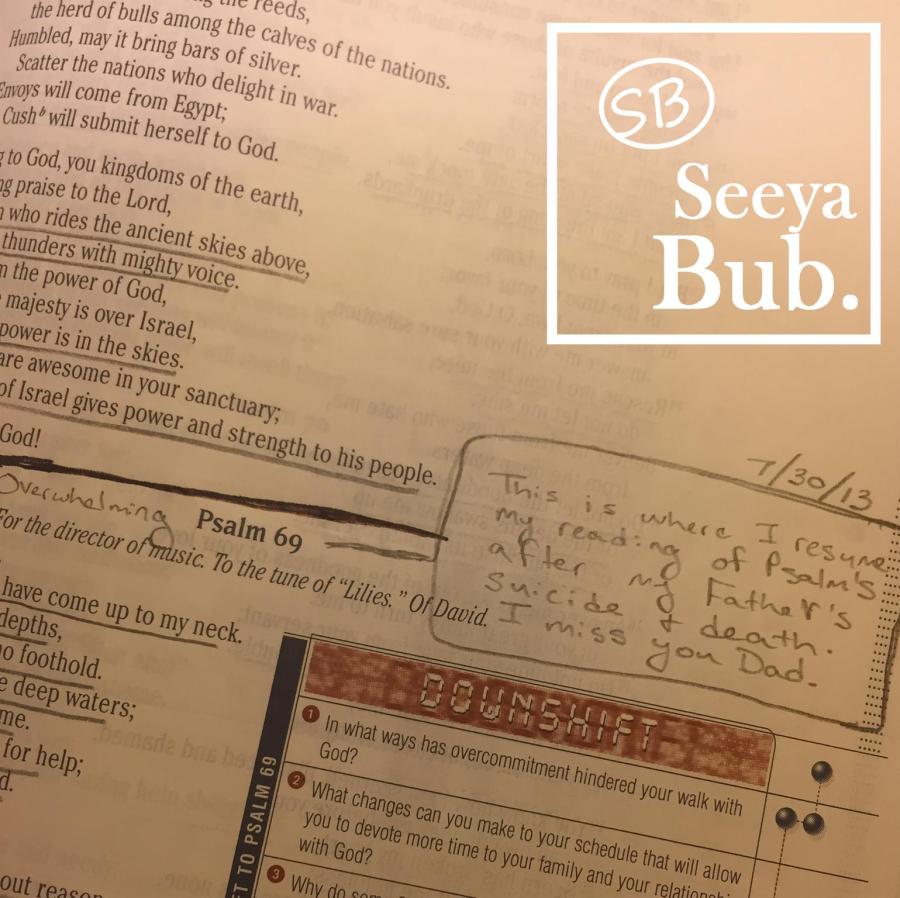
“When Jesus woke up, he rebuked the wind and said to the waves, ‘Silence! Be still!’ Suddenly the wind stopped, and there was a great calm.” Mark 4:39 (NLT)

The Time Line

On page 673 of my Bible, there is a line drawn at the end of the 68th Psalm. To the side of that line, there’s a note written and outlined in a box: “7/30/13: This is where I resume my reading of Psalms after my Father’s suicide and death. I miss you Dad.”

The line that’s there in my Bible is an important one. I had been in the process of reading through the entire Bible from start to finish when Dad passed away. I had started by reading through the New Testament first, and I was in the middle of working my way through the Psalms a few chapters at a night. When I closed my Bible on July 23, 2013, I had no idea that the trials and storms I had read about over so many chapters were getting ready to become very real for me and my family.

Over the years, I had written many notes in my Bible. Since college, I had always been an avid “underliner” in the books I read, constantly writing notes in the margins, boxing in concepts that stuck out to me, and marking up each and every book I could get my hands on (to any frequent readers who find red pen marks in their library books…please don’t report me). Grab any book on my bookshelf, and you’ll usually be able to tell if I’ve read it or not by red pen markings or the lack thereof. My Bible, of course, is the most marked-up book that I own because its marked my life more than anything else. I mostly use pencil or a soft highlighter because of the tissue-paper-thickness of the pages, but even in graphite my handiwork is pretty evident.

But no marking is more important than that line on page 673. It’s a line in the most important book I’ll ever own, but it’s so much more than that. It’s the most important line I’ve ever drawn, and it’s one I had never expected to draw in the first place.

When Dad died, the way I described time became very, very different. Suddenly, every time I told a story, the time descriptor I used resembled the language I had heard in so many history lectures. I found myself saying “Before Dad died…” or “After Dad died…” every time I told a story.

At no other point in my life had I ever used a single event or circumstance to define when I had done something. Yes, there was the occasional “In fourth grade…” or “When I was a kid…”, or “That one time I got rejected by a girl in high school…” (which was used more frequently than the rest), but those descriptors usually changed based on the story. Now, no matter the content, I was using “B.D. and A.D.” time to preface every story (Before Dad died, and After Dad). It’s a feeling that I think anyone who loses a loved one begins to experience, and it’s much more than a simple line. Understanding the significance of that line can help to understand the magnitude of grief that permeates a survivor of suicide or any traumatic experience.

I remember drawing that line. It felt like a momentous, life-defining exercise. It had only been a few days after my Dad’s death, and just a day after his funeral when I felt the urge to retreat to my office, close the door, and pick up where I had left off. I partly wanted to escape and just be by myself for a while, because for the past week it felt as if I hadn’t been able to spend a moment’s time to myself. I knew that my thoughts were building up, but I hadn’t even had time to process them just yet. Mostly, I wanted to try and recapture some of the normalcy of my life, because things had been anything but normal for the past six days. Sitting at my desk and reading my Bible had become the most regular activity of my life over the past year or so. It seemed only natural to sit down and resume the work, but there was also an immense guilt that swept over me. My life’s history was transitioning periods from B.D. to A.D., and there was a mourning in my soul that told me if I refused to draw the line, maybe things would go back to normal. It’s irrational, but it’s natural.

When I drew that line, there was a sense of finality that swept across my mind. One chapter, an extremely significant chapter in my life had closed shut rather abruptly. And the conclusion of that chapter would affect all the ones that came after it. That realization weighed heavily on my shoulders.

But I drew it anyway. With tears in my eyes, I slowly and weakly drew a single solid line across the page, deliberately and slowly recognizing the magnitude of the moment. But the fact that I drew a line at all helped me comprehend one very, very important truth.

There is life after the line.

It sounds insensitive to even write those words. Even now, three years and more removed from Dad’s death, I feel guilty when I write that. But I can’t deny truth, and I refuse to let evil thoughts and the storms of this life hinder the joy that can still exist all around me. Yes, life isn’t the same after Dad died; but there is still life. And for all the dark moments it’s been filled with since he’s gone, there have also been beautiful moments that celebrate everything that my Dad loved.

When Dad died, there were moments, heart-wrenching moments, where it felt like life couldn’t go on, even when you know deep down that it will. Convincing yourself that life will go on in spite of the tragedy is the difficult part, but it does.

Life after the line isn’t easy. As a matter of fact, there are days where it feels impossible.

But guess what? Just like life before the line wasn’t always wonderful, life after the line isn’t always horrible. Don’t get me wrong—I would give anything to completely erase that line from my Bible and my memory and have my Dad back with me again. Life was just better when he was in it, and life will never be the same without him. But even though it’s not the same as it once was, there are moments in life where I see glimpses and snapshots of the joy I once experienced when Dad was alive. Since Dad has died, I’ve met wonderful friends and had tremendously fun moments with them. I’ve reconciled friendships from the past that have made life more enjoyable. There are times when life feels normal again, even though its dramatically broken, and instead of feeling guilty about those moments, I’m slowly learning to accept them. Day by day, I’m learning to live life after the line. I’m learning that it’s okay to hurt, but that it’s also okay to live. If I needed to learn anything from my Dad’s death, it’s that truth.


I don’t think it’s any coincidence that God put me where He did within my Bible-reading journey, and I don’t think it’s any coincidence that that line is drawn where it is. God knew that I would need the words that would follow in the 69th Psalm to guide me through my life beyond the line, and those words continue to speak to me when I think about my Dad’s death. The first section of that Psalm, the words I read through tearstained eyes on the evening of July 30, 2013, will be with me forever:

Save me, O God!

The water is already up to my neck!

I am sinking in deep mud.

There is nothing to stand on.

I am in deep water:

A flood is sweeping me away.

I am exhausted from crying for help.

My throat is hoarse.

My eyes are strained from looking for my God.

(Psalm 69:1-3)


May my prayer come to you at an acceptable time, O Lord.

O God, out of the greatness of your mercy,

Answer me with the truth of your salvation.

Rescue me from the mud.

Do not let me sink into it.

I want to be rescued from those who hate me

And from the deep water.

Do not let floodwaters sweep me away.

Do not let the ocean swallow me up,

Or the pit to close its mouth over me.

Answer me, O Lord, because your mercy is good.

Out of your unlimited compassion, turn to me.

I am in trouble, so do not hide your face from me.

Answer me quickly!

Come close, and defend my soul.

Set me free because of my enemies.

(Psalm 69:13-18)

When those words were written, God answered David. And when those words are read thousands of years later, God answers me. He responded to my cries on that July night a few years ago, and he continues to respond as I navigate life on the other side of the line.

The dawning of another year always causes me to think about my Dad and the loss we all feel not having him around. I still quantify life by his passing, and I have no doubt that on New Year’s Eve this year, I’ll consciously start the counting in my head. 2017 will mark the fourth year of “A.D.” life for me. It’s a difficult chapter of life to embrace. But I’ll remind myself that life after the line isn’t always bad. I’ll be thankful for life in general—before or after the line. I’ll be grateful for the opportunity to have had a wonderful Dad for 26 years of life on this Earth, and I’ll rest easy in the fact that I’ll have a Father for all eternity that can lead me through this into a greater relationship with Him.

The line will always be there, but the Scriptures that surround it will never be outdone.

bible-page-with-sb-logoDad, I’d do anything to go back to that awful day in July 2013 and never have to draw a line in my Bible. But the fact that I’m even drawing that line means you made a tremendous impact on me and my life. You always approached your work with the utmost sincerity and dedication, but there was no job more important to you than being my Dad and the leader of our family. I’ll always be appreciative of that. I’m sad when I see the line, but I smile when I remember the man whose memory deserved it. I promise that my life after the line will honor you and make you proud. I promise that you will not have died in vain—that people will live their lives differently when they hear about you. Keep watching over me. Seeya, bub.

“Come close and defend my soul.” Psalm 69:18 (GW)

Merry Christmas from SeeyaBub.com!


A few months ago, I decided to launch this blog thinking that a few people would stumble across it and that it might help someone who is struggling with depression or the loss of a loved one to suicide. I didn’t quite know what to expect, but I didn’t expect what all the readers, and God, have provided in these few short months.

Over the past two months, Seeya Bub has had a few thousand views and has reached individuals in the United States, China, the United Kingdom, Canada, the Philippines, India, and a whole host of other countries.

To those of you who read each post, what’s been more important than any number or marker on a map, however, has been the overwhelming response of your heart. I can’t tell you how many nights I sit at my desk with my mouth agape, baffled at the work God is allowing this blog to do.

There have been the conversations with those of you who struggle with mental illness and suicidal thoughts. Hearing you open up and tell your story has been the privilege of a lifetime. From the moment I started this blog, I knew I wouldn’t be able to provide simple answers—but I could provide comfort, an open ear, and a shoulder to cry on when needed. You matter. Your story matters. And your life here on this earth is vitally important and consequential. I am honored to walk with you and share my Dad’s story in the hope that it might change and improve yours.

There have been the messages from survivors of suicide and individuals who have a friend or family member that struggles. There’s so much confusion, especially when a parent is suffering from a mental illness. How do we go from that person being our ultimate provider to suddenly having to take care of the caretaker? Your confusion is real, and it’s maddening, and it’s frustrating—but it’s a lot less overwhelming when you share that burden in community. I hate that you and your loved one are suffering, but I love that God has connected us so we can struggle and suffer together. Hearing so many people deal with their loved ones more tenderly after reading this blog has made it all worth it.

And to those of you who have lost a parent, regardless of the circumstances around their death, your pain and love for your loved one has touched the deepest parts of my heart. The loss of a parent is so profoundly painful. They’ve always been there, and they’ve always known just what to say when times got tough. And when they aren’t around anymore to say those things, the void hurts so deeply. I’ve found comfort in your experience and your journey, and I’m learning from you how I can continue living life when life seems unlivable.

To those of you who have shared stories about my Dad, all I can say is thank you. You have no idea how comforting it is to hear stories about my Dad. You would think, having known him my entire life, I would know everything there is to know about him. But I don’t, and as time goes on, one of the most difficult and troubling realizations is that I might be forgetting things about my Dad. When you tell me stories about my Dad and the things he did in this life, it’s like he’s right there next to me again. He’s still living in on your memory, which makes him even more vivid in my own. I can’t wait to share these stories in future posts.

This Christmas season, I simply say thank you. For reading, for sharing, and for connecting. For validating my story while processing your own. You’ve inspired me to make this the mission of my life—promoting a message of hope in the face of fear, light in the presence of darkness. I am completely astounded by the response, and I promise to continue serving all of you, and God, with all my heart and energy.

Dad and I were fans big fans of Garth Brooks…well, let me rephrase that. I was (and still am) a HUGE fan of Garth Brooks, and Dad liked him up until that whole “retirement” stunt. Recently, Garth (yeah, that’s right, we’re on a first name basis….well, at least I am) released a song with his wife Trisha Yearwood and the legendary James Taylor that is simply dubbed “The Thanksgiving Song”. The lyrics spoke to me at a heart level, and I wanted to share some of them with you:

What I’m thankful for ain’t on no list

For it only in my heart exists

For time has helped me understand

The things I can’t hold in my hand.


For those that came before my turn

Oh, from whom I’ve gathered lessons learned

That light the path that lies ahead

I see them as I bow my head.


Yes I’m thankful for the Lord above

The gift of His unending love

The promise kept that there is something more

These are the things I’m thankful for.

To all of you, I’m thankful that you’ve agreed to walk alongside me and all those who suffer from mental illness and grief. Merry Christmas and Happy Holidays to you and yours, and thank you for making the start of this journey such a remarkably blessed experience.

Dad, You would be astounded by all of the people who have visited this blog and read your story. You wouldn’t want the credit for any of it, but I give you so much credit for all the good things that have happened in my short life. You taught me all the things a Father should (and then some), and although the lessons didn’t always set in (I still can’t change my own oil in the truck), the important things you taught me will always be there. I miss you more than anything, and especially around Christmas it’s hard to think that you won’t be there to enjoy all the fun and food and family. But you are there, in my heart, and I’m thankful that you made me the man I am. Until that first Christmas that we spend together in heaven, seeya Bub.

Shopping for Dad

“Dad would really like that for Christmas this year.” It’s a pretty normal thing to say. That is for someone who isn’t me, because this is the fourth Christmas I’ve had without my Dad, and I still find myself saying that as I fight my way through the shopping malls filled with aggressive soccer Mom’s ready to fight over a hatching robotic bird (come on, America—we are better than this). But I still say it, and there’s part of me that probably always will.

When Dad was alive, he could be really hard to buy for. He was a man who had everything. And there was always a good chance that he had two of everything and they were both brand name.

When I look back on Christmases gone by, there were some years where I really struggled to find a good set of Christmas gifts for my Dad. One year, I fell for a TV infomercial for a set of screwdrivers that you never had to remove from the screw while you turned—as if they one thing my Dad could really use was another set of screwdrivers to add to the hundreds he already owned. The Kobalt Double Drive Screwdriver set–complete with magnetic tool belt pouch and free shipping and handling. I don’t even remember the benefits to this particular purchase, but they had a fancy name and I’m pretty sure Bob Vila or a Bob Vila impersonator had endorsed them. And they were sold at Lowes’. And if I called within the next 15 minutes, they would give me two of them. I could give one to my Dad and keep one for myself in case I wanted to send the impression to a visitor that I actually knew how to complete a home repair.

There were also years, however, when I was able to find really cool gifts for my Dad. It usually had something to do with an experience we could share together. I’ll never forget the year I got him tickets to a Miami University hockey game for Christmas. Dad wasn’t an avid hockey fan, so I think he was kind of confused when he opened up the tickets (even though he would never let me see that). But once he got to the game, everything changed. A carpenter and builder by trade, Dad was completely enamored with the intricate architecture of the Goggin Ice Arena in Oxford. He especially loved the white marble floors that make up the concourse, inlaid with silver trim in figure eight patterns to mimic skate cuts in the ice. And although he didn’t really understand the rules of the game, he was a competitor at heart who loved the energy of a Miami hockey game. By the end of the game, we were both into it, cheering on the RedHawks even though he didn’t always know what he was cheering for. It’s a night I’ll remember for a long time. One that was very special for both of us.

No matter what gift I eventually settled on, the process of finding something for Dad was always rather difficult. For as many possessions as my Dad owned, he never let those possessions define him. Sure he loved gifts, but he loved the gift-givers even more. My Dad found true joy in community and loving other people. He loved spending time with people on the holidays and making others smile. The special charm of Christmas was never about what awesome gifts he might receive—which made shopping for him a particularly frustrating task. I could’ve found peace in the fact that my Dad would have loved any gift I got him, but I often found myself stressing out to try and blow him away with something he hadn’t even thought of. Over the years, I don’t know how many times I succeeded.

Now, the Christmas shopping is still frustrating, but for an entirely different set of reasons. The Christmas season used to feel like a warm embrace, but now it feels like a slap in the face—and Christmas shopping has become one of the primary experiences that makes the season so emotionally difficult.

For all the years he was alive, I struggled to find Christmas gifts for Dad. Now that he’s gone, however,I see hundreds of things in the stores that I would have loved to buy for him. Sweatshirts he would have worn well. Tickets to events he would have enjoyed. Movies he could have laughed at. Tools that he could have….well, added to his other tools.

The exhilaration of gift-giving has been stolen from me. It’s been irreparably tainted. The tradition is now enveloped with sadness, and it’s difficult for me to accept that. With every item I pass in the stores that makes me think of my Dad, I grow wearier and feel like I’m losing him more and more. I’m always trying to find ways to cope, but I’ve been largely unsuccessful. The joy, albeit stressful, of giving my Dad a gift is gone. The tradition is extinguished. And it’s really, really tough to admit that.

So, this year, I’ll start a new tradition, but I’ll still buy for Dad. A few months ago, I started a new job in Downtown Cincinnati. I have to park about fifteen minutes away from my office building, which gives me some time to pay attention to the city around me. As I exit the building and start to walk down Main, the sights of the city hit my square in the face. The ballpark, the skyscrapers, the streetcar…and then, the homelessness.

There is a man who leans against a light pole on most days as I walk by. I’ll confess—I’ve never spoken to him. I’ve made eye contact a few times, but his glazed and vacant expression never connects with mine. He holds a sign, which I’ve never taken the time to read. And as the Cincinnati winter settles in, I notice his coat always looks a little thinner than all the other streetwalkers. He never chats with anyone, but stands with his sign and a few belongings in a backpack. I never see him eating, even though I usually walk by him with an apple in my hand for the ride home. I never see him drinking a Starbucks coffee like so many of the other pedestrians. He is the city that the city doesn’t see. A man loved by Jesus but ignored by the world—including me.

This man deserves a Christmas. This man deserves a Christmas as much as I ever will or my Dad ever did.

So, this Christmas, I’ll still buy for my Dad—but I’ll give it to this man. I’ll pick up a coat or some gloves that my Dad would have loved. I’ll get him a gift card for a local restaurant. I’ll box this all up and wrap it with the same love and attention to detail that my Dad always wrapped his gifts with. And a couple days before Christmas, I’ll stop and have Christmas with this man. I don’t know if I’ll tell him about my Dad, or just hand him the gift and let him know that I want him to have a merry Christmas. And although I know that a coat and a gift card can’t change the world, I hope they give this man an ounce of brightness in his seemingly difficult life.

But let’s remember—Christmas gifts can change the world. Think of the one that was given over 2,000 years ago in the form of God’s only Son. Think about the difference that gift made. Who knows where this one will go, but I’ll just trust that God wants me to give it—I’ll let him figure out the rest.

I’ll give this gift because I’m thankful for the one that was given to me—the gift of a Heavenly Father who loves me every day, and the gift of an earthly Father who made that love tangible to me for so many years. I believe that God sends Dads to this world with a very special mission—to have them exemplify the type of love he shows us in an earthly body. Not every Father answers the call; but for 26 years, my Dad answered it each and every day. I’m so thankful that I had a Dad who made Christmas special, but more importantly, a Dad who took the spirit of Christmas and lived it out throughout the year. I want to be more like him this Christmas, and this new tradition will be a big step in that direction.

I know the joy that I get when I open a Christmas present, and I know the joy my Dad used to get as well—even if he was opening yet another set of TV infomercial screwdrivers. But I don’t know the pain this man on the street experiences in his everyday life. I don’t know if he’ll even be able to enjoy opening that gift because of all the overwhelming things that make up his life. But this is something my Dad would’ve done. And I just trust that God wouldn’t be putting this on my heart if He didn’t have a plan for it.

As much as I’ve tried to make the Christmases stay the same after Dad, I’m learning that a more appropriate response (for me at least) has been to change them into new traditions. My Dad changed my life for the better, and his memory should do that as well. My life should be a testament to the man he was, and so should my Christmas traditions. So I’ll hold onto as many traditions as I can without him, and I’ll make new ones in his absence that honor his legacy. I’ll make traditions inspired by his love for all of us, and I’ll continue to shop for him even though I’ll give the gift to someone else.

As much as I hope this gift to the man I walk by will help him, selfishly I hope it will also help me. When I make my Christmas shopping list, I can still have a category for “Dad”. When I go out into the stores and have that “Oh, Dad would really like this” moment, I can still make a purchase. I can buy a gift for Dad. I can wrap a gift for Dad. And I can give it to someone who could really, really use it.

I’ve learned that new traditions aren’t all about missing my Dad; instead, new traditions are about doing things that he would have done. My Dad was the type of guy who would have bought a few gifts for a homeless man he didn’t know. My Dad was the type of guy who would have wrapped that gift delicately and put a unique tag on it. My Dad was the type of guy who would have walked right up to someone he didn’t know, but someone who he knew needed a hand-up, and given it to him without hesitation. I’m not that type of guy, but because my Dad was, I’ll try to be.

For those of you who miss your loved one this Christmas, I hope you’ll go out and shop for them. I hope you’ll find a way to give your loved one’s gift to someone who could really use it.

“Dad would’ve liked this,” I say to myself as I shop. “He really would’ve enjoyed opening this gift.” Now, in the eyes of another man, I hope I’ll get to see a glimmer of the same glistening sparkle I always saw in my Dad’s eyes on Christmas morning. I may be saying goodbye to him again this Christmas, but I’ll say hello to someone else who just might need it.

dads-christmas-angel-with-sb-logoDad, It’s so hard to believe that another Christmas has gone by and you’re not here to experience it. You always made the holidays so special for Mom and I, and the tree is always a bit emptier when you’re not around it. There were so many things you enjoyed around Christmas—especially watching our family dogs open gifts and tear them apart. We were all joyful around the holidays because you made it that way for us. In your absence, I hope we are keeping the spirit alive that you always gave to us. And, I’m sorry for all the screwdrivers. Merry Christmas, Dad, and until we celebrate together again, seeya Bub.

“They went quickly and found Mary and Joseph with the baby, who was lying in a manger. When they saw the child, they repeated what they had been told about him. Everyone who heard the shepherds’ story was amazed. Mary treasured all these things in her heart and always thought about them.” Luke 2:16-19 (GW)