

“He’s gone.”
My body had never experienced a physical response like it did in that moment. It was as if every bone in my entire body had suddenly disappeared. Against my own desire to forget, I remember that moment very vividly. I grabbed the Kentucky hat I had thrown on that morning and threw it violently across the front yard. I collapsed onto the grass and began to sob. Everything had gone black. My Dad was gone, and so were my senses.
I remember hearing my Mom screaming. I remember hearing my Grandpa attempt to corral the chaos that was enveloping in our front yard. But before I knew it, the sounds were drifting away. It was almost as if I was under water—I knew there was noise and commotion, but I couldn’t make out or process what any of it was. Everything sounded muffled as the sea of emotion overwhelmed me. My body was so overcome with emotion that it seemed to be rejecting any stimulus of the physical world around me. My mind had been hijacked, and in my head, a track was stuck on repeat, playing those words over and over again: “He’s gone. He’s gone. He’s gone.”
The dark and muffled moments that followed were difficult to comprehend. At some point, our neighbor, Billie, made her way into the front yard. I remember hearing her voice, feeling her hand on my shoulder as I lay weeping in the front yard. I remember her saying “Tyler, come with me. We need to get you out of here.” Without even wanting to, my body lifted itself from the ground—but I had no strength at all. Billie had to support me as tears streamed down my face. Had I wanted to run from the scene, I couldn’t have. My body seemed to be paralyzed.
We crossed the street into Billie and Sam’s driveway. As a youngster, I had made that trek so many times. As a grade schooler, I had always enjoyed going over to their house—partially because of the can of Dr. Pepper I knew Billie would always bring me, but also because they made me feel so loved. They were genuinely interested in me as a young boy, and when they talked to me, I felt like the most important person in the world. Fortunately, as I grew older, their sincerity never changed.
All the comfort and memory of a childhood chat with the friendly neighbors across the street had been shattered a few minutes earlier. That walk across the street to their driveway would now be forever tainted, no matter how many trips I ended up making into that familiar landscape. No matter what the occasion, I always knew my mind would be flooded with the thoughts of that morning. “This is where you walked the morning your Dad died. This is the door you came through the morning your Dad died. This is the chair you sat in the morning your Dad died.” The thought of life being different from that point forward had already set in, and my Dad had only been gone for a few minutes.
I was walking, but I wasn’t taking anything in because my mind was so consumed with the evil voices telling me that I would never forget, that I would never be able to move on. I walked down that driveway. I walked through their door. And I sat on a couch in their patio room. Billie, silent as I sat down, was in as much shock as I was. She stood there, not knowing what to do—and neither did I, as I held my hanging head limply in my hands. We had both entered a new world. The things we had once known would always be different. I searched for answers, and so did she.
“Do you need something to drink?” she said.
More than anything, I wanted a can of Dr. Pepper and to be seven years old again.
I describe the moments after my Dad’s death as “shockwave” moments. They were moments where the pain radiated through my body in ways I had never experienced. I’m sure you’ve seen pictures of earthquakes, and that was how my life felt in that very moment—except the pain had been centralized to one particular family and community of people. I could look across the landscape of my life and recognize the terrain and familiar aspects—but they were irreparably damaged and fractured. There was a devastation sweeping over our family home, and it was completely unexpected.
Although I still felt trapped underwater after being ushered over to Billie’s house, I remember my emotions switching dramatically from one feeling to the next. My inner dialogue ran high with what I hoped was my own voice, but which likely could have been Satan trying to drive me deeper into despair. I didn’t know who to believe, and I didn’t even know if I could trust myself.
I felt overwhelming loss. For my entire life, I had known my Dad. I had relied on him for so many things. He was my provider. He was my trusted resource. He was a problem-solver anytime an engine failed or a piece of furniture needed constructing. He was my personal comedian anytime I needed a laugh. He was my catcher when I wanted to toss. He was my biggest fan when I realized I would never make it as an athlete and needed to transition into the broadcast booth. In every moment, and in every memory, Dad was there. Every aspect of my life that was good seemed to involve my Dad.
I felt confusion. And I desperately searched for answers. If life was that good and that enjoyable, how could Dad have wanted to end his? How could the quality of his life sink that low to make it appear inescapable? Was it something I had said? Could I have said something differently that would have helped him avoid this end? Could I have told him how much I loved him one more time? How could a loving God allow me to lose one of the people I needed most? How could a loving God allow one of his most authentic followers to meet such a demise? Was God really loving? These questions all swirled around in my head, beating my soul mercilessly and without interruption. I had all the questions in the world, but not a single answer.
I felt abandonment. It was irrational, but completely real—but sometimes our most irrational fears are the ones that captivate us most. Yes, I would have people in my life that would surround me. I still had a loving Mother who would support me and love me to the ends of the earth. But it felt like I had nothing. Having the man who had been my superhero for my entire life suddenly ripped from my everyday was bone-chilling. My Dad had been there in nearly every capacity of my life, and he was more than just a Father. He was a Dad—involved, and loving, and always there for his child. I was in my twenties, and from a legalistic definition I wasn’t orphaned, but I felt like I was.
I felt doubt. Even in the minutes after Dad’s death, I began to think about all of the things that would be different now that he was gone. If I wanted to call him, I wouldn’t be able to. If I wanted to go have dinner with him on the nights that Mom worked late, I would have to go alone. If my car broke or the house caught on fire again (long story for another post…), I would have to deal with it on my own. I would need to help take care of Mom when she needed it. I would have to do all the things my Dad normally did. And there was no way I could live up to the example he set. There was no way I could ever be a fraction of the man he was. The life that lay ahead of me seemed to be clouded with eminent failure. It was inescapable.
And yes, I felt anger…but not at the source most people would probably assume. I’ve talked with other survivors of suicide, and many of them told me “It’s okay to be angry with your Dad,” but I never was—not even in the immediate aftermath of his death. How could I be mad at my Dad? It wasn’t his fault that he dealt with depression. He didn’t want to feel sad on purpose. Even if I had tried, I couldn’t have been mad at my Dad.
I was angry at the forces that led to his depression, and I didn’t even know what they were at the moment. I was angry at a chemical imbalance, if that was the result that had led him to suffer. I was angry at the life circumstances that had put unnecessary pressure on him and driven him further into the pit. I was angry at the medication that had not done what it had promised. To this day, I’ve felt anger at all of those things—but never once have I felt anger towards him.
And deep down, I was angry at myself. Why had I left him that morning? Why had I not stayed with him the entire day? Offered to take him out to lunch? Or just watched television with him? Why had my life gotten to such a point that a graduate school presentation seemed more important than making my Dad feel like he was loved? Call it guilt, or self-doubt, or inward-directed-anger, or any other name you can think of—but I felt like I could have done more, even though I consciously realized I had probably done all I could have.
I felt everything, and I felt nothing.
What I also remember feeling was a feeling that I was sinking. I lost all track of time, but I couldn’t shake the feelings of being both in the moment and completely disconnected from it. That “under the water” sensation was still there, and it lingered for days and weeks after he passed. I knew people were talking—and I could see their lips moving and I could hear the words they said. But I couldn’t put them together. I couldn’t get anything to make sense in my head. I couldn’t find meaning in what was happening. Everything still sounded jumbled and muffled, as were the thoughts in my head.
On the same morning of Dad’s death but prior to the incident, I had been sitting at the desk in my cozy home office, working on a PowerPoint and sipping a warm tea. Now, I was sitting in front of a detective from the Fairfield Township Police Department answering questions about my Dad and what had gone wrong.
I don’t even remember his specific questions, but I do remember that this particular police officer was gentle. As gentle as a police detective can be, that is. He understood the sensitivity of the situation. I remember him walking into the room, putting his hand on my shoulder, and saying that he was sorry he had to do this. I was sorry he had to do it, too.
I remember him saying that he didn’t want to have to ask me questions right now, but because of the tragic nature of the morning’s events, they needed to collect as much information as possible to find out what had happened to my Dad. Their goal was to help me, to help my family, in any way they could. As I sat up on the couch, I nodded my head and wiped away the tears. I had no desire to answer his questions, but maybe the quicker I answered them, the quicker he could leave me.
He would ask me questions about what my Dad and I had discussed that morning, and how Dad had responded. I tried to string together answers to his questions, but my mind was still drowning in emotion. I heard a dark voice inside my head over and over again saying “This is your life. This is what you are now. This is your new life.” And it was completely overwhelming. The same glazed-over look my Dad had earlier that morning when I went to talk to him, I now replicated to the police detective who sat opposite me.
I had answers for the detective’s questions, but I knew that no matter how much information I gave him, he probably wouldn’t be able to have answers for mine. Yes, he might be able to create a timeline of events and a file full of evidence, but he wouldn’t be able to tell me why my Dad had felt life was so painful that he had to resort to suicide to escape it. He wouldn’t be able to tell me why the combination of my Dad’s biological and life experiences had collided together in a lethal mix. He wouldn’t be able to tell me how to navigate life without a Father. The more I thought about all the questions I had, the more overwhelmed I became.
Eventually, the detective had everything he needed. The one vivid detail I do remember is that, when he arose from the chair across the room, he walked over to me and extended his hand. Weak and failing, I reached out and limply shook his hand with as much strength as I could muster. He looked at me, with genuine, caring eyes.
“I truly am sorry about your Dad and your loss. I met him before, and he was a great man. Please let me know if I can do anything to help. We will be here to support you any way we can.”
Boom. Another shockwave. It was the first time that anyone had ever told me they were sorry to hear about my Dad’s death.
“Dad’s death.” The words hit me with the force of a boulder barreling straight for my chest. I couldn’t absorb it, I couldn’t comprehend it. Everything still felt very, very unreal. A lazy summer morning had turned into an unbearable new chapter of my life, and I didn’t know how to survive the shock.
With any earthquake, there are significant aftershocks, and those aftershocks have continued to strike for the past three and a half years.
There are days where the underwater sensation returns, and I feel like I’m barely treading to stay alive. Even though I’m years removed, I will still have those days where the thoughts of missing my Dad are so powerful that I can’t concentrate. There are still days where the words just don’t sink in and I feel like I’m drowning all over again.
Fortunately, there are also days when I’m reminded that our God doesn’t let his people drown. When the nation of Israel was being pursued by Pharoh and the Egyptian Army, God used Moses to part the Red Sea. He let his people through to safety, and then called the waters to crash back down on top of their trailing enemies (Exodus 14). When a storm struck the boat carrying Jesus and the disciples through the Sea of Galilee, he told the waves to stop their tossing—and they did (Matthew 8, Mark 4, Luke 8). And when Jesus called Peter out onto the water, and Peter’s lack of faith caused him to begin drowning, Jesus literally reached out his hand and prevented him from going under (Matthew 14).
When I look at my life, I see the mounting waves; but when I look at Jesus, I see the solution.
It doesn’t always make life easier. It doesn’t automatically remove the obstacles. The waves are still there. The Israelites still had to run through the wall of waves. The disciples still had to guide the boat, and Peter still had to get out of his. But Jesus was there through all of it. And little by little, in every single moment, he’s helped me navigate through the waters just like he did thousands of years ago. The same power that rescued those men and women still rescues me.
My emotions still run deep when I think of that initial day, and it’s hard to deal with the thought of losing my Dad. I find little ways to deal with the storms, and while some are successful, there are many that don’t work. I have my good days, and I have my days where I feel like I’ve made no progress from that fateful Wednesday morning.
But I’ve learned that feelings aren’t facts. Just because I feel helpless doesn’t mean I am. Just because life feels hopeless doesn’t mean it is. Just because I have bouts of confusion doesn’t mean I’m living a confused life. Just because the world looks overwhelming doesn’t make the words of my Bible any less true. I so wish that I always lived my life every day like I believed this, but step by step, I’m navigating the waters. And you will too.
 Dad, I don’t think a single day goes by where I don’t replay the sights and sounds of that awful July morning. I constantly fight against my mind to not let the tragedy overshadow the love you showed me, but I’m not always successful. There are days when it’s hard for me to feel happy. There are days when it’s hard for me to feel like I couldn’t have done more to help you. But I never questioned your love for me and for our family. In the moments where life gets really tough and the waters especially overwhelming, I can always feel your presence right there with me. I can always feel you helping me fight against those aftershocks. I’m thankful that you taught me how to love others. I’m thankful that you helped prepare me for the difficulties that would come my way. I’m grateful to have had a Dad who always knew how to comfort me, and I’m thankful that, even from Heaven, you still continue to love me and direct me. Until then, seeya Bub.
“When Jesus woke up, he rebuked the wind and said to the waves, ‘Silence! Be still!’ Suddenly the wind stopped, and there was a great calm.” Mark 4:39 (NLT)
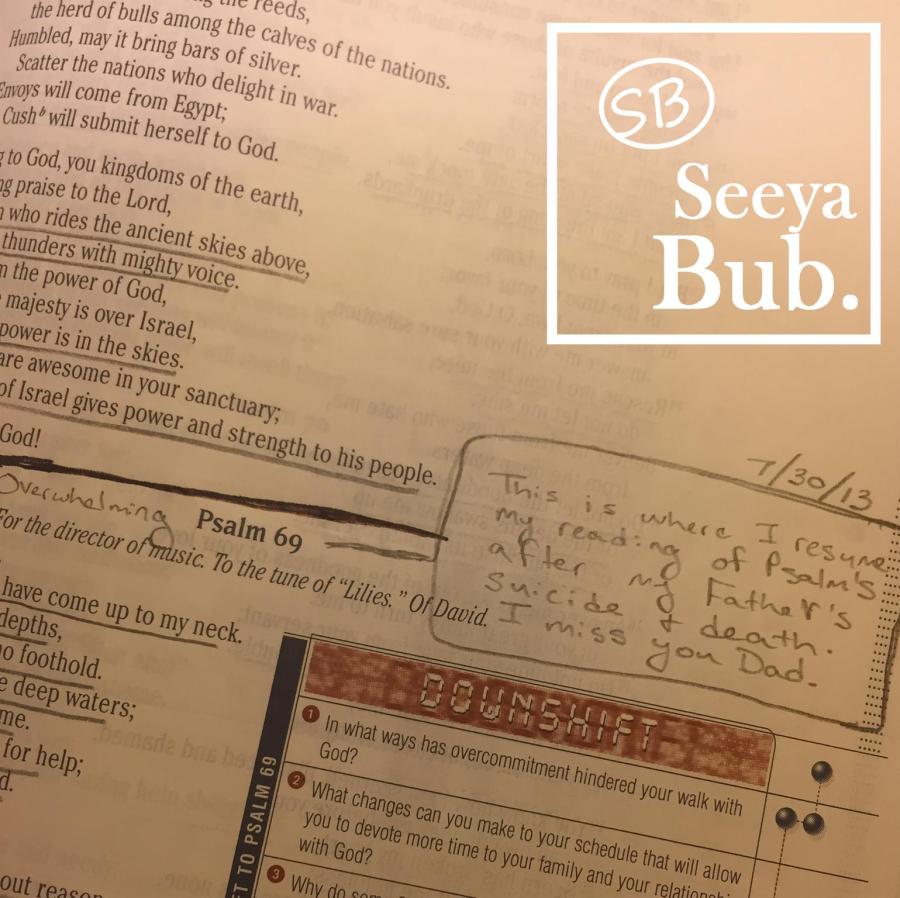
 Dad, I’d do anything to go back to that awful day in July 2013 and never have to draw a line in my Bible. But the fact that I’m even drawing that line means you made a tremendous impact on me and my life. You always approached your work with the utmost sincerity and dedication, but there was no job more important to you than being my Dad and the leader of our family. I’ll always be appreciative of that. I’m sad when I see the line, but I smile when I remember the man whose memory deserved it. I promise that my life after the line will honor you and make you proud. I promise that you will not have died in vain—that people will live their lives differently when they hear about you. Keep watching over me. Seeya, bub.


 Dad, It’s so hard to believe that another Christmas has gone by and you’re not here to experience it. You always made the holidays so special for Mom and I, and the tree is always a bit emptier when you’re not around it. There were so many things you enjoyed around Christmas—especially watching our family dogs open gifts and tear them apart. We were all joyful around the holidays because you made it that way for us. In your absence, I hope we are keeping the spirit alive that you always gave to us. And, I’m sorry for all the screwdrivers. Merry Christmas, Dad, and until we celebrate together again, seeya Bub.

 Then, I spotted a patch made of his softball pants and the stitched name and number (always 11 for symmetry) from the letterman’s jacket of our church team. Dad was a tremendous athlete. Known as “Scooter” since before I was born, Dad was always fast—real fast. I loved watching him play softball, and when I saw that patch, my mind immediately went back to the familiar smells and sounds of a softball field, watching my Dad scoot around the bases as I cheered from a splintered wooden bench behind home plate.
 I noticed his dark blue coveralls from Matandy Steel, the job where he worked for what was nearly the last decade of his life. So many times, I had seen Dad come home weary and exhausted from a long day at work, his hands and face smudged with grease from the machines he worked on all day. But my Dad loved his job, and he loved working, and I always associate those coveralls with pride and loyalty. My Dad was proud of his work, and we were all proud of the work he did.
 Dad, I would love for you to see this quilt, but I would give anything to see you wearing the clothes that make up the patches again. You would be so proud of Mom for finding such a wonderful way to honor your memory. When times get tough, I grab that quilt and think about you. I press my face against your work uniform, and remember how those patches used to feel on my face when I’d hug you as you came home from work as a child. I remember how sweaty those softball uniforms used to get after you had played a game on a hot summer night. I remember all the days we lounged together on the shores in Alabama, and how we all felt closer to God and each other being close to the ocean. I long for those days—and I know we will have them again, only better. My quilt only has meaning because of the meaning you gave to our lives when you were here. That quilt tells a story because you made life so special, each and every day. And although it will be sad to go through yet another Christmas without you to provide the fun and laughter, I feel you watching over us each and every year. Until our first Christmas together again, seeya Bub.


 Dad, I would do absolutely anything to go back to that moment when you came home and change the way I acted. I know you don’t want me to feel guilty, but now that I know more about what you went through, it pains me that I treated you the way I did. It breaks my heart to know how alone you must have felt in that moment, and now that our time together on this earth has ended, I would give anything to have it back. Had you been able to simply “snap out” of your depression and never suffer again, I know you would have. I want you to know that I would never judge your love for me and our family based on an illness that periodically overtook your mind and senses. Although I’m so thankful you don’t suffer from the darkness you once felt anymore, I wish I had just one more opportunity to hug you and tell you that I’ll always love you. Someday, I know I’ll be able to hug you once more. Until then, seeya bub.
  Seeya Bub