

“I think I am beginning to understand why grief feels like suspense. It comes from the frustration of so many impulses that had become habitual. Thought after thought, feeling after feeling, action after action, had her [Lewis’ wife] for their subject. Now, their target is gone.” -C.S. Lewis, A Grief Observed
Every so often, it happens. Every so often, I lose control of any emotional stability that I have and I break down when I think about my Dad, his death, and how much I miss him.
And nearly every time, it’s triggered by some sensation-based memory of my Dad.
The triggers are different, but always associated with him in some unique and special way. They can be as small or insignificant as seeing a bottle of Mountain Dew (his favorite guilty pleasure drink and what I often saw him chug when I was little) or a certain episode of Home Improvement (one of his favorite shows), or as big and significant as hearing someone talk about their father or seeing a father and son together in public.
I think often of my Dad; and I think often of those triggers.
One of my earliest lessons as a small kindergartner helped me to understand the five senses: sight, hearing, touch, smell, and taste. I always enjoyed those lessons and associating certain experiences with the correct sensory mechanism, but I never realized how ever-present those senses are—and how powerful they can be. That power seems to take on new strength, ironically, when we lose someone we love. Even though the catalyst of those particular memories is gone, the slightest sensation can bring us right back to that moment as if our loved one had never left us.
Like the sight of a bald dude.
My Dad would get a real kick out of this, but anytime I see a bald person in public, it makes me think of him. My Dad lost his hair early. He chaperoned one of my 3rd grade field trips, and I remember all of my classmates asking why my Dad didn’t have any hair. Looking back, it wasn’t so much a loss. It was more of a forfeit. Dad’s hair line started to recede a bit in the front, and he absolutely refused to embrace the George Costanza horseshoe that he criticized anytime he saw it. “Just give it up, buddy,” he’d say under his breath as we passed someone who was clinging to any combover or wrap-around-patch he could possibly muster. At age 30, Dad decided to shave it clean and he never went back. For the next 20 years he sported the chrome-dome, and I’ll be honest—he rocked it. My Dad was one of the few men who was given the silver lining of a great head shape during the throes of his follicle tragedy. He had a really good head shape: not too round, not to square, and no weird bumps or crevices. Whenever I pass someone whose hair is thinning, or on occasion pass that man in the mirror who (reluctantly) is experiencing the same thing, I laugh and think about my Dad.
A sound, too, can also bring me back to the many memories that I have of him—mostly associated with music. Certain 90’s country songs (particularly this classic) can pop me right back into the cab of his old pick up truck, bouncing along in a car seat with the windows down as Dad would thumb-drum the steering wheel. If you were in the truck with Dad, you were listening to good country music and that was your only option. Now, when I hear those songs we used to listen to together, I’m instantly transported back with him. Right by his side. Listening. Singing. Tapping my hands along to the beat.
A whiff of aftershave can bring me to memories of my Dad as well. When it came to the application of cologne, Dad did not quite understand the “less is more” rule. He didn’t believe in the “hint” or “leave them wanting more” approach. Instead, he favored a more liberal assault on the senses. He didn’t need high-end scents either. Dad’s go-to aftershave was a green bottle of Brut that could burn your nostrils with just one whiff. A small bottle was likely to last the average person a couple months to a year, but I’m pretty sure Dad thought the bottles were single-use-only. He would eventually work his way up to the men’s line of Bath & Body Works fragrances, and I remember on multiple occasions either myself or Mom having to beg him to dial it back a bit.
“Dad, just because it’s from Bath & Body Works doesn’t mean you need to bathe in it!” I’d tease him.
Now that he’s gone, I admit that I miss those scents. On occasion, I’ll pull out one of his bottles of aftershave that I kept after his death just to take me back to those memories that I have of him (and to clear out my airways).
Running my hands across the quilt that my Mom had made for me from all of his old t-shirts and sweatshirts, I’m immediately drawn to elements of him that awaken my touch memory. Specifically, placing my hands on top of his work coveralls with the stitched name badge embroidered onto the front brings me back to familiar memories of him.
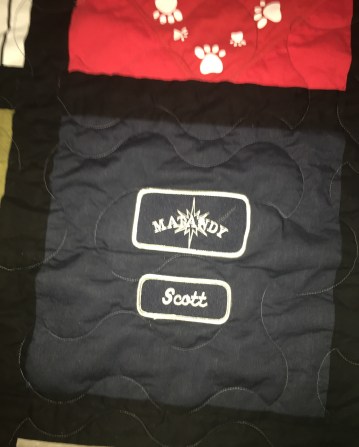 My Dad was a maintenance technician at a steel plant, and coveralls were his jam. He worked a lot (mainly because he enjoyed his work), and there was rarely a day in this life that I didn’t see him in coveralls. They were typically dark blue, and very, very heavy. I remember picking them up on occasion when Mom had just finished doing the laundry and wondering why anyone would want to wear such heavy clothing. Looking back, I likely didn’t appreciate the fact of how difficult my Dad’s job could be. He wasn’t always working in a temperature-controlled building. During the winter, drafts would sweep through the open garage doors that trucks would use to pick up massive steel coils, so my Dad needed the protection. Every time I feel those coveralls, I think about how hard he worked to provide for our family, and how amazing it was that I never really knew how hard he worked. Dad didn’t want to be a burden to others, and he rarely (if ever) complained about having to work in such a physically demanding job.
The tactile memory of his coveralls and Dad coming home after a sweat-drenched day working in a hot steel plant reminds me of his determination, hard work, and sacrifice; but when I feel those coveralls, they also remind me of the joy that I felt each and every time he would come home. Our house was always a warm refuge, but it truly felt like home when all three of us were there.
And of course, my Dad and I shared a mutual love of food. Those food memories are often so strong because our family mostly always ate together and Dad really, really enjoyed family meals—both because he got to eat delicious food, and because he got to spend time with those people that he loved. If I go to Kings Island or a Reds game at Great American Ballpark, I can’t walk by a LaRosa’s pizza stand without thinking of my Dad. It was always his go-to item to eat at those places, but even at home he loved LaRosa’s. Their salads were his favorite, and oftentimes on our “bachelor nights” when Mom would have to work late, Dad and I would find ourselves at the local LaRosa’s Pizzeria chowing down on salads, calzones, pizzas, and Cokes. The first time I had LaRosa’s after losing Dad, I broke down at the table when I instinctively went to pass my olives over to him not even realizing that he would never be there to enjoy them again.
I think of him every time I walk into Grecian Delight, one of our all-time favorite restaurants because of both the food and the dear, sweet woman (Maria) who owns it and rules over the kitchen (along with help from her loving husband and family). When my Dad worked in Middletown at Southwestern Ohio Steel, he and a coworker who lunched together discovered Grecian Delight, and Dad raved about it. Dad made it a point to take Mom and I there one evening for dinner, and hesitantly (we weren’t always the most adventurous), we ate a meal there for the first time when I was ten years old. Our lives were never the same!
 To this day, I still eat at Grecian Delight. One of the best parts of the time I spent working at Miami University’s campus in Middletown was getting to eat lunch at Maria’s multiple times a week! I would walk in and Maria and her husband, Dimitri, would immediately greet me with a smile and a warm hug. That delicious, warm meal (most times a chicken teriyaki pita with cucumber sauce, waffle fries, and a Greek salad) would give me comfort and bring back all the wonderful, vivid memories that Dad had introduced our family to so many years earlier.
Our senses are absolutely incredible.
Our senses have this unbelievable way of transporting us back to an earlier time and place.
And when we experience loss, our senses can also remind us of what we no longer have.
We experience life through our senses; and it’s through those same senses that we experience grief and loss. Little moments that we’ve subconsciously experienced for years or maybe even decades all of a sudden become a focal point that can bring that memory to life in an instant.
As our senses envelop us, so too does any grief that we associate with those sensations. Our senses are always there, ever-present. We cannot simply flip a switch and turn off our senses—they are always with us, and always sensing. And because we are always open to sense, we are also always, and a bit unfortunately, open to grief. That’s why grief is so inexplicable—it can happen at any point, at the slightest touch, or because of the most random vision, or as a result of the faintest scent that might remind us of our loved one and what was lost.
Those senses and the memories that we associate with our lost loved ones can feel like a curse; but with a long-term perspective of grief, we also realize that they will be one of our greatest blessings and a great mechanism that leads to our ultimate healing. Today, I’m writing to those of you who have felt the recent sting of loss and grief (and unfortunately, still in the midst of a horrible global pandemic, the audience that I write to is larger than any of us could ever dreamed it would be). I’m writing to let you know that what might feel like a weapon being used against you right now in this moment will later soothe your soul and bring you some semblance of healing and normalcy again.
Early on, our sensations can spark real pain. I do not and will not deny the pain you’re experiencing. In the immediate aftermath of a traumatic loss, every sensation that reminds us of our loved one can evoke pain and unexpected feelings of longing and heartache. We can break down at the sight of a photo, the voice of a loved one on a forgotten voicemail, or just the touch of a familiar piece of clothing or keepsake.
I’ve said it before and I’ll say it again; there is no textbook way to grieve. We are all built uniquely, therefore we all grieve uniquely (although not in isolation). In the aftermath of losing someone we love, we all react to these sensations differently. Oftentimes, after losing our loved ones, we are looking for ways to control our days in an effort to provide stability in a world that feels rocked by the unexpected. These unanticipated sensations and memories of our loved ones, however, can shatter any semblance of predictability that we may have and throw us into a tumultuous emotional state.
Unfortunately, there is also no timeline on how long these emotional reactions might stay with us or continue to occur. For some, those feelings of pain brought on by a sensational memory might only occur upon our first exposure to whatever that stimulus might be. Other times, however, we might find ourselves having a severe emotional reaction far beyond that first exposure. Especially to those stimuli that have a significant emotional connection to our loved ones.
My Dad has been gone for nearly eight years, which in and of itself is still hard for me to reconcile. Some days, the pain is so fresh and raw that it feels as if my Dad’s death occurred just yesterday; other days, it feels as if I’ve lived an entire lifetime without him. And yes, even eight years later, there are still sensory-based memories of my Father that evoke a particularly painful reaction.
Namely, my Father’s handwriting. I’m not sure what it is, but to this day I still experience deep-seated, emotional grief every time I see my Dad’s handwriting. Maybe it’s because my Dad’s handwriting was such a characteristic part of who he was. His all-capitals-style handwriting was precise, measured, and methodical—just like my Dad. Maybe it’s because our handwriting is something so commonplace that we grow accustomed to seeing every day that, once it’s gone, feels as if every note and every expression of it is a cherished heirloom that we must hold onto. Nonetheless, seeing my Dad’s handwriting still brings with it a visceral emotional reaction from me. I still keep a pad of paper that he had in his truck with random measurements that he had taken from work written on it. Those measurements mean nothing to me; but the hand that wrote them means everything. Eight years removed, I still have to keep that pad of paper stowed away in a box. Just looking at those random scribbled notes can break me down, and I can’t really explain why. It’s a difficult thing for me to understand and make sense of. For now, seeing his handwriting has not yet elicited a positive emotional memory.
But other memories, although they initially brought pain, have now transformed into something much more therapeutic.
In time, those same sensations can bring us real, lasting comfort. With time, the very same things that once triggered our trauma become the very things that heal our deepest hurts. Our exposure to a sensory memory of our lost loved one in the immediate aftermath of the loss can be significantly different from the reaction we will have months, years, or even decades down the road. What reopens a wound in one moment can soothe and salve it in another.
Over time, I began to associate many of those sensory details less with what I had lost and more with what I had gained during the 26 wonderful years of life when my Dad was physically in it. Immediately after losing my Dad, I had an unbelievably difficult time looking at pictures of him. They caused me too much pain because I just wanted to reach out and touch him through the picture, knowing that this would never happen again on this side of Eternity. Now, however, those very same pictures that once brought a tear to my eye can put a smile across my face. Don’t get me wrong; the hurt, heartache, and hunger for his presence are all still there. But the negative consequences of those feelings aren’t as intense. When I look at pictures now, I’m able to channel the positive memories that I often associate with each picture, rather than focusing on the fact that my Dad is no longer here. Instead, the consequences of those feelings of loss are reminders of how much I loved my Dad and how much he loved me.
And ultimately, thanks to my faith in God, they remind me that I’ll see him again.
 Honestly, I’m always a bit amazed that eight years after losing my Dad, I’m mostly able to look at pictures of him without sobbing like I did in those early days (especially because photos can be a very difficult trigger for so many people who are grieving, even years and decades down the road). Every time I see a photo of my Dad, it’s a reminder of how far I’ve come through this journey. It’s a reminder of how much God has loved me and protected me through this inexplicably difficult loss, just as He promised He would. It’s a reminder that where we are in the immediate throes of a traumatic loss is not where God wants us to remain. And it’s a reminder that grief isn’t an impediment to our growth in this life. Grief can be a temporary stop on our journey, but in time, we grow as much in our grief as we do at any other juncture of our development.
Although there’s no definitive timeline, our grief tends to change as the calendar lurches forward. The more time that stands between us and our grief, the more perspective we earn and gain.
The difficulty is maintaining this perspective in the midst of a storm of grief. One of the most difficult parts of these sensory-based reactions to our loss is that we tend to think those temporary reactions are going to be permanent when, in reality, they are far from it. In the immediate aftermath of losing a loved one, we often dread what is to come thinking that our immediate grief is going to be our permanent companion. That is not true. This thinking can defeat us if we allow it to. We must remember that our grief is a non-linear journey that takes time, and that we can’t forcibly wind forward the hands of the clock when it comes to our grief. We may fall and falter with certain steps, but oftentimes we make more progress than we can possibly know or recognize, even if we are not always able to see it from our own vantage point.
As grievers, we must resist the urge to talk about our sensory memories in defeatist, extremist language. I know this sounds like mental gymnastics, but I’ve written this truth many times in this forum: our words matter. And when we are talking about words mattering, it’s not just those words that we speak to others which have consequence. So to do the words that we speak to ourselves. Our internal dialogues are so pervasive and impactful. The conversations that we have in the inner recesses of our own mind, whether positive or negative, have a tremendous capacity to dictate and determine how we progress through the grief journey.
Your right now is not your forever; but you have to think, speak, and behave in a way that acknowledges this.
If you say to yourself, “I’ll never be able to eat at the restaurant that my Dad loved,” that’s (unfortunately) likely to be true. But if you say to yourself “Right now, I can’t see myself eating at that restaurant…but someday down the road I hope to be able to go back,” you then approach your grief with the perspective of a person who will change, grow, and even heal over time.
If you say to yourself, “I am going to completely fall apart every time I see a picture of my loved one,” that’s likely to be the case. If you say to yourself instead, “In this moment, I feel very sad when I see pictures of my loved one…but someday, I know that I’ll have a more positive memory and reaction when I see those pictures,” you immediately recognize that, in time, you will find ways to positively process your grief.
If you speak to yourself in fatalistic, “now or never” tones, that language does not recognize the ability for little steps and developmental moments of growth throughout our grief. Grief isn’t an “all or nothing,” “now or never” experience. One day, a sensory memory might bring with it a ton of pain. And the next time, it might feel a little better. And then each and every exposure after that gets easier and easier until, in time, it transforms into something greater that can help us heal.
You will always have scars when dealing with a traumatic loss; but with time, what feels like a weapon against our soul can transform into a bandage.
If you are grieving or struggling with loss, I am speaking directly to you in this moment: Be kind to yourself. Don’t feel as if you have to plow through your timeline of grief as fast as you possibly can. Don’t feel the need to open yourself up to every sensory memory of your loved one at this exact moment, but be open to the possibility of it down the road. Approach that memory on your own timetable, when it feels right, and be patient with yourself as you figure out what hurts and what helps. And open yourself up to the possibility of change throughout your grief.
 The reality is this: Our sensation-based-memories are an inexhaustible currency of life within which we can, in the right time, find our most valuable riches. Time, however, is that magic ingredient. Just as some precious metals require age to galvanize them and make them more beautiful, so too do those sensory memories of our loved ones. They require time to take off the sharp veneers and edges that can cause us pain so those memories can glow through and help us tap into those positive reactions.
In time, you’ll be okay; and in time, those memories will be more than just okay. They’ll be precious. They’ll be cherished. They’ll provide hope at just the right moment.
And so will you.
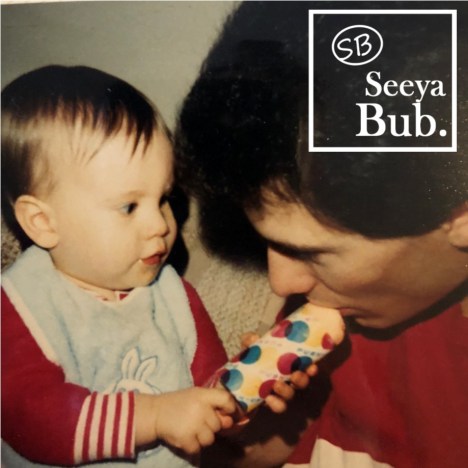 Dad, Losing you was difficult for so many reasons, but it felt even more difficult because you had lived life so fully. You always lived your life with gusto. You loved the visual beauty of nature, the joy of a great meal and a Coca-Cola (or three), and the smell of a summer’s eve bonfire. You shared this love and passion for life with everyone around you, and when you were gone, it made it difficult to enjoy all the things you loved. In time, however, I found that one of the greatest ways to honor you was to experience life just as you always enjoyed it. As time went on, I found myself crying less at the sensory memories I have of you and instead craving them because they provided me healing. Dad, thank you for always living your life in a way that led to wonderful memories. Thank you for being unique, having a personality, and just generally being a character! Thank you for teaching me what things would be helpful as I grieved before I knew that I’d ever need it. Dad, I know there is a day waiting for you and I on the other side of Eternity within which I’ll get to experience all of these things made anew. I’ll get to feel the warmth of your hug, hear the sound of your laughter, and see the smile and familiar twinkle in your eye. I long for that moment, but in the meantime, I’ll cherish the memories that I do have while embracing the things that remind me of you. I love you, Dad. Until that day, seeya Bub.
“You came near when I called you, and you said, ‘Do not fear.’ You, Lord, took up my case; you redeemed my life.” Lamentations 3:57-58 (NIV)

 Dad, I’m sorry for all of those moments that we should have spent together. I’m sorry for all of those times that I wasted when we had the opportunity to just be together, but I didn’t realize the value of those moments. Ultimately, I’m just sorry we didn’t have more time. Dad, you brought such joy to my life—and to everyone’s life that you interacted with. Any amount of time with you would have failed to be enough. There are so many things we should have done together, and I’m sorry I didn’t make a more genuine effort to make those things happen. Dad, I hope that I’m still learning from your life. I hope that I am taking the time that God has given me and using it more wisely than I did before you died. It still doesn’t erase the pain of losing you and the desire to have more of you in my life, but I hope that I’m realizing the fragility of life and the need to invest my time in the things that matter—the things associated with loving God and loving other people. Dad, please continue teaching me. Thank you for living a vivid life that still feels important each and every day. And Dad, I’m keeping a list of all those things we should have done. Someday, we will have the opportunity to do them all, and I can’t wait. Until that day and the glorious reunion that awaits, seeya Bub.
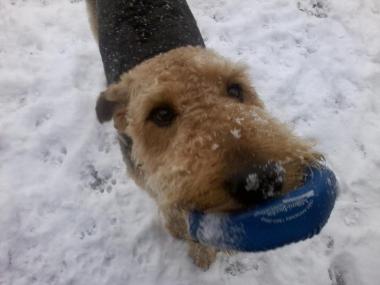
 From the moment she came home, Lucy was impossible to resist. I have a weak-constitution for puppy cuteness, and Lucy melted my defenses rather quickly. Airedale terriers are adorable puppies. What will eventually grow into a 60 or 70-pound dog starts out as an eight-pound ball of fur with a shortened snout and gangly legs. Lucy looked like most Airedale pups I had seen in photographs, but there was one defining characteristic that was different. Lucy had a tiny little white patch of fur right on the middle of her chest. I had never seen an Airedale with any color fur other than black and brown. Immediately, she was different from the rest; and the more I got to know her, the more wonderfully different I discovered she was.
 Dad sat the blanket bundle down on his lap, and Lucy poked her head out from the blanket mound and peered around our family room. She looked straight at me with her dark eyes, and when she made her way down onto the carpet and slowly meandered towards me, I knew that I was done. My resistance would have to fall, because this pup was just too cute. With the pain of losing Willow momentarily fading, I reached down and scooped Lucy into my arms. For the rest of the night, she and I spent our time on the couch as she adjusted to her new surroundings. A few times, I glanced at Mom and Dad and saw them giving one another that familiar “I told you he’d cave” look. I tried my best to not let them get any satisfaction from defying my gutless order to not bring home another family dog, but it was useless.
 And from that moment on, I don’t think I ever quit loving Lucy. Even if my stubborn pride wouldn’t let me admit it.
 Lucy had that in abundance. Lucy’s calm demeanor during the first 24 hours of her life in my family was a well-executed mirage delivered by a sneaky infiltrator. When I came home on Lucy’s second day in the Bradshaw house, the docile, pleasant pup that I had left that morning was replaced with a rambunctious, mischievous, four-legged fur-covered peddler of destruction. When I came home that day, my poor Mother looked like she had barely survived a hurricane. She looked at me with a frazzled exasperation as Lucy, with toys strewn all across our normally-clean family room, bounced and barked and bolted to every corner of the house. She was worse than a baby because she was faster. I couldn’t believe she had fooled us! Lucy had spunk—and a whole lot of it.
 But with Lucy, it was different from the start. She was immediately allowed onto the couch—and I was shocked! And then, the unthinkable happened; Mom actually let Lucy sleep in the bed with her! What world was I living in?! Who had abducted my Mom and who was this woman that now gladly beckoned the dog onto the furniture?
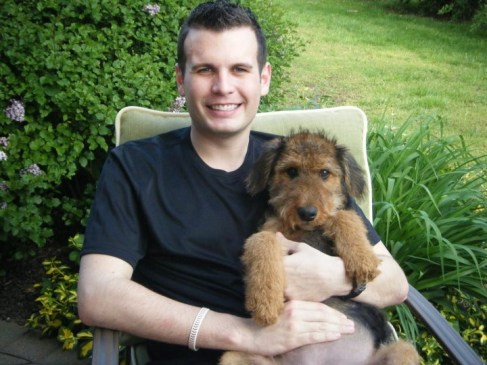 When Lucy was little, I used to carry her around the house quite often. And unlike most dogs, she really enjoyed being carried! After a little while, it got more and more difficult to carry her around as she continued to grow. And by the time she reached 40 pounds, our little puppy, who I affectionately called “Monkey”, was a bit to heavy to carry with one arm. So I did what any normal person would do.
 I would actually pick Lucy up by her front legs and toss them over my shoulder. Then, Lucy would wrap her hind legs around my waist, and I would comfortably carry her around as she nuzzled her snout on my shoulder. Looking back, it’s the most ridiculous thing I could ever imagine doing as a dog owner.
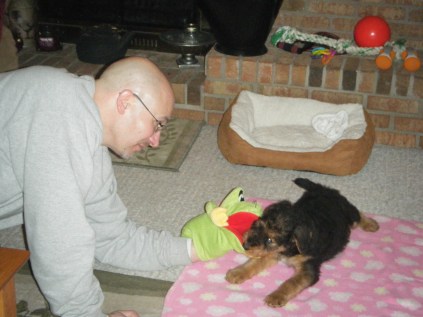 Thankfully, my Dad, our dog-whisperer-in-residence, was there to take care of most of the discipline and direction when we first got Lucy. My Dad loved working with animals, even when the animals weren’t easy to work with. I think he saw teaching pets as a challenge that he wanted to conquer, and he had a way of showing love through firmness. Quickly and efficiently, Lucy was housebroken and learning how to sit, lay down, and yes…play hide and seek with Dad. My Dad had a special talent, and we all benefited from it.
 Dad, being a playful guy, did everything with Lucy. If he was home, he wanted to be near her. If he had a bonfire in the backyard, Lucy was with him. If he was eating dinner, she was patiently waiting for a scrap nearby. If he was taking a nap, she was on the couch cuddled next to him. There were hour-long walks to the park, trips to the dog beach at Hueston Woods, and countless other memories that the two of them created together. They are memories filled with laughter and companionship, but joy more than anything else.
 And Lucy was there to help me—and all of us—find a small ray of light in the midst of the dark clouds that enveloped our family. Lucy—sweet Lucy—would help to save us as best she could.
 Every single day is difficult—all 1,827 of them; but every single year, July 24 is a date that stares at me from the calendar. It looms in the distance for months, and when it passes, I always breathe a sigh of relief that it’s come and gone. But I know, deep down, that it’s coming again. It will always be there. No particular July 24 has been more or less difficult—just different. But because of the nice, round number, this one feels like a milestone. A milestone I wish I didn’t have to reach.
 But guess what? No amount of procrastination could stop that date from coming. No amount of denial could stop me from thinking about what this day represents. This day would come—and yes, it would eventually pass—but the second it did, the clock just begin counting down towards another unfortunate milestone. The next Christmas. The next birthday. The next Father’s Day.
 On the other side of all that grief and sadness, there will be an everlasting love made whole again. On the other side of that grief, there will be a man whom I recognize, smiling and welcoming me into his arms. In that moment, I’ll love never having to say “seeya, Bub” again. That day is coming, although it’s very far off.
 Dad, I cry so much when I think that it’s been five years since you and I last talked. Sometimes, those tears are unstoppable. We never even went five days in this life without talking to one another. Dad, it really has felt like an eternity—but sometimes your memory is so real and so vivid that it seems like it was just yesterday when we lost you. But I know the real time. I know that it’s been five whole years since we’ve been able to be in your presence. And life simply isn’t the same without you. We all cling to your memory. We marvel at the things you built and the way you provided for our family. We laugh about the funny things you did to make life more fun. But I also weep when I think about how much life you had left to live. Dad, I’m so sorry that you were sick. I feel horrible that we couldn’t do more to help you find the cure you deserved. I’m sorry that you were robbed of the life you deserved to enjoy. I’ve felt so much guilt in losing you Dad. I know that you don’t want me to feel this way, but I just wish there was more I could have done. You deserved that, Dad. You deserved more, because you gave everything. As painful as these five years have been, Dad, I find peace in the truth of Eternity. I find comfort knowing that you are enjoying God’s eternal glory in a paradise that I can’t even begin to fathom. Dad, thank you for watching over me for these past five years. Thank you for never giving up on me—both in this life, and in the next. Thank you for giving me a lifetime of memories and an example of what fatherhood should be. I love you, Dad. I always did, and I always will. Thank you for loving me back. Until I see you again, seeya Bub.
 Dad, I wish I had known. In spite of all your struggles that you dealt with each and every day, I never, ever thought that suicide would attack you and our family. I never believed for one moment that your life was in danger, probably because you shielded us from so much of your heartache in an effort to protect us. Dad, I wish I could have done more to help you. I don’t blame myself for what happened, but I would do anything to replay those moments when I should have done something. But in your memory and because you always taught me to help people, I’m trying to keep others from suffering like you did. I’m trying to make people aware of something that I wasn’t aware of until it stole you away from us. Dad, I miss you every single day. I wish I had many more minutes to spend with you. Someday, we will have those minutes and many more. Someday, we will be able to enjoy being together again. Until then, seeya Bub.
 Dad, Even though I know you would tell me not to feel regret, I do wish that I had the chance to hit the “do-over” button on so many things in my life. I wish I had been more of a support to you when you needed me. I wish that I had spent more time with you doing the things you loved to do. I wish that I could have done more to help you find peace and solace in the tumult of your depression. I don’t know the answer to why this terrible tragedy happened, but I do know that God has a plan to make something good out of it. I often wonder what could possibly be better than more time with you, but I know that although I feel a horrible separation from you in these moments, there will come a day when you and I can both live completely free of regret and goodbyes. I long for that day, but until then, seeya Bub.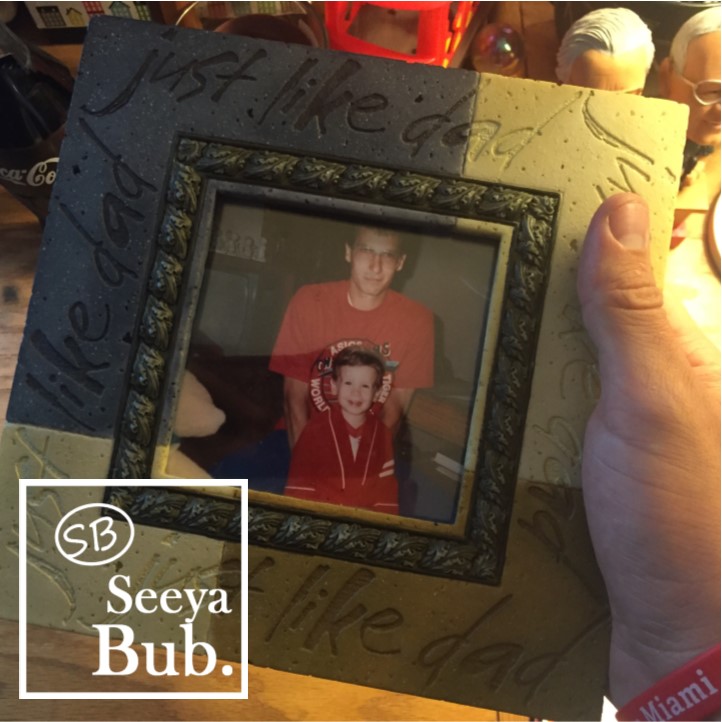
 Dad, I hate that I ever had to say goodbye to you. It’s been four years since I said goodbye to you for the last time here on this Earth. I feel the pain of losing you each and every day. I would give absolutely anything to have you back, even if only for a day. For 26 years, you were always here for me, and now that you aren’t I feel the awful heartache of losing you. But I know that I could only feel that heartache because you touched my heart in ways no one else could. You taught me so many important lessons in this life, but more than anything you taught me that love matters above all else. In every moment of every day, I never doubted your love for me, for my Mom, for our family, and to all who mattered to you. You didn’t just tell people that you loved them, you showed them. And I’m thankful for that. The days stretch on without you, Dad. There are days, like today, when it’s all I can do to get out of bed at the thought of losing you. But I know that all of the wonderful moments we shared in our time together here will be completely outshined by the life we will live together in the glory of God’s grace. Thank you, Dad, for everything. I’ll never be able to tell you how much I loved you, but until that day when I try, seeya Bub.
 Dad, Even though you weren’t able to mold me into a terrific athlete (yes, I’m going to blame this on you), you never quit teaching me that athletic competition was just a vehicle to deliver some of life’s most important lessons. You taught me about humility, hard work, dedication, courage, and competition. You knew that, when you compete, there are lots of people watching how you react to adverse situations. And you always, always made sure that your character was on display. I wish I had been a better athlete because I wanted to make you proud, but I hope you know how much I enjoyed watching you compete…and how much I desperately wanted to be like you. Dad, you made a tremendous impact on people each and every time you played. Thank you for being a character-giant in my life. Thank you for always giving me a solid example of Christ-centered love to look up to. And thank you, seriously, for putting up with my pathetic arm when we would toss. When I’m perfected in Heaven, our games of toss will be a lot more fun. And until that day, seeya Bub.
  Dave Hicks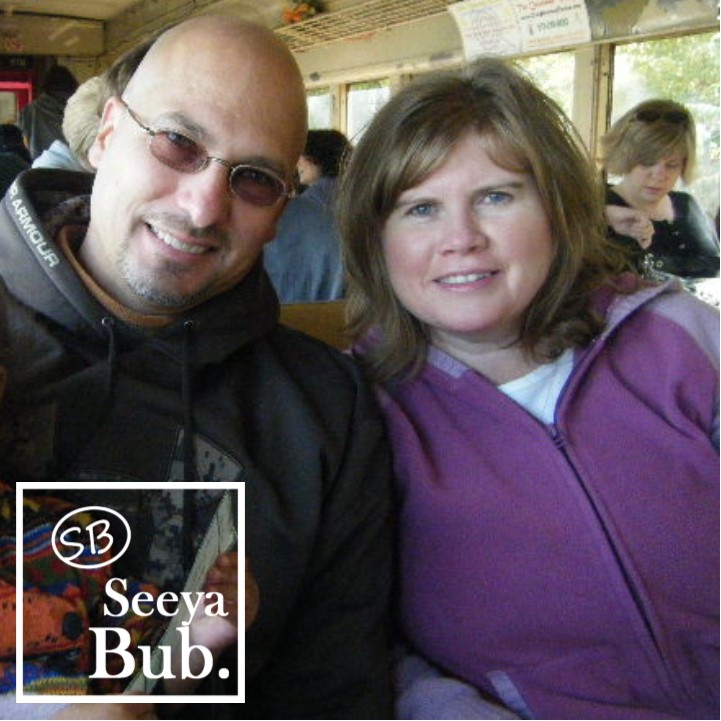
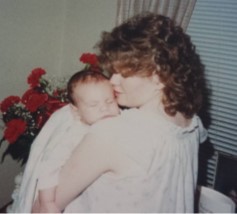 God has given me so many wonderful blessings in this life, but none greater than the two loving parents that have been with me since before I took my first breath. I’ve always had a special connection with my Mom since I was little. As an only child, I was fortunate to have all of her love and attention. I’m thankful that even though I’m growing older, I’ve never stopped receiving that.
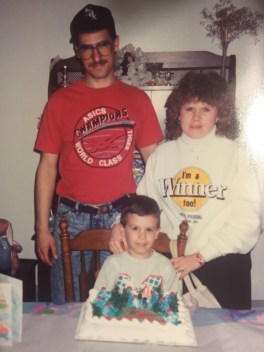 Farm (for those of you who are old enough to remember this place), picnics, movies, making crafts, zoo trips and much more. Birthdays and holidays were also special times at the Bradshaw house. Scott and I always wanted to make Tyler’s birthdays special. Every year we would plan a big birthday party for him, and Scott was always excited and would always try to plan something different each year.
 Dad, I always pictured you growing old with Mom. I knew you would make a tremendous Grandpa, but just as importantly I know that Mom will be an amazing Grandma someday. I hate that you didn’t get to enjoy this chapter of life here on this Earth with her. But I know that you are so unbelievably proud of her as you watch how she’s handled the troubles of this life without you. I know that you are watching over her each and every day. She is lucky to have such an amazing guardian angel. It doesn’t change the fact that we would rather have you here with us, but it does make life easier to handle knowing that, someday, we will all be reunited—a family again. Although we don’t have you here with us, we will always cherish and hold near to our hearts the memories that you gave us. You gave us so many. Thank you for always doing that. Thank you for being a wonderful Father, and thank you for choosing the best Mother any kid could ever hope for. Until we get to relive those wonderful memories together again, seeya Bub.
  Becky Bradshaw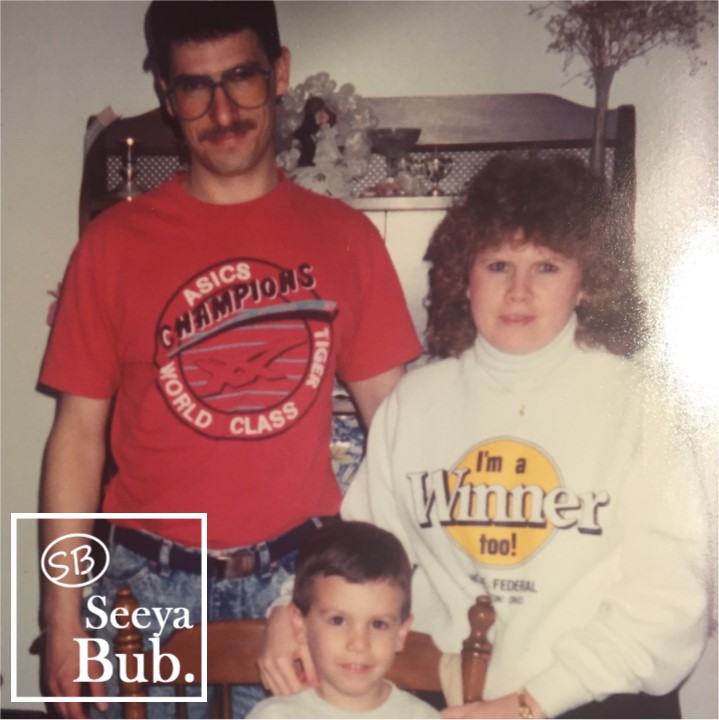
 Dad, A birthday just isn’t a birthday without you here to celebrate. I often think about the great jokes you would have had worked up for me now that I’ve turned 30. I guarantee that there would have been some hair growth treatments involved—you should know that better than anyone. As painful as it’s been to blow out the candles on a cake without you for the fourth year, I’m thankful that I got to spend 26 wonderful birthdays with you here. You always made birthdays so special for me, and I’ll always be thankful for your unbelievably fun-loving attitude towards life. You have a new birthday in Heaven now. One that represents the start of your eternal life in paradise. As much as I hate aging, I’m thankful that with every passing day I’m one step close to hugging your neck again and telling you how much I’ve missed you. I long for that first hug, because I know it will be even better than the last one we shared. We are going to have a lot of birthdays to catch up on! And I can’t wait to tell you about every day that you’ve been gone. You’ll always be here with me, even when you aren’t. And I’ll always be grateful that on this day 30 years ago, I received one of the greatest birthday gifts God could ever give me. The gift of loving parents, and a Father who made life worth living. Thanks for giving me life, and thanks for always adding love to it. Until I can thank you in person, seeya Bub.
 Seeya Bub