The Inside Cover

Usually, I only write my last name on the inside cover of the books I own (which is too many). Mostly in bright red pen, I emblazon “BRADSHAW” in all capital letters in the top left hand corner of most of my books. Just in case I decide to lend my precious books out and they don’t find their way home, I want the perpetrator to be haunted with the guilt of their thievery forever and ever.

But my Bible? Well, that’s a different story…

Since shortly after graduating from Miami, I’ve carried a hardcover Zondervan Bible. It’s a TNIV (Today’s New International Version) men’s Bible called Strive that I picked up at Half-Price Books. I love it, and I always have. It has great inserts with thought-provoking questions, profiles of historical figures from my faith’s past, and counters to modern-day myths associated with a man’s journey as a Christian.

This is the Bible I’ve always read since I started drawing closer with my faith after college. I read all the way through this Bible from cover to cover, which was a big accomplishment for me. I’ve marked that Bible up with underlinings and notes and circles of passages that grabbed my heartstrings or caused me to think of my faith in a new light. This was the Bible I was reading before my Dad died that has a deeply significant timeline drawn between Psalms 68 and 69—the before and after line marking my Dad’s death during my reading journey. It’s the Bible that I’ve carried with me to church each and every Sunday—on the days that I’ve wanted to go, and on the days when I’ve been so shattered by the grief I feel that I have to drag myself there. This Bible has traveled with me in countless rental cars and hotel rooms when I travel for my job. The thin plastic protective cover has started to peel, and some of the pages might be creased, but it’s never diminished the value of the precious words inside.

The words in the Bible tell the story of my faith; but the words I’ve written on the inside cover help remind me why I believe.

A year or so before my Dad passed, I made a decision about the inside cover of my Bible. I told myself that I was going to wait for the most poignant, thought-provoking, powerful statements about my faith in God and lodge them there. Once I heard those phrases, I would write them on the inside cover of my Bible. It was a pretty simple premise, but one that I took seriously.

I took it seriously because the inside cover of my Bible is precious real estate. It’s the first thing you see when you open the book. Once you use up all the space on the inside cover of your Bible, it’s gone. You can never get another inside cover.

That first quote on the inside cover of my Bible is still my favorite one.

I didn’t write the date (an addition I would add to future quotes). I didn’t note the particular sermon. I didn’t even write it in red pen! (My coworkers probably are probably shocked to see my writing in anything but red pen.) I do, however, remember the speaker who introduced that quote to me.

It was my pastor, Reverend Harville Duncan. I always loved Harville’s messages because they were intellectually challenging, thought-provoking, convicting yet hopeful. His messages always had powerful themes and nuggets of wisdom all throughout that challenged me in my faith in ways that I didn’t think was possible. He also made a somewhat-weekly LA Fitness reference which I conveniently tallied on a post-it note in the back of my Bible (and just in case you’re curious, he told 67 LA Fitness stories between 2013 and his retirement in 2016, with a +/-3% sampling error for the services I missed).

More important than any LA Fitness reference, however, was the quote from Reverend Duncan that founds its way into my Bible:

“You should not go to the Lord and tell Him how big the mountain is. You should go to the mountain and tell it how big your God is!”

It wasn’t an original quote, but it was new to me—and it was beautiful. I had never heard that phrase, but I loved it. It gave me courage that I never thought I’d need. It helped me visualize strength in the midst of difficult circumstances. I just loved it, and I knew the second that I heard it where it should belong.

I grabbed a pen from the pew in the middle of his sermon, and I inscribed the quote in my typical all capital (albeit blue) writing on the inside cover of my Bible.

It’s been there ever since; but more importantly, it’s been in my heart and mind every single day since I wrote it down.

I loved the quote—and in a few months, I would need that quote.


When I decided to speak at my Dad’s funeral, I honestly had no idea what I was going to say. I had no words for what had happened just a few days prior. What could I possibly say at that lectern to capture the love I felt for my Dad and the grief I felt in losing him? It just wasn’t possible. I didn’t have the courage.

I did something on that day that I have rarely done when it comes to public speaking. I didn’t prepare at all. I didn’t write out any notes. I didn’t rehearse my eulogy like I typically would any other time I spoke in public. I didn’t even have a general outline. I played a few things through my head during the few quiet times I had in the days after Dad’s death, but nothing would stick. I just prayed that God would give me the strength to say what He wanted me to say in that moment. I didn’t know what to say—but He did.

In an effort to try and prepare, I sat down at my desk the morning of my Dad’s funeral. Adjusting my black suit as I sat down, I said a quick prayer and asked God for guidance, perspective, and a courageous spirit. I told him how beat down I was. I told him that I had never felt this kind of pain before, and that I didn’t know what to do with any of it. I told him that I was completely lost, and insecure, and doubting whether or not I could live life without my Dad.

And then, I opened my Bible. And there it was:

“YOU SHOULD NOT GO TO THE LORD AND TELL HIM HOW BIG THE MOUNTAIN IS. YOU SHOULD GO TO THE MOUNTAIN AND TELL IT HOW BIG YOUR GOD IS.”
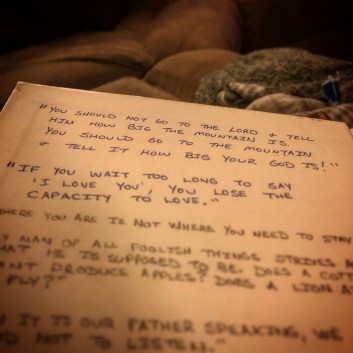
Bible Inside CoverGod wanted me to hear that message the day that I originally wrote it down, but he wanted me to live it in this new storm. That was the message God gave to me in a moment of ease to prepare me for a lifetime of perplexing grief. That was the message that God put on Harville’s heart, knowing he would need to pass it along to the members of the flock he cared for. That would be the message of my life, given to help save it.

And that would be the message I would need to say goodbye to my Dad.


I spoke at the funeral that day, and although I didn’t have a clear framework of where I wanted to head with my message, I knew that God wanted me to share this one truth. He had put it on my heart (and on my Bible cover) for a reason. This was that reason.

I didn’t talk long that day. I physically couldn’t. I talked about my Dad and how much I missed him. I talked about the sadness we felt as a family and the gaping hole we would feel in his absence. I shared some stories about his sense of humor. And I was honest with the few hundred friends and family members who had gathered to say goodbye to my Dad. The truth that, deep down, I didn’t know how my Mom and I would ever get through this. I was deeply confused, and I had questions that I feared would never be answered.

But I told them that Harville had shared an important quote with me and our church shortly before my Dad’s death. “We should not go to the Lord and tell Him how big the mountain is,” I said with slowly mustering confidence. “Instead, we should go to the mountain and tell it how big our God is.”

I looked out across the darkened sanctuary, and although I saw tear-stained faces, I also saw nods. I saw people nodding, and smiling through their grief, and encouraging my Mom and I to never give up. I saw people believing that my Dad’s death would be a huge, looming mountain; but I saw them believing that God could help us climb that mountain and conquer it with the strength only He can provide.

The mountain of grief we were facing would never, ever go away; but neither would the Almighty God who could help us climb it.


A few weeks after the funeral, as life began to ease its way into a difficult new-normal, I got an unexpected gift from my Uncle Lee. Lee was my Mom’s only brother, my Dad’s only brother-in-law. Dad and my Uncle Lee may have been brothers-in-law, but they had a bond of brotherhood that was enviable to this only child. They grew up as teenagers playing softball together. They played pick-up basketball together with members of our church from the time I was little. They would always count on one another for help with big household projects, appliance repairs, and the ever-occurring backyard swimming pool problems. I think Uncle Lee and my Dad always got along with one another because they are unbelievably similar—for all the right reasons. They are two of the most hardworking individuals I’ve ever known. They provide for their families without ever begrudging the hard days and long hours. They are each humble to a fault, never boasting or seeking credit for the amazing work they do. I know that when my Dad died, Uncle Lee was just as devastated as anyone else—and rightly so. My Dad had been the brother that he never had, and now he was gone.

In the immediate aftermath of losing my Dad, Uncle Lee was one of the first people on the scene—and one of the last to leave. He stayed with my Mom and I anytime we needed him. He helped us with countless chores and projects around our homes, cutting our lawns and helping with other repairs. He was there for emotional support, even though he was grieving himself.

His personal grief was real, but he always found a way to make sure he was a source of strength for my Mom and I whenever we needed him. I’ll never be able to thank him enough for the support he gave us, and his gift to me after losing my Dad inspires me in new ways every day.

His gift was a sign—a beautiful sign. Uncle Lee wanted to give me a reminder that the words I spoke at Dad’s funeral were more than just words; they represented an undeniable truth. He knew that I would need to do more than remember those words—I would need to live them. So, to help me remember, Uncle Lee made me a beautiful sign that read: “Don’t tell GOD how big the mountain is, Tell the mountain how big GOD is!”

Sign from Uncle Lee

I cried like a baby when I saw that sign for the first time. I ran my hands to and fro across the sign as I read the words and wept at the thought of losing my Dad and living life without him. But I also smiled and nodded my head through the tears because I knew those words were absolutely true. I knew that those words would guide me through the unchartered waters of grief and loss. I would go to that mountain of grief and despair, and I would let God guide me to the peak. This sign was an overflowing of the love in my Uncle’s heart. I’ll always be thankful to him for loving my Mom and I, and I’ll always have this sign to remember the courage and belief he had in us to overcome.

And let me tell you…I’ve needed the reminder many, many times.

Those words would become a mantra to me in the months and milestones that passed after losing Dad—and they still are. Especially in the weeks that followed after losing him, I would recite those words to myself over and over and over again first-thing every morning. I would wake up from a restless, nightmare-laden night. I would take a few deep breaths, trying to shake away the reality of losing my Dad. I would dread having to face the world without my Dad by my side. And on those days when it was hard to believe, I recited the words that I knew would carry me through: “Don’t tell God how big the mountain is; tell the mountain how big God is.”

On nights filled with paralyzing pain, I would have trouble peeling myself off of the couch. There were many nights when I would collapse in the floor of my living room, convulsing and weeping at the mere mention of my Dad’s name. And in those horribly painful moments, I would say those words again: “Don’t tell God how big the mountain is; tell the mountain how big God is.”

And on days when Satan crept into my mind and tried to convince me that my Dad’s death from suicide was unforgiveable, I would beat back his ploys with the truth of God’s love. I would remind myself that God doesn’t just love a chosen few. He chooses to love all of us—including my Dad, mental illness and all. And I would say, with a smile on my face and an eye towards the heavens “Don’t tell God how big the mountain is; tell the mountain how big God is.”

That beautiful sign hangs above the window in my home office, my favorite retreat nestled in the back corner of my home. It’s the office my Dad helped me paint. It’s the office where he installed a beautiful chair molding to help me execute the vision I had for a lovely baseball-themed workroom. And there, above the window where I stare out and daydream, hangs the sign that my Uncle Lee made me with the words that have carried me through my grief. I look at it often, especially when I write. I let it remind me God has a bigger purpose for our pain. He doesn’t demolish the mountains in our lives. He grabs us by the hand and helps us navigate the terrain until we reach the mountaintop.

I live my life relying on those words. I live those words knowing that they were written in the inside cover of my Bible for a reason. That reason is bigger than anything I’ll ever be able to explain on this side of Eternity; but I still trust them. I believe that they are true because they’ve carried me this far. No mountain will ever be too big for my God, and every time I open my Bible that truth jumps out at me—both on the inside cover, and in every single story those pages tell.

Dad in Easter SuitDad, You were always so courageous and so brave, and I wish I had more of that in me. You never let a daunting challenge intimidate you. You believed in your ability, and you believed in your God. Ironically, it was watching your brave example that prepared me to survive the grief of losing you. You taught me that I could do anything if I believed in God and let Him lead my way. Dad, I don’t focus on the one battle that you lost with depression. Instead, I focus on the many years that you fought successfully and conquered your sickness. You tried so hard—for me, for Mom, and for those who loved you. You fought the hardest fight of your life each and every day, and you were unbelievably brave. I’ll always remember that. I’ll always live my life through your example. And until I can see you again and tell you just how courageous you truly were, seeya Bub.

“Then David continued, ‘Be strong and courageous, and do the work. Don’t be afraid or discouraged, for the Lord God, my God, is with you. He will not fail you or forsake you. He will see to it that all the work related to the Temple of the Lord is finished correctly.’” 1 Chronicles 28:20 (NLT)

Dad’s Song

“I hate that I have to ask you this so soon, but…is there a song you would like played or performed at the service for your Dad?”

My Dad had only been gone for a day. Just a few days earlier, we were making the final plans for our family vacation to the beach. Now, we were making plans to say goodbye to my Dad for the final time. Oh, how life changes in an instant. One horrible, irreversible instant.

Harville, my pastor, was sitting in a chair in the corner of my darkened bedroom. We had been talking for the past thirty minutes or so about the tragedy of the past few days. My pastor had a tender kindness that was so very important to my family in the aftermath of Dad’s death. He came into the room that day to see how I was doing and to tend to my spirit, which had been bruised and battered since that awful Wednesday morning. As tender and thoughtful as Harville was in those tumultuous few days, there were some painful questions that just couldn’t be tenderized. I knew that Harville had to ask questions like this. The reality was that my Dad was dead, and that there would be services to honor his life within the next few days—that unfortunate truth was fixed, unchanging. We couldn’t put it off for too long. We were going to have to come face to face with this horrible reality and plan a service fitting for a life well-lived.

I am still very thankful for Harville, my Mom, and my Grandpa Vern (among many others) who really took control of the funeral planning and shielded me from the heavy lifting. I had very little to do with the wonderful funeral service we were able to hold for my Dad, but when Harville asked a question about music and a song, I had an immediate answer.

“Yes,” I said to Harville, “There is a song.”


Just a few months before that fateful July morning, I found myself in the basement of my friend Steve’s home watching the Super Bowl on his jumbo projection screen. There was nowhere better to watch a football game, especially if it was the big game of all big games. Steve had engineered a projector in his basement to project the cable feed onto his entire wall. If you think you’ve watched a great game on a beautiful television, try watching it on an 8×12 foot wall projection. You’ll take your 70-inch flatscreen and chuck it out the window (don’t do that).

Even though the lights in the Superdome went out that night, it was still a fun game to watch. And, like most who tune into the Super Bowl, I kept a sideways glance at the screen when the commercials came on to make sure I didn’t miss something funny that all my friends would be talking about the next day. Per usual, there were commercials that made you chuckle or pulled at your heartstrings. The Gangnam Style guy was apparently a big fan of pistachios. There was the Budweiser baby Clydesdale. There was also a weird Dorito’s commercial about a goat that made me never want to eat Doritos again.

But there was one commercial in particular that grabbed my attention from the opening chord. As I sat in the glow of the giant wall projection, there was a beautifully-elegant, simple, and rustic guitar intro that caught my ear. It had a country-simplicity to it that I loved. This was the type of country song that existed before most of the current country artists began to ruin country music (You heard me, Rascal Flatts…).

He’s a twenty years straight get to work on time… He’s a love one woman for all his life…

I loved it already.

Then, my love for the commercial turned into complete infatuation when I saw the product that was being advertised: the Chevy Silverado.

The Silverado was the truck of all trucks, in my opinion. It was rugged. Versatile. Reliable. And my Dad always drove one. I trusted his taste in many things, but I especially trusted his taste in trucks.

As the commercial rolled on and my eyes glazed as flashy Silverado after Silverado rolled across a field of amber grain or a windy mountain road, the lyrics of the song continued to speak to me.

He’s the shirt off his back, Give ya his last dime, He’s strong.

It was unbelievably ironic to hear this song paired with this particular product. This was the exact truck that my Dad drove, but it was also a song in which every line spoke to the man he was. This was a song that told the story of my Dad and how he lived his life.

I remembered hearing the song through the first verse during the commercial and immediately getting to my phone to Google the lyrics. After a few seconds, I found the song. Strong by Will Hoge. It was a song I had never heard before, sung by an artist I had never heard of. His voice, however, made it feel like I had been listening to him sing my entire life. Mainly because he was singing about a topic that was so familiar to me. The name “Scott Bradshaw” is never mentioned once in the song, but I felt like every lyric was about him.

I listened to the song on the way home from Steve’s that night. I downloaded it from iTunes and added it to my phone. And each time I heard it or listened to it, I said the same thing to myself: One day, I’ll play this song for Dad and let him know that I think of him every time I hear it.


I had no idea that our time together was running so short. When I thought about playing that song for my Dad, I envisioned playing it many years into the future, possibly when my Dad was in an advanced age and balder than he currently was (not possible). I thought, naively, that I would have a ton of time to play that song for my Dad and share it with him, along with my feelings.

I never got a chance to play that song for my Dad and tell him what it meant to me—what he meant to me. His death from suicide shattered our lives unexpectedly, and now I would have to settle for playing the song at his funeral. I just couldn’t believe it. I am fortunate that God has blessed me more than I deserve and that I have very few regrets in my young life. This, however, is one of my greater regrets. I wish that one day, while riding around together in his Silverado, I would have taken the time and shared the song and my emotions with him. I had the opportunities, but I also thought we would have so much more time together. There were many more drives with the windows rolled down and the radio up to be had.

Alas, we didn’t.

So, the first time I was able to play that song for my Dad was in his memory. Sitting in the first pew of the dimly-lit church our family had called home, Mom and I gazed upon the cherry casket resting a few feet in front of us. As we sat there with hundreds of our family and friends sitting behind us while the clock neared 10:00am, the familiar guitar strum began to emanate from the speakers.

I ask you to place yourself in that moment. I ask you to close your eyes, imagine that day, visualize that church, and listen to the song that I chose for my Dad.

Strong

Will Hoge

He’s a twenty year straight get to work on time
He’s a love one woman for all his life
He’s a shirt off his back give you his last dime
He’s strong

He’s a need to move something you can use my truck
He’s an overtime worker when the bills pile up
Everybody knows he ain’t just tough
He’s strong

Strong

He’ll pick you up and won’t let you down
Rock solid inside out
Somebody you can trust
Steady as the sun
Ain’t nothing gonna knock him off the road he’s rollin on
He’s strong

It ain’t what he can carry what he can lift
It’s a dirt road lesson talkin to his kids
Bout how to hold your ground and how to live
Strong

He’s strong

He’ll pick you up and won’t let you down
Rock solid inside out
Somebody you can trust
Steady as the sun
Ain’t nothing gonna knock him off the road he’s rollin on
He’s strong

Strong
Like the river rollin’
Strong
Gonna keep on going
Strong
When the road runs out
They gonna keep on talkin about

How he was strong

Strong

He’ll pick you up and won’t let you down
Rock solid inside out
Somebody you can trust
Steady as the sun
Ain’t nothing gonna knock him off the road he’s rollin on
He’s strong

Everybody knows he ain’t just tough
He’s strong

Songwriters: Ashley Gorley / Miller Crowell / Will Hoge / Zach Crowell

Strong lyrics © Warner/Chappell Music, Inc, BMG Rights Management US, LLC

 I stared resolutely ahead at the casket, defiant, trying to deny the fact that my Father was gone as that song played through the sanctuary. I tried my best to hold in my emotions and remain stoic, but that weak dam eventually gave way. Every bit of pain I had felt over the last few days tore through me when I heard that song, because it was everything I wanted to be able to tell my Dad, face to face, one last time. I can vividly remember sitting there in that pew with tears streaming down my face as the song played, wishing more than anything that in that moment I could have just one more with my Dad. One more to play that song for him, look him in the eye, and tell him how strong I thought he was. To tell him that he was stronger than he ever thought he could be. To tell him that he was strong enough to beat this.

Mom wept next to me as the song played. She raised her hand towards the heavens as the second verse picked up because she realized, like I did, that although this song may have been written with some other inspiration in mind, it really was written for my Dad. The song was written for this man and this moment. The words spoke to everything he was to us.

After the funeral, I had so many people ask me about that song. It made me feel good that we had been able to pick a song that resonated with so many people and their memory of my Dad. It made me feel relief that people saw past my Dad’s mental illness and his death from suicide to see the man we saw. A man who fought courageously for so long. A man who smiled and loved those around him with beautiful abandon, even though he might not have felt smiley or lovely on the inside. A man that pushed through his own sadness to provide for his family and give them a home life full of wonderful memories. People loved the song because they loved the man whose memory it brought forth. People loved he song because they realized that my Dad’s final chapter was not a true reflection of the beautiful story he wrote in this life for himself and so many others.

Yes, my Father died from suicide. And yes, he is still the strongest man I’ve ever known.

My Dad, Scott Bradshaw, was strong. And he still is. And this song, whenever I need it, is my reminder.

On occasion, particularly when the weather is warm and the sun is shining, I’ll take a detour in my truck—which is ironically the very same Chevy Silverado that my Dad drove. I’ll find myself feeling particularly lonely on those difficult days. Although time may pass from the moment we last said goodbye, the heart never completely heals. And there are moments, tremendously painful but necessary moments, when I need to hear that song again. So, like my Dad would have done, I’ll roll down the windows, crank up the volume, and hear that old familiar chord rattle through the truck speakers. In my mind, I’ll look over towards the passenger seat and see my Dad sitting right next to me with a huge smile on his face. I’ll see him begin to bob his head as the music picks up. I’ll see him thumping his thumb on the middle console between us the way he always did when a particularly good song warmed his ears. And I’ll see his face turn towards me through his sun-darkened spectacles, beaming with that beautiful smile of his.

And I’ll look back over at him, with tears streaming down my face, and I’ll let him know that this song was for him—and that for as long as I live, it will always be his. It will always be the song that helps me remember him. As long as I live, this will be my Dad’s anthem. When my future children and grandchildren ask about my Dad, I’ll play this song for them. This will be the song that reminds me of the love I felt for an amazing Father. It resurrects tremendous pain when I hear the words of that song, but at the same time it reassures me that the man I knew and the man who raised me will never truly leave. Because his heart lives on in me. His memory will never die as long as lyrics like this tell the story of the life he lived.

And that song, a song of love for my Dad, will always play in my mind and in my heart. I’m grateful for a beautiful song and the hearts and minds who wrote it, but I’m even more thankful that I had a Father who lived out the lyrics every single day.

“When the road runs out, they’re gonna keep on talkin’ ‘bout how he was strong.” Will Hoge, truer words have never been written. I’m still talkin’. And I always will be

Dad with Baby Lucy and SB LogoDad, You have no idea how I wish I could wind back the clock and play this song for you. I wish that I could play it, watch you listen, and then say to you that whenever I hear the words I immediately think of you. I desperately wish I could see you thumping your thumb on the console of your truck like you always used to do. I’m sorry that the first time I had a chance to play this for you was at your funeral. So many people have heard the song and told me how perfect it was for you, which is the best testament to your life. It’s what you deserve. Dad, people still talk about how strong you are. People still talk about how courageous you were for fighting through your mental illness for so many years. I know you were hurting desperately, Dad. I know that your soul was troubled. But I pray that you’re able to hear this song in heaven and know that I think of you each and every time I hear it. I’ll always love you, Dad, and I’ll always admire how strong you were. I’ll try to live up to example you gave me—the example that you gave all of us—each day for as long as I live. Someday, I’ll look you in the eyes again and tell you that you were the strongest man I’ve ever known. Until that reunion when we can listen together, seeya Bub.
But he said to me, ‘My grace is sufficient for you, for my power is made perfect in weakness.’ Therefore I will boast all the more gladly about my weaknesses, so that Christ’s power may rest on me. That is why, for Christ’s sake, I delight in weaknesses, in insults, in hardships, in persecutions, in difficulties. For when I am weak, then I am strong.” 2 Corinthians 12:9-10 (NIV)

Bringing Back the Magic: Guest Blog by Christian Morrow

Ty: We were standing near a weight bench, and I couldn’t help but feel tremendous sorrow as Christian talked. He was thanking me for the blog and sharing his deeply personal story—one that I had never known in the interactions we had with one another. It broke my heart to watch him try and fight back tears. His heart was grieving intensely, and I could tell his mind desperately searched for an explanation for his grief. Like so many people I encounter, I had no idea he was carrying such pain. In all of our previous exchanges, I never knew that he had been impacted by such unfortunate trauma and loss.

Christian Morrow is one of those friends who comes into your life in a very unexpected way. One of those friends that walk into your life seemingly by happenstance, but you realize later through divine intervention. One of those friends that God knows you will need down the road when you can’t see for yourself.

And in this case, God connected me to Christian over my need for a Chrysler 200.

My job requires that I do a lot of traveling and driving, which has also led me to be a frequent customer of the local Enterprise. I get to know the local Enterprise folks pretty well…I mean, they’re the people who pick you up. I usually try to get to know the people who work at Enterprise and treat them as kindly as possible because…I really don’t want them to give me that lime green Kia Soul.

Christian knew I worked at Miami, and when he asked me how I liked my job. In the conversation that followed, he shared with me how he, too, hoped to someday work in student affairs. I handed him my business card and told him to call or e-mail if I could do anything to help, and unlike so many people, he took me up on it. It was amazing that our paths hadn’t crossed before: we graduated from the same high school, went to the same college, had the same undergraduate mentor, and lived just a few minutes away from one another.

But God connected us at the right moment. At the moment we could help each other most.

And it’s in this moment that I hope his story and his example can help you as much as it’s helped me, especially for those of us who are grieving during this holiday season.


Christian: Here I sit, at my parent’s cherry wood roll top desk, a tear-stained piece of college ruled sitting in front of me on this fall morning. As I search for the strength and courage to write this, the steam from my mom’s favorite Christmas coffee cup rises into the brisk air that inhabits the top floor of my modest Cape Cod home. This very desk is the same in which my mother built an empire, where my mom spent countless hours doing payroll for her staff of teachers at her school, paid bills and relentlessly navigated Christmas as a single mother every year.

“Thanksgiving is over and I can’t run away from the fact that Christmas is right around the corner.” I think to myself.

More than two years have passed since I lost my mom, yet every year I still have to invest every ounce of energy and focus into mentally preparing myself for this time of year. It can be anything from the simple smell of a cinnamon-scented candle at Yankee, to a cheesy rendition of a Christmas classic from The Carpenters that can send me into one of those heart-sinking, jaw tightening moments of: “Okay, don’t cry. Your daughter is watching you.” You know the kind.

Life can be hard for a single parent like my Mom, but I can only imagine it’s especially hard during the holidays. My mom lived for Christmas, and if we’re being completely honest here, I think Christmas was designed especially for her. She went all out for Christmas every year and not in a tacky, load your house up with hodgepodge decorations-kind of way. I’m talking a 12 foot tree that my sister and I ceremoniously topped off from the balcony…on the second floor, garland wrapped around every inch of the banister going upstairs, and of course the crystal angels and deer that I was never allowed to touch. If there was some sort of holiday activity happening, we were there; Christmas ranches, the zoo, the waterpark and of course, Fountain Square for the tree lighting. It was all so vibrant and cheerful, just like mom.

You never want to lose that feeling of joy and wonder when you’re staring out the car window, in awe of the millions of colorful lights. Or driving home from the grandparents’ Christmas Eve dinner and looking up, hoping to catch a glimpse of reindeer and Tim Allen…oh yeah, my childhood image of Santa was Tim Allen. Go figure.

For some time I lost that feeling. I resented Christmas and, selfishly, I grew very bitter and cold when I saw other families experiencing that same feeling that my Mom and I shared for so many years. Every time I begin to experience one of those Hallmark-induced breakdowns, a vicious series of moments play in my mind, as if they happened just yesterday. “She’s gone.” Those words are perpetually affixed into my subconscious, those two words will forever penetrate my soul and bring me to my knees.

Depression is one of those things that can’t be explained. We don’t know that it’s coming and we don’t really know how to stop it. It’s ironic to think that someone as cheerful and caring as my mom, especially during the holidays, was harboring a dark and crippling feeling of sadness and grief during the happiest time of the year. As I became a teenager, I started to pick up on my Mom’s sadness. I’ll never forget the time my I caught my Mom crying in the kitchen just after we opened our presents.

“What’s wrong, mom?” I said.

“Nothing, I’m okay. Did you have a good Christmas?”

Even in her sadness she was more worried about my happiness and whether or not I was happy with all my presents that year.

When we think about someone taking their own life, often times we think about the “whys” and the “how’s,” as in: “How could she do this to herself, she was the happiest person I’ve ever known?” or “Why did she do this?” These are two of the most common questions I get asked, two years after my mother’s death. That’s the thing about depression and mental illness, it raises many questions and offers little answers.

I’ve never been a drinker, but one night just before Christmas last year I found myself sitting in a sports bar that I had never been to before. I told myself that I would watch a little bit of the Red Wings game, have a gin and tonic and call it. After more than one, I found myself looking around at all the cheerful patrons, some in festive sweaters and others wearing Santa hats. I took note of the colorful lights around the windows of the bar and I realized, once again, that the magic was gone—she was gone. There I sat, alone and in a dark corner of some place I had no business being in. It was at that moment that I lost it, I lost it more than I had ever lost it before in my life. I sat in the dark and cried for hours. No one could see me in the dim lighting. Well, no one except for the poor waitress, who I might add was incredibly kind and even sat down at my table at one point to “talk.”

Despite my outward, stoic appearance, I’ve always been a sensitive guy. I cry at the ending of Marley & Me for Pete’s sake. But my pride gets the best of me this time of year and I’ve had ample opportunities to perfect the art of holding back the tears. I can never bring myself to just cry when I really need to. It’s easy to do when you’re alone, but it takes a brave man to do it in front of loved ones. I think that’s the danger of being sad. We never want to be judged for it so we suppress those feelings. Unfortunately for my Mom, she had suppressed them for too long and I often times blame myself for not doing more to change that.

A few months ago I decided I didn’t want to dread Christmas anymore. I certainly don’t want to forget my mom and all her wonderful traditions, but I was ready to enjoy this time of year again.

When I was younger my Mom had this one decoration that I absolutely adored; a Mr. Christmas “Rock & Roll Christmas” holiday scene. It played music and featured ice skaters circling a magnetic pond with accents of 1960’s imagery, like a diner and some old hot rods situated around the pond. I would play with that thing for hours, taking the ice skaters off and putting them back on while listening to the cheerful music coming from it. It got to the point where my mom wouldn’t even put it on an end table anymore because I would damn near drop every piece trying to relocate it to the floor. Eventually some pieces went missing and it became outdated so we donated it to Goodwill and I hadn’t seen it for about 15 years.

Out of nowhere something sparked in me, I remembered the decoration and decided I was going to have one of my own so I could share it with my daughter. After some extensive research and diligent Ebay shopping, I finally found it! I was a little disgruntled that this almost twenty-year-old decoration still had quite a hefty price tag, but I didn’t let that stop me. I would’ve paid just about anything to relive just one of those Christmas memories. When it finally came in the mail, my daughter and I ripped it open and put it together straight away. I now have to move all the little ice skaters to higher ground or Charlie introduces them to a different kind of pond (the toilet). I’ll catch her just staring intently, the same exact way I did, mesmerized by the busyness of it all and taking in the holiday joy.

Christmas is still a tough time for me, but as a father sharing those wonderful experiences the same way they were shared with me, I have something to look forward to each year. I worry less and focus more on my daughter and bringing the magic back into our home.

Christian Morrow Guest Post GraphicMom,

Thank you for giving me the warmest memories of Christmas. You managed to make it magical and exciting every year. I wish more than anything you were here to see your granddaughter’s face light up as she stares at the lights on the tree or as she watches the ice skaters dance around the pond. Thank you for teaching me how to bring home the magic of Christmas.

Love Always,

Christian


Ty: I’ve said this many times, but it’s worth saying at this moment.

Although we may grieve uniquely, we never grieve in isolation. And although I would give anything for to have my Dad back and for Christian to have his Mom, I find myself experiencing God’s grace in my friendship with this amazing man. I had no idea on that day I met Christian at Enterprise that we would both be bonded over something as tragic as the loss of a parent to suicide. Although I would give anything for both of us to escape this hurt and have our loved ones back, I am beyond grateful to have Christian as a friend as we walk this difficult journey together.

The Christmas season can feel so lonely and dim for those whose hearts are enraptured with grief and loss. The magic that once filled our hearts is replaced by a deep longing for the past. That longing can lead to desperation. To heartache. And for some, it can lead them to turn away, turn inward, or turn off the heart entirely. Christian had a choice to let his grief beat him, or to fight his grief with love. He’s winning that battle, and so can you. We all can.

Christian has given me and everyone who watches him an amazing gift this Christmas season. Christian is not oblivious to pain. He’s suffered, he still suffers, and he will have moments throughout his entire life where the pain is just as real as it was the day he heard of his Mom’s death. But Christian has persevered in spite of his suffering. He’s been able to find the gifts, to appreciate them, and thrive in spite of his pain. It hasn’t been easy, but the good stuff never is.

On that day standing near the weight bench when Christian shared that his Mom was a victim of suicide like my Dad, he thanked me for writing the blog. Now, a few years removed from the pain of that conversation, I know I am the one who should be thanking him.

I struggle at Christmas, but I am not as much afraid of the present-day Christmases as I am of the ones that will come in the future when I have children of my own (a terrifying thought for all who will come into contact with these little heck-raisers). I worry that the intensified grief I feel around this time of the year might ruin their holidays. I often wonder how I’ll explain to my future children why I’m so sad around the happiest time of year. I wonder how I’ll tell them why their Grandpa isn’t there to give them presents and read them stories and eat cookies with them. I dread that day, and I think about it every year around Christmas. My Dad loved Christmas, but I know he would have loved it even more with his grandchildren.

Watching Christian interact with his beautiful little daughter Charlie gives me every bit of inspiration I could ever hope for. It invigorates my soul in a way I have trouble describing. I see Christian, a young man with maturity far beyond his years, acknowledging his own grief while simultaneously celebrating the joy of life in his new family—celebrating the way his Mom taught him to, and preserving her memory each time he does. I see him making new memories and traditions at Christmastime, and the smile on his daughter’s face says it all. Yes, Christian is grieving. Yes, Christian is hurting. Yes, Christian is suffering. But he’s thriving in spite of it all. One of the greatest gifts I’ll receive this year is his unbelievable example in courage.

Those conversations about Christian’s desire to work in student affairs led to something great. I’m fortunate to also call Christian a colleague, as he started his higher education career in admission at Miami just a few months ago. It’s hard not to smile when I see how he’s taken the hurt in his life and refused to let it defeat him. But as much as I’m smiling at the success he’s having, I know there’s someone out there with an even bigger smile watching over him this Christmas season. I’m proud of you, Christian, and this Christmas, I know your Mom is even prouder. Thank you for teaching all of us that our pain is real, but so is the faith we have in our hearts to bring back the magic and overcome it.

“A friend is always loyal, and a brother is born to help in time of need.” Proverbs 17:17 (NLT)

Christian Morrow

Guest Blogger Bio:

Christian Morrow

Christian was born and raised in Fairfield, Ohio. Following graduation from Fairfield Senior High School, he went on to study at Miami University, obtaining his Bachelor’s degree. Christian currently works for his Alma Matter, Miami, serving as a college admission counselor. “I find immense joy and fulfillment in being on the other side of the college admittance process, advocating for student success and higher education within our community,” says Christian. He plans to pursue his master’s degree in education in the summer of 2018.  As a Fairfield Township Citizen Police Academy alum, Christian is able to remain an active and involved member of the community. “I have a one year old daughter named Charlotte “Charlie” Sue, who is a spitting image of her beautiful mother, Jacqueline and has given me incredible strength and hope in her one short year. On any given day you can find me riding my bike around downtown Hamilton/Oxford, enjoying the farmer’s market, participating in a ‘Tough Mudder Marathon’ or simply spending time with my beautiful family,” says Christian.

Of his Mother, Connie, Christian says this: “On the morning of April 10th, 2015 I was serving on a college committee when I received the news that my mother had passed away. The news was earth-shattering for me, as she was truly my best friend, role model and hero. Connie Morrow was incredibly spirited and passionate about life, she owned and operated Tiny Tots Childcare Center for 25 years and touched the lives of countless families in the Fairfield community. Despite my mom’s altruistic and warm-hearted nature, she suffered in silence for most of her life. My goal in sharing her story is to uncover the vicious and covert nature of depression and mental illness. It can manifest itself in the most vibrant, successful and seemingly positive people. I encourage you take a second look at your loved ones, recognize the signs and reach out—you could save someone’s father, daughter,  brother or mother.”

Regrets

“Tyler, you can’t blame yourself for what happened to your Dad. You can’t live with any regrets. Your Dad loved you so much.”

In some variation, I probably heard this hundreds of times in the days and weeks and months following my Dad’s death. As friends and family members poured through the visitation line, most of them said something to this effect. When I would talk with fellow Christians in deep conversation about my sorrow, they would always reassure me with this truth. Over and over again, whether from those who had lived close to grief’s shadow or those who were far away, I heard the same encouragement to press on and to live without regret.

And I’m glad I heard this, because the regret and the questioning entered my thoughts moments after hearing that horrible news of my Dad’s death. I immediately started to second-guess myself. I panicked that I had not done enough to save my Dad from the darkness that invaded his mind. I quickly grew nauseous over the thought of all the missed opportunities to spend time with my Dad, knowing that these would likely haunt me for the rest of my earthly existence.

I tried to convince myself, deep down, that I had done all I could. That I had lived life, in every moment, to the fullest when my Dad was around.

But it’s only natural to have regrets. Yes, regrets are natural, and I think that although it may not be easy to think about your regrets when you’re grieving, it’s completely okay to do it when you’re ready. In a perfect world, we would all live lives without regrets, but everyone who reads this blog knows that life isn’t perfect. It’s messy, and complicated, and extremely difficult at times. As a result, we don’t always do things perfectly, which makes regret natural in the aftermath.

I think that the intensity of our regrets are often amplified in the immediate aftermath of a tragic loss. Naturally, we begin to ponder a desired alternative—and in order for that desired alternative to come true, we often envision ourselves making different choices.

Suicide amplifies these regrets to another level. Suicide, above so many death mechanisms, is preventable. It is unnecessary. I’m not saying it’s any more or less tragic than any other type of death, but I do think suicide is unique in that it brings with it an entirely unique set of circumstances.

I live with these regrets, each and every day. I live with the questions of what I could have done differently. And I pray that both God and my Dad might forgive me, in the hopes that I will, someday, be able to forgive myself.

I regret not doing more to let my Dad know that I didn’t blame him for his depression. I know that my Dad was ashamed of his depression. I know that it made him feel weak. I know that he didn’t want to admit that it was getting the best of him. And although I grew to have a more mature understanding of mental health and depression as I aged, there were many times when I, whether consciously or not, failed to recognize the severity of Dad’s depression or the lack of control he had over it. I expected him, as he did with so many things in his life, to find a way to control the way he felt. I didn’t always understand that, of course, if my Dad had the ability to change the way he felt, he would have done it in an instant.

I think back to the times that my Dad’s depression would get the best of him. I’m thankful that there were moments when I let him know that I cared deeply for him. That I understood the nature of his depression was intense, and entirely not his fault.

But there were other times, like the first time I learned of my Dad’s depression, where I was ruthless, unforgiving, and even cruel. I expected him, unwisely, to find a way to “snap out of it.” I regret that I ever considered my Dad weak because of his depression, because I know looking back that he showed tremendous, unbelievable courage to fight for as long as he did. He was unbelievably strong—and definitely stronger than me.

Eventually, I found the proper lens to view my Dad’s depression through. I realized that someone with depression, just like a victim of a physical illness like cancer, should never be blamed for the problems they are plagued with. But I regret those moments, in my immaturity and stubbornness, that I wasn’t more compassionate to a Father who was nothing but compassionate to me whenever I needed it—even though I didn’t always deserve it.

I regret not being more forceful in my plea for Dad to find help. My Dad was a fixer. He was a man who built things with his hands, and as a maintenance technician at a local steel plant, his job was to fix things—huge machines, specifically. Big, complex, very complicated machines. Most people would look at those machines and be immediately overwhelmed and intimidated—but not my Dad. He could take the most complicated problem and break it down, piece by piece, arriving at a solution quicker than most. Dad was smart, intelligent, and very talented. There were very few problems that could whip my Dad.

And I think it was exactly that fixer’s mindset that made depression so difficult for my Father to cope with. If he could fix huge, multifaceted, million-dollar machines with nothing more than his brain and his own two hands, I’m sure he wondered, then why couldn’t he figure out the solution to his own depression?

Of all the regrets I live with, I think what I regret most is failing to encourage my Dad to seek appropriate medical attention from a counselor to help him cope with his mental illness. As I’ve written about before, the one thing my Dad always resisted was going to speak to a mental illness counselor or therapist. I think that his resistance was part pride, part embarrassment, and part a lack of knowledge for what a therapist actually is and the difference this person could have made in his life and thinking.

The first time I really encouraged my Dad to go speak with someone and shared my own experiences with my counselor was, unfortunately, on the last day of his life. I wish that my Dad and I could have had more honest, deep, and heartfelt conversations about our struggles with mental illness. This would have given me the opportunity to share with him how helpful my therapist, Jeff, had been to me. And maybe, just maybe, it would have encouraged Dad to find a counselor. And maybe that counselor would have helped my Dad avoid his untimely death.

I regret not asking my Dad if he was feeling suicidal tendencies. In our final conversation together, I asked my Dad a lot of questions about how he was feeling and why he might be feeling the way he did. Some he could answer, but others he couldn’t.

But there’s one question that I couldn’t bring myself to ask him—partly because I didn’t want to know the answer, and partly because I already thought I knew. But I was wrong on both accounts.

I regret not asking my Dad whether or not he was feeling so depressed that it might lead to suicide.

It’s so tough to even write that question because of the regret I feel. As much courage as I might have been able to muster on that morning, I don’t think I could have ever have built up enough strength to ask him that question—but it doesn’t change the fact that I wish I would have. And now that I know how he died, I definitely would have asked him.

Yes, so much of this is Monday-morning quarterbacking, because in all of my Dad’s struggles with depression, he had never once attempted suicide or led us to believe that suicide would enter his mind. So many people who knew my Dad were utterly shocked at his funeral because they never suspected he might succumb to something so tragic. Those who lived closest to him, like me, were just as shocked.

I wonder if I would have behaved differently that morning had I asked that question. I wonder how Dad would have responded. Would he break down and confess that, indeed, he was feeling suicidal? And would I have been able to save him? Call a doctor? An ambulance? Anything? Or would he have masked his inner sadness as he had done so many times before, unable to tell his son the true answer? Would me asking that question have opened up a new avenue for our conversation on that day? Would I have been able to convey to my Dad that life would be almost unbearable without him? And whether it was guilt or responsibility, would either of those emotions or thoughts been enough to deter him in those final moments?

I live with regret because I don’t know the answer to any of these questions. And, unfortunately, I never will. But I know, given the opportunity to live my life over again, I would have at least asked. Yes, it would have been the toughest question I would have ever asked my Dad—but it would have also been the most important.

I regret not living life more with my Dad. I am fortunate to live in a country of surplus, but no matter what tangible blessings I might accumulate in my life, I will never, ever be able to accumulate more time. And more than anything, I regret all those moments where I chose less meaningful things over precious time with my Father.

There were so many things that Dad wanted to do with me, and that I wanted to do with him, that we never got a chance to do. Dad wanted to go to a country concert together, but we never got the chance to make that happen. Dad had always wanted to go on a kayaking trip together, but we never got that opportunity. Dad would often beg me to go watch UFC fights with him. I would stop dead in my tracks, roll my eyes, and then tell him how much I hated UFC fights more than…anything else in this life (that’s right UFC fans, you heard me). There were so many times when my Dad would ask me to do something with him, and I would be too busy or too preoccupied to make it happen. And boy, do I regret ever saying no to him.

Now, instead of doing those things with my Dad, I do them in his memory. I do them because I know he would have wanted me to do them. I had never kayaked before Dad died, but about a year after his death, I bought a kayak and I’ve fallen in love with being on the water. The rowing calms my mind and the beauty of the surrounding nature soothes my soul, but all the while I usually think about my Dad. I think about how much he would have enjoyed being out on the water with me. I think about all the great laughs we would have enjoyed together, especially the first time I ever got in my kayak and abruptly tumbled into the water on the riverbank and flopped around like an idiot for a few seconds. I laugh about how many times he would have pointed out a certain type of tree on the riverbank or a bird that would fly overhead. I wish I was doing things like this with Dad, not in his memory. I regret that we never had the opportunity to do it together in this life, but I’m hopeful for an Eternity where we can do them together, forever.

But this regret, as powerful as it is, would be there no matter how fully I had lived life with Dad. As much as I regret these specific things, I know that there were so many times when I did live life to the max with my Dad. When death strikes, the one thing we all wish we had was more time with our loved one—even if we had spent every single waking hour with that person. Coupled with this regret is an appreciation for all the dinners we had at LaRosa’s, all the hours we spent in the truck together singing country music, the trips to the beach, the zip-lining excursion together for Father’s Day, and all the episodes of The Office we watched together on our family room couch. Yes, there would have always been other times I could have spent with Dad, but I’m thankful that looking back on our lives together, we were there for each other more often than not. I don’t necessarily regret the opportunities which I said no as much as I long for more of the opportunities when I did say yes.

I think that regret can only be natural if a deep, abiding love was there at one time—and I’m tremendously grateful for that. I’m thankful that life with my Father was so good and so amazing for 26 years that it made me desperately yearn for more and more of it. Yes, when we look back on our lives we would all make changes—some minor, and some significant. And although I try my best to live without regret, it’s a natural part of the grieving process brought on, only naturally, by the love I have for my Father.

And as much as I may do in his memory…I think I’ll still pass on those UFC fights.

Dad in Hoodie with SB LogoDad, Even though I know you would tell me not to feel regret, I do wish that I had the chance to hit the “do-over” button on so many things in my life. I wish I had been more of a support to you when you needed me. I wish that I had spent more time with you doing the things you loved to do. I wish that I could have done more to help you find peace and solace in the tumult of your depression. I don’t know the answer to why this terrible tragedy happened, but I do know that God has a plan to make something good out of it. I often wonder what could possibly be better than more time with you, but I know that although I feel a horrible separation from you in these moments, there will come a day when you and I can both live completely free of regret and goodbyes. I long for that day, but until then, seeya Bub.

“No, dear brothers, I am still not all I should be, but I am brining all my energies to bear on this one thing: Forgetting the past and looking forward to what lies ahead.” Philippians 3:13 (TLB)

Killing a Snake

I believe that in our darkest hours, when despair surrounds us, we are put in situations that show us how courageous and brave we truly are. Even if those situations are not fun or easy to deal with.

I believe this because God has shown me that it’s true.

It was hot and I was tired. It had only been 3 days after Dad’s funeral when I set out to cut the lawns for the first time. I did not enjoy cutting the lawn as a general rule of thumb, but the idea of cutting two lawns was very, very tiring. As I’ve mentioned in previous posts, I live next to my parent’s house, our yards adjacent to one another. Compared to the newer subdivisions that offer a backyard the size of a postage stamp, our neighborhood offered very spacious and comfortable yards for each resident. But with a bigger yard comes bigger responsibility…and on a hot day comes a bigger pain in the rear end when you have to cut your grass in the stifling July heat and humidity.

My Dad did a great job of taking care of the lawn. In fact, unlike his son, he actually enjoyed yardwork (there are so many better things to enjoy in this life, but I digress…). My Dad was always planting new trees, adding new pots of flowers, building patios and firepits, and doing something to improve the essence of our backyard at my childhood home. It was a backyard paradise, and I think I often took it for granted when he was around. When I bought my own home, I definitely had a greater appreciation for his green thumb.

But now, the thought of increased yardwork combined with the trauma I felt in my heart after Dad died was difficult to bear. I couldn’t stop thinking about the fact that my Dad had finally lost his battle with depression, a victim of suicide, and the reality and weight of that truth was still setting in. I was exhausted, emotionally spent, and questioning everything—including my ability to be successful in this new chapter of my life.

I was feeling overwhelmed and very scared—how was I going to manage not one, but two huge lawns all by myself? And would I have to do it forever? It might sound like a trivial concern in the context of the larger loss we were suffering, but when you are in the midst of a family crisis, you tend to amplify all of the minor obstacles into major challenges. Life seems unbearable without your loved one, so molehills always look like mountains in the immediate aftermath of a traumatic loss.

Fortunately, some friends from our old church were buzzing around my lawn and my Mom’s lawn. They had shown up on that day to help me take care of the lawns, and I don’t know that I’ve ever been more grateful. I remember feeling so relieved when they all showed up with a trailer that hauled three riding lawnmowers. I had dispatched them to different areas of our yards, and I had taken on the unpleasant task of trimming with a weedeater.

Let me preface the rest of this story by saying this: If I hate mowing the lawn, I utterly loathe and despise trimming with a string trimmer. It is probably my least favorite lawn chore of all. I’m constantly being pelted with rocks and sticks that get caught in the whipping strings. My shins get whacked over and over again, and I usually mumble unsavory words under my breath and curse Mother Nature. And I am in a constant, ongoing battle with how to properly load string onto the head of the string trimmer without it getting tangled (I’ll gladly take any suggestions from my green-thumbed readers).

Reluctantly I took on the trimming, starting with my yard first. As I was walking through the yard, my mind would not stop racing. I felt overwhelmed without my Dad. I had cut my yard many times, but there was something about doing it knowing that I wouldn’t see my Dad smiling and waving from the yard next door. I wouldn’t get to see him stop over and chat about things I could do to improve the landscaping. My face was streaked with both sweat and tears. He had taught me how to mow the grass and how to maintain the yard, and now I had have to do it without him. I didn’t like this new reality.

Then, as I was getting ready to trim around a large boulder in my side yard, I looked down at my feet and nearly fainted.

A snake slithered its way between my feet. Right in between my legs.

I hate snakes. I hate them. I hate snakes more than string trimmers. I hate snakes more than anything. Folks, I don’t think it’s any coincidence that it was a snake that tempted Adam and Eve in the Garden of Eden causing the subsequent Fall of Man. Those animals are pure evil, and they have been since the day God created them. I haven’t liked them since I was a kid and that one snake, Kaa, tried to hypnotize poor Mowgli in The Jungle Book. I used to be attracted to Britney Spears. Then she did that thing with the snake at the MTV awards, and I could never look at her with the same admiration that I once did. They are corrupt, vile, sneaky, horrible creatures, and in my opinion are the embodiment of the devil on earth.

The snake that slithered through my legs on that day was a massive, hulking, likely-venomous son-of-a-gun that could probably swallow a small child with one gigantic gulp. Okay, I’m embellishing slightly because I think it was a common black garden snake…but that’s how they get you! They look all small and get you to let your guard down and before you know it….BAM! They’ve got their fangs in your neck and you’re a goner. I had no doubt this snake was out for the kill.

I needed a plan. I had nearly dropped the string trimmer when I saw the snake, and I was frozen, unable to move as I watched it raise its sneaky little snake head off of the grass. Suddenly, panic set in. When I thought to myself “What do I do?” the first thing that came to my mind was “Go get Dad!”

In the past, anytime I had encountered a snake, I would run to my Dad and have him catch (and hopefully kill) it. He would laugh at my fear of snakes and tell me that it wasn’t going to harm me. I would then tell him that he was not a snake mind reader and he had no idea what it was going to do to me. In most cases, my Dad would catch the snake and release it in the canal by our house, laughing and shaking his head the entire way.

But in that moment, the gravity of the situation suddenly washed over me. My Dad wasn’t going to be there to catch that snake. He would never be there again to catch that snake. To help me with anything. My Dad was gone, and he was gone forever.

I wanted to collapse. I really wanted to give up. I felt a pit in my stomach that is very hard to describe. The weight of all of my emotions was triggered by a seemingly mundane situation in the yard. If I couldn’t handle this, I thought, how would I handle all of the challenges that would face me in the aftermath of losing my Dad?

As scared as I was, I wasn’t about to let my Dad’s death defeat me. I knew that I had to use that moment to start taking a step up the mountain. I knew what Dad would want me to do.

*Note: If you are a snake lover, you might want to skip this next part of the story because it gets a little graphic.

**Note About the Note: If you are a snake lover, you should also have a psychological evaluation or an exorcism to take care of that problem.

I found an untapped source of fury and an anger that bubbled up from deep within me, and I found a courage to face my fear. Rather than run from the snake, I ran towards it. I took the string trimmer, gave it some gas, and got the strings spinning at full speed.

I hit the snake with the string trimmer. And then I hit it again. And again. And one more time, just to make sure the strings were doing their job. #MowglisRevenge

After that, I threw the string trimmer down onto the ground, and I sprinted into the greenhouse in my backyard. I grabbed a shovel and returned to the area of the attack, and just to make sure that snake was good and gone, I gave him a few nice little love taps with the shovel. His slithering days were done. His reign of terror had ended. Our long national nightmare was over.

I sat on the boulder nearby, and cried from exhaustion. For some reason, I just fell apart. There was something about not having my Dad by me to help me face one of my fears that made the situation very overwhelming.

Then, I looked to the Heavens, and I cried out with a decent sense of anger and frustration. All I could think in that moment was “God, why are you doing this to me? In my darkest hour, why would you let me see this snake which you know I fear?” I’ll admit that I felt anger towards God in that moment. “Isn’t it enough that my Dad is dead?!” I remember yelling. “Isn’t it enough that I’m hurting? Now you have to scare me, too?” It felt like God was kicking me when I was down. When everything already seemed so scary and so hard to deal with, God threw a snake into the mix.

But I sat there and thought, and I began to pray and talk with God as I tried to collect myself. In the conversation that ensued, I started to see my encounter with the snake in a new light. I started to understand that God was showing me that I was stronger than I thought. By bringing that snake into my yard, God was showing me that I could face my fears, and that I underestimate my abilities. God was showing me that I will be able to survive without my Dad. And there were many days after his passing where I thought I wouldn’t be able to. Satan wanted me to be afraid of that snake, throw in my cards, and give up in that moment. But God was helping me place a foothold on the mountain. God knew my breaking point, and he wanted me to overcome it.

By allowing me to go after that snake, I think God was not kicking me when I was down, but that He was allowing me to experience a victory when I needed it most. He was showing me that, yes, life was going to be difficult in the days and weeks and years to come. There were going to be snakes that slithered into my life and moments that seemed completely unbearable. But God was showing me that he would always be there to give me the courage and strength I needed to kill those snakes and tackle my fears.

I think God was also showing me that it’s okay to release my emotions when I feel them. I had heard so many people tell me during the funeral that I needed to “stay strong” for my Mom and my family. But I just didn’t feel strong. I wanted to cry and I wanted to yell and I wanted to throw things. God knew these emotions were real, and he knew I needed an outlet to let them escape. I think God was showing me that it’s okay to grieve, and that in my moments of desperation he actually wants me to cry out to him. I did on that day, and I’ve been doing it many days since then.

I needed God to push me to the limits so I would realize that all my weaknesses and emptiness would be completely fulfilled through Him. I am stubborn, and God has to work a little harder with me than He should have to in order to get the truth to set in. God was telling me all throughout my Dad’s death that I would get through it, and I refused to believe Him. So He showed me, in a small, seemingly simple encounter with a snake, that I would do more than just get through it. I would thrive. I would conquer. And I would win.

I sat on that rock in the yard, and the defeat I felt began to give way to a new sense of empowerment and inspiration. I began to feel a wave of bravery wash over my heart—not because of my own strength, but because of the strength of the God I believed in. When I was too afraid to chase after the snakes, God would give me the courage (and momentary insanity) to do it anyway.

As days gave way to weeks and weeks gave way to months, I continued to experience those little victories. I found little victories when I least expected them, and in moments of darkness and despair, I would find ways to put on the armor of God and fight on through the storm when I never thought I could. I constantly thought about that day after Dad’s death and my battle with the evil snake. I remembered that when I am weak, my God is strong, and that when I ask for the courage to overcome the heartache I felt, God would provide. In my Dad’s absence, my Heavenly Father would always provide. I’m still reminding myself of that each and every day. And I think I’ve been able to chase the devil away. And I’ll point out…I haven’t had a single snake in my yard since (that I know of…).

I imagine that God and my Dad are in heaven having a good laugh watching me pound on this snake with a shovel more times than I needed to. But after their laughter, I also imagine that they look at each other and say how proud they are of their son—and that gives me a really, really good feeling. I am thankful to have a Father on Earth who fought the snakes when I couldn’t, and I’m glad to have a Father in heaven who reminds me that I can.

Dad on Porch with SB LogoDad, There have been so many days when life has seemed unlivable without you in it. There have been moments when I’ve completely collapsed under the weight of my own worry and troubles, and I wish more than anything that you were here to encourage me in those moments of doubt and frustration. But in a sense, you are here with me. The lessons you taught me throughout my life were always lessons of empowerment. You taught me that I am always stronger than I think I am, and that when I am weak God is strong. You also showed me that it’s okay to have feelings and emotions and that I can express those when I feel them. You showed such bravery in your life, and I hate that in your final moments you doubted your own courage. Dad, you were the most courageous man I’ve ever known. You fought so hard for so long, and I’m glad you’re not fighting anymore because that enemy that you faced is defeated once and for all. I’m so thankful that you are completely at peace, completely healed, and completely perfected in God’s love and image. Dad, you deserve eternal rest in paradise (hopefully free of snakes), but boy do I wish you were still here with me to help me in this imperfect world. Keep giving me that courage when I need it most. And until I can thank you in person, seeya Bub.

“Finally, be strong in the Lord and in his mighty power. Put on the full armor of God, so that you can take your stand against the devil’s schemes.” Ephesians 6:10-11 (NIV)

“Let The Young Guys Play: Guest Blog by Dave Hicks

Ty: There is a deep mystery in my life. One that plagues me to this day…

How is it possible that my Dad could raise a son who was such a terrible, horrible athlete?

I’ve written on this topic in a number of different posts, mainly because so many of my childhood exploits involve my failures as an athlete. I should probably link to a post so you can sample it, but it’s impossible to link to so many different stories, because my lack of athleticism has been a frequent topic of conversation on this forum.

This probably surprises you if you knew my Dad, because he was a naturally gifted athlete. My Dad was a super-speedy runner, which served him well at about any sport he tried. My Dad absolutely loved playing basketball. Even as he aged, he could beat most of the younger players up and down the court at our weekly church pick-up games on Monday night. He was a natural wide-receiver for backyard football games because he could outrun any coverage. Even when he played kickball with my neighborhood friends, it was easy to see just how fast he really was. He could scoot around the basepaths quicker than anyone. I guess the moniker “Scooter” was well earned.

More than any sport, however, I think my Dad excelled at baseball and, later in life, softball. I will always remember my Dad as a softball player. From the time I was little, I remember tagging along with him to the North End softball diamonds on Joe Nuxhall Boulevard and watching him play with our church teams. I remember the countless weekend tournaments he played in, usually always playing for a team that had a legitimate shot to win. At least once a week, and usually multiple nights, my Dad was having fun at the softball diamonds: playing in some games, and usually talking with his teammates for hours after.

I, on the other hand, just hoped that if I went with him as a little boy that he would take me for a Flubb’s ice cream afterwards.

Most guys who play softball annoy me beyond belief because they think that being good at softball means being able to hit a ball over the fence (even though it’s an underhand pitch, but I digress…). My Dad, however, took a different approach to the game of softball. Never the power hitter, my Dad learned how to “hit it where they ain’t.” He could place his hits, which is extremely valuable in softball when defense really isn’t a popular option. Then, my Dad would speed around the bases, legging out doubles and triples on a regular basis. In fact, my Dad never hit a homerun over the fence one time in his entire career…but he had a few inside-the-parkers which, in my opinion, is even more impressive.

Where most softball players begin to tire out as they age, my Dad just got better and better. Always wearing an 11 across his back (he only wore numbers that were “symmetrical”), Dad continued to play softball until the week he died. I made it a regular habit to go and watch his games as often as I could (still, secretly, hoping for that ice cream). I look back on the times that I didn’t go to his games for one reason or another, and I wish that I could turn back the clock and see him play once more.

As he got older, however, my Dad did a curious thing. He would take himself out of the lineup. I would show up to his games, knowing he was just as talented as anyone on the field, and I would see him sitting on the bench with his hands by his side in his uniform, watching the game intensely.

When that was the case, I would always go and sit next to him and ask him why he wasn’t playing, and I would always get the same answer from him:

“I’d rather let the young guys play.”

I would shake my head at my Dad and get mad at him when he gave me this answer. Oftentimes, I would look out onto the field and see the player who had taken his position in left center. And usually on cue, that particular player would misplay a routine fly ball or miss the cut-off man on a throw to the infield. It was infuriating because I knew my Dad, even as he aged, was better in every aspect of the game.

Late last week, right when I needed it most, my pastor, Dave Hicks of Walden Ponds Community Church, sent in a story about my Dad using the “Scott Stories” feature at SeeyaBub.com. It gave me a different perspective on why my Dad did what he did, and it reminded me of why he was such a special person. I’d like to let Dave share that memory with you.


Dave: I met Scott Bradshaw in 1987 at a softball tournament in Hamilton, Ohio. I was asked to play with a bunch of guys from his church. It was the first time I played with that team before, so I was a little nervous. I remember being casually introduced to the team by the guy who asked me to play (coincidentally, he was the same guy who set my wife and I up on a date for the first time) and I put my stuff on the bench. I hadn’t warmed up yet, but was too shy to ask any of those guys to throw before the game started. My plan was to just to pretend that my shoes needed to be re-tied so I could keep my head down and wait for the first pitch.

As I was trying to be inconspicuous, Scott came over, introduced himself, and asked if I needed to warm up. I accepted his offer and, at that moment, began a friendship that would last for decades to come.

As I got to know Scott more and more, I noticed that his friendliness to me that summer day was just another day in the life of Scott Bradshaw. I know it sounds like a cliche, but Scott literally never met a stranger. And if you remained in his presence for more than a few minutes, he quickly became someone you wanted to know better.

Scott has his mischievous side, as well. One time, I attempted to install a piece of linoleum in the kitchen of my in-laws’ house. I am not a handy guy at all, but I gave it a shot. When I finished, it couldn’t have been more of a disaster if I had done it blindfolded. My father-in-law called Scott and he came over to help salvage the project. As soon as he arrived, Scott started laughing, along with my father-in-law, at the mess that I had created. And, because it was Scott, I laughed along with him.

You see, a person couldn’t get mad at Scott because you knew it was never malicious. It always came from a place of love. So, from that failed project on, Scott managed to work that story into conversation as often as possible. And, as I did that day, I would laugh with him every time he told it.

Normally, people don’t enjoy being teased. But, today as I remember those moments with Scott, I would give just about anything to laugh with you again, even if it is at my expense. And, I would give anything to be able to say to you, as you always said to your son, Tyler, “Seeya, bub.”


Ty: I look at Dave, who is now the pastor of my church and someone who challenges me to be a better follower of Jesus each and every day, and I see the impact that my Dad made on him. I see how a simple gesture, like saying hello to the new guy on the softball team, could make a huge difference. And it makes me feel bad about ever questioning why he would voluntarily sit out of a game.

To my Dad, softball was fun; but life was always bigger.

My Dad made a habit of letting the young guys play and making them feel welcome on the team because he knew how much it would mean to them to have somebody as good as my Dad give up his spot for them. He was validating them. He was making them feel that they mattered. And he knew that, even if they made mistakes, they needed to play and learn to get better.

But my Dad didn’t just give up his spot for that player. You could watch him and you knew right away that he was making an effort to support and coach that player from the dugout as he sat and watched. If they made a good play, Dad would run out of the dugout during the middle of the inning and give them a high five and a pat on the butt. If they made a mistake, he would talk to them when they came in the dugout and give them some pointers—but people always took his criticism well because they knew it came from a heart that wanted to make them better, not a heart that wanted to show off how much he knew. Dad would shout base-running instructions or coach third base, and even though he wasn’t technically in the lineup, he was still in the game.

I have many words I use to describe my Dad: thoughtful, considerate, kind, loving, hardworking, faithful, hilarious, and many, many more. But if I had to pick just one word, I think that word would be humble. My Dad was well-liked by so many people because he was one of the most humble individuals I’ve ever met. And although there were many places throughout our community where my Dad was well-liked, he was extremely admired by those who played softball with him—and even those he competed against.

The beautiful part about all of this is that my Dad found a way to be humble while never losing his competitive spirit—and never failing to teach those younger players. One of my favorite memories of my Dad is when he played on a church team that had a number of young players (mostly high schoolers) who were some of the most egotistical athletes I have ever seen. They thought that softball would be easy because they had some athletic ability, but time and time again at the plate and in the field they showed athletic ability was not enough to outweigh stupidity (yes, I said it). They swung for the fences every single time…and 90% of the time their swings would end in an easy fly ball for the opposing outfielders. They would make simple base running errors, and my scoresheet was absolutely littered with “E’s” from their mistakes in the field. And they would often violate one of my Dad’s cardinal rules by failing to run out a ball in play regardless of whether or not you were likely to reach first base.

There was one player in particular (I’ll call him Shawn here) who had a sense of arrogance about every single thing he ever did. My Dad would often get frustrated with him because he was living in a dream world in which he thought he was God’s gift to softball. Oftentimes, he was God’s gift to the other team.

One night, Shawn made a comment about how he could outrun my Dad. My Dad just smiled, but then Shawn continued to make the comment. So, having heard enough, my Dad told Shawn he would race him down the line after the game was over. The team gathered eagerly, and I said a quick prayer that Dad wouldn’t injure himself. Shawn ran harder than I had ever see him run in his life once we said “Go!”, but he was still a good two lengths behind my Dad when they crossed the finish line. Shawn’s face was red and strained, but my Dad looked like he was just getting started. He made it look effortless. He did a little strutting and a dance I can still picture today, gave out some high fives, grabbed his ball bag, and we got in the truck. I’ll admit (and ask for forgiveness) that I probably said a few “non-Christian” things about that little jerk adversary on our ride home. But Dad just smiled, knowing he had proven his point without completely humiliating his competitor.

I think my Dad did this, to show that young punk…I mean, child of God, that he wasn’t all he thought he was. My Dad did this not to show him up, but to show him humility. To show him that in life, there is always room for improvement.

My Dad really was playing some of the best softball of his entire life right up until his death. He played with Dave on the Walden Ponds Community Church team, Dave often in left field with my Dad next to him in left center. When the team got word of my Dad’s death, the coach of the team, Mel, went out and bought a bunch of white sweatbands, just like the ones my Dad always used to wear on his arms. Mel sat down and drew the number “11” on each of those sweatbands, and with a heavy heart, the team went out and played for the first time without my Dad—each player wearing those handmade sweatbands.

I have one of those sweatbands that I’ll cherish forever. I have trouble going to softball games now, because it’s just too hard for me to go and look into the outfield and not see my Dad. But I hear memories from people like Dave, and I think back to the numerous people that Dad came in contact with, and I know that he played the game the way it was meant to be played. And I’m not talking about softball. I’m talking about the game of life.

Dad's Softball CollageDad, Even though you weren’t able to mold me into a terrific athlete (yes, I’m going to blame this on you), you never quit teaching me that athletic competition was just a vehicle to deliver some of life’s most important lessons. You taught me about humility, hard work, dedication, courage, and competition. You knew that, when you compete, there are lots of people watching how you react to adverse situations. And you always, always made sure that your character was on display. I wish I had been a better athlete because I wanted to make you proud, but I hope you know how much I enjoyed watching you compete…and how much I desperately wanted to be like you. Dad, you made a tremendous impact on people each and every time you played. Thank you for being a character-giant in my life. Thank you for always giving me a solid example of Christ-centered love to look up to. And thank you, seriously, for putting up with my pathetic arm when we would toss. When I’m perfected in Heaven, our games of toss will be a lot more fun. And until that day, seeya Bub.

“Nevertheless, the one who receives instruction in the Word should share all good things with their instructor.” Galatians 6:6 (NIV)


Dave HicksDave Hicks

Senior Pastor, Walden Ponds Community Church of the Nazarene

Dave serves as the Pastor of Walden Ponds Community Church of the Nazarene, located in Fairfield Township. For decades, Dave has served in youth and adult ministry at the local and district level, preparing the hearts and minds of young Christians, and encouraging them to serve others. Dave’s belief that “God is good, all the time” drives his work in the church, as he continues to grow and serve the local congregation at Walden Ponds with an innovative approach to Christian ministry.

Words Matter

“How do you tell people…how your Dad died?”

I sat across the table at a Panera from a good friend of mine. Unfortunately, we sat at that table together as victims of a similar tragedy, having each lost a parent to suicide. We talked that night about many things, especially the difficulties we encountered as grief stayed constant while life moved on.

I closed my eyes and nodded my head, because I remember asking myself this same question. I remember struggling to find the words when people asked why my Dad died so young. When I looked across that table, I saw a man walking through the same horrible questions and doubt that I had been dealing with. I would have done anything in that moment to take his pain away, because living a life after suicide makes even the most simple moments ridiculously complex. It’s hard to find the words to describe the death of a loved one when suicide enters the picture.

I thank God that, although eventually and painfully, I found the words I needed.


“My Dad committed suicide.”

“My Dad took his own life.”

“My Dad died from a suicide.”

I just didn’t know how to say it.

In the week or so after my Dad died, as crazy as this might sound, I would stand in front of my mirror at home and I would practice saying these things aloud. I would look at my own eyes, often swollen and tear-stained, and say these words to myself. Each and every time, they would break my heart.

No matter what variation I came up with, however, I just couldn’t find a way to do this. I couldn’t bring myself to say these words, mainly because they felt so unnatural. I never, never convicted my Dad of his death. I never, at any moment, held my Dad responsible for what happened to him in his battle with depression. I know that every survivor of suicide can’t say this (and that’s completely okay), but I was never at any moment mad at my Dad for what happened to him. He was not responsible for his death—depression was. Depression, a horrible and difficult to comprehend illness, stole him from his family and everything he loved. My Dad didn’t “commit” anything.

During my years in graduate school, I learned many things about life that extended far beyond the training I was receiving for a career as a college educator. One of the lessons that our faculty members constantly tried to drive home is a rather simple one: words matter. The words we choose to use each day matter. The words we use to define other people and their identities are important. It seems like a simple lesson, but I don’t think I realized just how meaningful this truth was until it hit home with my Dad’s death.

Now, in the midst of the greatest turmoil of my life, I found myself struggling each and every day to tell people how my Dad died.

I didn’t want people who didn’t know my Dad to have a wrong impression of the man he was. I didn’t want all the negative stereotypes and stigmas typically associated with suicide to discolor my Dad’s memory and legacy. If anything, I wanted people to know that even the strongest amongst our midst still suffer and still succumb. I wanted to convey this in a simple phrase—and like I do in so many areas of my life, I turned to a good book to help.

The gift of a good book is one of the most precious things you can give someone, in my opinion. I’m thankful that members of my family feel the same way. My grandmother, Pat, is an avid reader like me, and a thoughtful reader at that. Pat was my Dad’s step-mother, and in the aftermath of my Dad’s passing, Pat was extremely gracious and loving as my Mom and I continued to grieve. At the same time that she was suffering, she made sure to watch over my Mom and I, helping any way she could.

Grieving a Suicide BookOne of her most thoughtful gestures during that time came in the form of a book that has helped me in more ways than I’ll ever be able to thank her for. In an attempt to cope with her own sadness after losing my Dad, Pat came across an amazing book written by Albert Y. Hsu called Grieving a Suicide: A Loved One’s Search for Comfort, Answers & Hope. Pat was kind enough to read the book and recognize how helpful it was, and she bought two more copies: one for me, and one for my Mom. (For this book and others that helped me cope with my Dad’s death, visit the “Library” section of Seeya Bub.)

As soon as I received the book, I stopped reading what I currently had on the docket and made this my priority—and I’m so thankful that I did. This book was sent from Pat, but I know that it was also sent from God. I received the book from Grandma Pat right in the midst of my struggle to verbalize my Dad’s death. Like all good books, it came at just the right time.

In the understatement of the century, I’ll say this: Albert Hsu’s book is a real blessing and an inspiration—especially for everything I do on this blog. Hsu lost his father, Terry, to suicide. On an everyday Thursday morning, Albert received a call from his mother that is all too familiar for so many families in our country. Albert’s Mom had discovered Terry’s body, cold and lifeless, in their family home. In such a perfect way in the pages that follow, Albert describes each and every emotion that he felt and still feels and all the unique struggles he encounters as a survivor of suicide. His story is one of the most helpful things I encountered in the aftermath of my Dad’s death, for so many reasons.

And just as I was struggling with how to describe my Dad’s death, I came across a section in the book titled “How To Talk About Suicide”. It was like a message sent directly from God through another loyal follower. It was exactly, exactly what I needed in that exact moment.

Forgive the long passage, but understand how vitally important these words were for me in my struggle to grieve. Hsu wrote:

Survivors are hypersensitive to the topic of suicide. It punches us in the gut if someone jokes, “If this doesn’t work out, I’m going to kill myself!” One survivor told me that she challenges coworkers who say things like that, asking them if they’ve ever considered how painful those flip comments might be to others. Suicide is no laughing matter.

How should people describe the act of suicide? This has been an ongoing debate for some years. The traditional phrase has been to say that someone “committed suicide.” Survivors reacted against this, saying that it implies criminality, as one would commit murder. Is suicide a crime that is committed, like a burglary? In some cases, perhaps, but in many cases, no.

In the past few decades, psychologists and suicide survivor groups have moved toward saying that someone “completed suicide.” In this parlance, suicide is not a single act but the final episode in what may have been a period of self-destructive tendencies.

The problem is that in many cases, suicide is a single act, not one of a series of attempts or part of a larger pattern. Furthermore, to say that someone “completed” suicide sounds like noting a laudatory accomplishment, like completing a term paper or college degree. It also comes across as somewhat clinical and cold.

So more recently, grief organizations and counselors have suggested that we use more neutral terms: for example, someone “died of suicide” or “died by suicide.” The Compassionate Friends, an organization dedicated to helping families who have lost children, officially changed its language in 199 so that all its materials reflect this. Executive Director Diana Cunningham said, “Both expressions [‘committed suicide’ and ‘completed suicide’] perpetuate a stigma that is neither accurate nor relevant in today’s society.”

I resonate with this. I find it difficult to form the phrase “My dad committed suicide.” And it seems wholly unnatural to say that “my dad completed suicide.” It is somewhat easier to tell someone that “my dad died from suicide”… (Hsu, 2002, pp. 145-146)

I put the book down, and in that very moment I knew that I would never say the phrase “committed suicide” when describing my Dad or other people who suffered the same fate he did. I just couldn’t do it, because it didn’t accurately describe what happened to my Dad. “Committed” gave the impression that my Dad did what he did willingly and with a sound mind. That he welcomed death, even though I knew he fought against it each and every day of his life. Even though I have many questions about his death, I knew this was not the case.

I wanted to find language that reflected the fact that my Dad’s life was stolen. Stolen by a terrible disease that attacked his mind and his well-being. People don’t commit death by cancer. They don’t commit death via car accidents or strange and inexplicable illnesses. And they don’t commit suicide either. They suffer, and there’s no guilt to be felt by those who suffer from diseases that we don’t quite understand—whether physical or mental. I liked these phrases that Hsu suggested, but I still found myself searching for the perfect phrase.

And then, in the midst of all these thoughts, I heard someone say it for the first time. I don’t remember where, and I don’t even remember who said, but I heard someone refer to their loved one as a “victim of suicide.” Their loved one was a victim. A victim of a horrible illness that attacks and hijacks our thought processes to make life appear unlivable.

I knew, in that moment, that would be the phrase I used to describe my Dad’s death. I knew that that particular phrase captured the way I felt about my Dad’s death. It would send the most accurate message about my Dad’s death—that his life was cut short by a terrible disease and illness that stole his life prematurely. That I didn’t hold him responsible for that July morning in 2013. That I never, in any moment, blamed him for what happened.

So, whenever I would speak publicly about my Dad or talk to someone who asked why he died, my phrasing was always consistent and purposeful. My Dad, a strong, sturdy, and stable man was a victim. A victim of suicide. It didn’t remove the tears or the hurt, but using that phrase helped me honor my Dad each time I shared his story.


Sitting in Panera a few years after my Dad’s death, I found myself speaking passionately and purposefully to another young suicide survivor about this very topic. And I realized, in that moment, that God led me down that journey to describe my Dad’s death for a reason. I realized that words, no matter how innocuous or mundane, matter more than anything.

I admit, both selfishly and with regret, that before suicide impacted my life I never gave a second thought to how this language might bother or hurt those who were suffering. Before Dad’s death, I had a very different understanding of suicide. I would have willingly and readily used the phrase “commit suicide” without giving it a second thought.

But now, in this new life of mine, just hearing the word “suicide” causes me to stop dead in my tracks. I get goosebumps, still, every time I hear it. Because suicide has touched my life. And now, those words are personal.

To some people, this is nothing more than semantics and mental gymnastics. A meaningless attempt for someone who is hurting to cover their wounds with a bandage until the next wound surfaces. But to me, it’s everything. I believe words hold a unique power, because both the richest and poorest people in our world, separated by miles of inequality, still have stories and still have words to describe them. The psychologist Sigmund Freud said “Words have a magical power. They can bring either the greatest happiness or deepest despair; they can transfer knowledge from teacher to student; words enable the orator to sway his audience and dictate its decisions. Words are capable of arousing the strongest emotions and prompting all men’s actions.”

And I hope, with the words I choose, that I can sway someone else from meeting the same unfortunate end that my Dad found. I hope that the words I use, even those so seemingly simple as the way in which I describe his death, will cause someone to think differently about suicide, mental illness, and the need to fight against depression with everything we have.

This may sound simple, but the fight begins with the words we choose regarding suicide and mental illness. Our biggest obstacle in this battle, one that I hope you’ll join me in, is helping fight the shame and stigma of mental illness—and in order to get people to talk about how they feel, we have to make them feel that it’s okay to talk.

My words, your words, the words of hurting people—our words matter.

Dad and Lucy at Pumpkin PatchDad, Each day I wrestle with telling your story and making sure people who never knew you know the type of man you were. I want them to know you were strong. I want them to know you were thoughtful. I want them to know you were caring and loving and everything a Father should be. I hope that the words I choose to use convey the love I have for you and the love you gave to all of us each and every day here on Earth. You never inflicted pain with the words you chose. You built people up by telling them and showing them how important they were to you. You and I had many wonderful conversations together, and we shared so many words. I’m sorry for the moments that my words may have hurt you. I wish I had spent more time telling you the words you deserved to hear—that I loved you, that I was proud of you, and that I was always there to listen when you were hurting. I know that we will have these conversations again. I wait longingly for that day. But until our words meet each other’s ears again, seeya Bub.

“May these words of my mouth and this meditation of my heart be pleasing in your sight, Lord, my Rock and my Redeemer.” Psalm 19:14 (NIV)

Happy Birthday, Dad

On Sunday May 21, 2017, my Dad would have celebrated his 54th birthday.

It tears me up inside to have to say “would have”.

My Dad never made a big deal out of his birthday. He was always happy if Mom made one of his favorite home cooked meals and a tasty dessert. We would all get him a few gifts, and we would usually spend the night at home together. We would usually get one of his favorites—a Graeter’s black raspberry chip ice cream cake—and he would eat one big piece. And then another. And then usually another before bed. My Dad enjoyed the simple moments in his life, and a birthday didn’t need to have a bunch of extravagance to enjoy the day any more. A good meal, good family, and good cake and ice cream. I love that my Dad loved life’s simplicity. I strive to be more like him in this way.

Now that those moments are gone forever, I would give anything to go back to those days and make a ridiculously big deal out of his birthday. I would give anything to have another birthday to celebrate with him. I don’t know if it’s even what he would have wanted, because he really enjoyed life at a low-key pace and volume. Extravagant to Dad would have been two Graeter’s cakes instead of one. No matter what we did, I would have wished we had a huge blowout on his birthday. Looking back, that’s probably more about me than it is about him, and I’m ashamed to say that, but it’s all about the love I feel for him.

I’m sure this is a common sentiment to anyone who has lost a loved one, and it probably isn’t relegated to just birthdays. Christmas feels emptier. Thanksgiving feels emptier. Mother’s or Father’s days feel emptier. Yes, every day will feel a certain level of emptiness, but that emptiness is really magnified on those “big days”.

Losing a loved one to suicide (or losing a loved one prematurely) also brings on a new layer of feeling: the feeling of being robbed. The feeling of having one of life’s greatest treasures stolen prematurely.

My Dad deserved more birthdays. He deserved birthdays into his eighties and nineties and triple-digits. He deserved to celebrate his birthdays not just with me and Mom, but with his grandkids and maybe even great grandkids. He deserved more.

I experience a whole host of emotions on my Dad’s birthday, and it’s hard to predict what I might feel in any given moment throughout the day.

I feel sadness. Sadness that I can no longer say “Happy Birthday” to my Dad face to face. Or give him a gift or buy him a card. Sadness that I’ll never get to see the smile on his face or hear his familiar chuckle when he opens up a birthday card that I bought to poke fun at his age. Sadness that I’ll never be able to eat another birthday meal with him. Sadness that I’ll never be able to rub his bald head and make a joke about him having nothing else to lose since his hair was already gone years before. There’s so much sadness now on a day that was once all about being happy. It’s difficult to fathom.

I also feel distance. As each year passes by, I feel more and more distance from my Dad—and it scares me. Instead of celebrating his 52nd or 53rd or 54th birthday, I find myself celebrating the second, or third, or fourth birthday since he’s gone. I find myself dividing my life into Before Dad and After Dad, and there’s a pain that invades my heart as I accumulate more birthdays and big days without him. I feel like the further away I get from the last conversation he and I shared, the more of him I’m losing. I feel like the more years that rack up since he’s been gone, the more I will forget. I don’t want my Dad to become a memory, but I’m worried that all I have left of him are memories which I’m bound to someday forget. The distance between then and now scares me tremendously.

I feel guilt. Tremendous guilt. Guilt for all of his birthdays that I took for granted. Guilt for all the birthdays of his that I likely treated as just another day. Guilt for all the birthdays where I scrambled at the last minute for a gift when I should have spent more time being thoughtful and considerate. Guilt for all the birthdays where I had something on my calendar other than spending time with the man who deserved it. I know, I know. It’s easy to be a Monday Morning Quarterback. It’s easy to have these feelings in retrospect, and I’d likely have them regardless of how I acted while he was here. I would always want more. But that doesn’t negate those feelings. That will never erase them. They are there, and they likely always will be.

I feel, oddly enough, like the victim of a robbery. Because my Dad died when he was only 50, I feel like something irreplaceable has been stolen from me. I never, ever, imagined that my Dad would be so overcome by his depression that it would threaten the existence of his life. I never thought that my family would join the unfortunate group of millions of Americans who are affected and impacted by suicide. My Dad’s life and my family’s life were not on course for this. This was not meant for us. But it happened anyway. And now, I’m left dealing with the repercussions of not having him here. I’m not trying to make this about me. It’s about my Dad’s life being stolen by a terrible disease—not mine. And that’s what I feel was stolen.

And yes, I feel anger. Immense anger. Not at my Dad—never at my Dad. I feel anger at the pressures that caused him to think life wasn’t worth living. I’m angry at depression, a disease that stole my Dad. I’m angry at all the things that shortened my Dad’s life unnecessarily. I’ve never felt anger at my Dad—something that not every survivor of suicide can say honestly. I’m not saying they shouldn’t be angry at the victim in their situation—I’m just sharing that I’ve never felt that way. Every situation is just so unique and so different. I’m fortunate that I can say this honestly, but I do have anger. Anger at the things that caused my Dad’s life to end and mine to change so dramatically. But I’ll never, ever be mad at my Dad.

I’ll admit—I haven’t yet found a good way to deal with losing my Dad on his birthday. I’ve tried different things every single year. I’ve tried writing him a letter. I’ve thought about visiting his grave site. I’ve thought about trying to do something he would have enjoyed, like eating a great meal or spending time outdoors in the park. Or eating an entire Graeter’s ice cream cake by myself—I think he would have advocated for this option. I’ve tried to ignore the magnitude of the date entirely (unsuccessfully I might add).

It’s a day on the calendar that will always be there for me, regardless of whether my Dad is here to celebrate or not. And honestly, I don’t know that these emotions that I feel today will ever subside. I will always miss my Dad, and that date will always be there. As a result, I think I’ll always experience all of these emotions—some years more, and other years less. I’ll always long to spend just one more birthday with him—knowing darn well that at the end of that birthday I would have still been asking for more. I’ll always dream of how he would have looked on his 60th, 70th, 80th, and 90th birthday. I’ll always long for the moments that were stolen from our family—the moments he should have had but never will.

But, I guess, there’s an alternative that I don’t wish for either. I could have lived a life without a father like the one I had. I could have been free from the pain of losing him, but that would have meant I would have had to been free of the love and joy that it was to spend 26 years with him here in this world. It’s so hard and so difficult to say goodbye to those we love, but it’s only hard and difficult if those people made a tremendous impact on our lives before they left. And I would choose the pain any day over if it means I can have the joy and love.

And boy, did my Dad do that. Not just on birthdays, but each and every day. He made me feel loved. He told me he was proud of me. He spent time with me when his busy workload and schedule offered him thousands of other alternatives. He did everything a Father should do, each and every day.

I wish I could give him more birthdays. I wish I could go back and redo the birthdays I did give him. I wish I had the perspective then that I do now so I could show my Dad how much he meant to me while he was here to experience it.

But, as I have to remind myself, he is experiencing it—just from a distance. Although I don’t always live this way, I know that my Dad is watching over me in heaven. I know that he knows my heart and that he doesn’t want me to experience any of these feelings I’m feeling on his birthday. I know that he’s watching over me, saying gently, “Bub, we will have plenty more birthdays to celebrate in Eternity—and they’ll be even better than anything we’ve ever had before.”

I don’t know what I’ll do this year. I don’t know how I’ll remember my Dad, and I don’t know what feelings I will feel.

But I can guarantee this. Even if it’s clouded in sadness, I will feel love. And appreciation. Love and appreciation for a Father who deserves it. Love and appreciation for a Father who gave everything he had, each and every day, to make people feel valued. Love and appreciation for a Dad whose absence brings a pain I never thought I could feel.

And love and appreciation for a man who had great taste in ice cream cakes.

Dad Smiling Against StairsDad, It still doesn’t seem right that this is the fourth birthday that’s passed since you left us. It doesn’t feel right that life is going on without you. There are times when my heart feels so much pain that I can’t imagine ever celebrating anything without you again. But, in a weird way, I’m thankful for this pain because it reminds me how special you made life feel while you were here. You brought a vivid color and energy to my life each and every day that I don’t know I’ll ever be able to experience until I see you again. But I will see you again. I’ll make up for all those birthdays that I wished I could do over. You and I will, one day, celebrate our new birthdays in heaven. And fortunately, we will never, ever, see those birthdays come to an end. Happy birthday, Bub. You live on in my heart each and every day. Until I can tell you this face to face once again, seeya Bub.

“I tell you the truth, anyone who believes has eternal life.” John 6:47 (NLT)

More Than Four Wheels (Part 1)

My best friend Chris and I stood over the opened hood of my 1998 GMC Envoy pretending to know what we were looking at. We knew for sure that the car wouldn’t start…and that was about the extent of our mechanical assessment.

Chris and I were just graduating from Miami, and this night was a rarity for us—we had actually been invited to a party and we had girls to go with us. Those same girls were now sitting impatiently in the backseat of a GMC Envoy that was parked on Bishop Street in Oxford and had no plans of moving from that particular location any time soon.

“I think we’ve almost got it fixed,” I yelled as I poked my head out from underneath the hood, flashing my best smile to our damsels in distress. Both girls smiled and laughed, probably knowing that I was using a liberal application of the word “almost”.

“I have no idea what I’m looking at here,” I said to Chris as we peered over the engine. I probably also added a few additional “adjectives” to help capture my emotions towards the vehicle, the car my Dad had bought for me during my senior year in high school. When he had bought it, I was super excited to have a car with a leather interior, a CD player, heated seats, and a sunroof. Four years and lots of driving, however, had gotten the best of the Silver Bullet. She was exhausted from the over 160,000 miles she had earned. The victim of my Dad’s attempts at numerous repairs had gotten the best of her. And now she was refusing to do the one thing I needed her to do: to start.

So Chris and I did what any college boys trying to impress a couple girls would have done. We took off our button downs, bent over the engine in white t-shirts and jeans, and started banging unmercifully on any piece of the engine that looked like it needed to be hit.

And when that didn’t work, we called my Dad.

Dad had received dozens of these calls over the years. “Dad, I went to get in the car after work and it won’t start.” “Dad, I have to be to class in 15 minutes and my car won’t start.” “Dad, I’m stuck in the middle of Route 4 and my car just died and there is an angry mob with pitchforks and torches ready to flip this hunk of junk if I can’t get it going. I might join them.” He always had a solution, usually something completely outside of my technical understanding of motor vehicles, but more times than not he could tell me what I needed to do to get the car moving, at least temporarily until we could get it to the shop.

But on this night, our call would be different. Memorable, and different.

I dialed his number and told him the story. “Dad, Chris and I and some friends are stuck in Oxford because my car won’t start.”

And then, he did the unthinkable.

He laughed.

“Did you hear me?!” I said, ready to explode. “I said my car won’t start! We are stuck. I don’t know what to do.”

“Well, I don’t know. Do you have the hood open?” he replied.

“Yes, Dad, of course we do.”

“Have you tried banging around on the engine yet?” he said.

“ARE YOU SERIOUS RIGHT NOW?! DAD!”

He laughed even harder. I, on the other hand, found myself within moments of violating a handful of the Ten Commandments in a single response.

“It’s a Friday night. Hang out in Oxford for a bit, try to start it again, and if it doesn’t work you’ll find a way to get home,” he said. “Maybe this is why you don’t get invited to parties that often,” he said in between his maniacal fits of chuckling.

I closed my phone, looked at Chris, and gave the only response I could possibly drum up that would explain the conversation I had just had.

“I think my Dad is on drugs.”

So, Chris and I regrouped and came up with a new plan. We would bang on the engine even harder than we had done the last time, and then we would start feeling around for parts that had popped loose and we would jam them back into the spots where we guessed they probably belonged.

And, miraculously, the car started.

Sometimes, a little dumb luck and advice from your Dad goes a long way.


“I can’t believe you were just going to leave us stranded up there!” I yelled at my Dad after getting home much later than I had originally planned. “You know I’ve got a big day tomorrow, and you were no help at all!”

Dad just sat in his recliner, smiling from ear to ear. He had stayed downstairs watching television, probably falling asleep in the recliner and waking up once he heard me come through the door. I swear I saw popsicle sticks laying on the side table. The audacity! Your only son is stranded and you have the nerve to eat popsicles?!

“You got home alright, didn’t you? Did you bang on it like I told you?” he smirked.

Yes-I-banged-on-it-like-you-told-me-to. And it worked, but that’s not the point!”

“Is the point that you want to thank me for giving you such great mechanical advice?” he said, with that all-familiar smugness of a Father knowing he has his son cornered in an argument he can’t win.

I turned around, face beat red, ears burning, and said “I can’t talk to you when you act like this.”

“We will fix it tomorrow,” he yelled up the stairs. I ignored him and went into my room, slamming the door in an all-to-predictable move for an angry son.

As I stormed up the stairs, I could still hear him laughing to himself in the chair. That laugh would infuriate me more than anything. I was half-tempted to tell him I hitchhiked home with a drug dealer just to see if it would get him to stop laughing.


I hadn’t lied to my Dad when I told him that the next day was a big one. Maybe more busy than big, but jam-packed nonetheless. It was a hot day in the early summer of 2009, and I had classically overcommitted myself yet again. I was scheduled to referee two soccer games in the morning. Then, I had a brief break in the middle of the day before I needed to leave and announce a post-season baseball game. After that, I would have to scurry back home, clean up, and leave again because that night promised to be a special night.

My college graduation party. My Mom and Dad had worked really, really hard to put together a beautiful graduation party for me to celebrate the end of my time as a student at Miami. They had rented out the athletic center at a local school that my Dad had helped to construct. My Mom had ordered a ton of food from my favorite Greek restaurant in town, and had also cooked many more items for everyone to enjoy. They had each set up tables, decorated, set up cornhole boards, hired a DJ, ordered a cake, and done just about everything they could to make this an amazingly special night. They had invited hundreds of our friends, family, and neighbors to come to the party, and I was beyond excited to see everyone.

I got home from the morning soccer games on that Saturday—sweaty, smelly, and overly exhausted. I hopped in the shower, put on some fresh clothes after, and hit the bed for what I hoped would be a brief and refreshing nap. And as soon as I did, I was disrupted.

“Ty,” my Mom said from the bottom of the stairs, “we need you to come outside for a minute. There’s someone here who wants to see you and say hi.”

I immediately felt annoyed. I was tired, and wanted a nap more than anything to prepare for the rest of the day.

“Okay, Mom,” I said. I got up, dragging, and made my way down the staircase.

As I made my way down the staircase, I saw a really sharp black SUV parked in our driveway. I tried to look out the windows in the hopes that I might recognize who it was, but I had no idea. This being my graduation party, I figured it was probably some long lost relative that my Mom and Dad wanted me to meet. Whoever it was, he/she drove a really nice car. I made my way through the foyer, opened the front door, and stood there with a look of shock on my face as I saw who was waiting in the driveway.

It was my Dad, standing next to the black SUV, with a camera in his hand—pointed directly at me.

“Happy graduation, Bub!”

When Dad Gave Me My Car Surprise

When the reality of what was happening actually set in, I completely broke down. I started crying, and I turned around and hugged my Mom, who stood in the doorway right behind me.

“We love you, Ty,” she said. “Happy graduation!”

“Mom, you guys shouldn’t have done this,” I responded, tears already forming.

“Ty, your Dad really wanted to do this for you,” she said.

I ran out into the driveway, and threw myself into my Dad’s arms. He put his camera down and hugged me really tight—I can still feel that hug. “Happy graduation, bub. You’ve made us all really proud, and you deserve this.”

I opened the doors of the new car—my new car–another Envoy, but much sleeker, newer, and reliable than the one I had previously had. It was absolutely beautiful, and it looked brand new. It had everything I wanted in a car. I just couldn’t believe it was actually mine.

Envoy New

Dad had gone the extra mile, as he did with everything in life. He had driven all the way up to Oxford and bought Miami University license plate frames, window decals, and some of my very first Miami “Alumni” items that I ever owned. We walked around the car, checking everything out from top to bottom. The engine grill was mesh and really made the car pop. There wasn’t a scratch to be found on it. The interior was spotless.

When Dad Gave Me My Car

“Want to take it for a quick spin?” Dad said. He tossed me the keys, and of course, he had added a Miami RedHawks key chain to them.

I hopped in the driver’s seat as Dad climbed into the passenger seat and Mom hopped in the back row. I began to drive down the road, shaking my head the entire time and repeating over and over again “I just can’t believe you did this.”

We rolled down the streets of our neighborhood as Dad showed me all of the cool features that the car had. He rolled from the main console to the seat controls and to all of the other things that this car had which my old one didn’t. We rolled down the windows and rode together as a family down Canal Road near our home, basking in the sunlight of a summer day and a boy with fresh wheels.

And then, it hit me.

“THAT’S WHY YOU WERE LAUGHING LIKE A MANIAC WHEN I CALLED YOU LAST NIGHT!”

And there it was again. The same laugh I had heard the night before when I stood over a cold engine on the streets of Oxford. The same laugh that is burned into my senses anytime I think about my Dad now that he is gone. The same laugh that brought me, my family, and anyone who met my Dad such tremendous joy. The laugh that I long, more than anything, to hear again someday.

Yes, the night before when my old car had once again failed to start, my Dad knew all along that he would be giving me a new car the very next day. As a matter of fact, I found out that my Dad was actually cleaning the interior of my new car when I had called him. With a bottle of leather cleaner and a microfiber cloth in hand, Dad was laughing at the irony of the situation—and probably at the thought of how much more I would appreciate the new ride in less than 24 hours.

My Dad understood that for a boy in college (or freshly graduated from it), a car is so much more than four wheels. A car tells a story about the driver. A car is not simply a transportation device to get someone from Point A to Point B. A car has character. A car has its own story to tell. And a car, in my life, represents much more than freedom.

“You’ve worked really, really hard in college,” my Dad told me as we drove around. “I wanted to think of a way for your Mom and I to show you how proud we are of you for working so hard.”

That new Envoy was a trophy. It was a daily reminder, each day that I opened the door, of how proud my Mom and Dad were of me. Every day when I opened that car door, I could feel a sense of happiness, appreciation, and confidence wash over me. It was a daily reminder of the love my parents had made me feel my entire life. And it reminded me of the sacrifice they made—and had always made—to show me how loved I was.

I remember pulling into the parking lot at Foundation Field later that day to announce the baseball game, and the look of surprise from the coaches who saw me roll into the complex in a sleek new ride. They all came jogging out to the spot I parked in (very, very far away from the reach of any particularly pesky foul balls) and put their arm around me when they saw the new car.

“My Dad and Mom gave it to me,” I said proudly as I shook my head. “I still can’t believe it.”

After the game, I drove with a new sense of pride and purpose to my graduation party across town. Dad made me park the Envoy right out in front of the door, and he went back to work on my new gift—polishing, cleaning, waxing, and perfecting. Apparently, Dad had told a number of people that we worked with what he was getting me for a graduation gift—it was amazing that his secret actually stayed a secret!

That car became a reminder of my Dad each and every time I opened the door and sat behind the wheel. He had found the car from an old coworker and friend and bought it while it didn’t have many miles on it. Even though it had miles, it looked brand new. He had come up with the idea of getting me a car for graduation, and convinced my Mom that it would be a great idea.

And then, when my Dad passed away, it became a tangible reminder of his love for me. Daily, that car would bring me back to happier times when my Dad was here to love all of us in person—but it also reminded me that he was still loving me and my Mom and our entire family from the other side of Eternity. After he was gone, I often that back to that day when I stepped out of our front door and saw him standing there with a camera. It’s a memory, thankfully, that is burned in my mind forever. I’ll never forget the feeling my parents gave me that day, and I’ll never quit seeing the smile on my Dad’s face.

But even the very best cars that are gifted from loving parents will break down over time. The interior will dirty and the engine will fail, and there will always come a time when that car is no longer as functional as it was before.

But how do you let go of a car that is more than four wheels? A car that is a gift from a Father who is no longer there? A car that is a physical reminder of the Dad who raised me, loved me, and taught me how to drive and so much more?

I’ll tell you how I let go next week in the conclusion of this story.

dad-in-redhawks-sweater-with-sb-logoDad, I still remember that Saturday afternoon when you and Mom gave me the new Envoy for graduation. I remember the smile on your face when you saw me come outside. I remember that you took so many pictures, and I remember how happy you were to show me every detail and feature the car had to offer. I cherished that car and I will always cherish that day. You made that entire day so special, but more than any tangible gift you ever gave me, you always told me how proud you were of me. I never told you how much confidence that gave me and how your belief in me helped me overcome so many obstacles. After you left, there were so many days where I would just hop in the car, drive down the road, and reminisce about the day you gave it to me. You blessed me with so many gifts in this life, and I am eagerly waiting for the day when I can see you and thank you again. Until then, seeya Bub.

“Start children off on the way they should go, and even when they are old they will not turn from it.” Proverbs 22:6 (NIV)

Think to Feel: Guest Blog by Jeff Yetter

Ty: I can say this with the utmost certainty: I have never once blamed my Dad for his death.

I have never once been mad at my Dad for leaving us earlier than he should have.

I have never once been angry at my Dad since his death.

But that doesn’t mean there are things I wouldn’t change about my Dad’s struggle. 

When I look back at my Dad’s experience with depression and his eventual suicide, there are definitely moments of “Monday Morning Quarterbacking” that I would return to and reverse if I had the capability. I think back to my first response to learning of my Dad’s depression, and how I wish I would have treated him with more love and compassion (read more about his in an earlier post). I think back to all the moments where I told him I didn’t have the energy to go on a bike ride or toss in the yard, and given the opportunity to change it, I would have put down the television remote and spent more time with him. I would have never left him alone that morning that he died. I would have prayed with him.

But if there is one thing above all that I wish my Dad would have done differently, it’s this: I wish my Dad would have gone to see a professional counselor.

Let me reiterate: I’m not blaming my Dad for his untimely end. I’m not even saying that this would have definitely changed the final chapter of his life, because that’s for God to know—not me.

What I am trying to do is understand the things that went wrong in our story in an attempt to prevent these same situations from happening to other fathers, other sons, and other families.

I’m trying to understand the reasons why my Dad wouldn’t go see a professional counselor, and they are reasons that aren’t unique to his situation. As a culture, we are often afraid of the stigma or stereotype that comes along with going to see a mental health professional. We are afraid that it makes us look weak. We are afraid to admit that we have a problem. This, coupled with a masculine cultural reinforcement that we simply need to buck up and hide our feelings kept my Dad (and plenty of others) from getting the help they need.

But there’s one more reason worthy of our exploration together: the fear of the unknown.

I know this fear all too well. The first time I decided to go to a counseling session, I didn’t quite know what to expect. I had seen depictions of therapists in movies and on television, and I worried that it was all hokum designed to make a quick buck.

I’m so glad that my counselor proved all of these stereotypes wrong.

If my Dad knew what counseling really was, he would have gone. If he knew what actually happened in those sessions, he would have gone. If he knew that getting help was not a sign of a weakness but was, instead, one of the boldest, bravest decisions an individual can make, he would have gone—if not for himself, for my Mom and I.

Which leads us to this post. Welcome back my friend (and I hope yours) Jeff Yetter—Licensed Professional Clinical Counselor, and the man who has walked with me “arm in arm” through so many struggles. He is the counselor who helped me realize the power and potential of going to see someone who can provide help. Jeff is a sincere, authentic, man of God who has provided so much brightness in the face of the evil that has invaded my life. Jeff’s first post detailed how we came to know each other and how we’ve come to walk together through the trials of my life. Now, I’ve asked him to provide a description of his unique counseling style—a theory he created called “Think to Feel”—in an effort to destigmatize the counseling profession.

So, if you find yourself needing help but are too afraid to pick up the phone and schedule that first appointment, I hope this message provides the ultimate encouragement you need.


Jeff: I am so humbled and grateful to have been asked by Tyler to contribute, again, to this amazing blog. What an incredible ministry this is for Tyler, and for all who come here to read, and share, and learn, and love! It is an honor to be with you all once again…

For this post, Tyler has asked that I share with you all the way that I “do counseling”. He has asked that I share my primary method of working with the folks who come to see me, because he believes this has been helpful on “our walk”.  I sincerely hope you find it valuable as well.

A Little History…

As a first-semester graduate student in counseling studies, way back when, my earliest recollection was being directed by department faculty to decide what theory of counseling I was going to practice when I completed my degree. In other words, I needed to decide what I believed about human beings and their behavior, in order to know exactly how I was going to do counseling when I got out in the “real world”. Sure, there were courses on counseling theories and techniques, and I learned about the greats in the field, like Freud, Jung, Adler, Rogers, Skinner, and Ellis (to name a few). But where did I fit in this picture? I knew I wasn’t going to be a “clone” of one of these theorists, and I had an inkling that I believed in Cognitive Behavioralism (“thinking” as it relates to behavior), but I was pretty uncertain as to which direction I was going to go as a practitioner. So, I left grad school with three wonderful gifts: excellent grades (all grad students do well, academically), a beautiful diploma (fit for framing), and infinite confusion with regard to theory and effective techniques of counseling practice. So…

The Birth of a Theory

I entered the counseling profession determined to help people. True, the notion of “helping people” emanates from the minds and hearts of nearly every recent graduate in the health care field, but I really believed it was possible – I just didn’t know exactly how to go about it. I needed to think about what I believed about human beings, their behavior, and what, if anything, produces change in human behavior. So, I started to actually practice counseling. I was nice. I listened well. I could paraphrase and re-state what I heard with the best of them. But this wasn’t enough to me. Not to mention, I was placing an incredible amount of pressure on myself to heal my patients. This was not going to work well for me, if I wanted to be in the field for very long. So, I began to consider, “What makes me feel?” Seemed like a logical place to start. And that was it – “makes me feel”. I realized that NOTHING “makes” me feel. Things, people, songs, movies, situations, the weather, do NOT “make” us feel. We actually “make ourselves feel” by the way we THINK about these things. And a theory was born. My “theory”. Simply put, we “Think to Feel”.

Think to Feel

Ok, Jeff, what are you talking about? We think to feel? What?? Like I said above, nothing “makes” us feel. People come into my office every day with the belief that things, people, situations, movies, music, etc. “make” them feel. Have you ever said, “a sunny day makes me happy”? Or, “that movie made me cry”? Or, “he really makes me mad”? Well, that’s not true. Any of it. And believe me when I say this, that’s GOOD NEWS! Allow me to explain…

If a sunny day “made” people happy, EVERYBODY would be happy on sunny days. If movies “made” people cry, EVERYONE watching the same movie, at the same time, would be crying. The entire audience. All of them. This simply does not bear out. There is always variation in an individual’s response to his/her environment. Different people “feel” differently, because they “think” differently. In other words, it is the way we “think” about the sunny day that produces the way we feel about it. For instance, I may look out the window and say, “thank you Lord, for this day. I have my twins (9 year old son and daughter), my health, and I’m doin’ ok”. So I feel ok. Someone else may look out the window and say, “yeah it’s sunny, but it’s still too cold out there”. So, he/she may feel less than enthused with the weather, and therefore he/she does not allow for a positive impact on his/her mood. Similarly, when watching a movie, it is what we are thinking when we are watching that produces how we feel about the film. We may be engrossed in the story, identify with a character, or relate it to something in our own life, and ultimately shed a tear. Someone else may be watching the movie, thinking of all he/she needs to do at work tomorrow, and has no feelings about the movie, whatsoever. Thoughts “produce” feelings. Things do not “make” us feel. Let’s continue…

Powerful

The foundation of my theory is one of “empowerment”. I want people to feel strong and empowered. I want people to know they actually have a choice in how they feel about the things they encounter in their lives. And this is the crux of “Think to Feel”: THE ONLY PERSON IN THIS WOLRD YOU CAN CONTROL IS YOU. Think about this for a second. “I can only control me”. Pretty cool, right? Also happens to be true. We can only control ourselves. Consider this: God gave us Free Will. He made us, He created us, and yet, He doesn’t “control” us. He allows for us to make choices. His will, yes. His plan, absolutely. But our choice. Free will. I figure if this logic was good enough for the Lord, it probably makes sense for us as well. Therefore, we cannot control what another person says, does, thinks, or feels. And conversely, no one controls what we say, do, think, or feel. Pretty powerful, if you allow for it to be. The only person who can “make you feel”, is you.

Feelings are choices. Not like choosing a flavor of ice cream, but choices nevertheless. Because “choice is power”. Think of this example: if I say “Joe Blow makes me mad”, who has my power? Joe does. Now, I am mad, but powerless to do anything productive about it, because my power resides with “Joe”. However, if I say, “I’m mad at Joe”, I am mad, but my power still resides with me. May sound like “semantics”, but rest assured, it is not. Two very different and distinct subjective experiences. One: you are mad and powerless. The other: you are mad and “in charge” of your feelings. You have “chosen” to be angry. And that’s fine. Feelings aren’t always pleasant, but they are always a choice.

To further this “power” example, I use the sport of football. Many years ago, I was a quarterback, and in the huddle, when I would call a “hand-off”, I would kindly remind the running back to “hold the ball”. Meaning, don’t fumble. Don’t put the ball on the ground. Don’t toss it up in the stands to your friends. And don’t hand it to the linebacker trying to tackle you. Seems logical. But my point is, the football represents the team’s power. Without it, you can’t score. For metaphorical purposes, I refer to “holding the ball” in life. Don’t give it away. It’s your power. Don’t give your power to the weather, to a movie, or to another person. That “ball” is yours. It’s your power. Hold onto it. Hold the ball!

Positive Thoughts: That’s It?

Ok, now some of you might be thinking, “Alright Jeff, if we “Think to Feel”, all we need to do is just ‘think happy thoughts’, right?”  We just need to “look on the bright side, and all will be well?”  Nope. Believe me, if thinking happy thoughts worked, I would be unemployed. Everyone would simply walk around thinking positively, and all would be well. But of course, that is not how life works. Bad things happen. Sadness and depression are part of life. People get anxious. Sometimes we feel lousy. Negative feelings occur all the time. See, even though we “think to feel”, and feelings are a choice, sometimes the appropriate or even necessary way to feel, is to feel “bad”. “Thinking to feel” is not a “cure” for feeling bad. It simply allows for the “ownership” of those feelings. “I feel bad”, versus “it makes me feel bad”. A choice. Therefore, empowered to do something about it. It’s the difference between “having bad feelings”, and “bad feelings having us”. The difference between “having depression” and “depression having you”, etc.

Although life doesn’t “make us feel”, we are still very much “affected” and “impacted” by life. I always say, “if you jump in a lake, you get wet”. Life “affects” us. We are “impacted” by things people do and say. It’s just that those things don’t “make us feel”. We get to “hold the ball”. Keep our power. And now, life becomes a little more manageable. And in essence, that’s what I do each and every day. I teach people how to “hold the ball”, keep their power, and learn how to “think” in ways that allow them to “feel” better than they did with their old way of thinking. So, each day, each session, each person who comes to see me, learns that we “Think to Feel”.

Always Help

Like I mentioned in my first post, we all have hurt, confusion, pain, and issues. But it’s important to remember: you’re not alone. Because we “think to feel”, it’s important to remember that we are never alone. It is times when people believe they are “alone”, or no one understands, that they feel hopeless. That “thought” of being “alone”, produces the “feeling” of hopelessness. But as I said, we are never alone. There is always “someone”. Whether a family member, a friend, a clergy person, a coworker, or even a professional. There is someone. Let’s all find that “someone”, and maybe even be that “someone” to others. The thought that there is someone out there, produces hope. And that’s the goal of “Think to Feel”. To offer hope…

Bless you all. Until we speak again.

– Jeff

“For as he thinks in his heart, so is he…” Proverbs 23:7


Dad Smiling Against StairsTy: Dad, you would have loved spending time with Jeff, and more importantly I’m confident that he would have been able to help you find a level of peace and comfort in the midst of your depression. I have many regrets in this life, but one of my biggest is that I didn’t encourage you to go seek professional help more vigorously. I know that his style of counseling is something that would have resonated with you. I know that you would have been comfortable talking to him, and I have no doubt that you would have befriended him, just like you did with nearly everyone you crossed paths with. I wish that, as a family, we could have found a way to make you more comfortable with the idea of counseling. But, I find peace in the fact that you are now in a place where you no longer experience the pain of depression. You are living in a beautiful paradise with our Maker in a land where the trials of this world are long forgotten. I long to see you experience this peace, but until then, seeya Bub.

“Ask and it will be given to you; seek and you will find; knock and the door will be opened to you. For everyone who asks receives; the one who seeks finds; and to the one who knocks, the door will be opened.” Matthew 7:7-8 (NIV)

jeff-yetter-headshotJeffrey Yetter, M.Ed., LPCC
Licensed Professional Clinical Counselor

Jeff Yetter has practiced in the field of counseling and psychotherapy for the past 24 years. He has worked in both the public and private sector, and is currently in Private Practice in Middletown, Ohio. Jeff has also been an Adjunct Professor in the Graduate School of Counseling at Xavier University. Academically, Jeff completed his undergraduate study at the College of Mount Saint Joseph (now, MSJ University) in Cincinnati, Ohio, where he graduated Magna Cum Laude. He completed his Master’s Degree in Agency and Community Counseling at Xavier University. He completed his Post-Master’s Endorsement in Clinical Counseling at Xavier University as well.