
Ty: It’s hard to understand the suicidal mind—both for those who are experiencing the suicidal ideations, and for those of us who have loved ones who die from suicide or suffer from mental illness.
Thanks to the bravery, courage, and unbelievable faith of my next guest blogger, we now have that opportunity.
For the longest time after his death, I really wanted to get inside of my Dad’s head at the time leading up to his death from suicide—no matter how dark and depressed it might have been. When you lose a loved one to suicide, there’s an innate desire to feel what they felt, see what they saw, and try your best to answer questions that are largely unanswerable. I knew that one of the only ways to grasp the severity and pain of the depression that catalyzed my Father’s death would be to search out first hand experiences of individuals who attempted and survived a suicidal catastrophe. I read books (Kevin Hines Cracked, Not Broken is one of my favorites), listened to podcasts and videos, and devoured the writings of psychologists and psychiatrists who did their best to capture and share the true nature of mental illness that can lead to such a drastic end.
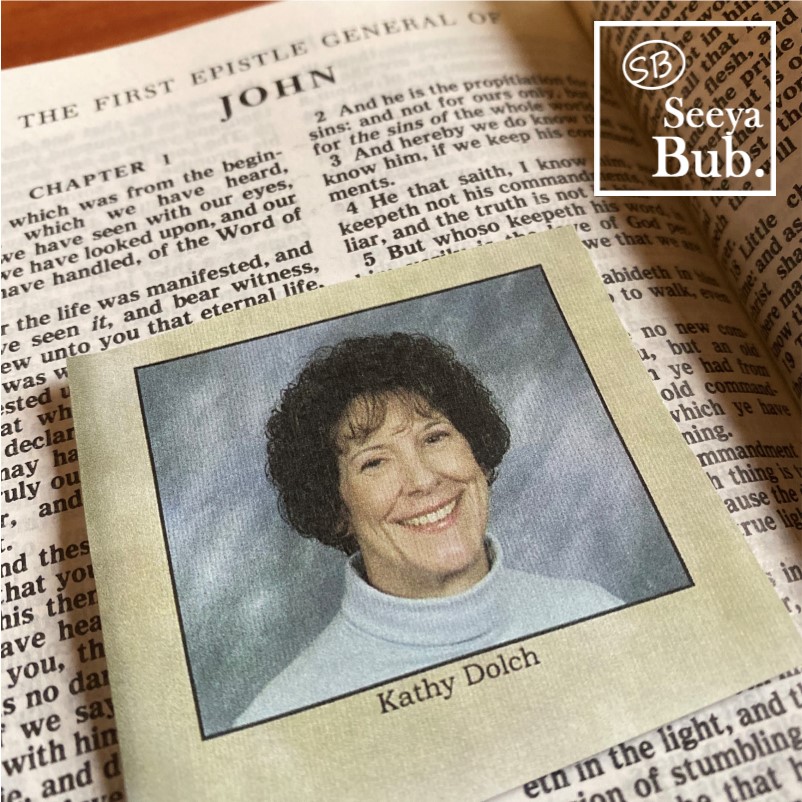
But a few evenings ago, I found someone better and more powerful than anything I’ve ever read before. I found Kathy Dolch.
While speaking at the inaugural Butler County Walk To Remember event, a woman sat next to me at a table near where I stood. As I talked, I could see the pain on her face, but I also sensed tremendous hope. A hope that can only come from someone who has seen the valley, scaled the mountain, and is ready to face life’s darkest moments head on.
After I finished speaking, Kathy made her way over to me, shook my hand, and then told me her story—a story that I was so privileged to hear from one of God’s most faithful servants. I knew, in that moment, that Kathy was put here in that moment, to help me understand the severe and unyielding pain my Dad must have been experiencing in the moments leading up to his death; but I also knew that God put her in front of me so she could have an opportunity to share her story with the world.
On that night, I invited Kathy to share her story of hurt, resilience, forgiveness, and love at Seeya Bub, and she accepted without hesitation. It is the honor of a lifetime for me to share her words with you now.
Kathy: In 2002 (seventeen years ago), my husband and I were planning to go out for dinner; but for some reason, my husband did not arrive home. I called his office, friends, emergency rooms and finally the police trying to find out where he was. No one had any answers, and the police would not do anything until midnight, telling me he would eventually call and finally come home. To my surprise, the police also suggested he was with another woman. It was a shock to think that could ever be true.
I was unable to eat dinner and also unable to sleep on that night. Finally, the police called at midnight and filed a missing person report for both Ohio and Indiana. After a painful and sleepless night, my husband called and left a message for me to return phone call. I was glad to know that he was okay, but worried about what he might say to me from the other end of the line.
I had no idea how earth-shattering his message to me on that day might be.
My husband told me he was not coming home and said that he had been with another woman for eight or nine months. He also encouraged me to see a psychiatrist. I ended the conversation quickly, unable to comprehend how the man I had been married to for decades could turn his back on our life together. He tried to call back, but I refused to answer the phone.
There was nothing he would be able to say to me on the other end of the line to prevent me from the only desperate path I could envision.
I put my dogs in their crates. I removed the gun from the dresser drawer and walked to the basement. The news my husband had given me left me no alternative—at least none that I could see through my heartache and pain. I did not want to suffer through the pain that my husband had inflicted upon me.
Holding the gun in my hand, I looked up and said “Father please let me be with you. Please take me home.” With what I thought would be my final words ever spoken, I shot myself in the right temple.
After he was unable to reach me and he began to grow suspicious about what I might have done, my husband called the police and told them I had received a little bad news on the phone. He asked if they would perform a welfare check to ensure I was safe, letting them know where the hide-a-key was hidden at our home. At the same time, my husband was in Indiana with the other woman and decided to drive back to our house with her.
After entering the home, the police found me clinging to life in our basement with a nearly-fatal gunshot wound. They immediately called the paramedics, who rushed me to the hospital.
I eventually arrived at the hospital, where I had surgery and remained in recovery for ten days. I do not remember any of that time. My entire memory is completely wiped clean because of the physical and emotional trauma of that moment.
My husband did not visit at all during those ten days. He did arrive to take me home once my recovery was complete, and he placed me in psychiatric therapy. The second week in psychiatric care, I was moved to lock down. My neighbor visited me, and I asked him to find a way for me to leave, as I desperately wanted to go home. My neighbor was told that I would have to sign myself out in order to be released, which I did the next day. On the day I was released, my neighbor drove me to the home that my husband and I had once lived in together—the same home where my life had almost ended as a result of my suicide attempt.
In the time that I was gone in recovery and recuperation, my husband had given my seven dogs to another home, and in that moment I knew that I was all alone. The house felt so empty, and I was alone with my thoughts and a mountain ahead of me that I knew I had to climb.
That mountain of recovery was not easy, but I committed myself to overcome the physical challenges that I was now facing. After the suicide attempt, I was diagnosed as legally blind. I have a hole in the back of each eye and all the direct vision cells and most of the optic nerve in my right eye were completely destroyed. I had surgery on the left eye a few weeks after the attempt to improve my vision. I went to the Cincinnati Academy for the Blind & Visually Impaired (CABVI) and was introduced to a large number of things to help me be more independent, and each and every day since then I’ve been working at this ever since.
The emotional hurdles were just as daunting. A few months after the incident, I was served divorce papers. I was completely shocked. The divorce proceedings were complicated and painful because of my husband’s self-centeredness. We spent an entire year in divorce court and after seemingly coming to an initial agreement, my husband tried to make many changes to the agreement in the final moments before the divorce was declared final—changes which would have left me in an even worse position than the one I was currently in.
Finally it was over. We have been back to court many times because my husband did not want to pay alimony. Unfortunately, my husband stopped paying alimony for a while just three years after my suicide attempt, and the bank foreclosed on my home and I lost the home. We had been married for thirty-one years, and it was hard to come to terms with how a man who said he had loved me and would take care of me could inflict so much pain upon me. In fact, in the aftermath of my suicide attempt, I learned that my husband had committed adultery throughout our entire marriage. None of this made sense with what I thought my marriage was and could be.
In that moment, trying to rebound from a suicide attempt, economic ruin, and a crumbled marriage, I knew that my only way to recover would be God. In the immediate aftermath of my suicide attempt, God talked to me one day and I heard that quiet, still voice say to me “Start attending Mass again, come home.”
I’m glad I listened.
I was given a ride to St. Francis de Sales by another member of the congregation. I walked up the stairs, opened the door, and having suffered unbelievable vision loss, I was so overjoyed that I was able to see the stained glass window in front of me. Standing in front of that window with tears, I heard chorus from all in heaven saying “Welcome home.”
I’ve been a member of St. Francis de Sales ever since coming home on that day, and now I am a member of the church prayer chain, a Lector, and an Extraordinary Minister of Holy Communion. My story is a painful one, but it is also a story of hope—God led me through one of the deepest, darkest valleys that has ever existed. He literally reached down His mighty hand and rescued me from the grips of death and my own despair, and I’ll never, ever stop loving him because He loved me at my weakest.
Throughout this experience, unfortunately, I felt I couldn’t trust anybody. My husband had lied to me for thirty-one years, and it left me in a place in which I felt like I could never trust anyone again. But God has shown me that there are still trustworthy, loving people in this broken world. I was amazed at how many people at CABVI wanted to help me cope with my blindness after the suicide attempt. My church has become my family, and they have given me such unbelievable support and encouragement. And everyone in heaven is my family. I know that those looking down on me will always love me, and feeling that love makes a huge difference.
But most importantly, knowing that God loves me has been my steady support since that awful day in 2002. Once I discovered I was alive after the attempt, my first words to my neighbor were “Even God doesn’t want me.” My life felt so hopeless, but after saying that to my neighbor, she simply responded, “Kathy, God does want you—just not yet.” I know that God has a purpose for my life, which is why he refused to let me die on that day. I pray for help all the time and I realize I should not have attempted to commit suicide. Even though I feel the pain of my suicide attempt and the vision and health issues it created, more than anything I feel the hope and love of God Almighty, whose love is everlasting in a world where too much pain exists.
Ty: On the night I first heard her story, I cried; and now, having read it many times in preparation for publication here, I find myself crying still.
I’m crying because, in her story, Kathy helps us understand just how desperate the world can seem to someone with a suicidal mind. To someone suffering from depression or any other mental illness, life’s obstacles (and life in general) can feel so overwhelming and painful that there seems to be no other escape but death. My heart breaks when I think about the hurt that Kathy must have felt when hearing about her husband’s infidelity. How alone Kathy must have felt in that moment. I am full of sorrow when I think about how isolated and hopeless Kathy must have felt if death seemed to be the only acceptable alternative.
But Kathy Dolch’s story, more than anything else, is a story of hope. Kathy’s story is not defined by her near-death experience, but by courage, determination, and sheer will she showed to survive and thrive in the years after. Kathy has not had an easy road at all. Imagine yourself in her shoes. As if surviving a life-threatening, self-inflicted gunshot wound isn’t enough, Kathy then had to learn how to live and function as a individual afflicted with blindness. She had to deal with the mental and spiritual anguish of unanswered questions, doubts, and guilt. And on top of all this, she had to make her journey towards recovery without her husband—a man who had pledged to stand by her side through sickness and in health, but had instead chose adultery.
Make no mistake though—Kathy was never, never alone. All throughout her recovery walk, Kathy was walking arm in arm with our Lord and Savior, Jesus Christ. Kathy had the power of the God who has known her since before she took her first breath, and in her most critical moment for reasons we may never know on this side of Eternity, God refused to let death win. I’m thankful for His grace in watching over Kathy, even when she felt like there was no one there to support her.
On the night I met Kathy, I told her that God had kept her on this planet for a reason, and I really believe that that reason is to share her story with those who are hurting. In my conversations with Kathy, I could tell how remorseful she was for what happened on that fateful day when her life almost ended; but more than anything, I was inspired by Kathy’s hope and resiliency. I commend Kathy for so many things, and I am so proud of her for sharing her story here.
After reading Kathy’s story, it’s only logical for you to feel more empathetic for those who are hurting and struggling with mental illness. Our world is broken, and the difficulties of this life can take quite a toll on our mental health and well-being. Kathy’s story is a heartbreaking example of a how a life well-lived can be attacked by sin. Her story shows how powerful and real suicidal temptations and ideations can truly be. Kathy had lived her life well and, by all accounts, had lived a life that bears many resemblances to me and you; which should be a warning that suicide isn’t just an epidemic that affects individuals on the fringes of society. Unfortunately, suicide isn’t an irregular incident; it’s an all-too-regular occurrence happening to all-too-regular friends, families, neighbors, and others that we love.
Kathy’s story has helped to give me perspective about how my Dad—a man who loved life—was driven to death by such tragic and avoidable means. In sharing her painful story, Kathy has helped me see how life circumstances coupled with mental distortions and drive someone, like my Father, to feel full of desperation.
But in her remorse, Kathy speaks directly to those individuals who may be reading and contemplating suicide themselves. When the dust settled, and to this day, Kathy felt extreme regret and wished to live. I imagine that every individual who dies from suicide, in their final moments, regrets the decision.
Finally, and maybe most importantly, I believe Kathy’s story is a reminder of the value of life and our actions towards our fellow man and woman. Don’t get me wrong—suicide is never, never anyone’s fault. It is always the fault of mental illness. However, it’s easy to see in Kathy’s story how the selfish, hateful actions of her husband led her down a path towards suicide. Each and every day, we all have an opportunity to either build people up or tear them down with our words and actions; on this particular day, and on all the days that he committed adultery, this individual chose to destroy rather than encourage. If we want to build a world where suicide and mental illness are eradicated, kindness and decency towards our fellow man and woman is the ultimate foundation.
Kathy has shown all of us kindness by sharing her story so powerfully. I’m proud of her for sharing, and Kathy, all of us are proud of you for overcoming this tragedy and living a life defined by courage.
 Dad, For so long, I’ve tried to understand the level of despair you were feeling in the moment that your life ended. For the longest time, I wasn’t able to empathize with your pain. But individuals like Kathy have come into my life since losing you and have helped me gain that level of empathy. Dad, I am so sorry that you were hurting for so long. I’m so sorry that I wasn’t more forgiving in the times when you were hurting. I wish we had been able to help you find the healing that you needed and that you deserved. Dad, you had so much more to accomplish in this life. You had so many talents to contribute, and so many people left to love. I don’t know that I’ll ever understand how someone with such an unbelievable level of kindness, skill, and grace could feel as helpless as you did. But Dad, I promise to you that you will never be defined by your death. I will do everything I can to make sure that people remember you for the vivid life you lived, and I’ll make sure that your death (like Kathy’s story) gives people a hopeful reminder that life is worth living. Dad, thank you for equipping me with the courage to face life head-on in the aftermath of your death. It’s amazing to think that you were always teaching me the skills I would eventually need to deal with life after you. I’ll never stop learning from you, and I can’t wait to thank you for always giving me that inspiration. Until the day when I see your face again, seeya Bub.
“And so we know and rely on the love God has for us. God is love. Whoever lives in love lives in God, and God in them.” 1 John 4:16 (NIV)
 Kathy Dolch
Kathy Dolch is a survivor of suicide, having overcome a self-inflicted gunshot wound in 2002 which rendered her legally blind. Kathy is a member of St. Francis de Sales Church where she serves as a member of the church prayer chain, a Lector, and an Extraordinary Minister of Holy Communion. Kathy was a middle school math teacher for five years, having earned her Bachelor of Science in Mathematics Education from State of University of New York Oneonta. Kathy showed cairn terriers in the United States and Canada for obedience and confirmation prior to her suicide attempt. Kathy is now a resident of Lebanon, Ohio.

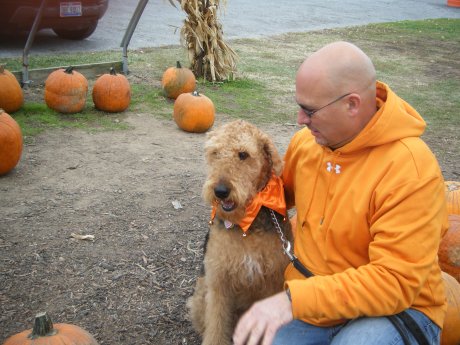
 Most nights, Lucy would make her way into my room, usually at just the right moment. She would push the door open with her snout, tail wagging feverishly, and climb up onto the bed. After arriving, Lucy would place a paw on either side of my shoulders and lick my face until I begged her to stop. A twin mattress doesn’t provide much room for a grown man and a 70-pound dog, but Lucy made a way. She would curl up alongside me and lay her head across my chest. And in those moments, even though she was a dog and might not have understood human emotions, Lucy soothed my heart in ways I’ll never be able to describe.
 Lucy also helped soothe my pain because of the fact that
  It was that puppy companionship, along with many other wonderful people and things, that helped me heal and grieve my Dad properly. I had so many wonderful people who knew exactly how to minister to me after losing Dad—my Mom, my grandparents, my church family, my friends, my coworkers, my neighbors, and even complete strangers. I also found little things I could do to help me grieve for Dad properly—things to help me forget about the pain of losing him. I read my Bible frequently in my study. I wrote feverishly—some of those scrawlings eventually turning into the foundations of this project. I exercised frequently, although the Ryan Gosling physique (or anything
  remotely close) still eluded me.
 On other days, I would let Lucy hop up into the passenger seat of my car and we would take a drive together. Lucy really enjoyed driving around town, and her excitement created smiles and laughter in neighboring vehicles as she sat calmly next to me in the car with her seatbelt on. I would make a conscious effort to go through drive-thrus with Lucy to show her off to anyone who would remark about what a cute pup she was. She was cute—she deserved the adoration!
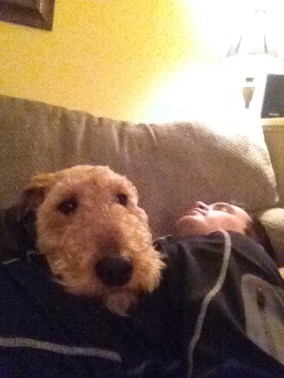 It’s hard to describe, but in those moments, Lucy would nervously saunter up to my side when she knew I was hurting. It was like she understood that she needed to be by my side. And that’s what she would do. She would hop on the couch and lay her head in my lap. She would leave all her toys (and boy did she love toys) to just lay near me. I would gently pat her head or her back, and slowly, her presence would help me escape from that immediate terror. She did more for me in those moments than I could ever tell her. Lucy showed me what it meant to be “man’s best friend.”
 That sadness would often give way to anger. Lucy’s death was completely avoidable and unnecessary. A groomer that we had trusted—a groomer who knew the despair of our family situation—had cared so little about our family and our pet that he let her die as a result of his negligence. As you might imagine, the story of Lucy’s death attracted the attention of a local news station.
  I bought a pound of the licorice dogs (and a few other goodies, of course), and the second Paige and I got into the truck, I opened the bags and started chowing down. I tasted the licorice, and it brought back all the memories of Lucy and how funny it was to watch her eat licorice. I began recounting the story to Paige, and before I knew it, I was flashing back to the moment I lost her. All of the sadness and despair of her death was as real then as it was on the day I lost her—all because of a piece of licorice that reminded me of her.
 On occasion, I’ll put on that
  Dad, I need to tell you that I’m sorry and that I’m thankful. I’m sorry that I acted so stubborn when you chose to bring Lucy into our family. I’m sorry that I acted like a “little jerk” (your words…and mine) when you were just doing what was best for us. Ultimately, I’m so grateful that you chose Lucy. I’m grateful that you raised her and trained her and taught her to be a fun, family dog. We had no idea how much we were going to need her fun-loving, thoughtful companionship after losing her. In a way, I feel like Lucy carried on so many of your personality traits after you were gone. She was a constant reminder of the zest and excitement you had for life. She was there to help us grieve in so many ways after you left us. I think Lucy was your angel here on Earth for us. I think that she was your way of telling us that life, even when it’s painful, can still have a lot of joy and happiness. Losing her was like losing you all over again. It was as if another piece of you—a very important piece—was gone forever. But Dad, I know that we will never lose you entirely. Your memory will always live on in our hearts and in our minds because you made such an indelible mark on all of us. Dad, thank you for Lucy. Thank you for teaching her to love us when we needed it most. Although I miss you both dearly, I hope that you are together again in heaven—and I hope there are plenty of Frisbees to toss. You deserve paradise, Dad. You deserve the greatest things that God can offer, and I can’t wait to experience that joy alongside you. Until that day where you and I are together again in a life that knows no end, seeya Bub.
 Dad, There have been so many times when I’ve thought about the fear you must have experienced in your life. You were always my Superman—that strong rock and foundation in my life when everything else seemed dangerous. On the outside, you were always “Mr. Fix It,” and I know it bothered you that you couldn’t solve your own struggles with depression. On the surface, you always held everything together—for your family, for your friends, and especially for Mom and I. But Dad, I wish I could have told you that your struggles with mental illness were never a disappointment to any of us. We never thought less of you when you battled with your depression. Sick or healthy, we always loved you and wanted to be near you. You were never a failure to us, Dad. You never failed us, and I wish you had known that more. I am afraid of doing life without you. I have a fear that I can’t do what God is calling me to do to tell your story. But I know that He is with me, and I know that you are with me. I know that you are watching down and pushing me and urging me onward, just as you always did when you were here with us. We all miss you, Dad. We will never stop missing you. You never let me down, and I can’t wait to tell you that in person. Until that day, seeya Bub.
 Reverend Dan Walters
 Dad, There have been so many days when life has seemed unlivable without you in it. There have been moments when I’ve completely collapsed under the weight of my own worry and troubles, and I wish more than anything that you were here to encourage me in those moments of doubt and frustration. But in a sense, you are here with me. The lessons you taught me throughout my life were always lessons of empowerment. You taught me that I am always stronger than I think I am, and that when I am weak God is strong. You also showed me that it’s okay to have feelings and emotions and that I can express those when I feel them. You showed such bravery in your life, and I hate that in your final moments you doubted your own courage. Dad, you were the most courageous man I’ve ever known. You fought so hard for so long, and I’m glad you’re not fighting anymore because that enemy that you faced is defeated once and for all. I’m so thankful that you are completely at peace, completely healed, and completely perfected in God’s love and image. Dad, you deserve eternal rest in paradise (hopefully free of snakes), but boy do I wish you were still here with me to help me in this imperfect world. Keep giving me that courage when I need it most. And until I can thank you in person, seeya Bub.
  Seeya Bub