
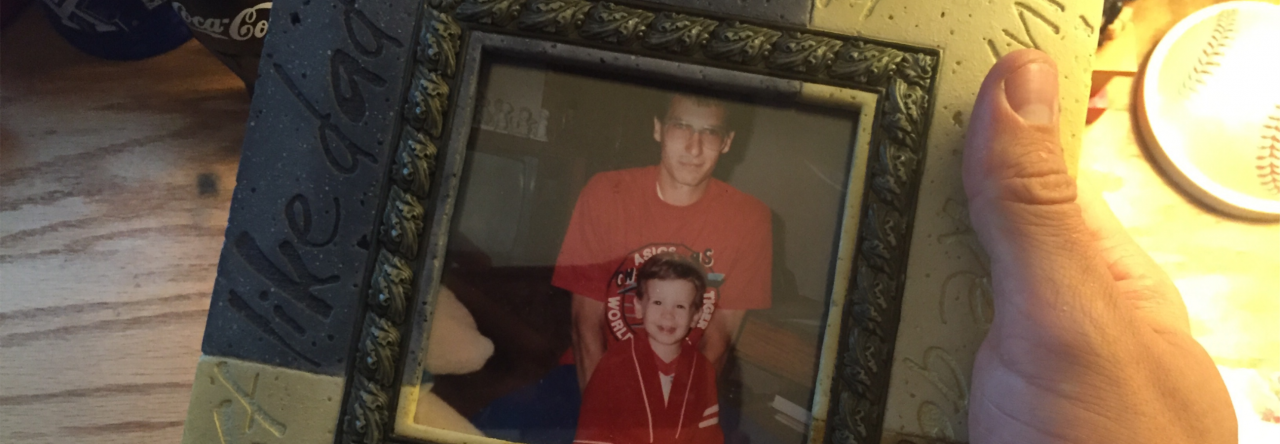

“I’ve spent my whole life building up this ivory tower, and now that I’m in it I keep wishing it would fall.” (Josh Gracin, “I Want to Live”)
Five years. Five long, sometimes-painful, seemingly-redemptive years.
It’s been five years—to the day, in fact—since I lost my Dad. 1,827 days full of a multitude of different emotions that I often can’t explain. Five years of heartache balanced by little victories all along the way. Five years of wondering what could have been had July 24, 2013 not happened. In those five years, a lot has happened; and a lot hasn’t happened because my Dad wasn’t here to make it so. I’ll always wish I could turn back the clock and change it.
 Every single day is difficult—all 1,827 of them; but every single year, July 24 is a date that stares at me from the calendar. It looms in the distance for months, and when it passes, I always breathe a sigh of relief that it’s come and gone. But I know, deep down, that it’s coming again. It will always be there. No particular July 24 has been more or less difficult—just different. But because of the nice, round number, this one feels like a milestone. A milestone I wish I didn’t have to reach.
And, likely incoherently, I’d like to share a bit of my heart with you today.
For this post, I’m doing something that I don’t often do when it comes to writing my story at Seeya Bub, I’m actually writing this story less than 24 hours before I’ll publish it. Those of you who read regularly know that I’m a verbose, wordy guy (this one might be a record). I hope it also shows through that I spend a lot of time on these posts. I do this not out of an effort to impress people who read. I do this because it’s a labor of love for my Dad. I enjoy sitting down and writing for hours at a desk because keeping my Dad’s memory alive is the least I can do to repay him for all the wonderful things he did for me. That being said, I often start working on posts weeks before they’re due. One post could be the end result of 1-2 months worth of thinking, writing, producing, editing, re-writing, editing again, and second-guessing. I try to write weeks (if not months) removed from the publication date so I don’t feel rushed to share my Dad’s story. His story is too important to write about carelessly. I usually don’t have trouble getting motivated to write. After all, I’m doing this for my Dad. What more motivation could I need or possibly want?
Today’s post is different. It’s hard for me to admit this to you, but I’ve been putting this one off for a while, and I’m struggling to tell you why. It wasn’t a surprise. I map my posts out months in advance, knowing what I’m going to write and when I’m going to write it. Sometimes it changes on the fly, but I knew this never would. When I turned the page to the month of July in my planner, I knew that I’d be publishing today. I didn’t know the message, but I knew the title of the post would be “Five Years.” It’s not like this snuck up on me.
Below the surface, I know the reasons why I’ve waited. I’ve been trying not to write this post because I simply didn’t want this date to come. I didn’t ever want to reach a point in my life where I defined time by losing someone I loved, and I definitely didn’t want those moments to turn into ever-increasing numbers. Subconsciously, I’ve been telling myself if I didn’t write this post, I wouldn’t have to deal with the grief of losing my Dad.
 But guess what? No amount of procrastination could stop that date from coming. No amount of denial could stop me from thinking about what this day represents. This day would come—and yes, it would eventually pass—but the second it did, the clock just begin counting down towards another unfortunate milestone. The next Christmas. The next birthday. The next Father’s Day.
Time is relentless. It is unforgiving and cruel and unabating.
And then, ironically, time also heals. Never fully, and never without first inflicting severe pain, but it does heal partially. Time builds up scars to help us avoid certain elements of the pain we feel, but the scars are always there. We stare at them. We obsess over them. And yes, we feel them.
This has been my life after losing my Father to suicide. A life full of complexity—feeling everything, and at the same time feeling nothing. Wanting time to stop one moment, and then wanting it to speed up the next. Even though I try to do it through writing, it oftentimes feels impossible for me to explain my grief. But in this post, I want to tell you how I feel—honestly, authentically, and without much polishing. I want to tell you about some of the feelings I’ve felt over the past five years. Unlike how I usually write, I don’t have a central theme or focus for this post, other than giving you some insight into what the emotional experience has been like for me. I just want you to know what I’m feeling—mainly because I wish I had known more of how my Dad was feeling.
It’s important that we talk about our feelings, even if there isn’t any other point in doing it than to lift the burdens they have on our lives. I’ve felt a lot of different things over these five years. And more than anything, I just want you to know that although time might change some feelings, there is one that will never change; and that is the unconditional love that I feel for my Father.
I feel shock. At least every day, although at different points throughout the day, I have to face the truth of my Dad’s death. At some point every single day, I have to tell myself, “He’s gone.”
I hate facing that moment head on. I absolutely hate it, but I live with it. And I know I have to do it.
In the immediate aftermath of Dad’s death, this happened almost instantaneously every morning. I would wake up, and the first thing I would think about is the fact that Dad had died. “Dad’s dead,” I would hear over and over again in my head, almost like someone was taunting me. My mind would lock in and obsess over this. It was hard to let that thought go—or maybe it’s hard to get that thought to let go of me. Some days it never did.
Time wears on. And some years down the road, it was still the first thought I had. But on other days, it would sneak up on me. On those other days, I might go for an entire hour before the thought of Dad’s death would cross into my mind.
And I’ll admit that this made me feel unbelievably guilty.
On those days when I was able to live for an entire hour or two and not think about Dad’s death, I felt guilty because there was something inside of me telling me I needed to obsess over it. There was an evil voice inside my head saying “See, he’s only been gone for a few months and you’re already forgetting about him. You’re pathetic.” Unfortunately, I started to believe that voice. How was it possible that I could go for a period of hours without thinking about the man who had given me so much? I knew that I shouldn’t beat myself up over this—that not obsessing over his death was not a reflection of my love for my Father. But our feelings are often very difficult to interpret, and sometimes we listen to the voices we shouldn’t. For a long time, I let that guilt eat me alive. And some days, I’m still living it.
There’s only one type of day that’s worse than this one, however. It’s the days when the shock and truth of Dad’s death completely blindsides me. Five years removed from his death, there will be the occasional day where the busyness of my life distracts me from the reality of Dad’s death. But then, something great will happen. And I’ll reach into my phone, pull it out, and go to dial Dad’s number.
And when it hits me that he’s gone, I completely crumble.
I beat myself up for not thinking of him earlier. I accuse myself of being so focused on myself that I can’t focus on others. I feel guilty and horrible, as if not thinking of my Dad’s death is a sign that his life didn’t matter. I tell myself that I’m not living life the way I should, that somehow I’m not “grieving enough,” as if that were even a thing. I dwell in the self-doubt and accusatory guilt that keeps me from being the man I know God wants me to be.
Eventually, I escape from that prison; but even five years removed from Dad’s death, I still have a really hard time coming to terms with the fact that I am a survivor of a family suicide. Before losing Dad, suicide was always something that happened to other people. Not me, not us. My family was “normal.” My family was “perfect.” My family was the American Dream. Suicide and mental illness couldn’t touch my family.
But it did. And I am one of those people left behind in the aftermath. And no amount of denial will ever change that fact. I still have a hard time telling people that my Dad was a victim of suicide because I don’t know how they will react. I know how judgmental I would have been when receiving that kind of news prior to my Dad’s death, and I don’t want those folks to make false and unfair assumptions about the man he was.
I am staring suicide and my Dad’s death in the face every single day. Some days I deal with it better than others. Some days I don’t deal with it well at all and I have to completely disconnect and disengage. But it’s always there—hovering overhead, continuing to send shockwaves through my system. I wonder if that shock will ever fade entirely.
I feel terror. I’m yelling, even though the rest of the house is quiet.
It’s happened again.
I roll over and look at the time on the clock. 3:26 AM. This was a particular night, but it could have been any night. I know that I’ve just been yelling—likely something inaudible. I’m in a cold sweat, but my face is wet from tears, not perspiration. I can feel how tense my body is, and my limbs are shaking. It’s happened again. I’ve just had to relive everything.
I didn’t want to. In fact, I never want to relive the pain of that day again. But in my dreams, the same memory often invades me. The flashback and vivid memories of the day I lost my Dad.
It’s those dreams—nightmares really—that you wish would never occur which often plague you most frequently. The day I lost my Dad was the most consequential day of my entire life to this point. Horrible? Yes. But also consequential? Unfortunately.
I don’t ever think I’ll stop seeing it, reliving it, and experiencing it in my head—no matter how hard I try.
Honestly, it’s happened less and less over time. When Dad first died, I was waking up in the middle of the night on a fairly regular basis. I was worried that I might never get another full night of rest ever again, because those early nights were so painful.
As farfetched as some dreams can be, it’s amazing how lifelike others are. They can throw you in the midst of a sensory whirlwind that places you back into a particular moment in time. Dreams of my Father have often been like this. I hate to say that I rarely have dreams about all the great times we shared together. Instead, the dream I experience most often is the dream of that horrible day.
When I have this dream, my stomach still turns just like it did on that morning when I heard the news that there’d been an accident involving my Dad. I can feel things and hear things and smell things that don’t even matter to the end result of the story, but I experience them nonetheless. But it’s that horrific 20-second vignette that constantly replays in my mind. I can see my Grandpa walking out of the house. I can feel his strong arms pull my Mom and I into a hug as my Mom sobs. I can hear my Grandpa’s breaking voice when he looks at us, hopelessly, and says “He’s gone.” For as long as I live, I’ll never be able to escape the sound of my Mother’s anguished scream. I feel myself falling to the ground in the front yard, and I feel that familiar sensation of being thrown into the depths of a deep ocean and sinking under the weight of the waves. I can sense a feeling of evil hovering above me. And in my dreams, I feel this all again—just as strongly as I did on the day it happened.
Some memories fade after five years—and the ones you want to fade often don’t.
On this particular night, I rest on the edge of my bed, closing and squinting my eyes so hard, trying to shut out the memory and the pain of that experience. I grab my ears, trying to get the sound of my Mother’s cry to stop. It’s like I’m trying to physically shake this memory free from my consciousness.
But I can’t. At least not immediately.
Before I know it, I’m in a completely inconsolable position and unable to control my own physical movements. I know why this memory continues to haunt me. I know that the trauma of this life-altering experience has burned and branded the sights and sounds of that moment onto my brain forever. Painfully, I know that I’ll always experience these moments to a certain extent.
But I just want it to stop. I don’t ever want to forget my Dad, but I want to forget the moment I lost him. I want to be able to escape the pain this moment causes me, but I wonder if I could ever escape it without forgetting how much I loved my Dad. I’m sure there will be a day at some point in my life when the flashback of losing him is easier to manage. But it won’t make that memory any less intense. It won’t make that memory any less severe. It will just be different. I know I’ll feel different at some point, but on a night like this one, I feel scared. Scared by the ghosts of a past image continuously haunting me, and scared by when the flashback might occur again.
I feel exhausted. “I’m sorry man,” I type. “I know we had plans, but I just don’t think I can do it tonight.”
I can’t even begin to think how many times I had to send this message to friends and family members and coworkers in the aftermath of Dad’s death. Especially after Dad died, there were many people—well-intentioned people—who tried to get me out of the house. They wanted me to get out and do things to try and get my mind off of losing my Dad, and I’ll always appreciate those moments of normalcy I had with them after losing Dad.
But there were some days—many days—when I just couldn’t. My grief kept me in bed. My grief kept me locked in the house, unwilling to face the world around me. My grief kept me disconnected and wrapped within my own darkness.
There were some days when I just couldn’t go to work, because everything at work felt so trivial in the aftermath of losing my Dad to suicide. I would actually grow angry towards my job—a job I loved—because it felt like nothing else mattered anymore. It was weird to, for the first time, feel a lack of desire and passion for my work. I had never experienced this before, and I wondered if I’d ever find pleasure and satisfaction in any activity that didn’t involve grieving my Dad’s death.
Social activities felt that way, too. I knew that my Dad’s death had taught me the need to love those in the world around me, but I just couldn’t bring myself to put that into action. It felt like I should be doing something more important, even if I didn’t know what that “something more important” should have been.
Those nights when I would bail on plans were usually very difficult and isolating. I would lock myself in the house with blinds drawn and lights dimmed, and I would wallow in the grief I felt. I wouldn’t eat, and I’d retreat to sleeping hours and hours on end.
Some of the nights when I did go out, however, were just as bad. It sounds insane to say this, but I often felt like I was wearing this sign around my neck everywhere I went that read “My Dad Died from Suicide.” It was like everyone was staring at me, even though they weren’t. It was like I was the center of attention for all the wrong reasons. I’ve never been claustrophobic, but if there’s such a thing as social claustrophobia, I felt it then.
And there are many days, even five years down the road, when I still have to scrap what’s planned to deal with unplanned grief. I’m learning to be okay with it. I’m learning that grief, just like mental illness, is unplanned and impossible to predict. Unfortunately, I finally understood what it meant for grief to take a physical toll on someone. It sapped and eroded every ounce of energy I had.
If I stayed at home, I was emotionally exhausted. And if I went out, I was emotionally exhausted. It felt like, no matter what I did, I was going to be perpetually worn out from my grief. I worried that it would never end, and to a certain extent, it hasn’t. These days are fewer and far between, but when they occur, it’s like I’m right back where it all started.
I feel angry. “Okay. I’ll be praying for you. And if there’s anything I can do for you or your family, please make sure you let me know.”
I end the phone call with undeniable sorrow. A phone call I’ve had all too often since losing Dad.
It’s a phone call with another individual who has just lost someone they love to suicide.
When I started speaking and writing publicly about my Dad’s death, I had two overarching goals: (1) to try and prevent suicide from happening to anyone else, and (2) to minister to people who are affected by suicide in the scenario that we can’t prevent it. I knew that part of my ministry would be to do something that makes me completely uncomfortable. I would need to talk with people who are grieving and distraught and try to help them make sense of their new world, their new and darkened reality. Prior to losing Dad, I didn’t even like to attend funerals because of how uncomfortable they made me. Now, I wasn’t just watching the storm from the shore; I was driving straight into it. I was saying that I would walk alongside people in their grief, no matter how uncomfortable it made me.
I’ve learned how to be more compassionate. And I’ve learned how to identify with the sorrow of others by feeling it myself. But shortly after that sorrow begins to fade, I get angry.
Not at my Dad. Never at my Dad. In fact, I can say with 100% certainty that I’ve never once been mad at my Dad. I’ve never once held him responsible for his death. My Dad was a victim of suicide, and that’s more than just fancy phrasing. My Dad was attacked by a mental illness—depression. Had he died from cancer, I wouldn’t be made at my Dad. I’d be mad at the cancer. Or I’d be mad at the heart attack. Or whatever other illness might have taken him away. Not at him—and I can’t be mad at him in this scenario either. Yes, my Dad died from suicide; but the root cause was depression. In his right mind, my Dad would have never left us. He wanted to be here to love us, and I firmly believe that. An illness warped his mind into thinking he didn’t matter.
But I do get mad at other things. I get mad at a society and culture that portrays mental illness as a personal weakness. I get mad at a culture that says that to seek help in the form of counseling or treatment is a sign of weakness. I get mad at the culture of comparison that we’ve created that says we must do more, be more, and earn more to matter, when God tells us that none of these things are actually important. I get mad at the unfair pressures that were put on my Dad and everyone else impacted by suicide. And yes, I even get mad at individuals who, I think, contributed to my Dad’s death by putting unfair pressures on him. But more than anything, I get mad at a disease that we can’t seem to figure out. I get mad because I have questions. I get angry because I want to drive down the rates of suicide in our country, and because I know that there is more we can do.
I feel angry because I feel like I’ve been robbed. I’ve told this to God many, many times. He knows how I feel, so why would I ever try to hide those feelings from him? I feel like my happiness was stolen from me on July 24, 2013, even though I’ve been able to experience it in the aftermath of losing him. I feel like a thief came and stole away the promises of all the wonderful things that were to come in my Dad’s life and life of our family. It was completely unnecessary that my Dad was gone so soon, and I feel angry that we didn’t get to have the moments together that we should have had.
As much as I hate feeling this anger, I know that it motivates me. I know that it pushes me do more to try and prevent this story from replicating itself throughout my community. I don’t care to spend hours on the phone talking to people or meeting with them for dinner when they’ve been hurt just like we have. That anger towards my enemy—mental illness—is unrelenting, but I’m channeling it into something that I hope will help others who are hurting.
But I’ve never been angry at my Dad. And I know I never will be.
Even after feeling all of this, I still feel redeemed. “Wow, I had no idea that Dad did that…” I find myself saying this all the time, because I find myself learning new things about him. The fact that I can smile while hearing these stories, even if I might simultaneously shed a tear or two, is a sign that God is guiding his hand over the ashes of my life to bring something good out of it.
It’s strange to say that I feel hopeful, because there were moments after my Dad died when I never thought I’d be hopeful about anything ever again. Those moments when life felt empty could be paralyzing.
And then, a little victory would occur. And I would start to see the redemptive power of God’s love and his work.
There were moments when I would talk with people and they would tell me a story about something my Dad had done to positively shape their lives. People he had talked to—and boy, did he talk to a lot of them. Money he had given to help people when they were down on their luck. Money he had given to causes simply because he was charitable. Tools he had lent, knowing that he would never get them back. Things he had repaired for people even when he had no idea how to repair them until he got in the thick of the job.
I’m ashamed to say this, but it took my Dad’s death for me to learn about him because there were so many good things that he did which he would have never wanted credit for. And when I hear these new stories about my Dad, it’s like he’s still alive. When I learn new things about him, it’s like new life is breathed into his memory.
Sometimes, the victories have been seemingly insignificant; but to me, they’ve held tremendous power. There was the time I went into one of my Dad’s favorite restaurants for the first time without losing him. I was actually able to focus on the great memories we had shared there together rather than obsessing over losing him. Moments when I could drive by his work without breaking down. Times when I could see his writing or go to a softball game and think positively about his life.
Those little victories began to build—one after the next, one on top of the other.
It showed me that God has been working.
Don’t get me wrong—I’ve still got lots of questions for God that I plan to ask him. Why did this happen? Why did it happen to my Dad? Why did it happen to us and our family?
In spite of all my questions, I know this. I know that God didn’t cause this pain, but I do know that He’s building up the broken pieces of my life. I know that he’s bringing lots of people into my life who each take up a mantle of my Dad’s role in my life. He’ll never be replaced, but different people can live out some of his best qualities. I’ll latch onto those people, and I’ll cling closer to Jesus Christ. I’ll listen to His direction, and I’ll celebrate in the calm or in the storm. But as hard as it is for me to celebrate in the midst of a bad situation, I’ll keep searching for those little victories. Dad would have wanted it that way.
I hate this post. I hate it because it’s messy and unfocused and at times confusing.
Which is exactly why I’m leaving it the way it is. The control-freak inside of me who wants order and perfection wants to change it, but I’m letting that go. I’m letting that go because that’s the way our feelings work. Feelings are messy. Feelings are hard to control. Feelings are difficult to interpret and almost impossible to manufacture. Feelings are complicated and sometimes competing, conflicting, and contradictory.
But our feelings are real. And even when they are irrational, they are still very real.
I also hate this post because I could have written for twenty more pages about hundreds of other feelings and still never finish. I used to be a believe that we could classify or typify grief into stages; but now that I’ve had to experience it and live it, I know how fruitless any attempt is. Five stages to grief, you say? It’s not that simple. Sometimes, I experience all fives stages in twenty minutes. On any given day, I feel a hundred different feelings, and they are impossible to escape.
And all of these feelings—every single one of them—are rooted in a deep and never-failing love for my Dad. I can’t even begin to quantify how much I’ve missed him over these past five years. At Christmas, I miss being around the tree with him opening gifts. I miss having dinner with him in the evenings around our family dinner table. I miss watching him get excited about UFC fights and making fun of him for actually liking to watch them. I miss going to Kings Island with him and hearing his familiar scream of “Yeehaw!” as we rode each and every ride in the park. I miss sitting on the couch and watching episodes of The Office with him. I really, really miss those little moments.
I miss the big moments as well. There is no phrase that will capture how much I missed him on the day I proposed to Paige. I can’t even type that sentence without wanting to break down entirely. Gosh, he should have been there. He would have wanted to be there. He would have been smiling from ear to ear and talking about how Paige was too good for me (and he would have been absolutely correct). I think about how much he and Paige would have loved each other, and it bothers me every single day that I never got to introduce them. He would have loved having a daughter, and she would have been the perfect one for him.
I missed him when I graduated with my Master’s degree from Miami. My entire family was there, and it was wonderful—but I couldn’t help but gaze back in the bleachers at Yager Stadium in Oxford to see a gaping hole right next to my Mom where he should have been. I know she felt it too. Throughout all of those festivities, it hurt not having my Dad there. He was always so proud of the work I did in school from the time I was little. It made me believe I could do anything. I miss that reassurance from him.
And I obsess over the moments to come that I know he won’t be around to enjoy. For any of you who knew my Dad, you know that this is the understatement of the century: He would have made an amazing Grandpa. He was already bald and silly and loved naps—which is like half of what you need to make a great Grandpa! But my Dad loved children, primarily because he never let his inner child die. I often think about what it’s going to be like when I have children of my own. I’ll tell them about their Grandpa, but I don’t know that I’ll ever be able to paint an accurate portrait of the man he was. I hope they’ll love his memory as much as I loved him. But it’s unfair, because they deserved him. And he deserved them.
I feel love. And loss. And despair. And temporary relief. And sadness. And anger. And shock.
But all of these feelings—the good and the bad—are rooted in love. Five years have passed, and I love my Dad more and more each day. All these feelings may come and go randomly, but a consistent foundation of love has helped me face these five years one day at a time. And it will help me to face the 50 or 60 or 70 years still to come.
As daunting as the idea of facing that grief might be, it’s what is awaiting me on the other side of that gulf that gives me hope.
 On the other side of all that grief and sadness, there will be an everlasting love made whole again. On the other side of that grief, there will be a man whom I recognize, smiling and welcoming me into his arms. In that moment, I’ll love never having to say “seeya, Bub” again. That day is coming, although it’s very far off.
Five years. 1,827 days. Each new day different from the last. Each day a little darker without my Dad’s bright smile and engaging charisma. He. Is. Missed. Each and every moment. And in every moment, he is loved. By me, by my family, and by everyone in the world around him that he made better.
I constantly remind myself that, although I’ve had five years of life without my Dad, I had 26 years of unconditional love that inspired a foundation that will live on forever. And Dad spent 50 wonderful years living and loving those around him in ways we should all strive to do. Sure, it wasn’t enough. Sure, there should have been more. But my Dad made a big impact in his 50 years—an impact that some people who live double the age aren’t able to make. His impact lives on in me, and I know it will live on in our world forever.
I’ve survived these five years, and I’ll survive how ever many more come my way. I’ll fight for life because of what waits on the other side of Eternity.
And no matter how long that fight is, I’ll always love my Dad.
 Dad, I cry so much when I think that it’s been five years since you and I last talked. Sometimes, those tears are unstoppable. We never even went five days in this life without talking to one another. Dad, it really has felt like an eternity—but sometimes your memory is so real and so vivid that it seems like it was just yesterday when we lost you. But I know the real time. I know that it’s been five whole years since we’ve been able to be in your presence. And life simply isn’t the same without you. We all cling to your memory. We marvel at the things you built and the way you provided for our family. We laugh about the funny things you did to make life more fun. But I also weep when I think about how much life you had left to live. Dad, I’m so sorry that you were sick. I feel horrible that we couldn’t do more to help you find the cure you deserved. I’m sorry that you were robbed of the life you deserved to enjoy. I’ve felt so much guilt in losing you Dad. I know that you don’t want me to feel this way, but I just wish there was more I could have done. You deserved that, Dad. You deserved more, because you gave everything. As painful as these five years have been, Dad, I find peace in the truth of Eternity. I find comfort knowing that you are enjoying God’s eternal glory in a paradise that I can’t even begin to fathom. Dad, thank you for watching over me for these past five years. Thank you for never giving up on me—both in this life, and in the next. Thank you for giving me a lifetime of memories and an example of what fatherhood should be. I love you, Dad. I always did, and I always will. Thank you for loving me back. Until I see you again, seeya Bub.
“I give them eternal life, and they shall never perish; no one will snatch them out of my hand. My Father, who has given them to me, is greater than all; no one can snatch them out of my Father’s hand. I and the Father are one.” John 10:28-30 (NIV)

 Dad, There have been so many times when I’ve thought about the fear you must have experienced in your life. You were always my Superman—that strong rock and foundation in my life when everything else seemed dangerous. On the outside, you were always “Mr. Fix It,” and I know it bothered you that you couldn’t solve your own struggles with depression. On the surface, you always held everything together—for your family, for your friends, and especially for Mom and I. But Dad, I wish I could have told you that your struggles with mental illness were never a disappointment to any of us. We never thought less of you when you battled with your depression. Sick or healthy, we always loved you and wanted to be near you. You were never a failure to us, Dad. You never failed us, and I wish you had known that more. I am afraid of doing life without you. I have a fear that I can’t do what God is calling me to do to tell your story. But I know that He is with me, and I know that you are with me. I know that you are watching down and pushing me and urging me onward, just as you always did when you were here with us. We all miss you, Dad. We will never stop missing you. You never let me down, and I can’t wait to tell you that in person. Until that day, seeya Bub.
 Reverend Dan Walters
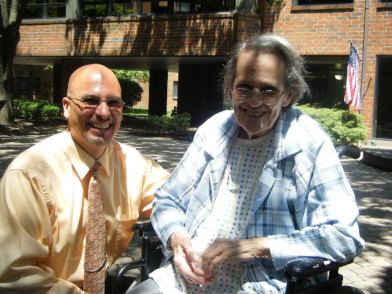
 And my Dad was a completely selfless Father. As a child, he spent every minute he had making sure I was entertained and happy in life, even on days when he was likely tired and exhausted from work. When I was in high school, my Mom and Dad took an entire weekend to redo my bedroom to make it more appropriate for a young man in adolescence (the motif went from childhood baseball to vintage baseball—and I loved it!). If my truck broke down in high school (which was a semi-regular occurrence), my Dad was the first person there to help me. And although I’m sure there were many other exciting places he would have rather been, he was always in the stands anytime I announced a basketball or baseball game.
 Dad, It hurts my heart tremendously when I think that there are people out there who think your death is selfish. It pains me when I hear individuals say that death from suicide is selfish because they didn’t understand your pain. They didn’t see the despair in your eyes on that last day. They didn’t see the years that you suffered. They didn’t see how badly you wanted to be healthy. They didn’t live with the unnecessary shame that you lived with for so long. Dad, none of this makes your death and absence any easier. None of this makes the pain of losing you any less real. And yes, I wish things had gone differently on the morning of July 24, 2013—for you, for me, and for all of us. But you suffered from a disease that you didn’t understand. A disease that not even medical professionals completely understand. You died because this disease took over your brain, and I hope you know that I understand this. It doesn’t make your death right, and more than anything I wish you were still here, living the life you always lived to the fullest. But I’ve never been angry with you for your death. I’ve never loved you any less—and I never will. Dad, you are not defined by your death, but by the tremendously selfless life you led. I’m so sorry if you ever felt like you weren’t enough for us, Dad. You were always enough. You lived a completely selfless life, and I wish I was able to remind you of that. Until that day, I’ll keep fighting for your legacy. I’ll keep fighting, alongside God, to redeem the pain of losing you in an effort to try and prevent this pain in the lives of others. And until that day when I can tell you just how selfless you were, seeya Bub.
 The greatest miracle? She said yes! And I’m the luckiest man alive to know that I’ll get to spend the rest of my life loving her.
 I cherish the unexpected when it comes to the way our paths crossed with one another. I know that God has been orchestrating little life moments all throughout my 31 years with the knowledge of eventually bringing us together. I know that God had a master plan, slowly but surely fitting all the puzzle pieces together at exactly the right moment.
 Both Paige and my Dad have a mutual love and appreciation for all things nature. From parks to puppies, Paige has always loved being surrounded by God’s creation. Secretly, I have a fear that I am going to be that husband who comes home and finds that his wife has picked up six puppies on her way home from work because she “just couldn’t say no to them!” (Note to Paige: Mentioning this on the blog is not an endorsement for you to actually do this.) My Dad had a way with animals that I’ve never seen before. Our family dogs always looked to my Dad as their favorite human. My Dad was able to befriend dogs in our neighborhood, horses on nearby farms, and I even have one picture of him petting—yes petting—a baby deer in the park close to our family home. Both Paige and my Dad just loved being in nature. My third date with Paige was at Sharon Woods, and I remember watching an indescribable sense of peace wash over her as we navigated the trails, creeks, and waterfalls (I tell myself it was my presence, not the natural surroundings, that provided this peace, but I digress…). My Dad had that same sense of calm and wonder any time he was in nature—which was often. My Dad would find any excuse to be outdoors, even if his son would claim it was “too hot” or “too sticky” or “too-not-television”. I think my Dad, and Paige, both feel that they are at their best when they are taking in God’s creation—and I’m thankful that they both remind me to slow down, look around, and join in the wonder.
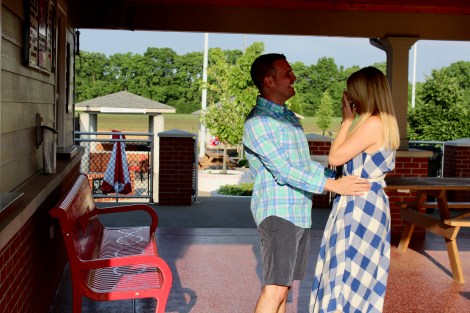 All throughout this journey, from the moment I decided I wanted to marry Paige to the moment she said yes, I felt tremendous joy; but it was a joy accompanied by sadness because I really, really wanted to have my Dad there for everything. In each and every moment, I wanted him there right alongside me. In moments like this, a boy needs his father. My Dad deserved to be there for all of it.
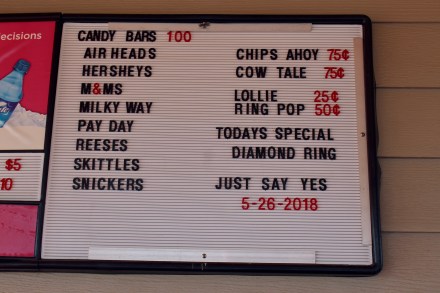 “Why does it say diamond ring?” she said to me nervously, and then, I placed my hands on her shoulders, and I told her how I felt about her. As I did this, photos of us together began to scroll on the video boards at the fields. Then, I got down on one knee (one very nervous, shaky knee) and asked her to marry me. She said yes, and all the promise of the next chapter of my life overwhelmed me with earth-shattering joy. I was able to envision our life together and see years into the future—and I absolutely loved what I saw.
 As our family members started to trickle out to the after-party, our dear friend Megan took some amazing pictures of us at the fields. As we smiled and posed for shot after shot, Megan asked us if there were any other pictures we would like to get before we left.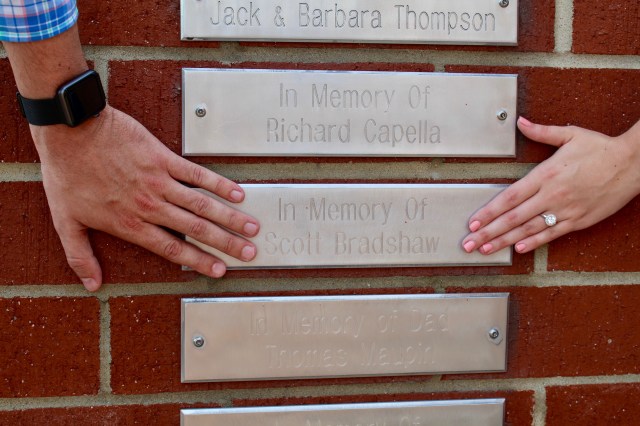
 Of all the things I’m fortunate to have in this life, I’ve always said I’m most fortunate to be the son of Scott and Becky Bradshaw. Now, I can add one more title to the list. I’m the luckiest man alive because I’ll get to call Paige Garber my wife. Although she never met my Dad, I know that she still loves him—and that’s the greatest type of love anyone could ever give. It’s unconditional, Christ-centered, and life-changing. It’s the same type of love that my Dad gave to everyone he knew. It’s the love I still feel him providing from Heaven. It’s the type of love that sustains, builds up, and encourages in spite of difficult circumstances. It’s a love I wish I could have reminded my Dad of on his last day here with us.
 Dad, You would have absolutely loved Paige. You are so alike in so many ways. I often think about what it would have been like to watch the two of you interact with one another—laughing at the same jokes, enjoying sitting around a bonfire together, and just generally appreciating the beauty and simplicity that life together affords. It would have been one of the greatest honors of my life to introduce her to you, but I would have felt that same honor in introducing you to her. Dad, I desperately wish that you could have been here for our relationship. I wish that you could have given me the wisdom and guidance that only a father can provide to a son when it comes to love and marriage. But even though you aren’t here with us right now, I can still feel your presence. I can still feel you prodding me along and helping me make the right moves in this life. I can imagine you would have said to me soon after meeting Paige, “You better hurry up and propose before she wises up!” And Dad, you’re exactly right. She is more than I deserve and more than I could ever hope for, and I thank God for that. On the night I proposed, and every night for that matter, I’ve wanted to have you in our life and in our relationship. You may not be here with us, but in so many ways you are here with us. Your memory lives on in everything I will do as a husband, and I’m thankful that I could watch your patient, kind example over the many years that you loved Mom and me. You are here with me, and you always will be. I promise that no matter how life might change, I’ll never, ever let your memory go. Thanks for loving me from afar, Dad. Thanks for loving us—all of us. I love you, and wish we were here together. Until that day when we are united again, seeya Bub.
  Seeya Bub