

This is Part 2 in a special three-part series on the Christian church and mental illness. Please make sure you check out Part 1: Silence.
Unspoken prayer requests are unspoken for a reason.
I know that not every unspoken prayer request is related to mental illness; but I do think that a large majority of those who suffer from mental illness are afraid to make it known.
And the last place they should be afraid is the Christian church.
But they are.
When I started this series, the easy part was realizing that the Christian church largely stays silent on the topic of mental illness. The difficult part was understanding why. Why would a caring, loving church stay silent on a topic that affects so many parishioners who sit in the pews week in and week out? Why would the church choose to stay silent when people are broken and hurting? When lives are being lost? When families are being torn apart?
There’s a reason why those unspoken requests continue to remain unspoken.
The stigmas that surround mental illness, although mostly untrue, are just as pervasive in the church as they are in any other institution in our society. And these stigmas are preventing people from finding the peace they deserve—and the love that Christ wants them to experience.
So what are these stigmas? What are these faulty thoughts surrounding mental illness and suicide? Why are they still alive in the modern church? How foolish are they? And what can we do to counter them? I have my ideas.
To prevent these stigmas from spreading, we’ve got to understand just how faulty they actually are. So, for the rest of this post, I’m going to ask you to engage in a bit of a metaphor with me.
I want you to imagine that a man comes to your church with a broken leg. He hobbles in on crutches. A huge, fiberglass cast holds his shattered bones into place. After some uncomfortable shuffling, he eventually finds a pew near the back of the church in an attempt to avoid the eyes of his fellow worshipers.
Now, imagine that you notice this man. And imagine that you immediately judge him negatively because of his broken leg. Or you question his walk with God. Or worse…you completely ignore him and his pain.
Crazy, right?
If someone has a broken leg in the church, we don’t ask any questions about why their leg is broken, but we offer to help. In any way we can.
If someone in the church has a brain function or thought process that is broken, however, our reaction is very, very different. And this differentiation is at the heart of the stigmas that prevent the Christian church, largely, from serving the mentally ill.
That, my friends, is the heart of my argument. Although the response and treatment for an injured leg and an injured brain are vastly different, our Christian response to each of those injuries should operate from the same exact place of love and compassion, not judgement. We must counter the stigmas; but to counter them, we have to call them out, one by one. Although there are many stigmas about mental illness that run rampant in both the church and everyday American society, I believe these three are the most particularly dangerous and damaging.
STIGMA 1: If you suffer from mental illness, your spirit is weak, your faith is low, or you are distant from God. Situate this stigma in the context of the conversation we had just a moment ago. Imagine if I had the audacity to question the physical or spiritual fortitude of the man with the broken leg. “Man, you must have some pretty weak bones there fella,” I would say to him. Or “That’s what you get for not drinking enough milk!” Or worse, imagine if I said, “Wow, what did you do to make God so mad that he broke your leg?!” If I ever responded to anyone with a broken leg with an attitude like that, everyone in the church would immediately call me a hypocrite. They would call out my lack of compassion—rightly so!
But there are believers in the Christian church each and every day who make those same judgments about their brothers and sisters who suffer from mental illness. They secretly call them crazy. They avoid interaction with these people. They question whether or not they actually believe in God at all.
This type of thinking is completely unacceptable.
I can’t speak to the root of each and every person’s own individual struggle with mental illness. I can’t say with 100% certainty that all cases of mental illness have nothing to do with a larger spiritual battle. But I can say that believing every case of mental illness stems from a person’s personal walk with Christ is foolish.
And I can also say I’ve encountered this stigma.
No, I’ve never interacted with someone after my Dad’s death who comes right out and says, “Your Father must have been mad at or distant from God,” but they don’t have to come right out and say it. I can see it in their eyes. I can tell that they don’t want to engage because they think of my Father as someone who must have had little faith in God.
But I can tell you that my Dad believed in God. He believed in the power of the Cross. He loved Jesus—and more importantly lived his life in a way that showed people how much he loved Jesus. But my Father’s mind was highjacked by a horrible, complex, and devastating disease. Just like someone who loses a family member to cancer or heart disease, I lost my Father to suicide. Suicide, a debilitating disease that clouds the mind and warps the senses stole my Father. In fact, I think my Father’s faith is probably the thing that allowed him to fight as successfully as he did for so long.
I think one of the most Christ-like things we can do is admit that sometimes, we just don’t know why certain things happen. And I’ll be the first to admit that I don’t always understand depression and mental illness. It could be spiritual, for some. It could be neurochemical and physiological for others. It could be brought on by dire circumstances or a whole host of other influences. But, like Jesus, I want to listen to people who are hurting. I want to listen to people who are suffering, hear their stories, and help them find comfort in the arms of Christ. And if I automatically assume that every battle with depression is entirely spiritual in nature, I’m missing the point of Jesus’ ministry—and so is His church.
STIGMA 2: Suicide is the unforgivable sin, and if you’ve ever entertained it or had suicidal ideations, you’ll never be forgiven. As a Christian, you should just know this isn’t an option. Somehow, we’ve come to believe in the church that suicide is a sin that is elevated above any other—and, unfortunately, we lump mental illness into this bucket of “unforgivable sins” that don’t actually exist.
Go back to the poor man I described in the previous section with a bum leg. Put yourself in his shoes (and cast). Imagine if someone told you that your struggle to stay healthy must be a punishment from God for some sin you had committed. Would it make you want to serve Him? Or would it scare you?
I don’t know about you, but I serve a loving God. I serve a compassionate, forgiving God. And I serve a God who says I have swept away your offenses like a cloud, your sins like the morning mist. Return to me, for I have redeemed you” (Isaiah 44:22, NIV).
Unfortunately, there are a whole host of people in the larger Christian church who, whether consciously or underneath the surface, believe that there is something unforgivable about mental illness and suicide. I don’t understand this, and I never will.
Charles Stanley is one of the most knowledgeable Christian speakers and scholars of our time, and I remember being given a copy of his book Emotions by my pastor, Harville, after my Dad’s death. I tore through page after page because I loved Stanley’s approach to dealing with our emotions (more on Stanley’s book in the Library section), but then my heart froze when I got to page 243 in a chapter entitled “Despair.” My eyes fixed on the word “suicide”, and I began to panic. My palms began to sweat because I was afraid of what might come next. Stanley is a Baptist minister who started his career behind the pulpit in the 1970’s, and I made assumptions about his beliefs on suicide. I worried that a man like Stanley—a studied and learned man—was going to tell me something about my Father’s eternity that my heart couldn’t bear to hear.
And then, with the tenderness I needed in just that moment, Stanley penned the words that my broken heart needed to hear. He wrote:
“Now, before we move on, let me clear up a misconception I frequently hear repeated. If you or someone you love has attempted suicide, please be assured that it is not the unpardonable sin. Some believe it is because the person does not have the opportunity to repent, but nothing in God’s Word suggests suicide will not be forgiven” (p. 246).
I put down the book, and I began crying. God knows my heart, and He knows I’m a natural skeptic, and he knew that I would need the perspective of a Biblical scholar like Charles Stanley to convince me that my Dad’s heart—and his Eternity—belonged to the Lord and Savior he served.
And it’s not just Stanley. After reading his book, I sought out more and more perspectives. And everywhere I looked I found the same thing from Christian scholars I knew I could trust—mental illness and suicide are not the unpardonable sin.
But the words of men shouldn’t be enough to convince us. Those of us in the Church should let everything we do be dictated by the Word of God, and nowhere in the Bible am I able to find evidence that those who suffer from mental illness or suicidal ideations are not welcome at the foot of the Cross.
In fact, I find example after example of broken, hurting people finding comfort in the arms of Jesus Christ.
Don’t miss what I’m saying—I don’t want to minimize the devastating impact of suicide. It’s horrible and it’s irreversible. It leaves a chaotic imprint on the hearts and minds of those who are left behind to deal with the trauma, anguish, and confusion. My Dad’s death has put questions on my heart that I know I’ll never have answers to on this side of Eternity. This one isn’t easy. We have to find a way to talk about mental illness and suicide in the Church without encouraging emotionally vulnerable and hurting people to do something they might regret. We have to let them know that even though all of our sins are forgiven, it doesn’t erase the collateral damage that a suicide might inflict. In showing God’s love, the suffering and potentially suicidal person will hopefully see the love of a fellow Christian that will encourage them to find help.
But in order to even bring those people into the conversation, we have to make them feel loved. And sending them the signal that their pain is unforgivable will immediately close off their path to the Cross.
STIGMA 3: I want to help you, but I don’t know how. In the Lifeway study that I shared last week, a large number of pastors who said they don’t regularly talk about the topic of mental health in their churches brought up a common reason for avoiding the subject: they said they aren’t prepared to help those people who are suffering. They worried that they didn’t have the knowledge or academic background or expertise to aid the mentally ill and potentially suicidal, so they avoided the topic all together.
Guess what? You’re more equipped than you think you are. We all are.
Let’s jump back to my metaphor once more. Imagine going up to the person with the broken leg in your church and saying “I would love to help you, but I’m not a doctor and I don’t know anything about how to mend bones. So best of luck!” It’s ludicrous, but it’s also what we are doing with mental health.
Pastors and church leaders, you are right. I don’t expect you to have the same knowledge as a trained clinical professional in the field of psychology. I also don’t expect you to have the medical knowledge of a physician, but I do expect you to talk about dealing with tragic illnesses. I don’t expect you to have the training and knowledge of a financial planner, but I do expect you to talk to Christians about their finances and God’s perspective on money and wealth. I don’t expect you to have the scientific background of Einstein, but I do expect you to talk about how Christians should treat the gift of God’s Creation.
So yes, I expect you to talk about mental illness, even if you don’t have all the answers.
You may not have the academic training or credentials, but you do have the wherewithal and perspective on the power of the Holy Spirit to direct hurting and broken people to the resources they need. No, you may not be able to fix the problem yourself—but isn’t that the point? Isn’t the true message of following Christ a desire to let the Holy Spirit work in our lives to pick us up when we can stand no longer? Isn’t the point of the Church to bring together people with different talents and functions and backgrounds to serve God and serve one another? You might not be able to solve the problem for that person, but you can pray for a solution. You can pray over their problem with them and pray for answers from above. Those answers may come in the form of a Christian counselor, a medical physician, or a clinical psychologist or therapist who can help that suffering person find the treatment they deserve.
I’ll say it as clearly as I know how: A lack of knowledge is not an excuse for a lack of empathy.
And that help is exactly why I write. I don’t point out the faults of the Christian church’s approach to mental illness purely as a critic. I come to the table desperately seeking solutions. I come to this conversation with a positive and optimistic belief that, together, God’s people can unite as a strong army in the fight against mental illness, depression, and suicide. I believe that we can counter these stigmas head on in our congregations and communities, and I believe we can change the world, just like our Father calls us to do.
I recognize the silence. I know there are stigmas.
What do we to counter all of this?
I’ll offer those solutions in next week’s conclusion.
Dad, I’m ashamed to say that it took your struggle and your death for me to realize just how hard the struggle to overcome mental illness really is. And it took losing you to soften my heart for other people who are hurting. It took watching you suffer to realize that mental illness is complex and hard to understand. It took your hurt for me to understand that mental illness is unpredictable and so very difficult to counter. It took losing you for me to understand how the judgement of mental illness weighs on an already heavy heart. It took losing you for me to realize that there are simple ways to help hurting people that might make all the difference. Dad, I think about you each and every day, and I think what more I could have done as a son and as a fellow follower of Jesus Christ to help you find the comfort and peace that you deserved. But I know, deep down, you’ve found an abundant and everlasting peace in Heaven. I would do anything I could to have you back here with me, but for now I’ll fight to help others who, like you, are hurting and fearful that they will never find acceptance. I love you, Dad, and I miss you dearly. Until my fight is complete, seeya Bub.
“The Lord is close to the brokenhearted and saves those who are crushed in spirit.” Psalm 34:18 (NIV)

 Dad, Since the time I was a little boy, you always taught me the importance of my relationship with Jesus. But you always taught me that my relationship with Jesus always needed to be reflected in my relationship with other people. I can’t imagine how many times we must have went to church together when you were hurting more than I ever knew. I wish I knew what to do then. I hope that I know what to do now. I’m trying my hardest to change the world around me, to make it a better place for those who are suffering like you did. Thank you for giving me a lifetime of inspiration, Dad. I’ll never get over losing you, but until we are together again, seeya Bub.
 Dad, Even though I know you would tell me not to feel regret, I do wish that I had the chance to hit the “do-over” button on so many things in my life. I wish I had been more of a support to you when you needed me. I wish that I had spent more time with you doing the things you loved to do. I wish that I could have done more to help you find peace and solace in the tumult of your depression. I don’t know the answer to why this terrible tragedy happened, but I do know that God has a plan to make something good out of it. I often wonder what could possibly be better than more time with you, but I know that although I feel a horrible separation from you in these moments, there will come a day when you and I can both live completely free of regret and goodbyes. I long for that day, but until then, seeya Bub.
 Dad, I hate that I ever had to say goodbye to you. It’s been four years since I said goodbye to you for the last time here on this Earth. I feel the pain of losing you each and every day. I would give absolutely anything to have you back, even if only for a day. For 26 years, you were always here for me, and now that you aren’t I feel the awful heartache of losing you. But I know that I could only feel that heartache because you touched my heart in ways no one else could. You taught me so many important lessons in this life, but more than anything you taught me that love matters above all else. In every moment of every day, I never doubted your love for me, for my Mom, for our family, and to all who mattered to you. You didn’t just tell people that you loved them, you showed them. And I’m thankful for that. The days stretch on without you, Dad. There are days, like today, when it’s all I can do to get out of bed at the thought of losing you. But I know that all of the wonderful moments we shared in our time together here will be completely outshined by the life we will live together in the glory of God’s grace. Thank you, Dad, for everything. I’ll never be able to tell you how much I loved you, but until that day when I try, seeya Bub.
 Dad, There have been so many days when life has seemed unlivable without you in it. There have been moments when I’ve completely collapsed under the weight of my own worry and troubles, and I wish more than anything that you were here to encourage me in those moments of doubt and frustration. But in a sense, you are here with me. The lessons you taught me throughout my life were always lessons of empowerment. You taught me that I am always stronger than I think I am, and that when I am weak God is strong. You also showed me that it’s okay to have feelings and emotions and that I can express those when I feel them. You showed such bravery in your life, and I hate that in your final moments you doubted your own courage. Dad, you were the most courageous man I’ve ever known. You fought so hard for so long, and I’m glad you’re not fighting anymore because that enemy that you faced is defeated once and for all. I’m so thankful that you are completely at peace, completely healed, and completely perfected in God’s love and image. Dad, you deserve eternal rest in paradise (hopefully free of snakes), but boy do I wish you were still here with me to help me in this imperfect world. Keep giving me that courage when I need it most. And until I can thank you in person, seeya Bub.
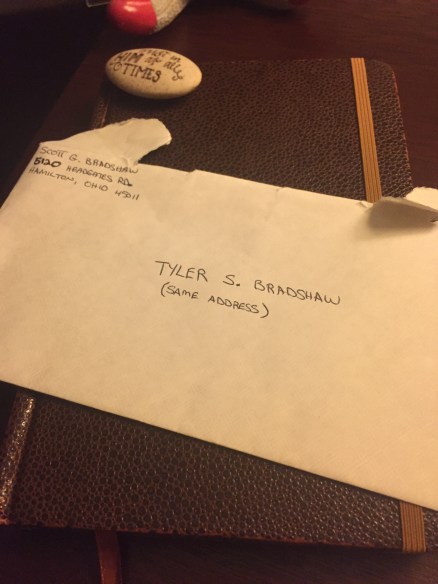
 Dad, In lieu of the letter I should have written to you before you died, I have been writing letters to you ever since. Letters that share my love for you and my sadness that you are no longer here. There isn’t a single day that goes by when I don’t miss you. You writing such an honest and authentic letter to me as a young freshie is just one of the many spectacular gifts you gave me as your son. I read your words, and although they still bring tears to my eyes as they did on the first day I read it, they also bring a sense of gratitude that I had you as a Father here on earth for all the years I did. I wasn’t just lucky to have you as a Dad—I was blessed beyond belief. Your words in that letter are so important to me because I know they aren’t just words. They are reflections of your innermost beliefs, and you lived and loved me in a way that made those words come to life. Thank you for writing that letter, Dad. I’m sorry that I never wrote you the one you deserved to read. It breaks my heart knowing that I never handed you a letter in return, but it gives me hope knowing that I’ll get to tell you exactly how much I love you face to face someday. Until that wonderful day, seeya Bub.
 Dad, I never thought I’d have to experience life without you so soon. I had images of you growing old, and I was excited to see you enter new chapters of your life, because you always had a sense of adventure. There are days, many days, when I feel helplessly lost without you. It always feels like something is missing when you aren’t around—it’s like there’s a gaping hole that can never be filled perfectly, even though good things are happening all around me. You brought such life to my life, and now I try to use your memory to fulfill that. I look forward to life in Eternity when the “you aren’t here” times are simply a thing of the past. Until that day, I’ll continue honoring your memory and loving you with all my heart. Seeya, Bub.
 When I was a kid, one of my favorite books was one that my Mom bought for me at a library book sale called “
 Dad, I hate that the confusion over your death would even lead to any doubt about whether or not you loved me, but I’m glad that I can quickly rely on the truth of God’s Word and the example you gave me each and every day to reaffirm your love. You were the epitome of a loving Father. I try each day to love people the way you did, and no matter how hard I try I know that I’ll always fall short—that’s how high you set the bar. You made love your mission. You made love your calling. You let God show you how to love, and then you showed God’s people how to love in everything you did. I pray that I’m able to become more and more like you as days go by. As those days pass, I rest assured knowing I will get to see you again. I’ll get to feel your hug and see your smile and know that everything about you is right, even though your circumstances here on Earth weren’t. Keep loving me, Dad. Keep watching over me and pushing me to be a better man. I’ll never stop loving you. Until I can tell you in person, seeya Bub.

 Dad, Each day I wrestle with telling your story and making sure people who never knew you know the type of man you were. I want them to know you were strong. I want them to know you were thoughtful. I want them to know you were caring and loving and everything a Father should be. I hope that the words I choose to use convey the love I have for you and the love you gave to all of us each and every day here on Earth. You never inflicted pain with the words you chose. You built people up by telling them and showing them how important they were to you. You and I had many wonderful conversations together, and we shared so many words. I’m sorry for the moments that my words may have hurt you. I wish I had spent more time telling you the words you deserved to hear—that I loved you, that I was proud of you, and that I was always there to listen when you were hurting. I know that we will have these conversations again. I wait longingly for that day. But until our words meet each other’s ears again, seeya Bub.
 Dad, It still doesn’t seem right that this is the fourth birthday that’s passed since you left us. It doesn’t feel right that life is going on without you. There are times when my heart feels so much pain that I can’t imagine ever celebrating anything without you again. But, in a weird way, I’m thankful for this pain because it reminds me how special you made life feel while you were here. You brought a vivid color and energy to my life each and every day that I don’t know I’ll ever be able to experience until I see you again. But I will see you again. I’ll make up for all those birthdays that I wished I could do over. You and I will, one day, celebrate our new birthdays in heaven. And fortunately, we will never, ever, see those birthdays come to an end. Happy birthday, Bub. You live on in my heart each and every day. Until I can tell you this face to face once again, seeya Bub.
  Seeya Bub