
I’m Here

I think the college crisis is worse than the mid-life crisis.

I mean, come one, at least you get a motorcycle out of the latter.

I was in college. Away at college. And I felt like I just needed to get away.

I think I’ve always dealt with anxiety to a certain extent. In a sense, I think I’ve had those moments where the world just feels too overwhelming at different points throughout my life. It’s likely that I’ve suffered here and there from anxiety before I could even put a name to it.

But even though I didn’t quite know what was going on or why, my Dad seemed to know. And he seemed to understand.

And most importantly, he was there.

The Fall of my junior year in college was not the Fall I had anticipated. I was living in an apartment in Oxford, and I was navigating one of those difficult moments of my life where the road was not only less-traveled, but it was windy and curvy and full of potholes and empty of any road signs. A road that had once seemed so straight and so predictable was suddenly anything but. It was treacherous, and I was trembling.

For the few months leading up to this moment, I had been questioning so much about my journey, mainly my vocational call. For my entire life, for as long as I could remember, I had said I wanted to be a teacher (except for that one weird phase when I mysteriously wanted to be a park ranger… too much Yogi Bear I guess…). When I was little, I would actually make-believe that I was a teacher in a classroom before I even started going to school myself. Once I went to school, I took an immediate liking to it. I enjoyed being in classrooms, and I always got along with my teacher and had deep admiration and respect for them.

As a youngster, I said I wanted to be a kindergarten teacher—mainly because kindergarten was all I knew. And it was awesome. We had fingerpaints, and snacks, and we were home by noon. Even as a little kid, I would often think about all of the fun activities I would someday replicate for my own students. I pictured the joy they would experience, all the coloring we would do, and the impact I would have in their little lives.

But then, once I got into middle school, I began to really enjoy my English and Social Studies and Science classes (no offense, math teachers), and my dream of teaching kindergarten began to fade. I was slowly warming up to the idea of teaching a single subject and working with older students. Also, Barney had lost his appeal…thank God.

And just when I thought I had everything figured out, I made it to high school…and, go figure, I decided I wanted to be a high school teacher. Specifically, I wanted to teach high school English. I loved my English classes. I loved reading, and I enjoyed writing, and I really appreciated the opportunities to be creative, explore different worlds, and express myself in ways that only literature and the written word could provide. I dreamt of sharing that excitement with my high school students. I longed for the days when I could choose the books they would read. I thought intensely about lectures I would give, activities and discussions I would lead, and the hundreds of students I would be able to reach.

It was no surprise to people who knew about my dream that I decided to go to Miami University and pursue a degree in teacher education. What was a surprise to those who knew me best, however, was my decision to leave it all behind and run in a different direction.

At the end of my sophomore year, I was having serious misgivings about my vocational choice. I had taken a number of education courses, and I just didn’t enjoy them nearly as much as I enjoyed the content-focused courses in the English department. Especially one class, taught by an arrogant and demeaning faculty member who was supposedly an “expert” in classroom techniques, even though he had spent only one year in the field actually teaching (wow, I guess I’m still bitter about that!). I learned I would rather be reading fiction novels than reading about how to teach them. I realized I wanted to work in education, but not the education I had always known.

So, I changed majors. To American Studies. The study of America. It sounded interesting. And…it happened to be the first major listed alphabetically in Miami University’s course catalog. The divine providence of the English alphabet still amazes me.

I dug into the curriculum, and the major looked perfect for me. I could take courses in all the areas I was passionate about and largely self-design a major that met my academic interests and desires. Literature. Communications. Political Science. Media and Journalism. History. Psychology. Nothing was off the table. It was a perfect mix.

It was also completely terrifying. People who got teacher education degrees became teachers. People who got American Studies degrees became…professional American Studiers? I had no idea what I was going to do with this degree, but I knew that studying those particular topics would make me extremely happy. Even though I was confident in my content choice, however, it didn’t diminish the employability concerns I had.

All of those feelings then decided to collide in the Fall of my junior year. Classes had only been in session for a few weeks, and I was unbelievably worried that I had made a huge mistake by dropping out of the teacher education program at Miami. Being a teacher was what I had wanted to do forever. Now, I was taking great classes, but also closing myself off from what had been my lifelong dream. Had I made a huge mistake? An irreversible one?

I was also dealing with many other huge life changes. I had made the transition from Miami’s Regional campus in Hamilton to the main campus in Oxford, and life on a residential campus was great—but it was also much different from what I was used to. Any transition, no matter when it happens, causes some anxiety. Making this transition into adulthood while simultaneously questioning the only dream I had ever known collided together in a wave of desperation and doubt, and on a random Wednesday night, I could only think of one thing…

I needed to get away.

I had been sitting in my apartment all day attempting to study. Instead, I was obsessing over the decisions I had made and convincing myself that they were all mistakes. At that time, I wouldn’t have even known what an anxiety attack was; nor would I have ever believed I was having one. Now, knowing what I know about mental illness, it’s easy to see that I was in the midst of a really severe period of overwhelming, paralyzing anxiety. The worst part is that I had kept all of this to myself. Like my Dad, I wasn’t crazy about letting people into my world far enough to see my darkness. I didn’t like the idea of telling other people I was hurting or confused or overwhelmed. I would internalize all of these feelings and endlessly ruminate over them, which likely fed a vicious loop of self-criticism and doubt that paralyzed me emotionally. And near the end of that night, I decided to get in the car and drive for a bit because getting away was the only thing I knew to do.

I got in the car and didn’t really know where I was going. In the age before smartphones or GPS devices, this was always a bit of a scary endeavor for a directionally-challenged individual like me. So I told myself to turn right out of my apartment complex, drive in a straight line, and see where it would take me.

As I drove in my silver Envoy, I passed cornfields and….well, cornfields. I began to think about everything, and my emotions started to get the best of me. Before I knew it, with the radio turned all the way down, I was beginning to tear up. I started to call myself names, questioning how I could have been so stupid to do what I had done over the past few months. How was it possible that one person could make so many idiotic decisions? And…why did that person have to be me? I drove across the Indiana state line—which sounds super dramatic to those who don’t know the geography of Oxford. Indiana was only about ten minutes away from campus, but there was something metaphorically significant about crossing a state line that made this drive feel scary. I felt like I was running away from something. I felt like I was giving up.

It was in the midst of all of these thoughts and doubts when my cell phone (a sweet Motorola Razr) began to buzz. I looked at the screen and the caller ID read “Incoming Call, Dad.”

I hesitated to pick up the phone, but after a few seconds I knew I had to. I collected myself and flipped the phone open (remember when phones used to flip?!) and put it to my ear. “Hey, Dad,” I said lightly.

“Hey, Bub. I’m here. Can you let me in?”

“You’re where?” I replied nervously.

“At your apartment. I’m standing outside,” he said.

“Oh, uh….I’m not home,” I answered.

“Where are you?” he questioned, a bit surprised.

“I….I don’t know,” I said. And then, I started to fall apart again.

I told my Dad how I just needed to go on a little drive. That I didn’t know where I was going, both on this drive and in life. I shared everything with Dad, and I let him in.

My situation hadn’t changed, but there was an immediate relief in being able to finally tell someone that I was having serious doubts.

“Bub, why don’t you come back and we will sit together and talk?” he said to me.

I listened. And I turned around. And I drove in a straight line until I was back at my apartment where I saw my Dad standing on my front porch.

The reason this story is so important is because I hadn’t told my Dad anything about how I was feeling before he drove to Oxford to visit me that night. And driving to Oxford on a whim like that was not a regular occurrence. My Mom and Dad were always planners. They came to visit me pretty often when I lived in Oxford, but they always scheduled it ahead of time. Even in college I kept a really busy schedule, so we usually had their visits to Oxford scheduled in advance.

Which is why Dad’s visit on that night was all the more special—because Dad had picked up on the fact that something was wrong. We had talked earlier in the day, but I thought I had concealed my feelings pretty well. I thought I had been able to keep my sadness to myself.

But Dad had realized that something wasn’t right. He could pick up on the fact that there was something troubling me. He knew that I wasn’t okay.

And because I wasn’t okay, he was there. He was there without warning. He was there in a moment’s notice. He was there as long as I needed him. And he was there at just the right moment.

Eerily, I look back on that night and it is strangely reminiscent of the last conversation I ever had with my Dad, even though our roles were reversed. On this night, I was the confused wanderer, perplexed by my inexplicable emotions. Dad, on the other hand, was the encourager. The trusted confidant. The Father full of wisdom and, most importantly, love.

We sat in my apartment and talked through all of the things I was feeling. I told him about my concerns for an eventual job after graduation, and Dad told me not to worry. He told me that I could major in anything, and that I would find a way to be successful. “You’re too talented,” he would say, “and any career you decide to pursue will be a good one.” Dad built up my academic confidence, reminding me that I had many years of success in the classroom that were proof of my ability to conquer the road ahead. Even in the midst of our serious conversation, Dad found a way to land a perfect joke or two at just the right moment at my expense. “How many girls have you had over to your apartment OTHER THAN the ones in that Sports Illustrated swimsuit edition calendar you have?”

Comeback? Anyone? I had nothing.

I don’t remember all the things that we talked about on that night, but I do remember this: I felt better. None of my circumstances had changed, but I felt relief. None of my decisions were any better or worse than they had originally been, but I felt hope. I felt security. I felt confidence.

And I felt all of this because of two simple words my Dad had spoken.

“I’m here.”

It was more than just physically being in my apartment. When Dad said “I’m here,” he meant he was there. He was in my corner. He was rooting me on. He was leading the way on that windy, curvy, confusing road when I couldn’t see far enough ahead to make sense of the journey. He was giving me all of the support and encouragement I would need. I don’t know whether or not my Dad agreed with my major switch, and I’m thankful for that. Instead, I know that Dad said he trusted my ability to make my own decisions. He trusted that I would find success. He empowered me to believe in myself.

Dad stayed at my apartment for a few hours that night. If my memory serves me correctly, he eventually coerced me into going out for dinner against my will. We came back to the apartment and watched television together for a little while. And then, when the night was nearing its end, he hugged me and told me that he loved me before he left for home.

My Dad didn’t have all the answers that night, so he did something even better.

He was there.

And I wish he was still here because there have been so many moments, just like this one, where I still need him.

There have been moments in my life, and there will always be moments, where I will revert to that same young college kid from many years ago—a young, lost, and wandering boy who just needs his Father for a little encouragement and advice. There have been moments when I’ve been at a crux in the road with an important decision to make that I’ve grabbed for my phone (no longer a Razr) and began dialing those familiar numbers, only to realize that he will never again pick up on the other line. There have been moments when I have felt his loss so deeply that I break down inexplicably, unable to escape the grief of losing him so suddenly, unexpectedly. Those moments are completely paralyzing. They rob me of my joy; but they can never rob me of my Dad’s memory.

That’s because even though Dad isn’t here, he is here. Even though he has been gone from this Earth for nearly five years now, I still feel Dad’s gentle hand guiding me and directing me on a daily basis. Although I can’t experience his physical embrace, I feel his watchful eye from up above, encouraging me when I doubt, celebrating with me when I find joy, and telling me that he is proud of me over and over and over again. When I open my eyes, I only see his absence; but when I close them, I see that beaming smile, those kind eyes, and a Father who is still with his wandering son.

I still feel my Dad saying “I’m here” in those moments where I crave his presence most. I hear him reminding me that he is here with me in each and every moment. There will be crises and good moments and desperate moments that fill the pages of my own life story, but it will be my Dad’s spiritual presence that is the common denominator in all of those moments. I am fortunate that I have a Heavenly Father who guides and directs me in the God I serve, but I’m lucky because I have another Father in Heaven doing the same exact thing.

My Dad may be gone, but he is still here.

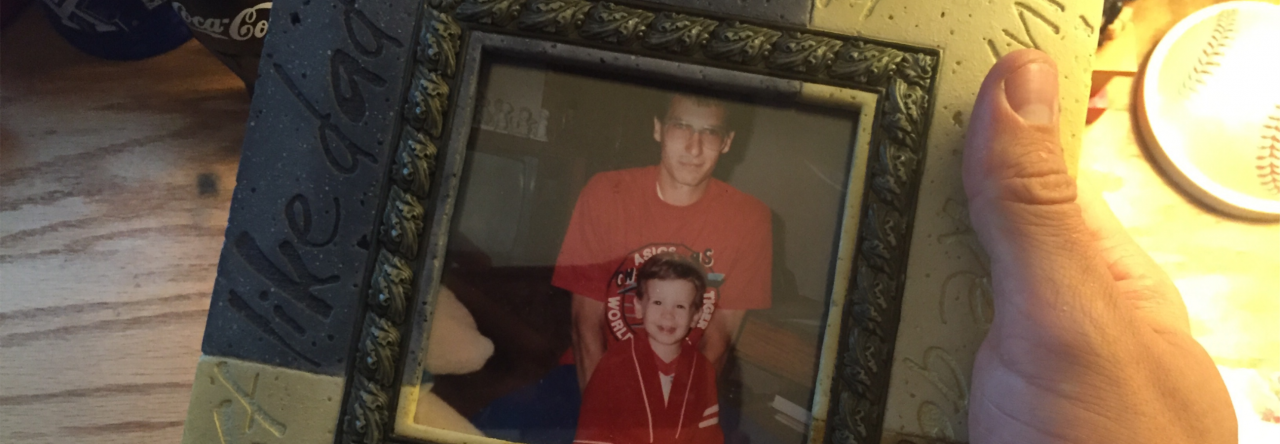
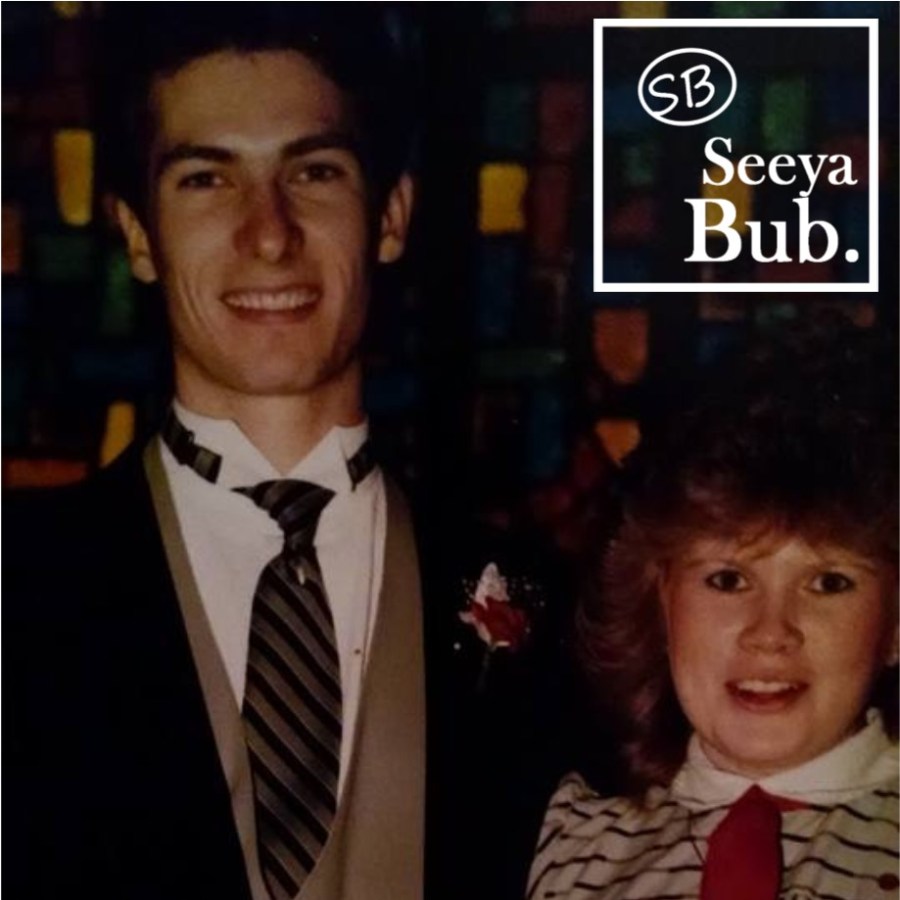
Me Dad and Lucy at Picnic with SB LogoDad, There were so many moments just like that night in college where your presence alone was all I needed to find happiness. You had an uncanny way of knowing the moments when people needed you most, and you responded with grace and unconditional love each time you were called. Nearly every day, Dad, I experience a moment when I just wish more than anything that you were here. I miss your smile, your voice, your heart, your shiny bald head, and everything that made you so very special. But in those moments where I experience your loss most severely, I try and remind myself that you are here. You are still watching. You are still listening. And you are still loving me and all those who feel your absence. Dad, thank you for always being there and for still being here. Thank you for being at my side at a moment’s notice–both in the moments when I knew I needed you, and especially in those I didn’t. I’ll never be able to say thank you enough. But, until that day when I try my best to let you know how much you are missed and how much you are loved, seeya Bub.

“Behold, I am with you and will keep you wherever you go, and will bring you back to this land. For I will not leave you until I have done what I have promised you.” Genesis 28:15 (ESV)
Masks

“We had no idea.”

When you’re standing next to a casket at a visitation, you hear lots of comments over and over again. “We will be praying for you.” “Is there anything we can do?” “If you need anything at all, please let us know.” “You’ll be in our thoughts and prayers.”

In reality, who knows what to say? Is there anything you can actually say to take the pain of losing a loved one away? I find myself saying the same things to grieving friends when I attend funerals or visitations. I don’t like that I say it, but I don’t know what else I could possibly say in its place. It’s what we do to show that we love.

My Dad’s visitation, however, was a bit different. My Dad had passed from suicide, and there was a certain shock of losing someone suddenly who, just a few days prior, had seemed completely healthy. I heard one particular comment more than any other from the more than 1,000 people who came to pay their respects to my Dad.

“We had no idea.”

Over and over and over again, friends and loved ones and coworkers and neighbors and childhood acquaintances made their way through the line, some waiting upwards of a few hours (which still touches my heart in ways I can’t possibly describe). Just a few minutes after the service had started, I remember looking up and being completely overwhelmed by what I saw. Our extremely spacious sanctuary had a line that clung to the entirety of the wall, streaming through the back doors and into the foyer. Who knows how far it went from that point, which was beyond my vision. There were folks sitting in the pews, catching up with one another but I’m sure also trying to figure out why this gathering had even needed to occur.

I tried sincerely to look into the faces of those who came. I tried to assess how people were feeling. I looked out at the other people who had known my Dad—other people who were hurting, too—and I saw the same look on their eyes. Shock. Confusion. Pain. Bewilderment.

My Father had died from suicide, and the flabbergasted looks I saw the night of my Dad’s visitation were justified. Although my Mother and I (along with a close circle of family members) had known of my Dad’s struggle with depression, neither of us thought it would ever get this bad. Neither of us believed that my Dad was hurting as bad as he was. Neither of us believed that the depression could create a stranglehold strong enough to make my Dad feel that life wasn’t livable.

Unlike those folks, we knew; but like those folks, we didn’t.

Many of the people who loved my Dad didn’t know because my Dad wore a mask. I’ve heard that phrase used so many times to describe the coping mechanism that individuals suffering from mental illness will use. They hide their true feelings. They bury the anguish down deep below the surface. They put on a happy face when happiness eludes their heart. That mask metaphor has helped me understand how my Dad was able to hide his depression from those he loved. But more importantly, it’s helped me understand why he would feel the need to hide his depression in the first place.

I anticipated the shock of my Dad’s death in the hearts of those who knew him because so many people knew my Dad as a happy, jovial man. That’s how I knew him, too, even though I would occasionally see into the dark egresses of his depression. Those were usually brief moments confined to a short amount of time. Eventually, that depression would pass—or at least I thought it did. As I reflect on those moments, I am beginning to understand that the depression never truly disappeared. My Dad just got better at coping with it at times. And sometimes, unfortunately, he got better at hiding it.

But most of the time, he was happy.

It’s more than that though. My Dad wasn’t just happy. He was one of the happiest men I’ve ever known. Happy to the point where, as a kid, I just wanted to see him get mad about things to know that he could. My Dad was the guy who could keep a smile on his face in any situation. The man who, in the most difficult moments, could tell the perfectly timed joked to make people laugh. In every circumstance, dark or light, my Dad was cheerful when he interacted with those around him. He had a bright smile, a twinkling eye, and a glistening personality that could instantly comfort other individuals and cheer them up.

Which is why depression confuses me so much. How could a man who could so instantly and effortlessly encourage and lift up others not do it for himself?

His entire life, my Dad worked in labor-intensive jobs. He worked in plants that were often entirely too hot during the summer and entirely too cold during the winter. He built things, and he fixed complex machines, and he worked long hours (a gene for which I have yet to inherit). And no matter the job, my Dad was always happy. He always had a smile on his face. His coworkers absolutely adored him. He was the guy you hoped would join you on a project because you knew you would not only get the job done but have fun while doing it. I wish I could tell him how much he meant to those he worked with.

Then, he would come home. And although he would find ways to relax, he would also find work to do there. He would spend hours sweating in the yard planting flowers and repairing the house. He loved gardening and outdoor work (once again, a gene I have not inherited). He would remodel bathrooms and fix electrical issues. And all the while, Dad would have a smile on his face. All the while, Dad would tell you that he was good, and that he was enjoying life. I wish I could tell him how much that meant to Mom and I. I wish I could go back and tell him that he didn’t have to work so hard.

And it wasn’t just work—his happiness invaded every corner of his life and his soul. Dad would go to church, and he would have a smile on his face while he stood around and chatted with folks for 45 minutes after the service as I rolled my eyes and tugged on his sleeve in an impatient effort to beat the Baptists to Frisch’s for lunch. He would go to my soccer games, which offered very few opportunities for smiles during my short-lived athletic career; but he would smile, and cheer, and even admit to other people that the horrible right fullback was actually his son. When we would go out to dinner and the food or service left something to be desired, Dad would smile and find ways to enjoy the time with his family. It was a contagious happiness that my Dad embodied. And it’s that contagious happiness of his that I miss every single day.

I don’t doubt that in many cases my Dad was simply happier than other people. I think he just had an appreciation for life and the simple things that make it wonderful which few of us are able to truly appreciate. This may sound strange considering that he eventually died from suicide, but my Dad found ways to appreciate life that I’ve yet to tap into.

However, I am also confident that there were likely times in my Dad’s life when he was extremely unhappy underneath the surface but felt as if he couldn’t let people see him in a state of weakness. I know that in the midst of his own personal turmoil, Dad was probably afraid to let people know that he just didn’t feel like himself. He was afraid to let them know that his depression was getting the best of him. He wanted to be a happy, smiling Superman to everyone at all times…and that is an unattainable expectation for anyone, even for my Dad, as great a man as he was.

My Dad was the man who was able to bring joy to other peoples’ lives whenever they needed it most. After his death, I heard countless stories of my Dad’s ability to help others find happiness. I heard stories about times when my Dad would take time out of his day to visit people, to talk with them, and to generally make them feel like someone cared. I heard stories about lunches that he bought for folks, repairs that he made at their homes, and silly things he had done to just get others to laugh a little.

I heard those stories and I believed them. Every single one. I believed them because he did the same thing with me in my life each and every day. There were so many times when I would feel down and my Dad would pick me up. Oftentimes, he didn’t even have to know I was down. I think he could simply sense it. Dad never made me feel ashamed or weak if I wasn’t feeling happy. Dad never judged me or told me to “snap out of it.” Dad gave me compassion. My Dad gave me unconditional and unabated love every single day.

More than anything, I think this is why I hated the fact that my Dad felt as if he couldn’t share his mental illness with the folks around him who loved him. Those folks loved him deeply, and had he shared his struggles, I’m confident that they still would have loved him. And they would have helped him. And they never, ever would have given up on him.

Instead, my Dad felt it was necessary to wear a mask. My Dad felt that he should hide the feelings he couldn’t explain from those he loved most. My Dad wore that mask because he couldn’t bear to let people see the depths of his depression, which he perceived as a personal weakness.

I wish I could tell him that he wasn’t weak. I wish I could tell them that he had no reason to be ashamed. And I wish, more than anything, I could tell him that he didn’t have to wear that mask anymore.

The mask, however, is not a tool of deception; it’s a weapon against embarrassment and shame. My Dad was not a deceitful man, and that’s the point I try to get across to individuals when I talk about depression or mental illness. He didn’t hide his depression because he was attempting to lie or mislead people. He hid his depression because he loved them. He masked his depression because he didn’t want others to worry about them. He buried his depression because he was ashamed of it. And unfortunately, it’s that very shame that led us to bury him.

Dear people, we must arrive at a point in this world where there is no shame surrounding depression and mental illness. And we should do this because…there is no reason for those individuals to feel ashamed. There is no reason for us to wear those masks, and there are other survival mechanisms that actually lead to true healing.

When I think of my Dad on the morning of July 24, 2013 (his last day on this Earth), my heart breaks when I picture how broken he was. He stared at the floor, unable to make eye contact with me. He looked disconnected and detached from everything around him. When I asked him about all of the pressures he was dealing with in life—and boy did he have a lot to deal with—he was even ashamed to admit he couldn’t handle all of those things. At one point, he even said to me, “Yeah, but I should be able to deal with this.”

No, Dad. You shouldn’t have been expected to deal with everything easily. You shouldn’t have been expected to be Superman in every moment of every day.

As much as it tears me apart to think of my Dad on that last day, it also causes me deep pain to think of the weight that must have burdened my Dad’s life from wearing that mask each and every day. This is a heavy mask that those with mental illness are wearing. This is a difficult load that they carry. That mask may hide fear and shame, but it doesn’t eradicate it.

I also know this from personal experience. Although much less severe than my Father’s struggle, my own struggles with anxiety have helped me understand this principle. Dealing with anxiety (or any mental illness) on its own is difficult enough; feeling like you have to lie and convince everyone around you that you’re fine when you’re really not takes that exhaustion to a whole new level. And that exhaustion just continues to fuel the mental illness in a vicious cycle, and before you know it the mask is not merely a coping tactic but a necessary tool for survival.

My Dad’s life may be finished, but his story is not. And what can we do about it? What can I do? What can you do? What can all of those shocked, hurting people who attended my Father’s visitation and funeral do to redeem his story?

Let people know that it’s okay to take off their mask. When individuals are suffering from mental illness, we have to let them know that it’s okay to let down their defenses. We have to let them know that taking off their mask is an act of bravery, not an admission of weakness. We have to let them know that their inexplicable feelings of sadness, despair, nervousness, or guilt are real but remediable. We have to make them feel that there are so, so many more solutions to ease their pain than suicide. Simply, we have to make people feel loved—and not just loved, but unconditionally loved. Loved regardless of their feelings. Loved regardless of their circumstances. Loved regardless of the things they can’t control or fix. Unconditional love is the true mask destroyer.

In order to love others, however, we have to make sure we love ourselves.

That’s why it’s ridiculously important to take off your own mask, too. We can’t tell people to take off their masks if we aren’t willing to take off our own. The best way to promote mental health is to model it. Removing our own mask requires courage and bravery, but it takes the most dangerous weapon mental illness wields—the unjustified humiliation—and completely removes its power. We show others who aren’t okay, in those instances, that we aren’t always okay either.

And we teach them, more than anything, that it’s okay to not be okay…but that it’s never okay to stay that way.

As time moves on from my Dad’s death, I am beginning to see his mask in a new light. I see it as a coping mechanism, not an act of deceit. I see it as an act of love. Yes, an act of love that I wish we could have redirected. But even though he wore that mask, I know that love existed underneath. I know it’s there. I feel it every day—and I’ll never forget it.

Mom and Dad at Church with SB LogoDad, You didn’t have to wear a mask. I think I know why you did. You wore a mask because you loved me and you loved all of us. And you couldn’t bear the thought of letting us down. Dad, you never would have let any of us down. Even in your death, you aren’t letting me down. You could never disappoint me. I would never be ashamed of you, no matter how sick you felt. Dad, you were courageous. You were brave. And you always had a huge smile on your face because you wanted others to smile, too. I know you were trying to be brave, but I wish I could have told you that being vulnerable and getting help was one of the bravest things you ever could have done. Thank you, Dad, for making my life happier. Thank you for teaching me how to enjoy life. And Dad, thank you for being the fighter that you were. Your story is teaching us all so much. Thanks for teaching me how to share it. Until I can say that I love you in person, seeya Bub.

“But he said to me, ‘My grace is sufficient for you, for my power is made perfect in weakness.’ Therefore I will boast all the more gladly of my weaknesses, so that the power of Christ may rest upon me. For the sake of Christ, then, I am content with weaknesses, insults, hardships, persecutions, and calamities. For when I am weak, then I am strong.” 2 Corinthians 12:9-10 (ESV)

The Inside Cover

Usually, I only write my last name on the inside cover of the books I own (which is too many). Mostly in bright red pen, I emblazon “BRADSHAW” in all capital letters in the top left hand corner of most of my books. Just in case I decide to lend my precious books out and they don’t find their way home, I want the perpetrator to be haunted with the guilt of their thievery forever and ever.

But my Bible? Well, that’s a different story…

Since shortly after graduating from Miami, I’ve carried a hardcover Zondervan Bible. It’s a TNIV (Today’s New International Version) men’s Bible called Strive that I picked up at Half-Price Books. I love it, and I always have. It has great inserts with thought-provoking questions, profiles of historical figures from my faith’s past, and counters to modern-day myths associated with a man’s journey as a Christian.

This is the Bible I’ve always read since I started drawing closer with my faith after college. I read all the way through this Bible from cover to cover, which was a big accomplishment for me. I’ve marked that Bible up with underlinings and notes and circles of passages that grabbed my heartstrings or caused me to think of my faith in a new light. This was the Bible I was reading before my Dad died that has a deeply significant timeline drawn between Psalms 68 and 69—the before and after line marking my Dad’s death during my reading journey. It’s the Bible that I’ve carried with me to church each and every Sunday—on the days that I’ve wanted to go, and on the days when I’ve been so shattered by the grief I feel that I have to drag myself there. This Bible has traveled with me in countless rental cars and hotel rooms when I travel for my job. The thin plastic protective cover has started to peel, and some of the pages might be creased, but it’s never diminished the value of the precious words inside.

The words in the Bible tell the story of my faith; but the words I’ve written on the inside cover help remind me why I believe.

A year or so before my Dad passed, I made a decision about the inside cover of my Bible. I told myself that I was going to wait for the most poignant, thought-provoking, powerful statements about my faith in God and lodge them there. Once I heard those phrases, I would write them on the inside cover of my Bible. It was a pretty simple premise, but one that I took seriously.

I took it seriously because the inside cover of my Bible is precious real estate. It’s the first thing you see when you open the book. Once you use up all the space on the inside cover of your Bible, it’s gone. You can never get another inside cover.

That first quote on the inside cover of my Bible is still my favorite one.

I didn’t write the date (an addition I would add to future quotes). I didn’t note the particular sermon. I didn’t even write it in red pen! (My coworkers probably are probably shocked to see my writing in anything but red pen.) I do, however, remember the speaker who introduced that quote to me.

It was my pastor, Reverend Harville Duncan. I always loved Harville’s messages because they were intellectually challenging, thought-provoking, convicting yet hopeful. His messages always had powerful themes and nuggets of wisdom all throughout that challenged me in my faith in ways that I didn’t think was possible. He also made a somewhat-weekly LA Fitness reference which I conveniently tallied on a post-it note in the back of my Bible (and just in case you’re curious, he told 67 LA Fitness stories between 2013 and his retirement in 2016, with a +/-3% sampling error for the services I missed).

More important than any LA Fitness reference, however, was the quote from Reverend Duncan that founds its way into my Bible:

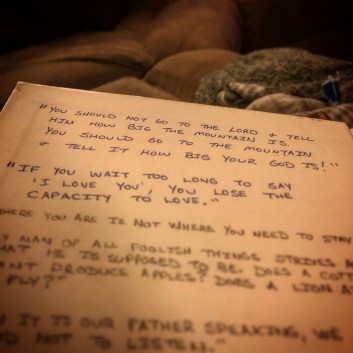
“You should not go to the Lord and tell Him how big the mountain is. You should go to the mountain and tell it how big your God is!”

It wasn’t an original quote, but it was new to me—and it was beautiful. I had never heard that phrase, but I loved it. It gave me courage that I never thought I’d need. It helped me visualize strength in the midst of difficult circumstances. I just loved it, and I knew the second that I heard it where it should belong.

I grabbed a pen from the pew in the middle of his sermon, and I inscribed the quote in my typical all capital (albeit blue) writing on the inside cover of my Bible.

It’s been there ever since; but more importantly, it’s been in my heart and mind every single day since I wrote it down.

I loved the quote—and in a few months, I would need that quote.


When I decided to speak at my Dad’s funeral, I honestly had no idea what I was going to say. I had no words for what had happened just a few days prior. What could I possibly say at that lectern to capture the love I felt for my Dad and the grief I felt in losing him? It just wasn’t possible. I didn’t have the courage.

I did something on that day that I have rarely done when it comes to public speaking. I didn’t prepare at all. I didn’t write out any notes. I didn’t rehearse my eulogy like I typically would any other time I spoke in public. I didn’t even have a general outline. I played a few things through my head during the few quiet times I had in the days after Dad’s death, but nothing would stick. I just prayed that God would give me the strength to say what He wanted me to say in that moment. I didn’t know what to say—but He did.

In an effort to try and prepare, I sat down at my desk the morning of my Dad’s funeral. Adjusting my black suit as I sat down, I said a quick prayer and asked God for guidance, perspective, and a courageous spirit. I told him how beat down I was. I told him that I had never felt this kind of pain before, and that I didn’t know what to do with any of it. I told him that I was completely lost, and insecure, and doubting whether or not I could live life without my Dad.

And then, I opened my Bible. And there it was:

“YOU SHOULD NOT GO TO THE LORD AND TELL HIM HOW BIG THE MOUNTAIN IS. YOU SHOULD GO TO THE MOUNTAIN AND TELL IT HOW BIG YOUR GOD IS.”

Bible Inside CoverGod wanted me to hear that message the day that I originally wrote it down, but he wanted me to live it in this new storm. That was the message God gave to me in a moment of ease to prepare me for a lifetime of perplexing grief. That was the message that God put on Harville’s heart, knowing he would need to pass it along to the members of the flock he cared for. That would be the message of my life, given to help save it.

And that would be the message I would need to say goodbye to my Dad.


I spoke at the funeral that day, and although I didn’t have a clear framework of where I wanted to head with my message, I knew that God wanted me to share this one truth. He had put it on my heart (and on my Bible cover) for a reason. This was that reason.

I didn’t talk long that day. I physically couldn’t. I talked about my Dad and how much I missed him. I talked about the sadness we felt as a family and the gaping hole we would feel in his absence. I shared some stories about his sense of humor. And I was honest with the few hundred friends and family members who had gathered to say goodbye to my Dad. The truth that, deep down, I didn’t know how my Mom and I would ever get through this. I was deeply confused, and I had questions that I feared would never be answered.

But I told them that Harville had shared an important quote with me and our church shortly before my Dad’s death. “We should not go to the Lord and tell Him how big the mountain is,” I said with slowly mustering confidence. “Instead, we should go to the mountain and tell it how big our God is.”

I looked out across the darkened sanctuary, and although I saw tear-stained faces, I also saw nods. I saw people nodding, and smiling through their grief, and encouraging my Mom and I to never give up. I saw people believing that my Dad’s death would be a huge, looming mountain; but I saw them believing that God could help us climb that mountain and conquer it with the strength only He can provide.

The mountain of grief we were facing would never, ever go away; but neither would the Almighty God who could help us climb it.


A few weeks after the funeral, as life began to ease its way into a difficult new-normal, I got an unexpected gift from my Uncle Lee. Lee was my Mom’s only brother, my Dad’s only brother-in-law. Dad and my Uncle Lee may have been brothers-in-law, but they had a bond of brotherhood that was enviable to this only child. They grew up as teenagers playing softball together. They played pick-up basketball together with members of our church from the time I was little. They would always count on one another for help with big household projects, appliance repairs, and the ever-occurring backyard swimming pool problems. I think Uncle Lee and my Dad always got along with one another because they are unbelievably similar—for all the right reasons. They are two of the most hardworking individuals I’ve ever known. They provide for their families without ever begrudging the hard days and long hours. They are each humble to a fault, never boasting or seeking credit for the amazing work they do. I know that when my Dad died, Uncle Lee was just as devastated as anyone else—and rightly so. My Dad had been the brother that he never had, and now he was gone.

In the immediate aftermath of losing my Dad, Uncle Lee was one of the first people on the scene—and one of the last to leave. He stayed with my Mom and I anytime we needed him. He helped us with countless chores and projects around our homes, cutting our lawns and helping with other repairs. He was there for emotional support, even though he was grieving himself.

His personal grief was real, but he always found a way to make sure he was a source of strength for my Mom and I whenever we needed him. I’ll never be able to thank him enough for the support he gave us, and his gift to me after losing my Dad inspires me in new ways every day.

His gift was a sign—a beautiful sign. Uncle Lee wanted to give me a reminder that the words I spoke at Dad’s funeral were more than just words; they represented an undeniable truth. He knew that I would need to do more than remember those words—I would need to live them. So, to help me remember, Uncle Lee made me a beautiful sign that read: “Don’t tell GOD how big the mountain is, Tell the mountain how big GOD is!”

Sign from Uncle Lee

I cried like a baby when I saw that sign for the first time. I ran my hands to and fro across the sign as I read the words and wept at the thought of losing my Dad and living life without him. But I also smiled and nodded my head through the tears because I knew those words were absolutely true. I knew that those words would guide me through the unchartered waters of grief and loss. I would go to that mountain of grief and despair, and I would let God guide me to the peak. This sign was an overflowing of the love in my Uncle’s heart. I’ll always be thankful to him for loving my Mom and I, and I’ll always have this sign to remember the courage and belief he had in us to overcome.

And let me tell you…I’ve needed the reminder many, many times.

Those words would become a mantra to me in the months and milestones that passed after losing Dad—and they still are. Especially in the weeks that followed after losing him, I would recite those words to myself over and over and over again first-thing every morning. I would wake up from a restless, nightmare-laden night. I would take a few deep breaths, trying to shake away the reality of losing my Dad. I would dread having to face the world without my Dad by my side. And on those days when it was hard to believe, I recited the words that I knew would carry me through: “Don’t tell God how big the mountain is; tell the mountain how big God is.”

On nights filled with paralyzing pain, I would have trouble peeling myself off of the couch. There were many nights when I would collapse in the floor of my living room, convulsing and weeping at the mere mention of my Dad’s name. And in those horribly painful moments, I would say those words again: “Don’t tell God how big the mountain is; tell the mountain how big God is.”

And on days when Satan crept into my mind and tried to convince me that my Dad’s death from suicide was unforgiveable, I would beat back his ploys with the truth of God’s love. I would remind myself that God doesn’t just love a chosen few. He chooses to love all of us—including my Dad, mental illness and all. And I would say, with a smile on my face and an eye towards the heavens “Don’t tell God how big the mountain is; tell the mountain how big God is.”

That beautiful sign hangs above the window in my home office, my favorite retreat nestled in the back corner of my home. It’s the office my Dad helped me paint. It’s the office where he installed a beautiful chair molding to help me execute the vision I had for a lovely baseball-themed workroom. And there, above the window where I stare out and daydream, hangs the sign that my Uncle Lee made me with the words that have carried me through my grief. I look at it often, especially when I write. I let it remind me God has a bigger purpose for our pain. He doesn’t demolish the mountains in our lives. He grabs us by the hand and helps us navigate the terrain until we reach the mountaintop.

I live my life relying on those words. I live those words knowing that they were written in the inside cover of my Bible for a reason. That reason is bigger than anything I’ll ever be able to explain on this side of Eternity; but I still trust them. I believe that they are true because they’ve carried me this far. No mountain will ever be too big for my God, and every time I open my Bible that truth jumps out at me—both on the inside cover, and in every single story those pages tell.

Dad in Easter SuitDad, You were always so courageous and so brave, and I wish I had more of that in me. You never let a daunting challenge intimidate you. You believed in your ability, and you believed in your God. Ironically, it was watching your brave example that prepared me to survive the grief of losing you. You taught me that I could do anything if I believed in God and let Him lead my way. Dad, I don’t focus on the one battle that you lost with depression. Instead, I focus on the many years that you fought successfully and conquered your sickness. You tried so hard—for me, for Mom, and for those who loved you. You fought the hardest fight of your life each and every day, and you were unbelievably brave. I’ll always remember that. I’ll always live my life through your example. And until I can see you again and tell you just how courageous you truly were, seeya Bub.

“Then David continued, ‘Be strong and courageous, and do the work. Don’t be afraid or discouraged, for the Lord God, my God, is with you. He will not fail you or forsake you. He will see to it that all the work related to the Temple of the Lord is finished correctly.’” 1 Chronicles 28:20 (NLT)

Grape Heart

As my family walked into church, we were each handed a snack-size Ziploc bag containing two items: one raisin, and one grape. The greeter smiled at us as he handed them out. Dad and I looked at each other and wondered….had our church converted to a different fruit-worshiping denomination since last week? Should we run?

For what seemed like an eternity, the morning announcements were given, the worship team sang, and the offering was collected. And the entire time, no one said a word about the bags of grapes and raisins. Did these people really understand the weirdness of what had happened when they came into the sanctuary this morning?!

Or wait…we did actually arrive on time to church that morning (a rarity in my family). Maybe they had been handing out grapes and raisins to the folks who showed up on time my entire life?! Maybe we had been missing out on the rewards for my entire life!

If all you get for showing up early is a grape and a raisin…I’ll take my extra 30 minutes of alarm-snooze—repeat. Wake me when they start giving out tacos and twenties.

If curiosity killed the cat, there was a vicious feline slaughter going on inside my brain during the beginning of the worship service. It just didn’t make any sense.

Finally, when our Pastor (Ted Herold) took the stage, he referenced the bag and its contents. And even though my Dad never explicitly told me this, the sermon that followed was my Dad’s favorite sermon that he ever heard. I’m positive of that. Dad always enjoyed Pastor Ted’s sermons, but I know how much he enjoyed this one, and I’m thankful for it.

I don’t remember the specific Scripture that Pastor Ted used that morning, but I do remember the message and I do remember the illustration (job well done, Pastor Ted!). It’s been stuck in my mind and my heart ever since that morning.

Pastor Ted instructed us to open our baggies and pull out the two contents: a red grape, and a wrinkled raisin. For the next few minutes, he actually had us compare and contrast the two items as a congregation. Dad rolled the grape and raisin around in his work-worn hands, and I looked on still wondering what was going on.

The raisin, the congregation agreed, was pretty lifeless. It was shrunken and wrinkled and shriveled. Pastor Ted asked the group “Does anyone here even like eating raisins anyway?!” A few of us raised our hands (I didn’t seek them out, but I didn’t hate them either), and Pastor Ted laughed. He then asked us to eat the raisins and react, as he feigned disgust from the front of the sanctuary.

Tasty? Maybe. But not as tasty as a grape.

Then, Pastor Ted went on to have us describe the grape we had in our hands. The grape was robust, especially compared to the raisin. The grape was full of life. The grape was colorful. The grape was bright. Essentially, the grape (although technically the same fruit) was everything that the raisin was not. Pastor Ted asked us to eat the grapes, and then describe it. They were tasty. They burst when you chewed them. They were juicy. Once again, all the things that the raisin we had previously ingested could not be.

That’s when the teaching began.

Pastor Ted asked us to think about the raisin and the grapes as metaphors. Metaphors for our heart. And he asked a simple question: “Do you have a grape heart? Or a raisin heart?”

If you had a raisin heart, your heart had lost its life. Your heart had shriveled into a fraction of what it used to be. Your raisin heart was lifeless, even dead. Your raisin heart had no brightness to it, no vividness. A raisin heart was empty. A raisin heart had nothing to give. It had been disconnected from the vine for too long.

A grape heart, on the other hand, was much different. A grape heart had life. A grape heart had energy. A grape heart had robustness, nearly bursting from the contents inside of it. A grape heart was so full of love that everything about its character was noticeably different from a heart that was empty, both inside and out.

And he continued to pose the question: “Do you have a raisin heart? Or a grape heart?” Do you have a heart that is shriveled and lifeless? Or do you have a heart that is bursting from all the love it contains? The message was simple. Jesus wanted His followers to live with grape hearts, not raisin hearts.

I’m sure we talked about that sermon on the way home and over lunch, because Dad would continue to bring it up throughout the years. And he would bring it up in typical Dad fashion.

Any teenager can get a bit….annoying; and I was no exception to that rule. At the top of all my annoyances? My impatience. I’ve always had trouble waiting for things, and I’ve never liked having to slow down.

My Dad, however, was different. He never, ever let the pace of life get the best of him, and I’ll always admire him for this. In fact, I strive to be like him in this way (and many others) more and more each day. Yes, his slower pace of life frustrated me beyond belief at times, but as I look back on his life, I am deeply envious of his ability to actually sit back, enjoy the moment, and escape from worry. I wish I had more of that in me.

I remember one time specifically when something had gone wrong with my car—which was not unusual. My brakes were squealing like a toddler on the playground with a pulled-pigtail, and I had been telling my Dad about it for what seemed like a month. Alas, there was still no repair, as my Dad was the family mechanic. Finally, with all of the teenage dramatics I could muster up, I went off on my Dad. I told him that I really needed him to fix the issue with my car. I told him that he always put things off. I told him that the squealing brakes were a safety issue. It was likely that I might slam into a tree or pedestrian because they wouldn’t function properly. Was he really this careless when it came to the safety of his only son? I told him the brakes were hurting my social life, which was already difficult enough to navigate with a silent vehicle. Girls wouldn’t even look at me if I had squeaky brakes. And if they didn’t look at me, I could never find someone to be with. Did he really want grandchildren? Well if he did, he better get to fixing those brakes!

After my tirade of nauseating complaints, my Dad just looked at me, months removed from that sermon, and delivered the ultimate comeback:

“You’ve got a little raisin heart,” he said. “You need a grape heart.”

Good luck coming up with a witty retort for that one. I had nothing.

I wasn’t the only victim of the “raisin heart” accusation. As all husbands and wives do, my Mom and Dad would occasionally bicker about things that needed to be done around the house. Mom, the keeper of the most immaculate and well-cleaned house I’ve ever seen, would grow frustrated with projects that would pile up around the house that my Dad had promised to take care of. He had promised to repair the holes in the wall from our fallen Christmas tree, but there were still two huge bolts in the living room from many, many years ago. He promised to clean up the garage and organize his tools (by the way, how much did he spend on that new Dewalt accessory?!), but there was still only room for one car in a two in a half car garage. And don’t you even get her started on that breaker that keeps shutting off every time we used the microwave and space heater at the same time! (My Dad has been gone for nearly five years, and that one still isn’t fixed…)

Dad, with all the sincerity and coolness that he brought to every situation, would simply look at my Mom with a loving smile and say “You’ve got a little raisin heart. You need a grape heart.”

Her comebacks to that were as nonexistent as mine.

Dad would use that refrain many, many times throughout the years to shut down arguments. And the sad part is—it always worked! We always, always let him get away with it! For all the times he used that line, we were never able to come up with a legitimate response.

Probably because we knew, deep down, that he was right. And also because my Dad lived with a grape heart each and every day of his life.

It’s easy to say this after someone is gone, but I would have said it when he was alive too. My Dad lived his life with more love than anyone I have ever known. My Dad lived his life so that others around him knew he loved them. In essence, my Dad lived with a grape heart, just like Pastor Ted had encouraged us to do many years ago. Dad lived with so much love that his heart was bursting at the seams. He lived with so much love that his heart was constantly overflowing with the love he felt for others and the world around him.

In true grape heart fashion, my Dad did more than tell people he loved them (which he often did). My Dad showed people that he loved them. I can’t even begin to recount all of the times that my Dad would show up at someone’s house who needed a repair. From installing ceiling fans to electrical repairs, my Dad was “that guy”. He was that guy that you knew would show up if you needed help with something. He was that guy who would show up to help you not out of obligation, but because he legitimately wanted to help. He didn’t do this for the gratitude. He didn’t do this out of any self-righteous desire to show how smart and talented he was. He did this because he had a grape heart—a heart bursting at the seams from all the love that it contained.

My Dad embodied the grape heart message long before he heard it, but I know that sermon left a lasting impact on him and the way he lived his life. Months and years after he heard that message, Dad still talked about it and made references to it. When it came to sermons, my Dad was a simple guy. He didn’t need complex theology. He didn’t need complicated or fanciful rhetoric. All he needed was the Scripture. All he needed was a bag with a grape and a raisin.

All he needed was a message of love.

Maybe you’re confused like I am. Maybe you’re reading and wondering how someone with this grape heart could succumb to a death from suicide. How could a person with a grape heart feel like life was unlivable?

As confused as I was at first by my Dad’s death, and on many days I still am, I think that his grape heart was precisely the reason why his depression could so severely manipulate his mind. Dad loved people, and he didn’t want to let them down. He never wanted to disappoint those he loved. Being “that guy” with a grape-heart attitude towards life, my Dad couldn’t bear to admit when he needed help and when he needed saving. Dad relied on that love for life, and when his depression got particularly strong, it preyed on his heart. His depression preyed on a misconception that if he let people down, they would think he didn’t love them.

I wish I could tell him we could never, ever be disappointed in him. I wish I could tell him that we would never stop loving him.

Above all, I wish that I had loved my Dad with more of a grape heart.

My Dad taught me how to love people. He taught me that grape-hearted people need to put hands and feet to the idea of love. Saying you love is one thing, but showing is confirmation of that love’s reality. I am learning day by day because of the example my Dad gave me. I don’t always do it perfectly, and the many times that I failed to show my Dad I loved him are examples of that. In spite of all my regrets, however, I’m thankful that on that fateful day when I saw him for the last time, I told him that I loved him. I told him how much he meant to me. I told him that we needed him in this life—not for what he did, but for who he was.

And now, almost five years removed from his death, I still need him. I still need his grape heart to love me and lead me. I still need the example that he set. I will never stop needing my Dad. Even though he can’t be here with me, I feel him near on so many days. Nearly every day in a different way, I’m reminded that his grape heart beats on.

Every now and then, usually right when I need it most, I hear a new story about my Dad that I hadn’t previously heard. I love hearing those stories. When I learn something new about my Dad, it’s like he’s still alive. If his new stories live on, so will he. And usually, those stories are always centered around the love he showed to someone. It’s the lunch he bought for someone he saw at a local restaurant. It’s the tool he leant to a neighbor or the well he helped install when a neighbor’s water went out. It’s the lengthy conversation he had with someone who was hurting deep down. It’s the car engines he fixed, the funny cards he gave, the jokes he told, the hospital visits, and so many more wonderful examples of grape-hearted love.

I’ll always remember that sermon and the way my Dad reacted to it. He didn’t just listen. He learned, and he lived differently as a result. He did more than eat a raisin and a grape. He let that grape heart of his change the world around him.

And I’ll always love my grape-hearted Dad.

Dad Holding Me as a Baby with SB LogoDad, I can still go back to that specific Sunday morning and remember the quizzical look on your face when we were handed that baggie with a grape and a raisin. I can remember and picture the way you engaged in that illustration. I can remember you always reminding me many Sundays after that about how I needed to live with a grape heart. But more than all of those memories, I remember the way you lived. I remember the way you loved others. I remember the way you lived and loved with a grape heart every single day. I’m trying to live more like you because you always showed people that your love was more than a sentiment. It meant something and it made a difference. It’s hard to find people who love others the way you did—and the way you still do from above. I still feel your love each and every day. I still feel your love guiding me through all the good times and the difficult times, and I’m thankful that your grape heart lives on. I wish I could tell you this in person. I wish I could give you the praise that you deserved. Until I can see you again and give you a big hug, seeya Bub.

“Let all that you do be done in love.” 1 Corinthians 16:14 (ESV)