
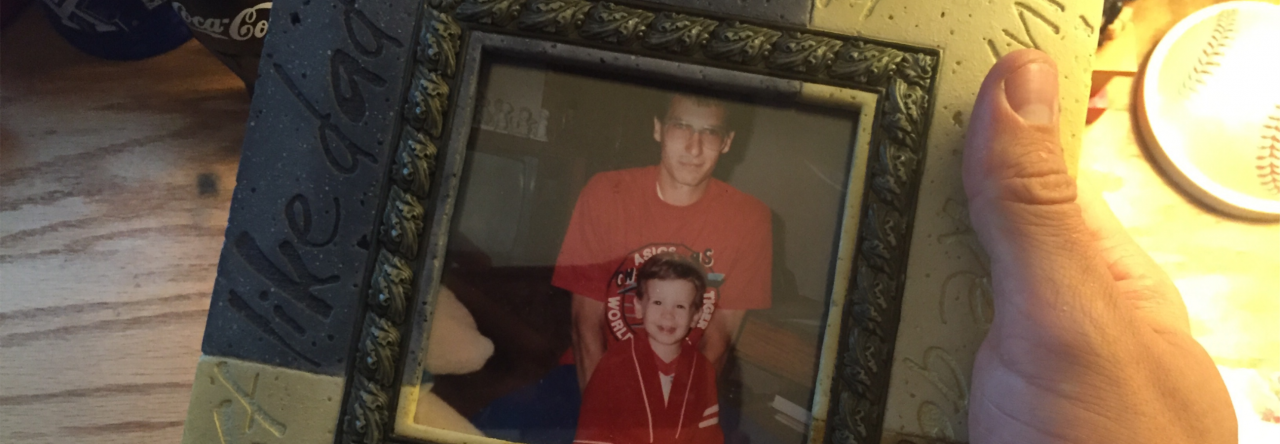

Ty: There is a deep mystery in my life. One that plagues me to this day…
How is it possible that my Dad could raise a son who was such a terrible, horrible athlete?
I’ve written on this topic in a number of different posts, mainly because so many of my childhood exploits involve my failures as an athlete. I should probably link to a post so you can sample it, but it’s impossible to link to so many different stories, because my lack of athleticism has been a frequent topic of conversation on this forum.
This probably surprises you if you knew my Dad, because he was a naturally gifted athlete. My Dad was a super-speedy runner, which served him well at about any sport he tried. My Dad absolutely loved playing basketball. Even as he aged, he could beat most of the younger players up and down the court at our weekly church pick-up games on Monday night. He was a natural wide-receiver for backyard football games because he could outrun any coverage. Even when he played kickball with my neighborhood friends, it was easy to see just how fast he really was. He could scoot around the basepaths quicker than anyone. I guess the moniker “Scooter” was well earned.
More than any sport, however, I think my Dad excelled at baseball and, later in life, softball. I will always remember my Dad as a softball player. From the time I was little, I remember tagging along with him to the North End softball diamonds on Joe Nuxhall Boulevard and watching him play with our church teams. I remember the countless weekend tournaments he played in, usually always playing for a team that had a legitimate shot to win. At least once a week, and usually multiple nights, my Dad was having fun at the softball diamonds: playing in some games, and usually talking with his teammates for hours after.
I, on the other hand, just hoped that if I went with him as a little boy that he would take me for a Flubb’s ice cream afterwards.
Most guys who play softball annoy me beyond belief because they think that being good at softball means being able to hit a ball over the fence (even though it’s an underhand pitch, but I digress…). My Dad, however, took a different approach to the game of softball. Never the power hitter, my Dad learned how to “hit it where they ain’t.” He could place his hits, which is extremely valuable in softball when defense really isn’t a popular option. Then, my Dad would speed around the bases, legging out doubles and triples on a regular basis. In fact, my Dad never hit a homerun over the fence one time in his entire career…but he had a few inside-the-parkers which, in my opinion, is even more impressive.
Where most softball players begin to tire out as they age, my Dad just got better and better. Always wearing an 11 across his back (he only wore numbers that were “symmetrical”), Dad continued to play softball until the week he died. I made it a regular habit to go and watch his games as often as I could (still, secretly, hoping for that ice cream). I look back on the times that I didn’t go to his games for one reason or another, and I wish that I could turn back the clock and see him play once more.
As he got older, however, my Dad did a curious thing. He would take himself out of the lineup. I would show up to his games, knowing he was just as talented as anyone on the field, and I would see him sitting on the bench with his hands by his side in his uniform, watching the game intensely.
When that was the case, I would always go and sit next to him and ask him why he wasn’t playing, and I would always get the same answer from him:
“I’d rather let the young guys play.”
I would shake my head at my Dad and get mad at him when he gave me this answer. Oftentimes, I would look out onto the field and see the player who had taken his position in left center. And usually on cue, that particular player would misplay a routine fly ball or miss the cut-off man on a throw to the infield. It was infuriating because I knew my Dad, even as he aged, was better in every aspect of the game.
Late last week, right when I needed it most, my pastor, Dave Hicks of Walden Ponds Community Church, sent in a story about my Dad using the “Scott Stories” feature at SeeyaBub.com. It gave me a different perspective on why my Dad did what he did, and it reminded me of why he was such a special person. I’d like to let Dave share that memory with you.
Dave: I met Scott Bradshaw in 1987 at a softball tournament in Hamilton, Ohio. I was asked to play with a bunch of guys from his church. It was the first time I played with that team before, so I was a little nervous. I remember being casually introduced to the team by the guy who asked me to play (coincidentally, he was the same guy who set my wife and I up on a date for the first time) and I put my stuff on the bench. I hadn’t warmed up yet, but was too shy to ask any of those guys to throw before the game started. My plan was to just to pretend that my shoes needed to be re-tied so I could keep my head down and wait for the first pitch.
As I was trying to be inconspicuous, Scott came over, introduced himself, and asked if I needed to warm up. I accepted his offer and, at that moment, began a friendship that would last for decades to come.
As I got to know Scott more and more, I noticed that his friendliness to me that summer day was just another day in the life of Scott Bradshaw. I know it sounds like a cliche, but Scott literally never met a stranger. And if you remained in his presence for more than a few minutes, he quickly became someone you wanted to know better.
Scott has his mischievous side, as well. One time, I attempted to install a piece of linoleum in the kitchen of my in-laws’ house. I am not a handy guy at all, but I gave it a shot. When I finished, it couldn’t have been more of a disaster if I had done it blindfolded. My father-in-law called Scott and he came over to help salvage the project. As soon as he arrived, Scott started laughing, along with my father-in-law, at the mess that I had created. And, because it was Scott, I laughed along with him.
You see, a person couldn’t get mad at Scott because you knew it was never malicious. It always came from a place of love. So, from that failed project on, Scott managed to work that story into conversation as often as possible. And, as I did that day, I would laugh with him every time he told it.
Normally, people don’t enjoy being teased. But, today as I remember those moments with Scott, I would give just about anything to laugh with you again, even if it is at my expense. And, I would give anything to be able to say to you, as you always said to your son, Tyler, “Seeya, bub.”
Ty: I look at Dave, who is now the pastor of my church and someone who challenges me to be a better follower of Jesus each and every day, and I see the impact that my Dad made on him. I see how a simple gesture, like saying hello to the new guy on the softball team, could make a huge difference. And it makes me feel bad about ever questioning why he would voluntarily sit out of a game.
To my Dad, softball was fun; but life was always bigger.
My Dad made a habit of letting the young guys play and making them feel welcome on the team because he knew how much it would mean to them to have somebody as good as my Dad give up his spot for them. He was validating them. He was making them feel that they mattered. And he knew that, even if they made mistakes, they needed to play and learn to get better.
But my Dad didn’t just give up his spot for that player. You could watch him and you knew right away that he was making an effort to support and coach that player from the dugout as he sat and watched. If they made a good play, Dad would run out of the dugout during the middle of the inning and give them a high five and a pat on the butt. If they made a mistake, he would talk to them when they came in the dugout and give them some pointers—but people always took his criticism well because they knew it came from a heart that wanted to make them better, not a heart that wanted to show off how much he knew. Dad would shout base-running instructions or coach third base, and even though he wasn’t technically in the lineup, he was still in the game.
I have many words I use to describe my Dad: thoughtful, considerate, kind, loving, hardworking, faithful, hilarious, and many, many more. But if I had to pick just one word, I think that word would be humble. My Dad was well-liked by so many people because he was one of the most humble individuals I’ve ever met. And although there were many places throughout our community where my Dad was well-liked, he was extremely admired by those who played softball with him—and even those he competed against.
The beautiful part about all of this is that my Dad found a way to be humble while never losing his competitive spirit—and never failing to teach those younger players. One of my favorite memories of my Dad is when he played on a church team that had a number of young players (mostly high schoolers) who were some of the most egotistical athletes I have ever seen. They thought that softball would be easy because they had some athletic ability, but time and time again at the plate and in the field they showed athletic ability was not enough to outweigh stupidity (yes, I said it). They swung for the fences every single time…and 90% of the time their swings would end in an easy fly ball for the opposing outfielders. They would make simple base running errors, and my scoresheet was absolutely littered with “E’s” from their mistakes in the field. And they would often violate one of my Dad’s cardinal rules by failing to run out a ball in play regardless of whether or not you were likely to reach first base.
There was one player in particular (I’ll call him Shawn here) who had a sense of arrogance about every single thing he ever did. My Dad would often get frustrated with him because he was living in a dream world in which he thought he was God’s gift to softball. Oftentimes, he was God’s gift to the other team.
One night, Shawn made a comment about how he could outrun my Dad. My Dad just smiled, but then Shawn continued to make the comment. So, having heard enough, my Dad told Shawn he would race him down the line after the game was over. The team gathered eagerly, and I said a quick prayer that Dad wouldn’t injure himself. Shawn ran harder than I had ever see him run in his life once we said “Go!”, but he was still a good two lengths behind my Dad when they crossed the finish line. Shawn’s face was red and strained, but my Dad looked like he was just getting started. He made it look effortless. He did a little strutting and a dance I can still picture today, gave out some high fives, grabbed his ball bag, and we got in the truck. I’ll admit (and ask for forgiveness) that I probably said a few “non-Christian” things about that little jerk adversary on our ride home. But Dad just smiled, knowing he had proven his point without completely humiliating his competitor.
I think my Dad did this, to show that young punk…I mean, child of God, that he wasn’t all he thought he was. My Dad did this not to show him up, but to show him humility. To show him that in life, there is always room for improvement.
My Dad really was playing some of the best softball of his entire life right up until his death. He played with Dave on the Walden Ponds Community Church team, Dave often in left field with my Dad next to him in left center. When the team got word of my Dad’s death, the coach of the team, Mel, went out and bought a bunch of white sweatbands, just like the ones my Dad always used to wear on his arms. Mel sat down and drew the number “11” on each of those sweatbands, and with a heavy heart, the team went out and played for the first time without my Dad—each player wearing those handmade sweatbands.
I have one of those sweatbands that I’ll cherish forever. I have trouble going to softball games now, because it’s just too hard for me to go and look into the outfield and not see my Dad. But I hear memories from people like Dave, and I think back to the numerous people that Dad came in contact with, and I know that he played the game the way it was meant to be played. And I’m not talking about softball. I’m talking about the game of life.
 Dad, Even though you weren’t able to mold me into a terrific athlete (yes, I’m going to blame this on you), you never quit teaching me that athletic competition was just a vehicle to deliver some of life’s most important lessons. You taught me about humility, hard work, dedication, courage, and competition. You knew that, when you compete, there are lots of people watching how you react to adverse situations. And you always, always made sure that your character was on display. I wish I had been a better athlete because I wanted to make you proud, but I hope you know how much I enjoyed watching you compete…and how much I desperately wanted to be like you. Dad, you made a tremendous impact on people each and every time you played. Thank you for being a character-giant in my life. Thank you for always giving me a solid example of Christ-centered love to look up to. And thank you, seriously, for putting up with my pathetic arm when we would toss. When I’m perfected in Heaven, our games of toss will be a lot more fun. And until that day, seeya Bub.
“Nevertheless, the one who receives instruction in the Word should share all good things with their instructor.” Galatians 6:6 (NIV)
 Dave Hicks
Senior Pastor, Walden Ponds Community Church of the Nazarene
Dave serves as the Pastor of Walden Ponds Community Church of the Nazarene, located in Fairfield Township. For decades, Dave has served in youth and adult ministry at the local and district level, preparing the hearts and minds of young Christians, and encouraging them to serve others. Dave’s belief that “God is good, all the time” drives his work in the church, as he continues to grow and serve the local congregation at Walden Ponds with an innovative approach to Christian ministry.

 Dad, I never thought I’d have to experience life without you so soon. I had images of you growing old, and I was excited to see you enter new chapters of your life, because you always had a sense of adventure. There are days, many days, when I feel helplessly lost without you. It always feels like something is missing when you aren’t around—it’s like there’s a gaping hole that can never be filled perfectly, even though good things are happening all around me. You brought such life to my life, and now I try to use your memory to fulfill that. I look forward to life in Eternity when the “you aren’t here” times are simply a thing of the past. Until that day, I’ll continue honoring your memory and loving you with all my heart. Seeya, Bub.
 When I was a kid, one of my favorite books was one that my Mom bought for me at a library book sale called “
 Dad, I hate that the confusion over your death would even lead to any doubt about whether or not you loved me, but I’m glad that I can quickly rely on the truth of God’s Word and the example you gave me each and every day to reaffirm your love. You were the epitome of a loving Father. I try each day to love people the way you did, and no matter how hard I try I know that I’ll always fall short—that’s how high you set the bar. You made love your mission. You made love your calling. You let God show you how to love, and then you showed God’s people how to love in everything you did. I pray that I’m able to become more and more like you as days go by. As those days pass, I rest assured knowing I will get to see you again. I’ll get to feel your hug and see your smile and know that everything about you is right, even though your circumstances here on Earth weren’t. Keep loving me, Dad. Keep watching over me and pushing me to be a better man. I’ll never stop loving you. Until I can tell you in person, seeya Bub.

 Dad, Each day I wrestle with telling your story and making sure people who never knew you know the type of man you were. I want them to know you were strong. I want them to know you were thoughtful. I want them to know you were caring and loving and everything a Father should be. I hope that the words I choose to use convey the love I have for you and the love you gave to all of us each and every day here on Earth. You never inflicted pain with the words you chose. You built people up by telling them and showing them how important they were to you. You and I had many wonderful conversations together, and we shared so many words. I’m sorry for the moments that my words may have hurt you. I wish I had spent more time telling you the words you deserved to hear—that I loved you, that I was proud of you, and that I was always there to listen when you were hurting. I know that we will have these conversations again. I wait longingly for that day. But until our words meet each other’s ears again, seeya Bub.
  Seeya Bub