
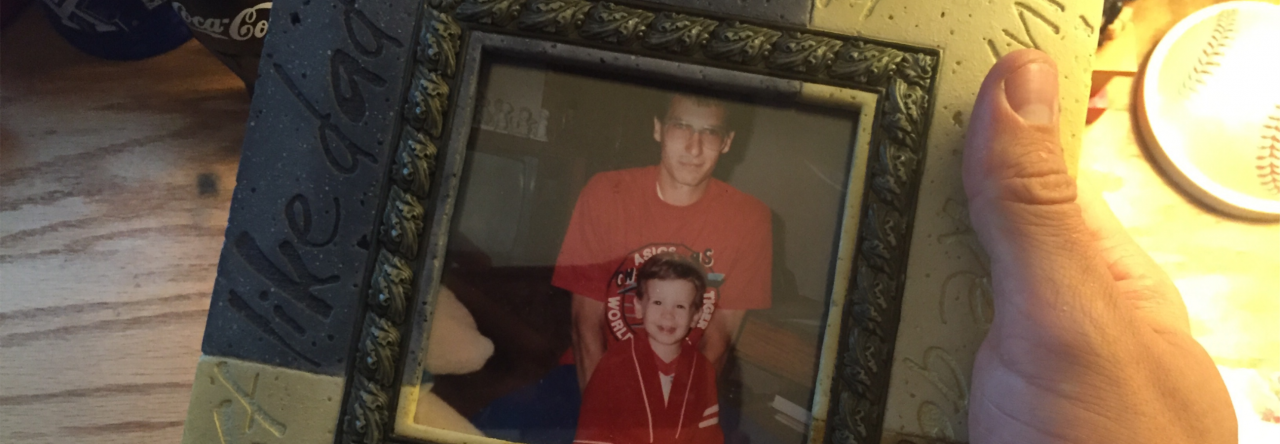

Ty: I often wonder what my Dad was thinking in the final moments of his life.
I’ve mentioned many times that I suffer from anxiety. There have been times in my life when the intensity of anxiety is so real that it completely shuts me down—physically, emotionally, mentally, and spiritually. It has caused me to call in sick to work. It has caused me to lock myself in my room and turn off all the lights.
But it has never, ever caused me to be suicidal.
Even in the darkest depths of my anxiety, I’ve never had a suicidal thought or temptation. I’ve never had the urge—conscious or subconscious—that I should run towards death. Mental illness manifests itself differently within the mind, body, and spirit of each sufferer; and those manifestations are widely varied.
Which is what makes my Dad’s death so difficult to understand, and explains my curiosity about his thoughts in those final, desperate moments. My Dad suffered from depression, which is entirely different from the mental illness I’ve combated. Because of this difference, it’s hard for me to understand how my Dad could have died from suicide. As someone who has never had that urge or temptation, it’s hard for me to understand how my Dad’s mind could have become so ill that it told him to take his own life—even though I’ve never blamed him for his death. I want to understand the incomprehensible so I can sympathize with my Dad for the years and years that he suffered.
Which is why I’m so thankful for Reverend Dan Walters.
This is Pastor Dan’s third installment at SeeyaBub.com, and in this extremely vulnerable post, my friend does something that very few men (and especially ministry-leading men) have been unable to do—he speaks honestly and courageously about his own suicidal temptations and urges. Reverend Walters also tells the stories of the distraught individuals that he ministered to throughout his journey—some of which were saved, and some who were not. Personally, Dan Walters has done for me in this post what I thought I’d never be able to achieve—he’s given me a snapshot into the mind of someone who has been tempted to die from suicide.
I’m glad that Pastor Dan is still here. I’m glad that he’s here to write this important message. I’m glad that he’s here because he matters. And you matter. And more than anything, his words will help those of you who (thankfully) don’t suffer from mental illness recognize its destructive power.
Rev. Dan Walters: It is said that a man can live about 40 days without food, about three days without water, about eight minutes without air, but only for one second without hope.
The causes for suicide are many. However, one thing that is common among all suicidal victims is the feeling of hopelessness. The apostle Paul wrote “If we have hope in this life only, we are of all men, most miserable,” (1 Corinthians 15:19). The apostle Peter wrote, “Blessed be the God and Father of our Lord Jesus Christ! By His great mercy He has given us a new birth into a living hope through the resurrection of Jesus Christ from the dead,” (1 Peter 1:3). It is only because of God’s grace and this living hope that many more of us do not become victims to this dark, mentally unstable state of mind called suicide.
Sometimes we feel hopeless as a result of making a major mistake, suffering a big disappointment or loss, or when we have to deal with an overwhelming situation which leads us to despair—which is the feeling of not having any hope left. That which leads an individual to this kind of “hopeless despair” is very complex and difficult to understand to say the least. However, a person who has experienced this kind of despair, and lived to tell about it, indeed is a person who has been plucked from the grip of suicidal death—That would be me!
In my own experience with the temptation of suicide, I came so close to crossing over what I call the “black line of no reasoning,” where I could not distinguish between the “conscious mind” which deals with the present reality, and the “unconscious mind” which deals with things that it perceives to be true. According to many psychologists, the unconscious mind influences our feelings and our judgements and ultimately becomes the driving source of our behavior, which will eventually conquer the conscious mind and affect how we perceive reality. I read somewhere, and I believe to be true, all of us have the capacity to practice brainwashing on ourselves. If we do not or cannot find our way back into that state of mind which deals with the reality of the present, we can ultimately find ourselves without hope – and as I said earlier, no one can live one second without hope!
The “black line of no reasoning” is the line of demarcation between the “conscious mind” and the “unconscious mind.” This is the place where the battle for hope is fought and the will to live is won or lost. It is here where the victim crosses over into the total darkness of despair where hope is diminished and there’s no way back. It is here where suicide and death appear to be a friend and the only solution from unbearable mental pain. While I cannot explain it in professional terms, I can say that I was there and felt the coldness of total darkness and experienced the lure of suicide—which appeared to be the only victory over my mental war.
I wrote in my book The Trap of Silent Depression that I could not openly reveal my battle with depression to anyone for fear that they would not understand and label me as sick and unfit to pastor my church congregation. This ultimately led me deeper into a state of “emotional isolation.” I had this feeling of being cut-off and alone, and at times even forsaken by God, and it was this aloneness in the intense darkness that I could not bear, and it was tempting me to cross over the “black line of no reasoning” from where there could be no return.
As a pastor, I had dealt with so many families who suffered losing a loved one to the terrible act of suicide, and in some strange way these experiences may have been a factor in keeping me in touch with reality when suicide came luring me into its darkness. When I cried out for mercy, I could hear the many voices that cried out to me across the past many years, and it would shock me back into reality—at least for the time being.
My first memory of a suicide victim was a man in his late forties who had a beautiful wife and teenage daughter. He was a Christian man who loved God and his church. One day I received a call that he, without warning, had taken his life and the family was overwhelmed with grief. His mental pain was finally over, but the family’s pain had just begun.
The Bible says in Romans 14:7 “For none of us lives to himself, and none of us dies to himself.” This is especially true in the case of a loved one who dies from suicide. The act itself may be a self-inflicted wound on just one person, but the after effects will be long lasting wounds that will be inflicted on many who are left behind. More often than not they will deal with the painful thoughts, the negative feelings, and unanswerable questions such as: What could they have done to prevent it? Whose fault was it? Should I have said or done something different? And the blame game begins as we think to ourselves “if I would just have been there,” or “was it something I said or did?” The questions never go away, and it’s a difficult burden to bear.
The funeral service for this man was one of pain, sorrow and terrible guilt, especially for his teenage daughter. The last words she spoke to her father were unkind and hurtful. This would be the final conversation and lasting remembrance of her dad in this life. And now, reality had set in, and the father she had always taken for granted was gone forever. I will never forget the scene at the end of the funeral service. I’ll never forget that young woman becoming so emotionally overwhelmed, and laden down with guilt, that she literally tried to climb into the casket and pull her father up to herself as she cried “Daddy, Daddy please forgive me, Daddy, Daddy I’m so sorry, Please wake up Daddy, I want to tell you that I love you.” It was a horrible ending to a life otherwise well-lived. The truth is this—we must live each day as if it is the last and give our roses while we are still living. The Proverb writer reminds us “Do not boast about tomorrow, for you do not know what a day may bring,” (Proverbs 27:1).
Several years ago, there was man who had checked into a Holiday Inn in Ft. Mitchell Kentucky. My name plate sat on the bedroom dresser which read, Rev. Dan Walters – Chaplain – and my phone number. I received a phone call after midnight from this man who was holding a gun in his hand. He had just left his wife and children and he said to me “Do you know of any reason why I should not kill myself tonight?” I consoled him and pleaded with the man to allow me to come to him and talk about his troubles. After a while, he agreed that he would not shoot himself until he heard me out. I nervously arrived at the motel at approximately 1:30 in the morning, and there he sat on the bed in his room with a loaded pistol in his hand.
I first prayed for my own protection and then I pulled from the dresser drawer a Gideon’s Bible and began to read scriptures about God’s love for him from John 3:16: “For God so loved the world that he gave his one and only Son, that whoever believes in him shall not perish but have eternal life.” The “unconscious mind” that was losing touch with reality slowly surrendered to the “conscious mind” and he returned to reality and now was seeing things through the eyes of hope. We prayed together and he repented before the Lord and accepted Christ into his heart. Christ restored his hope, and he packed up his suitcase, got into his car, and went back home to his wife and family and reconciled. Suicide was defeated and death was cheated—all because of the hope he found in Christ Jesus—Good ending!
God has a plan for each one of us. He says so in Jeremiah 29:11: “For I know the plans I have for you,” declares the Lord, “plans to prosper you and not to harm you, plans to give you hope and a future.” However, we also have an adversary, our enemy Satan, whose desire is to destroy us. This is why so many become weak in their faith. In their weakness, they are lured to the “the dark line of no reasoning” and if hope can be dispelled just for one second it could be enough to cause them to cross that dark line where sense and logic has no reason.
In Ephesians 6:12, the apostle Paul writes, “For our struggle is not against flesh and blood, but against the rulers, against the powers, against the world forces of this darkness, against the spiritual forces of wickedness in the heavenly places.” He warns us that we are in a “struggle” for life-and-death. That’s the kind of battle all humans face every day to varying degrees; however, for the person who is fighting mental illness this struggle is magnified many times over!
Finally the lingering question is always this: “What about the Christian father who for some unknown reason took his own life?” Whatever the momentary weakness and brief lapse of hope that caused him to take his life remains a mystery. Why he lacked courage to face the future we may never know, but in his state of mental illness he crossed over the “dark line of no reasoning” and it finally proved to be too much. One thing I am sure of for the Christian who dies this way, no amount of good works can earn God’s salvation, and no amount of bad works, such as a mental illness, disqualifies a person from God’s saving grace. There is a great difference between Satan getting a temporary upper hand and Satan being the Lord of life. While the battle for this life may be tragically lost for some who unintentionally cross the line of no reasoning, let us remember that the war over death and the grave was won on the cross at Calvary when Jesus looked up to his Father and said “It is finished. O death, where is thy sting? O grave, where is thy victory? The sting of death is sin; and the strength of sin is the law. But thanks be to God, which giveth us the victory through our Lord Jesus Christ,” (1 Corinthians 15:55-57). This is our hope!
Ty: Just like the man in his story, I’m thankful for Dan Walters. I’m thankful that he can provide such clarity to the spiritual and psychological battle of suicidal ideations. To the outsider looking in, these battles might seem trivial; but they are complex, and the consequences of these struggles can be detrimental.
Ultimately, we must do what Reverend Walters has done in this post. We must share our burdens with one another. We have to refuse to live with our mental illnesses in isolation and solitude. We must speak our troubles into the light; first to God, and then to one another.
I have no doubt that Satan is real, and I have no doubt that he rejoices when we suffer from mental illness and suicidal temptations. And just like he did on the day Jesus was crucified, I’m sure he is satisfied when another child of God dies from a successful suicidal attempt. Ultimately, however, I would give anything to see the look of shock and bewilderment on his face when Jesus welcomes that suffering son or daughter through the gates of Eternity. On the cross, death was defeated—for everyone. And that includes the son or daughter who struggles with mental illness.
It gives me tremendous comfort to know that one of those sons is my Dad. It gives me unbelievable peace to know that my Dad, despite his faults and failings, will be welcomed into the everlasting love and mercy of a God who forgives and understands. It gives me hope that I’ll see him again—I’ll hug him, and touch his face, and hear his laugh once more. That reunion is coming—not because of anything I’ve done, but because of what Jesus does.
But it’s just as important that we not use God’s mercy or forgiveness as an excuse to stop fighting to prevent suicide. Mark my words—suicide is never, never a part of our loving God’s plan. Everything I’ve read in the Bible and learned from spiritual counselors tells me that suicide is not a desire for a loving God. In fact, suicide occurs, in part, because of a lack of love for oneself, and God tells us over and over again that he cherishes us as his most prized possessions. Suicide disrupts love and life, and it leaves too much collateral damage amongst those who are left behind to pick up the pieces, just like the young daughter from Reverend Walters’ story.
But our God redeems bad endings. Our God finds fertile ground within the soil of destruction. He doesn’t ever wish for suicide; but He redeems the awful pain that occur when it happens.
I’m thankful that He’s offered redemption to Pastor Walters. I’m thankful that He’s offered redemption to my Dad. And as I struggle to navigate the difficulties of life without my Father, I’m thankful that he continues to redeem my own pain day by day.
 Dad, There are many moments when I think about your last day here on Earth and wish, desperately, that it would have ended differently. I can’t even begin to fathom or understand the pain and despair you must have felt in those moments. You loved life so much, which shows me how much hopelessness you were experiencing to believe that life wasn’t worth living any longer. I cry when I think of those moments because, Dad, you were so loved by so many. You should be here, right now, living life and loving every step along the way. You deserved that type of hope. But Dad, even in the midst of the pain you probably felt in those last few minutes, I’m grateful that you aren’t experiencing that pain any longer. You now reside in an everlasting paradise of joy, hope, comfort, and eternal fellowship with the God who loves you and loves all of us. Dad, I wake up every day wishing I could see you again. I picture your face and I can see your smile, and I just want you to be back here with us. But because you’re not, I’ll take comfort in the fact that I know where you are. And that I know I’ll see you again. I love you Dad. Until that wonderful reunion, seeya Bub.
“No temptation has overtaken you except what is common to mankind. And God is faithful; he will not let you be tempted beyond what you can bear. But when you are tempted, he will also provide a way out so that you can endure it.” 1 Corinthians 10:13 (NIV)
 Reverend Dan Walters
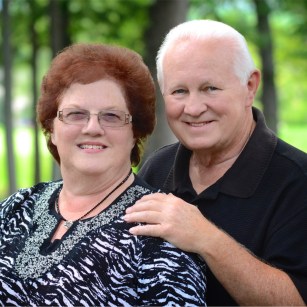
Dan Walters answered the call to preach in 1977 at age 31. He left secular employment in 1979 after fourteen years with the Ford Motor Company to enter full-time ministry. In 1982 Dan was ordained as an elder in the Church of the Nazarene and graduated from Mount Vernon Nazarene College that same year. He pastored churches in eastern Kentucky and southwestern Ohio. He retired in 2017 after almost 33 years as senior pastor of Tri-County Church of the Nazarene in West Chester, Ohio. Dan has been married to his childhood sweetheart, Darlene, for 53 years. They have three grown sons, Danny Scot and his wife Jenny; Darren Joel and his wife, Jody; and Devon Paul. They also have two wonderful grandchildren, Makenzie and Silas, who round out the Walters family. The family still resides in West Chester. Dan is co-author, with the late Stan Toler and Dan Casey, of an all-church discipleship program titled Growing Disciples. He has also developed a church leadership and growth program called “The G.R.E.A.T. Church.” Reverend Walters’ first book The Trap of Silent Depression: My Untold Story of Rejection, Depression, and Deliverance was published in 2018 and is currently available at Amazon.

 Every single day is difficult—all 1,827 of them; but every single year, July 24 is a date that stares at me from the calendar. It looms in the distance for months, and when it passes, I always breathe a sigh of relief that it’s come and gone. But I know, deep down, that it’s coming again. It will always be there. No particular July 24 has been more or less difficult—just different. But because of the nice, round number, this one feels like a milestone. A milestone I wish I didn’t have to reach.
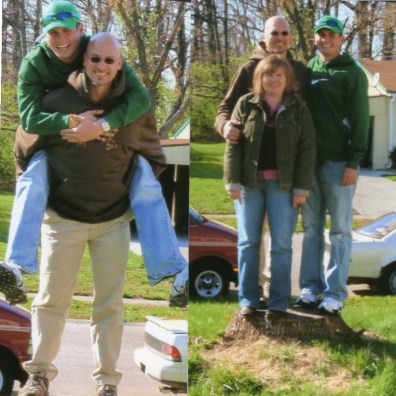 But guess what? No amount of procrastination could stop that date from coming. No amount of denial could stop me from thinking about what this day represents. This day would come—and yes, it would eventually pass—but the second it did, the clock just begin counting down towards another unfortunate milestone. The next Christmas. The next birthday. The next Father’s Day.
 On the other side of all that grief and sadness, there will be an everlasting love made whole again. On the other side of that grief, there will be a man whom I recognize, smiling and welcoming me into his arms. In that moment, I’ll love never having to say “seeya, Bub” again. That day is coming, although it’s very far off.
 Dad, I cry so much when I think that it’s been five years since you and I last talked. Sometimes, those tears are unstoppable. We never even went five days in this life without talking to one another. Dad, it really has felt like an eternity—but sometimes your memory is so real and so vivid that it seems like it was just yesterday when we lost you. But I know the real time. I know that it’s been five whole years since we’ve been able to be in your presence. And life simply isn’t the same without you. We all cling to your memory. We marvel at the things you built and the way you provided for our family. We laugh about the funny things you did to make life more fun. But I also weep when I think about how much life you had left to live. Dad, I’m so sorry that you were sick. I feel horrible that we couldn’t do more to help you find the cure you deserved. I’m sorry that you were robbed of the life you deserved to enjoy. I’ve felt so much guilt in losing you Dad. I know that you don’t want me to feel this way, but I just wish there was more I could have done. You deserved that, Dad. You deserved more, because you gave everything. As painful as these five years have been, Dad, I find peace in the truth of Eternity. I find comfort knowing that you are enjoying God’s eternal glory in a paradise that I can’t even begin to fathom. Dad, thank you for watching over me for these past five years. Thank you for never giving up on me—both in this life, and in the next. Thank you for giving me a lifetime of memories and an example of what fatherhood should be. I love you, Dad. I always did, and I always will. Thank you for loving me back. Until I see you again, seeya Bub.
 Dad, There have been so many times when I’ve thought about the fear you must have experienced in your life. You were always my Superman—that strong rock and foundation in my life when everything else seemed dangerous. On the outside, you were always “Mr. Fix It,” and I know it bothered you that you couldn’t solve your own struggles with depression. On the surface, you always held everything together—for your family, for your friends, and especially for Mom and I. But Dad, I wish I could have told you that your struggles with mental illness were never a disappointment to any of us. We never thought less of you when you battled with your depression. Sick or healthy, we always loved you and wanted to be near you. You were never a failure to us, Dad. You never failed us, and I wish you had known that more. I am afraid of doing life without you. I have a fear that I can’t do what God is calling me to do to tell your story. But I know that He is with me, and I know that you are with me. I know that you are watching down and pushing me and urging me onward, just as you always did when you were here with us. We all miss you, Dad. We will never stop missing you. You never let me down, and I can’t wait to tell you that in person. Until that day, seeya Bub.
 Reverend Dan Walters

 When I was extremely young, my family never took beach vacations. To this day, I’m not sure why because we all loved the beach so much. My very first time seeing the ocean was on a family trip to Panama City, Florida as an eighth grader. Our entire family (grandparents and cousins included) spent a wonderful week on the Gulf Coast, and I remember the momentous nature of that trip, even as a middle schooler. A 12-hour, multi-day car ride had finally concluded, and my Mom and Dad walked me out towards the ocean once we arrived. With my parents, I saw the ocean for the very first time and I got to experience its magnitude. I got to touch sand, and taste saltwater, and splash in the world’s largest pool. Even as a young kid, I appreciated the significance of this experience.
 After a really, really long drive, my family finally arrived to our condo in Gulf Shores. Shortly after arriving, I think we all knew then that we had found our family vacation spot. There was something about it that made us feel like we were home.
 As I’ve written before, Dad was a tremendous athlete. And also as I’ve written before, I was a horrible one. But Dad never let my lack of athleticism curb an opportunity to play. At the beach, Dad and I could throw a frisbee for hours—as long as the wind cooperated. We would warm up close to one another and gradually step back as we threw until we would finally hit a point where we had to wind our torsos like a corkscrew to get the frisbee to sail over the white sand. Dad and I would leap and dive into the sand to catch a frisbee—his leaps and dives always significantly more graceful than mine—and we would yell at each other for not being able to properly hit our target. “Did you actually expect me to catch that?!” we would yell across the beach at one another. “You’re gonna kill a kid with that thing if you don’t learn how to throw it!”
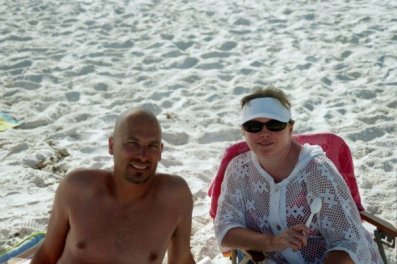 And at the beach, Dad never played it safe. More than anything, I think Dad and I probably got the most enjoyment of our daily game of “See Who Can Swim the Furthest Out from the Shore and Make Mom Freak Out the Most” (catchy, no?). Much to my Mom’s displeasure, Dad and I were notorious for jumping into the water and swimming straight ahead until our arms gave out. The water would grow colder and colder the further we would swim, and periodically Dad would stick his arms high above his head and straight-dive down to see if he could still touch the bottom. If he could, we still weren’t out far enough. All the while, my poor Mother would sit anxiously in her beach chair watching our bobbing heads grow smaller and smaller in the waves. The best version of the game was on the beaches where there were life guards on duty, and in those scenarios, we tried to see how loud we could get them to blow their whistles at us! We knew we were really killing the game if we could swim far enough to encounter a deeper sandbar, and if we did, we would sit out on the sandbar and rest until it was time to swim back in. Dad would wave to Mom on occasion from the depths of the mighty ocean, and it was amazing how peaceful the deep ocean water can be. All the ambient noises of the beach fade away when you’re that far out (you especially can’t hear life guard whistles or motherly-shrieks).
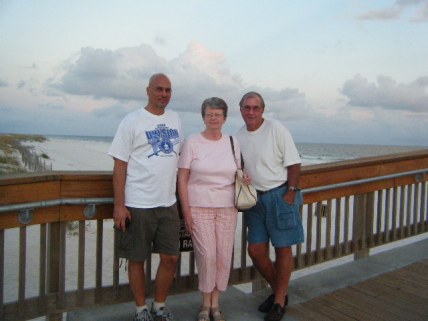 My Grandpa even told a story at Dad’s funeral about his love for always being the last one up. On occasion, my family would take vacations with our extended family, which included my Grandpa Vern, Grandma Sharon, my Uncle Lee, my Aunt Beth, and my two cousins Jake and Megan. Those were always wonderful vacations, and every day, my Grandpa and my Dad were always the last ones up to the condo. But even my Grandpa couldn’t hang with my Dad.
 Standing there at the beach, I told Steve how much I missed my Dad. I really didn’t have to say anything, because Steve knew—and he was experiencing the grief himself. Steve had been tremendously close with my entire family, and my Dad treated him just like he would treat his own son. Instead of only crying, though, I was able to share tremendous memories and stories of my Dad, telling Steve all about the funny things he had done at the beach on our family vacations. I shared stories about Dad’s Banana Boat expedition, his wave-runner sandbar collision, and how he was always the last one up for dinner. Little by little, the tears were slowly replaced with a smile and laughter. I didn’t miss him any less; I just had a different focus. Instead of focusing on the loss, I was able to focus on his life. Instead of focusing on the time we didn’t have together, I focused on all the wonderful times we did.
 I spend a lot of time on the beach during dusk as many of the families on the shore will begin to retreat to their condos. And I do this for a simple reason: that’s what Dad would have done. I’ve learned why he loved it so much. As the beach starts to quiet down from a busy day of frivolity and fun, there’s a quiet stillness that begins to wash across the shore. That stillness is enticing and comforting, and it’s in those moments that I often feel closest to God. And I think about how peaceful those moments must have been to a man who struggled with depression. Dad treasured that peace. And now, I treasure the memory of his life during those peaceful moments, and I try to live it out every chance I get.
 Dad, there has never been a time when I’ve gone to the beach without thinking of you—and there never will be. You made our time at the beach together so memorable, but more than that, you taught me so many important life lessons while we were there. You taught me to slow down and relax. You taught me to soak in God’s beautiful creation. You taught me to be kind to people and get to know them, because God created them, too. You taught me to let go of all the busy things from back home and simply enjoy the life that was in front of me in that moment. I take these lessons with me everywhere I go, but especially when I go to the beach. Even though I’m still able to have fun when I go, it just isn’t the same without you. I miss our throwing sessions, and sometimes I’ll just carry a baseball in my backpack to turn over and over in my hands and think of the time we spent together. I miss trying to see who could swim the furthest out, and watching you beckon me further even when I felt like I couldn’t keep swimming. I miss walking along the shoreline with you and listening to your stories about oil rigs in the distance or planes flying overhead. You had an inquisitive, appreciative spirit for all life had to offer. And more than anything, I miss watching you enjoy those moments on the shore by yourself being the last one up. It’s strange, but sometimes it’s like I look down from the balcony and I can still see you sitting there. Dad, I know you’re still with me. I know that you’re guiding me and watching over me in everything that I do. Thank you for always being my best teacher. Thank you for being a Dad unlike any other. And thank you for always teaching me that the last one up wins. I love you, Dad. I miss you tremendously. I sure hope there are beaches in heaven, because if there are, I promise I’m going to swim further out than you. Until that day when we can be beachside together again, seeya Bub.
 Dad, I wish you could have read Reverend Walters’ book and heard his story, because I think you felt many of the things he did. I know you struggled with how to share your hurt and your pain because you didn’t want to appear weak. You didn’t want people to think you were a failure. Dad, you never failed any of us—ever. You had an illness that you couldn’t understand, and I wish we had done more to help you escape the trap that forced you into silent suffering. But Dad, I know that our Heavenly Father has welcome you into His loving arms. I know that He is redeeming your story day by day with each individual who loves you and learns from you. Dad, I will never stop loving you. I will never stop trying to find ways to help those who are hurting like you were. Keep watching over me, because I can feel it. Until I can tell you how much you are loved face-to-face, seeya Bub.
  Reverend Dan Walters
 Dad, There were so many moments just like that night in college where your presence alone was all I needed to find happiness. You had an uncanny way of knowing the moments when people needed you most, and you responded with grace and unconditional love each time you were called. Nearly every day, Dad, I experience a moment when I just wish more than anything that you were here. I miss your smile, your voice, your heart, your shiny bald head, and everything that made you so very special. But in those moments where I experience your loss most severely, I try and remind myself that you are here. You are still watching. You are still listening. And you are still loving me and all those who feel your absence. Dad, thank you for always being there and for still being here. Thank you for being at my side at a moment’s notice–both in the moments when I knew I needed you, and especially in those I didn’t. I’ll never be able to say thank you enough. But, until that day when I try my best to let you know how much you are missed and how much you are loved, seeya Bub.
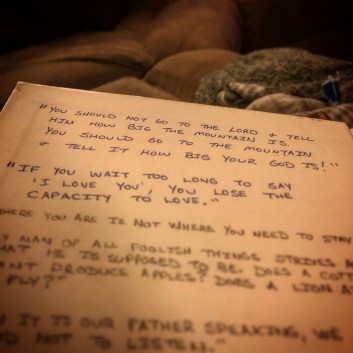 God wanted me to hear that message the day that I originally wrote it down, but he wanted me to live it in this new storm. That was the message God gave to me in a moment of ease to prepare me for a lifetime of perplexing grief. That was the message that God put on Harville’s heart, knowing he would need to pass it along to the members of the flock he cared for. That would be the message of my life, given to help save it.
 Dad, You were always so courageous and so brave, and I wish I had more of that in me. You never let a daunting challenge intimidate you. You believed in your ability, and you believed in your God. Ironically, it was watching your brave example that prepared me to survive the grief of losing you. You taught me that I could do anything if I believed in God and let Him lead my way. Dad, I don’t focus on the one battle that you lost with depression. Instead, I focus on the many years that you fought successfully and conquered your sickness. You tried so hard—for me, for Mom, and for those who loved you. You fought the hardest fight of your life each and every day, and you were unbelievably brave. I’ll always remember that. I’ll always live my life through your example. And until I can see you again and tell you just how courageous you truly were, seeya Bub.
 Dad, I can still go back to that specific Sunday morning and remember the quizzical look on your face when we were handed that baggie with a grape and a raisin. I can remember and picture the way you engaged in that illustration. I can remember you always reminding me many Sundays after that about how I needed to live with a grape heart. But more than all of those memories, I remember the way you lived. I remember the way you loved others. I remember the way you lived and loved with a grape heart every single day. I’m trying to live more like you because you always showed people that your love was more than a sentiment. It meant something and it made a difference. It’s hard to find people who love others the way you did—and the way you still do from above. I still feel your love each and every day. I still feel your love guiding me through all the good times and the difficult times, and I’m thankful that your grape heart lives on. I wish I could tell you this in person. I wish I could give you the praise that you deserved. Until I can see you again and give you a big hug, seeya Bub.
 Dad, I wish I had known. In spite of all your struggles that you dealt with each and every day, I never, ever thought that suicide would attack you and our family. I never believed for one moment that your life was in danger, probably because you shielded us from so much of your heartache in an effort to protect us. Dad, I wish I could have done more to help you. I don’t blame myself for what happened, but I would do anything to replay those moments when I should have done something. But in your memory and because you always taught me to help people, I’m trying to keep others from suffering like you did. I’m trying to make people aware of something that I wasn’t aware of until it stole you away from us. Dad, I miss you every single day. I wish I had many more minutes to spend with you. Someday, we will have those minutes and many more. Someday, we will be able to enjoy being together again. Until then, seeya Bub.
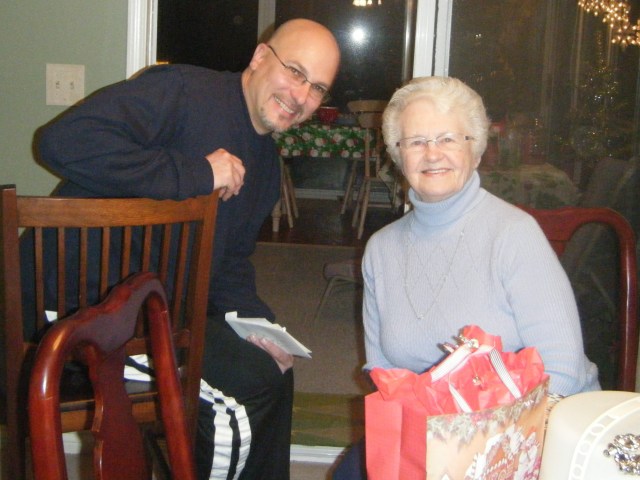 Positive, upbeat, and always smiling, my Aunt Vivian was more like a grandmother to me when I was younger. Both of my parents worked (and worked hard) to provide for our family, which meant I was often in the care of family members like my grandparents. And of course, Auntie was always in that rotation—and I couldn’t have been more thankful. Early on in my life, and during the summer months as I aged, I spent many a day under the loving and watchful eye of my Auntie. I’m a better man today because of all those days I spent with her growing up.
 I have a few prized and cherished treasures in my possession. They aren’t the things I’ve spent the most money on. They aren’t the name-branded and logoed sweaters I can’t afford but buy anyway. They aren’t the pieces of sports memorabilia I have accumulated. They are things that are truly irreplaceable. One of a kind. Sacred.
 Eventually, I got out of bed. Although there have been other days when I can’t. And during every one of those moments, I remind myself. Fear is knocking at the door. Faith must answer. My faith has led me through the challenge of my Dad’s death on days when I just couldn’t do it. It breaks my heart to watch families impacted by suicide or traumatic loss who turn away from their faith, because I know that my faith and the love of Jesus Christ has been the most important component of my survival in life after Dad.
 Dad, There have been so many days after your death that have been full of fear. I didn’t know what I would ever do without you, because you were such a rock for our family. While you were here with us on Earth, however, you gave us all a great example of what faith and courage looked like. Dad, you fought so hard for so long. I can’t imagine how many painful days you must have had and how many times you pushed through when life seemed unbearable. I wish that I could have done more to help you. I’m thankful that we’ve had wonderful family, like Auntie, to help us in your absence. But I know you’re still watching over us. All of us, each and every day. I love you, Dad. I continue to be afraid of what life will be like without you in the years and decades to come, but I know I’ll see you again. Until that day, seeya Bub.
 Seeya Bub