A Letter From Dad

A good teacher will teach you something that you didn’t previously know. A great teacher will teach you how that knowledge can make your life better.

And a spectacular teacher will change your life in ways you might not immediately recognize.

I’m thankful that in my many years as a student, I’ve had some pretty spectacular teachers—and one absolutely spectacular teacher who gave me an assignment that has helped me hold onto my Dad, even after I can’t hold on to him in person.

Of all the nicknames my Dad enjoyed giving to me over the years, I think he probably enjoyed my 9th grade school year more than any other because for an entire year, he was able to call me “Freshie.” Nearly every day when I was getting ready for school, I can remember Dad calling me “Freshie.” He loved it, mostly because I hated it. He could see the annoyance on my face every time he said it…which basically encouraged him to keep saying it. My Dad had a thing for nicknames.

I have many memories of that year as a Freshie. My first struggles with Algebra and Spanish happened that year. I met friends that would last far beyond my high school graduation. That was the year I started playing golf, and also the year that I would learn some fancy new adult words on the golf course that I would never use around my Mom! My freshman year of high school started in 2001, and I remember being in Art class when another teacher ran in and turned on our television, and for the rest of the day in every class we watched as the horror of September 11, 2001 unfolded before our very eyes. I knew on that day that my world would change, and it was probably the first time I really felt the pain of death, even though I didn’t personally know any of the people who died. My year as a freshie, in many respects, was extremely monumental.

But of all the things I remember from that freshman year, I remember and am eternally grateful for an assignment in my Work & Family Life Class.

My third block of first semester was Work & Family Life with Ms. Schultheiss. Ms. Schultheiss was a caring, personable, and relatable teacher who I immediately knew that I would like right away. She taught with a simple kindness and a sense of humor that made her immediately endearing. Having been pretty nervous about my first semester in high school, I was so appreciative that I would have a teacher who could help calm my nerves and validate me when I needed it most. Over the semester, Ms. Schultheiss would help me learn many things: how to cook, how to sew (I made my own stuffed lizard), and how to prepare for my journey after high school. These were all extremely valuable skills that I draw on quite often…well, maybe not the sewing as much as she would have hoped. But I remember walking away from that class with a feeling that I had grown tremendously as a student and as a person.

As the summer before that year drew to a close, I was extremely nervous about the anticipated academic difficulty of life as a high schooler. Not having an older sibling or any older friends, I didn’t really know what to expect. I had heard horror stories about hours and hours of homework, papers that stretched on for pages, and material that was difficult to grasp and comprehend. And then there was that whole Shakespeare guy. As a naturally nervous and neurotic little freshie, I worried that I wouldn’t be able to live up to the expectations of my teachers and parents.

That’s why I was surprised when Ms. Schultheiss shared our first assignment in Work & Family Life. It was not what I had expected high school work would be.

And I was thankful because…I really didn’t have to do much!

Ms. Schultheiss gave us a simple handout that explained our assignment. We were to ask a few adults in our life to write us a letter. Simple as that. These loved ones were to write us a letter that would share why they loved us. They would highlight our character, our good qualities, and why they thought we were special. Our loved ones would put the letters in an envelope, seal them, and give them to us. We would then bring the letters into class, show them to Ms. Schultheiss, and the assignment was complete. She wouldn’t even read the letters—we just had to show her that we received them.

I immediately knew who I would ask to write me a letter. I asked my Grandpa Vern and Grandma Sharon to each write a letter, which they readily agreed to. I also asked our neighbors and close family friends Shawn and America to write a letter. They both joked about all of the embarrassing things they would share in their letter, and they too agreed to write.

And, of course, I asked my Mom and Dad.

A week or so later, I collected the letters from each of my loved ones, took them into class, and showed them to Ms. Schultheiss. She checked my name off of the list indicating I would receive full credit (score!), and I returned to my desk, probably in my Nike sandals and a shortsleeve plaid button down, with six little envelopes in my hand. Ms. Schultheiss then told us that she was going to give us some quiet time to read our letters to ourselves at our desks.

I opened my Mom’s letter first, and if you know me well, you can probably guess what happened next…I began to cry. Yes, that shouldn’t be a surprise. I’m an emotional guy, and I’ve always been pretty sensitive.

But this was no time to be sensitive! I was a freshman in high school! The cool freshman weren’t sensitive. I could already tell that my sense of style and natural tendency to get lockjaw any time an attractive girl so much as stared at me were already going to make it difficult to make friends. If I started crying in class during my third week of high school, I would need to start lifting weights quickly to fight off all the butt-kickings I would receive over the next four years.

So I did what any mature, wise, and confident high school freshman would do…I became a complete coward. Like I’m sure many of my classmates did, I opened each of the letters, stared at the blank space in the corner of each page and pretended to read, and put the letters in my binder completely void of any tear stains.

But when I got home that afternoon, I could hardly contain the excitement of reopening each letter and reading the words my loved ones had written about me. I went through each letter and let the tears I had successfully contained in the classroom earlier that day pour freely.

I’ll never forget getting to my Dad’s letter. Always the jokester, Dad had even taken the envelope as an opportunity to show off his humor. In his familiar and precise all-caps handwriting, Dad wrote his full name and address in the return corner of the envelope. Then, he addressed the envelope to “Tyler S. Bradshaw (Same Address).” And if this wasn’t enough, in the postage stamp corner of the envelope, Dad wrote “No postage required if mailed to same household.” Typical Dad. #dadjokes
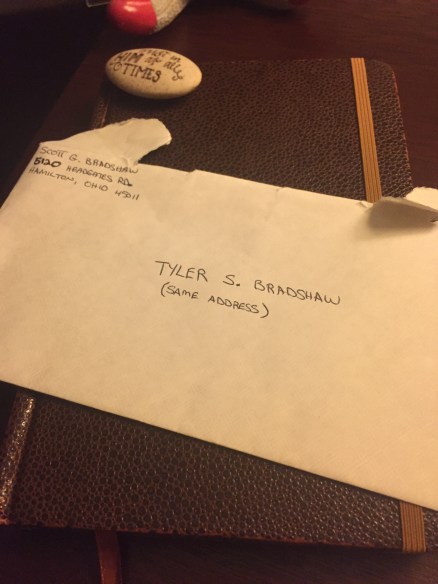
IMG_2987

I opened the letter to find a typed page from my Dad, emblazoned with the header “A Letter to My Son.” I read through his letter, and I cried like a baby at the words he shared with me.

And I still cry today every time I read it.

Yes, I still have all six of those letters that my loved ones wrote to me, but obviously my Dad’s letter took on a whole new meaning after his death. I remember going to the keepsake box where I kept some of my most valuable personal mementos shortly after Dad’s death. In the constant buzz and coming and going of family and friends in the days after Dad died, I knew that I would need to find a moment to myself to uncover that letter and read it before I said goodbye at Dad’s funeral.

So, one evening a few nights after Dad had passed, I locked myself in my home office, threw open the closet door, and took out my box of mementos. I shuffled through cards and drawings and photos, and then my chest tightened when I saw it.

Dad’s writing on the outside of the envelope. His message to me. Right there in my hands.

I cried before I could even get the letter open. Just seeing his handwriting there and knowing that his hands would never write those words ever again on this earth made the pain of his death impossible to comprehend.

There was lots of hysterical crying that night on the floor of my home office, but I was eventually able to collect myself enough to open the envelope and read the words my Dad had written to me.

In the midst of all the heartache and all the loss I felt in that moment, I also felt like my Dad was still there. Like he was still speaking to me. And that he was there telling me that, although my heart was bursting at the seams with pain right now, I would get through this.

Of course, Dad couldn’t just contain his humor to the envelope. He would have to make some jokes inside the letter too, and as I sat there with tears streaming down my face, I also couldn’t help but laugh. He told me that he liked me because two-thirds of my name was also two-thirds of his name. He also pointed out that I had captured many of his physical features and, as a result, had become a “fine-looking young man.” I would point out to him after first reading it that I still had a full head of hair, but that’s not the point…

Dad then went on to share how he admired me for my ability to be compassionate, and how he admired my intelligence. Dad also told me how he admired the fact that I was different from most children of my age.

Dad shared a lot of other things with me in that heartfelt letter. I could tell he had taken a lot of time to think through what he would write and how he would write it. His letter had touched my heart, and now it would continue to do that long after he was gone. I hugged the letter close to my chest, and rocked back and forth as I continued to cry, wishing he was next to me.

When I made the decision to start this blog, I knew that I would have to abandon the nervousness that had plagued me as a young freshie. I knew that I would have to become extremely vulnerable and share pieces of my life that I hadn’t previously shared before; all in an effort to help people who are suffering.

In that midst of that drive for vulnerability, however, I also knew that there would be areas of my life that would be off-limits. There would be things that I would not share. There would be things that were private and stories that would be just between my Dad and I. And to respect the intimacy of the letter he wrote to me, I’m choosing not share the content of that letter (and I hope you can respect my decision). Dad wrote that letter to me, and I’d like to keep it that way. I hope you can respect that.

And I’m also making that decision for this important truth: What matters is not what’s in the letter. What matters is that I have the letter.  

I am so thankful to Ms. Schultheiss for giving us that assignment. I am so appreciative that she found a creative way to teach us a lesson, while at the same time giving us a priceless artifact, a family heirloom that would be much more than a simple assignment. Ms. Schultheiss, you gave us a touchstone that we could come back to when times got tough and when life seemed unlivable. I’m sure that this particular assignment doesn’t satisfy a governmental decree or a requirement of No Child Left Behind, but it’s an assignment that every student should be fortunate enough to complete in their life. I’ve written many papers and essays throughout my life as a student, but I’ve never read and re-read an assignment even close to the amount of times that I’ve read my Dad’s letter and all the other letters I was written on that day. What I got in that assignment was even more important than the self-esteem boost that I’m sure Ms. Schultheiss had intended. I got a piece of my Dad that I could hold onto forever and ever. I’ll never be able to say thank you enough for that gift from a loving, wise, and brilliant teacher.

Even though I’ve chosen not to share the entirety of my Dad’s letter to me, I will share the closing sentences of my Dad’s letter, even though it’s so very, very difficult for me to read those sentences and write about them.

At the end of my Dad’s letter, right before he told me that he loved me, Dad wrote “I hope that sometime you will have to write a letter to your Mother and I for extra credit. It’s nice to see it on paper so that you can read it from time to time.”

Yes, Dad, it certainly is. And I’m sorry that I never wrote you that letter.

I’m ashamed to admit that in the midst of my self-absorbed freshiness, I never got around to writing my Dad a similar letter. It hurts my heart to know that the letter I would write to my Dad was not the one he hoped for, but one to include in his casket at his burial many years later. Amidst many of the regrets I have in my life, I think that not writing my Dad a letter is chief among them.

Nevertheless, and a bit selfishly I might add, I am grateful that my Dad was as mature and compassionate as he was. Compassionate enough to sit down and type a letter, even though I’m sure it took him longer to type it with his “hunting and pecking” approach. I’m thankful that my Dad was loving enough to be emotionally vulnerable to tell me, in words, exactly what I meant to him. I’m unbelievably happy that my Dad encouraged me to be who I was and live a life consistent with my values and faith.

I will cherish that letter for as long as I live. I hope to be able not only to pass that letter on to my future children who will never get to meet there Grandad, but to someday write them a letter—hopefully without the provocation of one of their teachers. I want to write them a letter to make them feel the way I do when I read my Dad’s. I want to be able to give them the words they deserve to hear. It’s amazing how a simple letter can touch one’s heart in such a profound way. Although depression might have taken my Dad, nothing could ever take away his love, his memory, and the words he wrote to me that day.

And in this post, I encourage you to write letters to those you love. Even if you don’t have a teacher who was as awesome as mine was, take the time to write letters to your loved ones. Let them know how much they mean to you…and when it’s in writing, it will be there forever.

I’m thankful for the teacher who assigned the letter, I’m thankful for the Father who wrote it, and I’m thankful that even though he might be gone, I can hear him speaking to me each time I read it.

dad-in-easter-suitDad, In lieu of the letter I should have written to you before you died, I have been writing letters to you ever since. Letters that share my love for you and my sadness that you are no longer here. There isn’t a single day that goes by when I don’t miss you. You writing such an honest and authentic letter to me as a young freshie is just one of the many spectacular gifts you gave me as your son. I read your words, and although they still bring tears to my eyes as they did on the first day I read it, they also bring a sense of gratitude that I had you as a Father here on earth for all the years I did. I wasn’t just lucky to have you as a Dad—I was blessed beyond belief. Your words in that letter are so important to me because I know they aren’t just words. They are reflections of your innermost beliefs, and you lived and loved me in a way that made those words come to life. Thank you for writing that letter, Dad. I’m sorry that I never wrote you the one you deserved to read. It breaks my heart knowing that I never handed you a letter in return, but it gives me hope knowing that I’ll get to tell you exactly how much I love you face to face someday. Until that wonderful day, seeya Bub.

“Let me give you a new command: Love one another. In the same way I loved you, you love one another. This is how everyone will recognize that you are my disciples—when they see the love you have for each other.” John 13:34-35 (MSG)

Father’s Day

From about mid-May until the middle of June, I take a different route through my local Target.

On a normal visit to Target (which I make all too frequently), I’ll always head to the hardlines side of the store before I go check out the clothes. I stroll through the everyday home products, then to the groceries, through the home goods, and then back to the electronics.

Okay, fine. Yes, I also go through the toys. Because I still feel like I’m a six year old in many respects.

But during this particular season of the year, I reverse my route. I’ll usually go through the clothes first. Not because I’m looking for something to wear. I actually do this for what I’m trying to avoid.

If I follow my traditional path during this particular time of the year, I’m hit in the face with the grief of my loss. If I make the familiar turn in the store, the first thing I’ll see for that entire month is a large rack of Father’s Day cards.

My eyes usually fixate on a bright, multi-colored banner that screams “Happy Father’s Day! Buy a card for Dad!” Families flock around the display and comb through cards, from the humorous to the serious, trying to find the perfect message for their Dad.

As they are looking at cards, however, I look at the display and my chest starts to feel tight. My eyes well up, and I can feel my heart begin to race. No matter how hard I try to ignore the display, it jumps out at me and reignites my grief and sorrow.

I remember that first Father’s Day without him, and seeing the display of cards. It hadn’t even occurred to me that I would no longer have a Father to celebrate with. I froze as I walked into the store on that day. When I realized what was going on, I actually turned and walked out of the store, got in my car, and started sobbing. I couldn’t stop the uncontrollable wave of emotions. I couldn’t stop thinking about how my Dad deserved another Father’s Day. Many, many more…

I’ve written many times about the difficulty of holidays in the aftermath of a traumatic loss or death, and out of all the pain I feel, I don’t know if I feel any pain more severe or crippling as the pain I feel on Father’s day. This is a day built to honor Dads, but what do you feel when you don’t have your Dad by your side? When you can’t tell him, face to face, exactly how you feel about him?

I feel deep sorrow because I still want to buy him a card. Sometimes, I walk past that display and think that this has all just been a bad dream. I think that my Dad has been here all along, and that losing him on that July day couldn’t have really happened. But I know it happened and I’m reminded of it every single day—but especially on this day.

On Father’s Day every year, I wish for one simple thing: I wish to have my Dad back. I know that it can’t happen in this life, but like a little kid I long for the thing that I know I can’t have.

I haven’t been able to look at that card display without crying ever since losing him. My heart hurts every time this time of the year comes rolling around. And I get angry because my Dad deserved to be here. He deserved a card this year, and he deserved a card for many years to come. He was robbed of his day by a disease and a sickness we don’t yet understand like we should. It hurts to know that he’s not here today even more than it does every day when I wake up and think about losing him.

I feel this pain coupled with regret for the years that I didn’t make a big deal out of Dad’s day. One of the challenges of growing up is learning to care for others while still caring for yourself. As we learn this delicate balance, we are prone to look back over our lives and see that we’ve made mistakes. When I look back over my life and the mistakes I’ve made, my wrongdoings are amplified on the Father’s Days of years gone by. And I feel tremendous, gut-wrenching guilt.

I can think of so many years, especially during those tumultuous teenage years, where Father’s Day was a mere afterthought for me. Wow, is that hard to admit—but it’s painfully true. I think of the years when I remembered, usually at the last moment, that the upcoming Sunday was Father’s Day. I would scramble to get my Dad a last-minute gift and a card, and there were so many years when I put such little thought into his gift that it embarrasses me when I think about it today.

I think of so many years when I should have planned something spectacular to celebrate my Dad, but I didn’t. I think of all the years when I should have cooked him lunch on the grill, or planned an outdoor trip for him to enjoy. I look back at those years with the pangs of regret, because I know that they were wasted opportunities. It’s almost cruel that I have so many ideas now for how to properly celebrate Father’s Day, but I have no Father to celebrate them with.

I look back on those years and wish desperately, more than anything, that I could go back and redo them. I wish that I could have abandoned my selfishness and let go of my self-centeredness to celebrate the man who gave me everything good in this life. I wish I could go back and tell him, face to face, how much he meant to me on that day—and every day.

I feel joy when I remember the Father’s Days that I did right. In spite of my failings, I’m glad that there were a handful of years when I celebrated my Dad on Father’s Day with the level of excitement and significance that he deserved. I think of one year in particular when my friend Steve and I decided to do a joint Father’s Day gift for our Dads. We decided to purchase a zip-lining trip for each of them, and we planned a day at Camp Kern in Oregonia, Ohio for the four of us to zip through the trees of the beautiful forest there.

I’m confident that when my days on this Earth are numbered, I will look back on the day of that zip-lining trip as one of my absolute best. It was such a wonderful, wonderful day—from start to finish. We had a perfect day to zip line—a little hot, but a slight overcast to keep us cool enough to enjoy our trip. None of the four of us in our group had ever been zip-lining before. This was an entirely new experience, and we had a great guide who helped us understand the mechanics and safety components of the activity, while still letting us have a tremendous amount of fun.

I remember one line in particular on that day—the River Line. A 1,300 foot line stretches across the rushing water that cuts through a canyon-like setting of trees. For over a minute, you fly down the line, landing in a tree stand on the other side of the riverbank. I remember going first, and I couldn’t quit smiling! But what was even more rewarding was standing on the tree stand and watching my Dad sail in from across the water. My Dad knew how to have fun and he knew how to appreciate the joyous moments of life with a sense of wonder and appreciation. Dad was so very happy when he finished that line. He got unhooked and came up and high-fived me as he laughed. “That’s what I’m talking about! That was awesome!” he said in a goofy voice. He so loved that trip, and I so loved watching him enjoy it.

I wish I had made every Father’s Day like that one. I desperately wish I had started thinking about a great gift for him every single June, giving it the foresight it deserved. But I’m thankful that on that year, and a few others, I gave Dad a special day. He deserved so many more.

I feel that regret because I know that I didn’t always make it a priority to tell my Dad how I felt about him. A card is a tremendous gesture, but what’s even more powerful than a card are words straight from the heart. I love getting cards, but more than anything I love getting a tender, handwritten message that usually accompanies it.

Let’s face it—emotions are tough. They are uncomfortable at times. Vulnerability is so very difficult. There are so many times in our lives when we know what we should tell someone, but we don’t have the courage to say it to them—even when it’s a compliment or a tender and encouraging word. Especially for men, it’s difficult to share how we truly feel with one another. I’ve lived through the awkwardness of not telling people how I truly feel about them, and as I look back on my life I know that I never want to live like that again.

There were so many things I should have told my Dad. Honestly, that’s one of the reasons I’ve started this blog. In lieu of being able to tell him in person, I’ll tell him here.

On Father’s Day every year, I should have told my Dad how much I loved him. I should have told him how thankful I was to have a Father who I could confide in when life was difficult to understand. I should have told him how lucky I was to always be provided for and to never have to worry about the material things in life. I should have told him how I appreciated the zest he had for life because it made life all the more fun. I should have told him that I was in awe of his talents and skills, especially when it came to building or constructing things. I should have told him that I appreciated that he was more concerned with being a good Father than a good friend. That, even though I didn’t always act like it, I was thankful that he wasn’t afraid to teach me right from wrong, even when it wasn’t “cool” to do so. I should have told him that every day, I strove to be more like him. That I wanted to emulate his humility and love of serving other people. That (other than having a shiny bald head), every day, I wished I could be just like him.

And that every single day, I still do want to be more like him.

My Dad was my hero—and he still is. I wish I had made him feel like the hero he was each and every day.

I feel and experience the pain of jealousy. As I walk by that card display at Target, I often see young boys and teenagers picking out cards for their Dads. I will watch some who, just like me a few years ago, will search frantically for a card and grab the first one they see. I’ll watch them as they do the same things I once did, and I desperately want to warn them.

It takes everything in me not to go up to those young men and tell them how lucky they are to have a Father and how they should cherish every single moment with him. I want to grab them by the shoulders and let them know that they should do something really, really special for the man who gives them everything in this life.

I think I feel this way because of regret, but I’m also extremely jealous of them. I’m jealous that they will get to hand that card to their Dad. I’m jealous that they will get to do something special with their Dad on that day. Or even something so seemingly-everyday as taking a walk together or tossing a baseball in the yard. Yes, I miss the big moments like Father’s Day, but I also miss the small, everyday interactions. The phone calls and texts. The dinners at LaRosa’s. The nights around the bonfire. The peaceful moments in the water at the beach. The wave he would give from his truck window as he drove by. I miss every single moment. Every one. Everything. And I’m jealous of those sons who still get to buy that card for their Dad.

Ultimately, there’s no card that I could ever buy that would accurately sum up how much I loved my Dad and how important he was—and still is—to me. On this Father’s Day, I’m reminded of the joy that it was to have Scott Bradshaw as a Father. My Dad was an amazing man, and his memory still inspires me each and every day. On this Father’s Day, and on the many more that will inevitably come, I will be thankful and grateful that for so many years I had a Father so good and so wholesome. A Father who told me how much he loved me and that he was proud of me.

And when I see him again, I won’t need to buy him a card. Because I’ll just tell him, face to face, exactly how I feel about him. Who needs Hallmark anyway?

dad-and-me-in-pool-with-sb-logoDad, There isn’t a single day that goes by when I don’t think about you, but on Father’s Day I miss you even more. You were everything a Father should be. You taught me so much about life and how to live it, but I think the true testament to your life is that you’re still teaching me what it means to be a great man even after your gone. I learned something from you every day when you were here with us, and I’m still learning something from you every single day as I think back over the life you led. Dad, there were so many Father’s Days that I would redo if I had the option. There are so many moments and things I said (or didn’t say) that I would take back and change if I had the ability to do it. I wish that I had made you feel as special as you truly were on every Father’s Day and every other day. You deserved more, because you were the most loving, thoughtful, caring, and generous man I’ve ever known. And although I feel so much hurt when I can’t celebrate Father’s Day with you now, I rest easy knowing that we will get to celebrate together again someday, together with our Heavenly Father. Thank you, Dad. Thank you for everything. I’ll never be able to say thank you enough for all you’ve given me in this life. Happy Father’s Day, Bub.

“The righteous man walks in his integrity; His children are blessed after him.” Proverbs 20:7 (NKJV)

Words Matter

“How do you tell people…how your Dad died?”

I sat across the table at a Panera from a good friend of mine. Unfortunately, we sat at that table together as victims of a similar tragedy, having each lost a parent to suicide. We talked that night about many things, especially the difficulties we encountered as grief stayed constant while life moved on.

I closed my eyes and nodded my head, because I remember asking myself this same question. I remember struggling to find the words when people asked why my Dad died so young. When I looked across that table, I saw a man walking through the same horrible questions and doubt that I had been dealing with. I would have done anything in that moment to take his pain away, because living a life after suicide makes even the most simple moments ridiculously complex. It’s hard to find the words to describe the death of a loved one when suicide enters the picture.

I thank God that, although eventually and painfully, I found the words I needed.


“My Dad committed suicide.”

“My Dad took his own life.”

“My Dad died from a suicide.”

I just didn’t know how to say it.

In the week or so after my Dad died, as crazy as this might sound, I would stand in front of my mirror at home and I would practice saying these things aloud. I would look at my own eyes, often swollen and tear-stained, and say these words to myself. Each and every time, they would break my heart.

No matter what variation I came up with, however, I just couldn’t find a way to do this. I couldn’t bring myself to say these words, mainly because they felt so unnatural. I never, never convicted my Dad of his death. I never, at any moment, held my Dad responsible for what happened to him in his battle with depression. I know that every survivor of suicide can’t say this (and that’s completely okay), but I was never at any moment mad at my Dad for what happened to him. He was not responsible for his death—depression was. Depression, a horrible and difficult to comprehend illness, stole him from his family and everything he loved. My Dad didn’t “commit” anything.

During my years in graduate school, I learned many things about life that extended far beyond the training I was receiving for a career as a college educator. One of the lessons that our faculty members constantly tried to drive home is a rather simple one: words matter. The words we choose to use each day matter. The words we use to define other people and their identities are important. It seems like a simple lesson, but I don’t think I realized just how meaningful this truth was until it hit home with my Dad’s death.

Now, in the midst of the greatest turmoil of my life, I found myself struggling each and every day to tell people how my Dad died.

I didn’t want people who didn’t know my Dad to have a wrong impression of the man he was. I didn’t want all the negative stereotypes and stigmas typically associated with suicide to discolor my Dad’s memory and legacy. If anything, I wanted people to know that even the strongest amongst our midst still suffer and still succumb. I wanted to convey this in a simple phrase—and like I do in so many areas of my life, I turned to a good book to help.

The gift of a good book is one of the most precious things you can give someone, in my opinion. I’m thankful that members of my family feel the same way. My grandmother, Pat, is an avid reader like me, and a thoughtful reader at that. Pat was my Dad’s step-mother, and in the aftermath of my Dad’s passing, Pat was extremely gracious and loving as my Mom and I continued to grieve. At the same time that she was suffering, she made sure to watch over my Mom and I, helping any way she could.

Grieving a Suicide BookOne of her most thoughtful gestures during that time came in the form of a book that has helped me in more ways than I’ll ever be able to thank her for. In an attempt to cope with her own sadness after losing my Dad, Pat came across an amazing book written by Albert Y. Hsu called Grieving a Suicide: A Loved One’s Search for Comfort, Answers & Hope. Pat was kind enough to read the book and recognize how helpful it was, and she bought two more copies: one for me, and one for my Mom. (For this book and others that helped me cope with my Dad’s death, visit the “Library” section of Seeya Bub.)

As soon as I received the book, I stopped reading what I currently had on the docket and made this my priority—and I’m so thankful that I did. This book was sent from Pat, but I know that it was also sent from God. I received the book from Grandma Pat right in the midst of my struggle to verbalize my Dad’s death. Like all good books, it came at just the right time.

In the understatement of the century, I’ll say this: Albert Hsu’s book is a real blessing and an inspiration—especially for everything I do on this blog. Hsu lost his father, Terry, to suicide. On an everyday Thursday morning, Albert received a call from his mother that is all too familiar for so many families in our country. Albert’s Mom had discovered Terry’s body, cold and lifeless, in their family home. In such a perfect way in the pages that follow, Albert describes each and every emotion that he felt and still feels and all the unique struggles he encounters as a survivor of suicide. His story is one of the most helpful things I encountered in the aftermath of my Dad’s death, for so many reasons.

And just as I was struggling with how to describe my Dad’s death, I came across a section in the book titled “How To Talk About Suicide”. It was like a message sent directly from God through another loyal follower. It was exactly, exactly what I needed in that exact moment.

Forgive the long passage, but understand how vitally important these words were for me in my struggle to grieve. Hsu wrote:

Survivors are hypersensitive to the topic of suicide. It punches us in the gut if someone jokes, “If this doesn’t work out, I’m going to kill myself!” One survivor told me that she challenges coworkers who say things like that, asking them if they’ve ever considered how painful those flip comments might be to others. Suicide is no laughing matter.

How should people describe the act of suicide? This has been an ongoing debate for some years. The traditional phrase has been to say that someone “committed suicide.” Survivors reacted against this, saying that it implies criminality, as one would commit murder. Is suicide a crime that is committed, like a burglary? In some cases, perhaps, but in many cases, no.

In the past few decades, psychologists and suicide survivor groups have moved toward saying that someone “completed suicide.” In this parlance, suicide is not a single act but the final episode in what may have been a period of self-destructive tendencies.

The problem is that in many cases, suicide is a single act, not one of a series of attempts or part of a larger pattern. Furthermore, to say that someone “completed” suicide sounds like noting a laudatory accomplishment, like completing a term paper or college degree. It also comes across as somewhat clinical and cold.

So more recently, grief organizations and counselors have suggested that we use more neutral terms: for example, someone “died of suicide” or “died by suicide.” The Compassionate Friends, an organization dedicated to helping families who have lost children, officially changed its language in 199 so that all its materials reflect this. Executive Director Diana Cunningham said, “Both expressions [‘committed suicide’ and ‘completed suicide’] perpetuate a stigma that is neither accurate nor relevant in today’s society.”

I resonate with this. I find it difficult to form the phrase “My dad committed suicide.” And it seems wholly unnatural to say that “my dad completed suicide.” It is somewhat easier to tell someone that “my dad died from suicide”… (Hsu, 2002, pp. 145-146)

I put the book down, and in that very moment I knew that I would never say the phrase “committed suicide” when describing my Dad or other people who suffered the same fate he did. I just couldn’t do it, because it didn’t accurately describe what happened to my Dad. “Committed” gave the impression that my Dad did what he did willingly and with a sound mind. That he welcomed death, even though I knew he fought against it each and every day of his life. Even though I have many questions about his death, I knew this was not the case.

I wanted to find language that reflected the fact that my Dad’s life was stolen. Stolen by a terrible disease that attacked his mind and his well-being. People don’t commit death by cancer. They don’t commit death via car accidents or strange and inexplicable illnesses. And they don’t commit suicide either. They suffer, and there’s no guilt to be felt by those who suffer from diseases that we don’t quite understand—whether physical or mental. I liked these phrases that Hsu suggested, but I still found myself searching for the perfect phrase.

And then, in the midst of all these thoughts, I heard someone say it for the first time. I don’t remember where, and I don’t even remember who said, but I heard someone refer to their loved one as a “victim of suicide.” Their loved one was a victim. A victim of a horrible illness that attacks and hijacks our thought processes to make life appear unlivable.

I knew, in that moment, that would be the phrase I used to describe my Dad’s death. I knew that that particular phrase captured the way I felt about my Dad’s death. It would send the most accurate message about my Dad’s death—that his life was cut short by a terrible disease and illness that stole his life prematurely. That I didn’t hold him responsible for that July morning in 2013. That I never, in any moment, blamed him for what happened.

So, whenever I would speak publicly about my Dad or talk to someone who asked why he died, my phrasing was always consistent and purposeful. My Dad, a strong, sturdy, and stable man was a victim. A victim of suicide. It didn’t remove the tears or the hurt, but using that phrase helped me honor my Dad each time I shared his story.


Sitting in Panera a few years after my Dad’s death, I found myself speaking passionately and purposefully to another young suicide survivor about this very topic. And I realized, in that moment, that God led me down that journey to describe my Dad’s death for a reason. I realized that words, no matter how innocuous or mundane, matter more than anything.

I admit, both selfishly and with regret, that before suicide impacted my life I never gave a second thought to how this language might bother or hurt those who were suffering. Before Dad’s death, I had a very different understanding of suicide. I would have willingly and readily used the phrase “commit suicide” without giving it a second thought.

But now, in this new life of mine, just hearing the word “suicide” causes me to stop dead in my tracks. I get goosebumps, still, every time I hear it. Because suicide has touched my life. And now, those words are personal.

To some people, this is nothing more than semantics and mental gymnastics. A meaningless attempt for someone who is hurting to cover their wounds with a bandage until the next wound surfaces. But to me, it’s everything. I believe words hold a unique power, because both the richest and poorest people in our world, separated by miles of inequality, still have stories and still have words to describe them. The psychologist Sigmund Freud said “Words have a magical power. They can bring either the greatest happiness or deepest despair; they can transfer knowledge from teacher to student; words enable the orator to sway his audience and dictate its decisions. Words are capable of arousing the strongest emotions and prompting all men’s actions.”

And I hope, with the words I choose, that I can sway someone else from meeting the same unfortunate end that my Dad found. I hope that the words I use, even those so seemingly simple as the way in which I describe his death, will cause someone to think differently about suicide, mental illness, and the need to fight against depression with everything we have.

This may sound simple, but the fight begins with the words we choose regarding suicide and mental illness. Our biggest obstacle in this battle, one that I hope you’ll join me in, is helping fight the shame and stigma of mental illness—and in order to get people to talk about how they feel, we have to make them feel that it’s okay to talk.

My words, your words, the words of hurting people—our words matter.

Dad and Lucy at Pumpkin PatchDad, Each day I wrestle with telling your story and making sure people who never knew you know the type of man you were. I want them to know you were strong. I want them to know you were thoughtful. I want them to know you were caring and loving and everything a Father should be. I hope that the words I choose to use convey the love I have for you and the love you gave to all of us each and every day here on Earth. You never inflicted pain with the words you chose. You built people up by telling them and showing them how important they were to you. You and I had many wonderful conversations together, and we shared so many words. I’m sorry for the moments that my words may have hurt you. I wish I had spent more time telling you the words you deserved to hear—that I loved you, that I was proud of you, and that I was always there to listen when you were hurting. I know that we will have these conversations again. I wait longingly for that day. But until our words meet each other’s ears again, seeya Bub.

“May these words of my mouth and this meditation of my heart be pleasing in your sight, Lord, my Rock and my Redeemer.” Psalm 19:14 (NIV)

More Than Four Wheels (Part 1)

My best friend Chris and I stood over the opened hood of my 1998 GMC Envoy pretending to know what we were looking at. We knew for sure that the car wouldn’t start…and that was about the extent of our mechanical assessment.

Chris and I were just graduating from Miami, and this night was a rarity for us—we had actually been invited to a party and we had girls to go with us. Those same girls were now sitting impatiently in the backseat of a GMC Envoy that was parked on Bishop Street in Oxford and had no plans of moving from that particular location any time soon.

“I think we’ve almost got it fixed,” I yelled as I poked my head out from underneath the hood, flashing my best smile to our damsels in distress. Both girls smiled and laughed, probably knowing that I was using a liberal application of the word “almost”.

“I have no idea what I’m looking at here,” I said to Chris as we peered over the engine. I probably also added a few additional “adjectives” to help capture my emotions towards the vehicle, the car my Dad had bought for me during my senior year in high school. When he had bought it, I was super excited to have a car with a leather interior, a CD player, heated seats, and a sunroof. Four years and lots of driving, however, had gotten the best of the Silver Bullet. She was exhausted from the over 160,000 miles she had earned. The victim of my Dad’s attempts at numerous repairs had gotten the best of her. And now she was refusing to do the one thing I needed her to do: to start.

So Chris and I did what any college boys trying to impress a couple girls would have done. We took off our button downs, bent over the engine in white t-shirts and jeans, and started banging unmercifully on any piece of the engine that looked like it needed to be hit.

And when that didn’t work, we called my Dad.

Dad had received dozens of these calls over the years. “Dad, I went to get in the car after work and it won’t start.” “Dad, I have to be to class in 15 minutes and my car won’t start.” “Dad, I’m stuck in the middle of Route 4 and my car just died and there is an angry mob with pitchforks and torches ready to flip this hunk of junk if I can’t get it going. I might join them.” He always had a solution, usually something completely outside of my technical understanding of motor vehicles, but more times than not he could tell me what I needed to do to get the car moving, at least temporarily until we could get it to the shop.

But on this night, our call would be different. Memorable, and different.

I dialed his number and told him the story. “Dad, Chris and I and some friends are stuck in Oxford because my car won’t start.”

And then, he did the unthinkable.

He laughed.

“Did you hear me?!” I said, ready to explode. “I said my car won’t start! We are stuck. I don’t know what to do.”

“Well, I don’t know. Do you have the hood open?” he replied.

“Yes, Dad, of course we do.”

“Have you tried banging around on the engine yet?” he said.

“ARE YOU SERIOUS RIGHT NOW?! DAD!”

He laughed even harder. I, on the other hand, found myself within moments of violating a handful of the Ten Commandments in a single response.

“It’s a Friday night. Hang out in Oxford for a bit, try to start it again, and if it doesn’t work you’ll find a way to get home,” he said. “Maybe this is why you don’t get invited to parties that often,” he said in between his maniacal fits of chuckling.

I closed my phone, looked at Chris, and gave the only response I could possibly drum up that would explain the conversation I had just had.

“I think my Dad is on drugs.”

So, Chris and I regrouped and came up with a new plan. We would bang on the engine even harder than we had done the last time, and then we would start feeling around for parts that had popped loose and we would jam them back into the spots where we guessed they probably belonged.

And, miraculously, the car started.

Sometimes, a little dumb luck and advice from your Dad goes a long way.


“I can’t believe you were just going to leave us stranded up there!” I yelled at my Dad after getting home much later than I had originally planned. “You know I’ve got a big day tomorrow, and you were no help at all!”

Dad just sat in his recliner, smiling from ear to ear. He had stayed downstairs watching television, probably falling asleep in the recliner and waking up once he heard me come through the door. I swear I saw popsicle sticks laying on the side table. The audacity! Your only son is stranded and you have the nerve to eat popsicles?!

“You got home alright, didn’t you? Did you bang on it like I told you?” he smirked.

Yes-I-banged-on-it-like-you-told-me-to. And it worked, but that’s not the point!”

“Is the point that you want to thank me for giving you such great mechanical advice?” he said, with that all-familiar smugness of a Father knowing he has his son cornered in an argument he can’t win.

I turned around, face beat red, ears burning, and said “I can’t talk to you when you act like this.”

“We will fix it tomorrow,” he yelled up the stairs. I ignored him and went into my room, slamming the door in an all-to-predictable move for an angry son.

As I stormed up the stairs, I could still hear him laughing to himself in the chair. That laugh would infuriate me more than anything. I was half-tempted to tell him I hitchhiked home with a drug dealer just to see if it would get him to stop laughing.


I hadn’t lied to my Dad when I told him that the next day was a big one. Maybe more busy than big, but jam-packed nonetheless. It was a hot day in the early summer of 2009, and I had classically overcommitted myself yet again. I was scheduled to referee two soccer games in the morning. Then, I had a brief break in the middle of the day before I needed to leave and announce a post-season baseball game. After that, I would have to scurry back home, clean up, and leave again because that night promised to be a special night.

My college graduation party. My Mom and Dad had worked really, really hard to put together a beautiful graduation party for me to celebrate the end of my time as a student at Miami. They had rented out the athletic center at a local school that my Dad had helped to construct. My Mom had ordered a ton of food from my favorite Greek restaurant in town, and had also cooked many more items for everyone to enjoy. They had each set up tables, decorated, set up cornhole boards, hired a DJ, ordered a cake, and done just about everything they could to make this an amazingly special night. They had invited hundreds of our friends, family, and neighbors to come to the party, and I was beyond excited to see everyone.

I got home from the morning soccer games on that Saturday—sweaty, smelly, and overly exhausted. I hopped in the shower, put on some fresh clothes after, and hit the bed for what I hoped would be a brief and refreshing nap. And as soon as I did, I was disrupted.

“Ty,” my Mom said from the bottom of the stairs, “we need you to come outside for a minute. There’s someone here who wants to see you and say hi.”

I immediately felt annoyed. I was tired, and wanted a nap more than anything to prepare for the rest of the day.

“Okay, Mom,” I said. I got up, dragging, and made my way down the staircase.

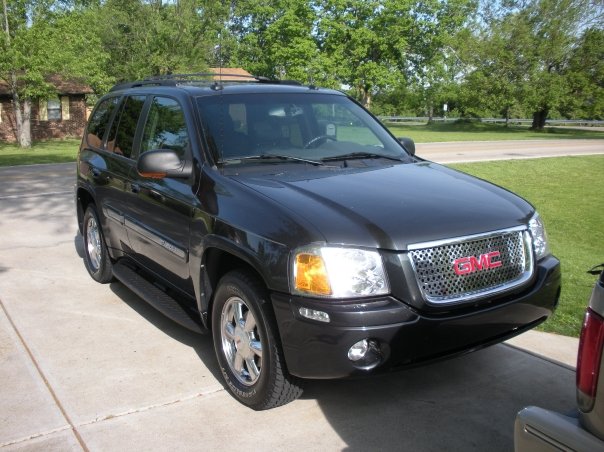
As I made my way down the staircase, I saw a really sharp black SUV parked in our driveway. I tried to look out the windows in the hopes that I might recognize who it was, but I had no idea. This being my graduation party, I figured it was probably some long lost relative that my Mom and Dad wanted me to meet. Whoever it was, he/she drove a really nice car. I made my way through the foyer, opened the front door, and stood there with a look of shock on my face as I saw who was waiting in the driveway.

It was my Dad, standing next to the black SUV, with a camera in his hand—pointed directly at me.

“Happy graduation, Bub!”

When Dad Gave Me My Car Surprise

When the reality of what was happening actually set in, I completely broke down. I started crying, and I turned around and hugged my Mom, who stood in the doorway right behind me.

“We love you, Ty,” she said. “Happy graduation!”

“Mom, you guys shouldn’t have done this,” I responded, tears already forming.

“Ty, your Dad really wanted to do this for you,” she said.

I ran out into the driveway, and threw myself into my Dad’s arms. He put his camera down and hugged me really tight—I can still feel that hug. “Happy graduation, bub. You’ve made us all really proud, and you deserve this.”

I opened the doors of the new car—my new car–another Envoy, but much sleeker, newer, and reliable than the one I had previously had. It was absolutely beautiful, and it looked brand new. It had everything I wanted in a car. I just couldn’t believe it was actually mine.

Envoy New

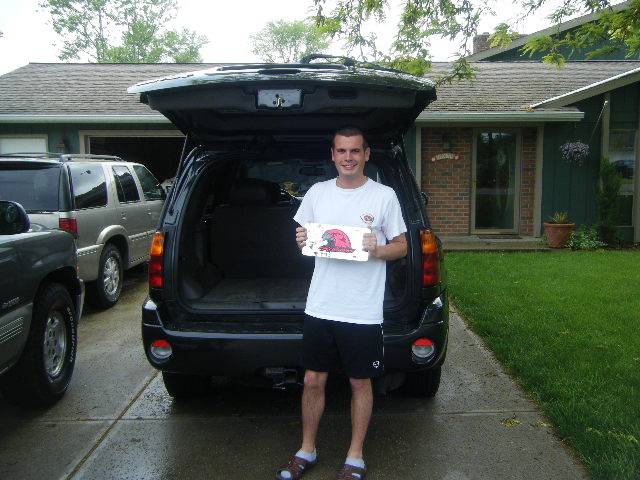
Dad had gone the extra mile, as he did with everything in life. He had driven all the way up to Oxford and bought Miami University license plate frames, window decals, and some of my very first Miami “Alumni” items that I ever owned. We walked around the car, checking everything out from top to bottom. The engine grill was mesh and really made the car pop. There wasn’t a scratch to be found on it. The interior was spotless.

When Dad Gave Me My Car

“Want to take it for a quick spin?” Dad said. He tossed me the keys, and of course, he had added a Miami RedHawks key chain to them.

I hopped in the driver’s seat as Dad climbed into the passenger seat and Mom hopped in the back row. I began to drive down the road, shaking my head the entire time and repeating over and over again “I just can’t believe you did this.”

We rolled down the streets of our neighborhood as Dad showed me all of the cool features that the car had. He rolled from the main console to the seat controls and to all of the other things that this car had which my old one didn’t. We rolled down the windows and rode together as a family down Canal Road near our home, basking in the sunlight of a summer day and a boy with fresh wheels.

And then, it hit me.

“THAT’S WHY YOU WERE LAUGHING LIKE A MANIAC WHEN I CALLED YOU LAST NIGHT!”

And there it was again. The same laugh I had heard the night before when I stood over a cold engine on the streets of Oxford. The same laugh that is burned into my senses anytime I think about my Dad now that he is gone. The same laugh that brought me, my family, and anyone who met my Dad such tremendous joy. The laugh that I long, more than anything, to hear again someday.

Yes, the night before when my old car had once again failed to start, my Dad knew all along that he would be giving me a new car the very next day. As a matter of fact, I found out that my Dad was actually cleaning the interior of my new car when I had called him. With a bottle of leather cleaner and a microfiber cloth in hand, Dad was laughing at the irony of the situation—and probably at the thought of how much more I would appreciate the new ride in less than 24 hours.

My Dad understood that for a boy in college (or freshly graduated from it), a car is so much more than four wheels. A car tells a story about the driver. A car is not simply a transportation device to get someone from Point A to Point B. A car has character. A car has its own story to tell. And a car, in my life, represents much more than freedom.

“You’ve worked really, really hard in college,” my Dad told me as we drove around. “I wanted to think of a way for your Mom and I to show you how proud we are of you for working so hard.”

That new Envoy was a trophy. It was a daily reminder, each day that I opened the door, of how proud my Mom and Dad were of me. Every day when I opened that car door, I could feel a sense of happiness, appreciation, and confidence wash over me. It was a daily reminder of the love my parents had made me feel my entire life. And it reminded me of the sacrifice they made—and had always made—to show me how loved I was.

I remember pulling into the parking lot at Foundation Field later that day to announce the baseball game, and the look of surprise from the coaches who saw me roll into the complex in a sleek new ride. They all came jogging out to the spot I parked in (very, very far away from the reach of any particularly pesky foul balls) and put their arm around me when they saw the new car.

“My Dad and Mom gave it to me,” I said proudly as I shook my head. “I still can’t believe it.”

After the game, I drove with a new sense of pride and purpose to my graduation party across town. Dad made me park the Envoy right out in front of the door, and he went back to work on my new gift—polishing, cleaning, waxing, and perfecting. Apparently, Dad had told a number of people that we worked with what he was getting me for a graduation gift—it was amazing that his secret actually stayed a secret!

That car became a reminder of my Dad each and every time I opened the door and sat behind the wheel. He had found the car from an old coworker and friend and bought it while it didn’t have many miles on it. Even though it had miles, it looked brand new. He had come up with the idea of getting me a car for graduation, and convinced my Mom that it would be a great idea.

And then, when my Dad passed away, it became a tangible reminder of his love for me. Daily, that car would bring me back to happier times when my Dad was here to love all of us in person—but it also reminded me that he was still loving me and my Mom and our entire family from the other side of Eternity. After he was gone, I often that back to that day when I stepped out of our front door and saw him standing there with a camera. It’s a memory, thankfully, that is burned in my mind forever. I’ll never forget the feeling my parents gave me that day, and I’ll never quit seeing the smile on my Dad’s face.

But even the very best cars that are gifted from loving parents will break down over time. The interior will dirty and the engine will fail, and there will always come a time when that car is no longer as functional as it was before.

But how do you let go of a car that is more than four wheels? A car that is a gift from a Father who is no longer there? A car that is a physical reminder of the Dad who raised me, loved me, and taught me how to drive and so much more?

I’ll tell you how I let go next week in the conclusion of this story.

dad-in-redhawks-sweater-with-sb-logoDad, I still remember that Saturday afternoon when you and Mom gave me the new Envoy for graduation. I remember the smile on your face when you saw me come outside. I remember that you took so many pictures, and I remember how happy you were to show me every detail and feature the car had to offer. I cherished that car and I will always cherish that day. You made that entire day so special, but more than any tangible gift you ever gave me, you always told me how proud you were of me. I never told you how much confidence that gave me and how your belief in me helped me overcome so many obstacles. After you left, there were so many days where I would just hop in the car, drive down the road, and reminisce about the day you gave it to me. You blessed me with so many gifts in this life, and I am eagerly waiting for the day when I can see you and thank you again. Until then, seeya Bub.

“Start children off on the way they should go, and even when they are old they will not turn from it.” Proverbs 22:6 (NIV)

Think to Feel: Guest Blog by Jeff Yetter

Ty: I can say this with the utmost certainty: I have never once blamed my Dad for his death.

I have never once been mad at my Dad for leaving us earlier than he should have.

I have never once been angry at my Dad since his death.

But that doesn’t mean there are things I wouldn’t change about my Dad’s struggle. 

When I look back at my Dad’s experience with depression and his eventual suicide, there are definitely moments of “Monday Morning Quarterbacking” that I would return to and reverse if I had the capability. I think back to my first response to learning of my Dad’s depression, and how I wish I would have treated him with more love and compassion (read more about his in an earlier post). I think back to all the moments where I told him I didn’t have the energy to go on a bike ride or toss in the yard, and given the opportunity to change it, I would have put down the television remote and spent more time with him. I would have never left him alone that morning that he died. I would have prayed with him.

But if there is one thing above all that I wish my Dad would have done differently, it’s this: I wish my Dad would have gone to see a professional counselor.

Let me reiterate: I’m not blaming my Dad for his untimely end. I’m not even saying that this would have definitely changed the final chapter of his life, because that’s for God to know—not me.

What I am trying to do is understand the things that went wrong in our story in an attempt to prevent these same situations from happening to other fathers, other sons, and other families.

I’m trying to understand the reasons why my Dad wouldn’t go see a professional counselor, and they are reasons that aren’t unique to his situation. As a culture, we are often afraid of the stigma or stereotype that comes along with going to see a mental health professional. We are afraid that it makes us look weak. We are afraid to admit that we have a problem. This, coupled with a masculine cultural reinforcement that we simply need to buck up and hide our feelings kept my Dad (and plenty of others) from getting the help they need.

But there’s one more reason worthy of our exploration together: the fear of the unknown.

I know this fear all too well. The first time I decided to go to a counseling session, I didn’t quite know what to expect. I had seen depictions of therapists in movies and on television, and I worried that it was all hokum designed to make a quick buck.

I’m so glad that my counselor proved all of these stereotypes wrong.

If my Dad knew what counseling really was, he would have gone. If he knew what actually happened in those sessions, he would have gone. If he knew that getting help was not a sign of a weakness but was, instead, one of the boldest, bravest decisions an individual can make, he would have gone—if not for himself, for my Mom and I.

Which leads us to this post. Welcome back my friend (and I hope yours) Jeff Yetter—Licensed Professional Clinical Counselor, and the man who has walked with me “arm in arm” through so many struggles. He is the counselor who helped me realize the power and potential of going to see someone who can provide help. Jeff is a sincere, authentic, man of God who has provided so much brightness in the face of the evil that has invaded my life. Jeff’s first post detailed how we came to know each other and how we’ve come to walk together through the trials of my life. Now, I’ve asked him to provide a description of his unique counseling style—a theory he created called “Think to Feel”—in an effort to destigmatize the counseling profession.

So, if you find yourself needing help but are too afraid to pick up the phone and schedule that first appointment, I hope this message provides the ultimate encouragement you need.


Jeff: I am so humbled and grateful to have been asked by Tyler to contribute, again, to this amazing blog. What an incredible ministry this is for Tyler, and for all who come here to read, and share, and learn, and love! It is an honor to be with you all once again…

For this post, Tyler has asked that I share with you all the way that I “do counseling”. He has asked that I share my primary method of working with the folks who come to see me, because he believes this has been helpful on “our walk”.  I sincerely hope you find it valuable as well.

A Little History…

As a first-semester graduate student in counseling studies, way back when, my earliest recollection was being directed by department faculty to decide what theory of counseling I was going to practice when I completed my degree. In other words, I needed to decide what I believed about human beings and their behavior, in order to know exactly how I was going to do counseling when I got out in the “real world”. Sure, there were courses on counseling theories and techniques, and I learned about the greats in the field, like Freud, Jung, Adler, Rogers, Skinner, and Ellis (to name a few). But where did I fit in this picture? I knew I wasn’t going to be a “clone” of one of these theorists, and I had an inkling that I believed in Cognitive Behavioralism (“thinking” as it relates to behavior), but I was pretty uncertain as to which direction I was going to go as a practitioner. So, I left grad school with three wonderful gifts: excellent grades (all grad students do well, academically), a beautiful diploma (fit for framing), and infinite confusion with regard to theory and effective techniques of counseling practice. So…

The Birth of a Theory

I entered the counseling profession determined to help people. True, the notion of “helping people” emanates from the minds and hearts of nearly every recent graduate in the health care field, but I really believed it was possible – I just didn’t know exactly how to go about it. I needed to think about what I believed about human beings, their behavior, and what, if anything, produces change in human behavior. So, I started to actually practice counseling. I was nice. I listened well. I could paraphrase and re-state what I heard with the best of them. But this wasn’t enough to me. Not to mention, I was placing an incredible amount of pressure on myself to heal my patients. This was not going to work well for me, if I wanted to be in the field for very long. So, I began to consider, “What makes me feel?” Seemed like a logical place to start. And that was it – “makes me feel”. I realized that NOTHING “makes” me feel. Things, people, songs, movies, situations, the weather, do NOT “make” us feel. We actually “make ourselves feel” by the way we THINK about these things. And a theory was born. My “theory”. Simply put, we “Think to Feel”.

Think to Feel

Ok, Jeff, what are you talking about? We think to feel? What?? Like I said above, nothing “makes” us feel. People come into my office every day with the belief that things, people, situations, movies, music, etc. “make” them feel. Have you ever said, “a sunny day makes me happy”? Or, “that movie made me cry”? Or, “he really makes me mad”? Well, that’s not true. Any of it. And believe me when I say this, that’s GOOD NEWS! Allow me to explain…

If a sunny day “made” people happy, EVERYBODY would be happy on sunny days. If movies “made” people cry, EVERYONE watching the same movie, at the same time, would be crying. The entire audience. All of them. This simply does not bear out. There is always variation in an individual’s response to his/her environment. Different people “feel” differently, because they “think” differently. In other words, it is the way we “think” about the sunny day that produces the way we feel about it. For instance, I may look out the window and say, “thank you Lord, for this day. I have my twins (9 year old son and daughter), my health, and I’m doin’ ok”. So I feel ok. Someone else may look out the window and say, “yeah it’s sunny, but it’s still too cold out there”. So, he/she may feel less than enthused with the weather, and therefore he/she does not allow for a positive impact on his/her mood. Similarly, when watching a movie, it is what we are thinking when we are watching that produces how we feel about the film. We may be engrossed in the story, identify with a character, or relate it to something in our own life, and ultimately shed a tear. Someone else may be watching the movie, thinking of all he/she needs to do at work tomorrow, and has no feelings about the movie, whatsoever. Thoughts “produce” feelings. Things do not “make” us feel. Let’s continue…

Powerful

The foundation of my theory is one of “empowerment”. I want people to feel strong and empowered. I want people to know they actually have a choice in how they feel about the things they encounter in their lives. And this is the crux of “Think to Feel”: THE ONLY PERSON IN THIS WOLRD YOU CAN CONTROL IS YOU. Think about this for a second. “I can only control me”. Pretty cool, right? Also happens to be true. We can only control ourselves. Consider this: God gave us Free Will. He made us, He created us, and yet, He doesn’t “control” us. He allows for us to make choices. His will, yes. His plan, absolutely. But our choice. Free will. I figure if this logic was good enough for the Lord, it probably makes sense for us as well. Therefore, we cannot control what another person says, does, thinks, or feels. And conversely, no one controls what we say, do, think, or feel. Pretty powerful, if you allow for it to be. The only person who can “make you feel”, is you.

Feelings are choices. Not like choosing a flavor of ice cream, but choices nevertheless. Because “choice is power”. Think of this example: if I say “Joe Blow makes me mad”, who has my power? Joe does. Now, I am mad, but powerless to do anything productive about it, because my power resides with “Joe”. However, if I say, “I’m mad at Joe”, I am mad, but my power still resides with me. May sound like “semantics”, but rest assured, it is not. Two very different and distinct subjective experiences. One: you are mad and powerless. The other: you are mad and “in charge” of your feelings. You have “chosen” to be angry. And that’s fine. Feelings aren’t always pleasant, but they are always a choice.

To further this “power” example, I use the sport of football. Many years ago, I was a quarterback, and in the huddle, when I would call a “hand-off”, I would kindly remind the running back to “hold the ball”. Meaning, don’t fumble. Don’t put the ball on the ground. Don’t toss it up in the stands to your friends. And don’t hand it to the linebacker trying to tackle you. Seems logical. But my point is, the football represents the team’s power. Without it, you can’t score. For metaphorical purposes, I refer to “holding the ball” in life. Don’t give it away. It’s your power. Don’t give your power to the weather, to a movie, or to another person. That “ball” is yours. It’s your power. Hold onto it. Hold the ball!

Positive Thoughts: That’s It?

Ok, now some of you might be thinking, “Alright Jeff, if we “Think to Feel”, all we need to do is just ‘think happy thoughts’, right?”  We just need to “look on the bright side, and all will be well?”  Nope. Believe me, if thinking happy thoughts worked, I would be unemployed. Everyone would simply walk around thinking positively, and all would be well. But of course, that is not how life works. Bad things happen. Sadness and depression are part of life. People get anxious. Sometimes we feel lousy. Negative feelings occur all the time. See, even though we “think to feel”, and feelings are a choice, sometimes the appropriate or even necessary way to feel, is to feel “bad”. “Thinking to feel” is not a “cure” for feeling bad. It simply allows for the “ownership” of those feelings. “I feel bad”, versus “it makes me feel bad”. A choice. Therefore, empowered to do something about it. It’s the difference between “having bad feelings”, and “bad feelings having us”. The difference between “having depression” and “depression having you”, etc.

Although life doesn’t “make us feel”, we are still very much “affected” and “impacted” by life. I always say, “if you jump in a lake, you get wet”. Life “affects” us. We are “impacted” by things people do and say. It’s just that those things don’t “make us feel”. We get to “hold the ball”. Keep our power. And now, life becomes a little more manageable. And in essence, that’s what I do each and every day. I teach people how to “hold the ball”, keep their power, and learn how to “think” in ways that allow them to “feel” better than they did with their old way of thinking. So, each day, each session, each person who comes to see me, learns that we “Think to Feel”.

Always Help

Like I mentioned in my first post, we all have hurt, confusion, pain, and issues. But it’s important to remember: you’re not alone. Because we “think to feel”, it’s important to remember that we are never alone. It is times when people believe they are “alone”, or no one understands, that they feel hopeless. That “thought” of being “alone”, produces the “feeling” of hopelessness. But as I said, we are never alone. There is always “someone”. Whether a family member, a friend, a clergy person, a coworker, or even a professional. There is someone. Let’s all find that “someone”, and maybe even be that “someone” to others. The thought that there is someone out there, produces hope. And that’s the goal of “Think to Feel”. To offer hope…

Bless you all. Until we speak again.

– Jeff

“For as he thinks in his heart, so is he…” Proverbs 23:7


Dad Smiling Against StairsTy: Dad, you would have loved spending time with Jeff, and more importantly I’m confident that he would have been able to help you find a level of peace and comfort in the midst of your depression. I have many regrets in this life, but one of my biggest is that I didn’t encourage you to go seek professional help more vigorously. I know that his style of counseling is something that would have resonated with you. I know that you would have been comfortable talking to him, and I have no doubt that you would have befriended him, just like you did with nearly everyone you crossed paths with. I wish that, as a family, we could have found a way to make you more comfortable with the idea of counseling. But, I find peace in the fact that you are now in a place where you no longer experience the pain of depression. You are living in a beautiful paradise with our Maker in a land where the trials of this world are long forgotten. I long to see you experience this peace, but until then, seeya Bub.

“Ask and it will be given to you; seek and you will find; knock and the door will be opened to you. For everyone who asks receives; the one who seeks finds; and to the one who knocks, the door will be opened.” Matthew 7:7-8 (NIV)

jeff-yetter-headshotJeffrey Yetter, M.Ed., LPCC
Licensed Professional Clinical Counselor

Jeff Yetter has practiced in the field of counseling and psychotherapy for the past 24 years. He has worked in both the public and private sector, and is currently in Private Practice in Middletown, Ohio. Jeff has also been an Adjunct Professor in the Graduate School of Counseling at Xavier University. Academically, Jeff completed his undergraduate study at the College of Mount Saint Joseph (now, MSJ University) in Cincinnati, Ohio, where he graduated Magna Cum Laude. He completed his Master’s Degree in Agency and Community Counseling at Xavier University. He completed his Post-Master’s Endorsement in Clinical Counseling at Xavier University as well.

Quietude

“You better slow down.”

It was a constant refrain from my Dad when I was fifteen-and-a-half and he was teaching me how to drive. I was planning to inherit my first vehicle: My Dad’s old 1992 Chevrolet Sierra pick up truck. It had a single bench seat, manual windows and locks, and roared pretty loud any time you hit the accelerator.

“Is this the pot calling the kettle fast?” I would reply. It was ironic that Dad was telling me to slow down, because he was the family member with the heaviest leadfoot.

Dad enjoyed driving fast because he enjoyed feeling the power of a vehicle. He never drove fast because he was in a hurry. He drove fast because…well, he just enjoyed driving fast.

Whether I realized it or not, I inherited the gene that causes leadfoot syndrome, and like my Dad, I enjoy driving faster than I probably should.

But Dad also had an uncanny ability to slow down—and I’m not simply talking about his ability to ease his foot off the accelerator. My Dad was a pro in slowing down at life and eliminating the noise that so often crowds our minds. Dad was very good at embracing the quiet and simple moments of life, and I’ll always envy his ability to do that.


My Dad was a man who could enjoy the simplicity of everyday life. The moments that so many of us take for granted were moments of complete serenity and clarity for my Father. When things were quiet, my Dad was at an extreme peace—a level of peace I hope to obtain someday.

I think some of it may have been a result of his vocation. My Dad was always a physical laborer. He started out in construction, and during his life he was able to build remarkable structures: from the garage and foyer addition of our family home to a handful of wooden crosses at our local cemetery’s veteran memorial. Where there’s building there is often banging, and the sound of a hammer pounding a nail was a natural one for him to hear.

After his career in construction, my Dad worked in a number of different steel plants as a maintenance technician. If you’ve never been inside of a steel plant, they are notoriously noisy places. Machines bang and whir as they roll out steel and cut it into pieces for customers to use. Cranes fly overhead and forklifts zoom across the floor, picking up steel while honking, buzzing, and beeping to alert pedestrians of their impending arrival. Dad, being a maintenance technician, was very close to all of the machines in the plants where he worked. It was his job to know that machine inside and out; to capture the intricacies of how it worked so he could fix them when they didn’t. Dad was very, very good at his job; but being good at his job required him to be in the midst of constant noise.

So when Dad came home, he got very good at finding ways to escape the noise and enjoy the peace and solitude of our life in suburbia. And Dad enjoyed finding that quiet peace outdoors.

The weather can be a bit of a mystery in our corner of Ohio, but from mid-April to September you can usually rely on a nice evening with a beautiful sunset rather regularly. Where most families like to eat at a dining room table, my Dad was always fond of eating outside. When I was young, he built a beautiful brick patio that became our family’s private backyard oasis. Dad would often grill (I mean burn) our dinner, Mom would salvage the meal with a handful of delicious sides, and we would all settle in to share a meal. Dad, often covered in the grease and grime of a hard days work in a steel plant, would sink back in his patio chair, eat his meal, and throw back a can (usually two cans) of ice cold Coca-Cola. There was nothing fancy about these dinners, but you could tell Dad enjoyed them.

And although he would talk and converse with us, we didn’t have to say much for the dinner to be enjoyable. Dad would enjoy listening to the sounds and sights of birds flying through the air. He would watch clouds as they moved across the sky. He would laugh as a squirrel tried to steal food from our bird feeders, or watch our family dogs as they meandered across the back lawn. Simple things brought him extreme pleasure.

On a nice summer night, Dad usually enjoyed a bike ride. My family was fortunate enough to grow up within biking distance of Rentschler Park, a beautiful hidden gem in our neck of the woods. Rentschler Park is full of hiking trails, natural woods, and a waters-edge view of the Great Miami River that is hard to beat. Whenever I take a bike ride, I will nearly always have a pair of headphones in, listening to my favorite music; but Dad’s bike rides were different. My Dad was never a big fan of headphones. He enjoyed taking in the natural beauty and wonder of the world around him without the noise of every day life. He would ride his bike, yes, but he would also make a stop near the river bank and listen to the wake of boats as they lapped against the shore. He would stop and listen to the stream near the hiking trail, or watch the waterfall as the cool water meticulously pelted the gray clay of the streambed. He would listen for birds as they chirped, and talked with any stranger who had a dog—always eager to steal an opportunity to befriend a puppy.

And when he would come home from these bike rides, usually after an hour or so, Dad had a favorite spot in our backyard. It was around the fire pit that he built for all of us to enjoy. My Dad enjoyed so many sounds, but I think he enjoyed the pops and crackles of a wood burning fire more than any other. Using the flame thrower that he “engineered” (an extremely dangerous toy that is hooked to a propane tank which I was fortunate enough to inherit after his death), Dad would start the fire, toss on lots of wood, grab our family dog and a lawn chair, and settle in for a few hours of quality rest and relaxation. He would try out new burning materials to see what interesting sounds they might make. He became a particular fan of bamboo which, if you don’t know, makes a loud explosion when it burns. Or pine tree limbs which, after a significant drying period, will burn faster than just about any other material. For hours my Dad could sit in his chair with the warmth of a good fire on his face. He would drink yet another Coca-Cola, eat a few popsicles or Klondike bars, and stare at the night sky above him. He would wonder at the marvel of the moon and the stars overhead, pointing out obscure facts he had learned about them over the years. No frills, nothing fancy—but completely and utterly at peace and happy.

Not every night was like this for Dad. There were nights where my Dad would have to work late or get called in after returning home. There were nights where he would go out to eat or come to one of my baseball games. There were nights where Dad would work side jobs in an effort to support our family financially. And on the unfortunate night that the rain and foul weather would prohibit any outdoor enjoyment, Dad would be relegated to the couch for another night of UFC reruns.

But I have no doubt that my Dad was happiest on the nights where he could enjoy nature and the peace and solitude they provide. I have no doubt that my Dad experienced a slice of heaven on those nights where he could escape the noise of everyday life and marvel in the joy of the world around him.


Mister Rogers popularized a unique phrase: “quietude”. Quietude was the act of withdrawing from the noise and constant chatter of the world we live in to embrace the beauty of God’s creation and listen as He speaks to us. Mister Rogers was a tremendous appreciator of silence, and he found ways to make quiet time for himself each and every day. Mister Rogers would wake up early each morning to pray, and then he would swim laps relentlessly. In one of his books, he even talks about a day he spent doing nothing but reading, praying, and listening to the world around him. He said that that particular period of “quietude” led to a restful night’s sleep and an extremely productive day of work. Fred Rogers said that his moments of quietude were an opportunity to “stop, reflect, and receive.”

I like to think that my Dad was able to achieve this same state of quietude pretty frequently in his life. Although he may have lost his final battle with depression, I like to think that he was able to fight of the mental illness for so long and so successfully because he was able to close off the distraction and noise of the world around him and embrace quietude. He was happiest listening to a bird chirp. He was happiest listening to a river flow. He was happiest listening to a dog bark. And he was happiest listening to a fire crackle. He didn’t need to talk to be happy. He didn’t need to be productive twenty-four hours a day to enjoy God’s creation. He took God’s command to relax and enjoy life seriously. And he lived it in a way that we should all strive to do.

Although it’s been many years since my Dad gave me that initial driving lesson, I think he’s still telling me that I better slow down. I think my Dad is still telling me that I need to find ways to take my foot off the accelerator of life and strive for a level of quietude that will brighten the world around me. There are so many times where my “to-do’s” distract me to the point that I can’t enjoy anything else I’ve already done. I’m constantly thinking about what’s next, what I can be doing to be successful, and all the ways that I can be productive and contribute. I rarely think that the best way for me to be productive might be to slow down, but I’m still learning this lesson from my Dad—even if he’s been gone for over three years.

There are days, less frequently than I’d like, where I’m able to replicate the life my Dad led. I’m trying to take more bike rides and make more backyard fires. I’m trying to listen to the natural world around me and pay attention to the amazing things that God has created all over. There are days where I’m able to hop on his bike, pedal my way back to the park, and enjoy the sights and sounds of a sunset over the river bank. In those moments, I find myself hearing the still, small voice of God that is so often described in the Bible.

But I also find myself hearing my Dad’s voice. We have conversations with one another. I’ll ask him questions about the tough things I’m dealing with in life. I’ll ask him to help me fight my feelings of doubt and insecurity and uncertainty and hopelessness and fear. I’ll tell him that I still don’t understand why things happened the way they did. And I’ll tell him how much I miss him and love him.

And I know I’ve found Dad’s quietude on the nights where I hear him answer back. And more than anything, I always hear him say “I miss you, but I’ve always been here and always will be. I love you, and I can’t wait to see you again, even though I see you in every moment of every day.” I hear it in the break of a wave against the shore or the flap of a bird’s wing overhead. I hear it in the crackle of log in the fire, too. But there are many times where I hear it in his voice. Speaking to me, from the heavens.

When I force the world around me to slow down and get quiet, I hear some of my favorite noises. I’m thankful to God for all that He’s created, but I’m especially thankful for my Dad for showing me how to slow down and enjoy it.

Dad Leaning Back in a ChairDad, I know that there were so many times when I didn’t understand why you would tell me to slow down, but now it all makes sense. I look back on the moments when you were happiest here in this life, and it seemed to be the moments when you were unplugged, disconnected, and severed from all the chatter and distraction that we think is important. You found what was really important in life, and you embraced it head on. You found ways to enjoy the beauty and simplicity of God’s creation, and you found a state of quietude that led to happiness and rest. I’m striving to be like you in so many ways, Dad, but I’m working especially hard on slowing down. You’d be proud to know that I still drive a little fast, just like you, but I’m slowing down to enjoy the things that were important to you and are important to me. Until we can enjoy them together in heave, I’ll seeya, Bub.

“He makes me lie down in green pastures, he leads me beside quiet waters.” Psalm 23:2 (NIV)

First Responders: Guest Blog by Dr. Bob Rusbosin

Ty: There were voices, I’m not sure whose, asking me questions.

“Who should we call immediately? Who do you need here right now?”

I had just been told minutes earlier that my Dad had passed away, a victim of suicide at age 50. My mind had been cloudy, foggy, overwhelmed ever since I heard that horrible news. There seemed to be a haze hanging over me. I knew that time was ticking on, but I felt like I was standing still, unable to progress forward.

But to that particular question, my mind cleared in an instant and I was able to form a response. I knew right away, in the eye of that storm, the people outside of my immediate family that I wanted there in that moment.

“I need my pastor, Harville. And I need Dr. Bob.”

Harville Duncan had been there through so many ups and downs of my spiritual journey. He knew the ins and outs of my struggles and my triumphs, and most importantly, he knew my family. He had ministered to my Mom and Dad since they were young. He had been there for us whenever we needed him. It makes sense that a Christian would call for their pastor in the immediate aftermath of a family death as tragic as ours.

But it probably makes less sense to an outsider looking in for a four-years-ago graduate of college to call for their Dean of Students. But to me, it made all the sense in the world.

I came to know Dr. Bob Rusbosin as a nervous college freshman when I started at Miami University’s Regional Campus in Hamilton. Pure chance inspired our first meeting. After leaving my geology class in Mosler Hall, I spotted a sign with flyers below it that read “Interested in Joining the Student Government Association?”

I had never participated in student government before, but I had always wanted to. My nerves and general shyness in high school had bested me in that chapter, but I refused to let it beat me in this new one. I flipped through the packet, read through the guidelines, and spotted a contact number: Dr. Bob Rusbosin, Dean of Students, Miami University Hamilton.

bob-rusbosin-muh-timeline

Once I arrived home, I picked up the phone and called Bob. I told him who I was, that I was interested in joining the Student Government Association (SGA), and hoped he might be able to answer a few questions. What I thought would be a ten-minute phone conversation quickly turned into 30 with the promise of a meeting on campus the next day.

I immediately knew I liked Bob from the moment I met him. I didn’t know exactly what it was, but he was unlike anybody I had ever met before. He was in a powerful position of authority at Miami, but he was humble and full of generosity. He was in a position to be a teacher full of knowledge to impart to his students, but he asked more questions than he answered. He was responsible for overseeing and attending to the needs of thousands of college students, but in that moment he made me feel like I was the only person who mattered.

At his urging, I ended up joining the SGA. And I ended up hanging around Bob’s office as long as I could—for the next four years. Bob was more than a student government advisor. He was a teacher when I needed to learn a lesson. He was an encouraging coach when I doubted myself. He was an advocate for me whenever he saw an opportunity I should take advantage of. Ultimately, Dr. Bob was always the person who would be there for me whenever I came calling. Just being there is one thing, but being entirely there to support someone else in every single moment is a trait we should all strive to develop. Bob embodies this trait better than anyone.

bob-three-amigos


 Bob: When Ty called me that fateful morning in late July 2013, he was completely devastated, distraught and beside himself in a way that I had rarely experienced ever before in my life.  Ty was able to tell me through his uncontrollable sobbing that his Dad was dead.  He told me that it had just happened at his Mom and Dad’s house, that Becky was at work when it happened but was now there but in a state of shock and that his grandfather was there with him.  I was in my office at Miami University Hamilton and I told him that I would come over immediately.  He thanked me profusely.

I did not hesitate in telling Ty that I would be there for him in his time of need.  Tyler and I forged a bond that started at the end of his senior year in high school.  He is the only high school student who ever called me to set up a meeting to discuss the Student Government Association (SGA).  Needless to say, I was duly impressed with this aspiring leader’s interest and enthusiasm in being a young activist on campus.  Little did I know that Tyler was someday going to be a model SGA President who would lead the organization with honesty, integrity, compassion and skills that were truly remarkable and noteworthy.

Tyler and I also bonded on a very personal level during our first meeting in my office shortly after that first phone call.  The meeting was going quite well and it appeared that Tyler was the real deal for the SGA until he suddenly realized that he was meeting with the proud father of an amazingly talented son from his bitter rival Hamilton High School who had scored a last second, game winning three point shot against his beloved alma mater four years earlier. He told of the intense hatred that he felt towards my son over the past four years because of that shot.  I told Ty how proud I was of Nate (and our daughter, Anna) for being great children and for their many amazing accomplishments including Nate’s memorable shot against Fairfield.  Ty was listening (one of his greatest attributes I later learned) and he immediately was able to put the dreadful shot into perspective and went home with every intent to filling out the SGA application.

Tyler was an exceptional student leader at Miami whose accomplishments always seemed to eclipse one another.  For example, he gave the best speech ever of all of the Communication 101 students as a freshman and this included all of the Oxford students as well as the regional campus students.  His communication skills were and still are top notch!  He developed the highly successful Campus Pride Initiative with the SGA on the Hamilton campus that was transformative and hugely significant in making the campus more vibrant, dynamic and visible.  He spontaneously presented on the Campus Pride model at a national conference for student government leaders and advisors in St. Louis.  He led campus-wide memorials for both 9/11 and the death of our hometown hero, Joe Nuxhall.  He was presented the notable President’s Distinguished Service Award for his service to the campus and the community.  He was the Voice of the Harriers for the basketball, volleyball and baseball games and was eventually tapped to fill in as the Voice of the RedHawks on the Oxford campus. This is when I first met Scott and Becky.  They were proud parents of their son and rightly so!

Ty told me a lot about Scott through the years.  I knew he was still playing basketball as was I and I kept thinking we would be meeting up somewhere on the courts but it never happened.  Ty told me about Scott’s tremendous work ethic and his ability to work with his hands on just about anything.  Ty told me about the love he had just being with his Dad that sounded so much like mine for my Dad.  When Ty called, I just had to be there.  Ty hugged me like he never wanted to let go.  I tried to console him and Becky as best I could.  Both seemed to be grateful for my presence.  I was so pleased that his grandfather and his pastor were there.  They were both saying good things and helping me feel welcome at this most challenging time for the family.  More relatives began to arrive and I eventually retreated to allow the family love and compassion to freely flow.

I see Scott in Tyler in many ways today–funny, loving, devoted, accomplished and very compassionate.  I was honored to be a mentor to Tyler during his undergraduate years at Miami and I am even more honored to have Tyler as a friend for life and now an almost brother to Anna and Nate!


Ty: I remember when Bob walked in that day. I saw him come through the foyer of our neighbor’s house, donning a blue polo and a look of complete, utter sympathy that I had seen him show to me so many times before. I broke down and fell into the arms of a man who had been a father to me at Miami. That hug lasted for a long time, but although our embrace did eventually end, the support, love, and care he exuded in that moment never has.

Yes, there were medical first responders and law enforcement officials on the scene who did an outstanding job attending to the situation. But there were also folks that I think of as emotional first responders that were there to support and care for me, my Mom, and my entire family.

Some people make good first responders, and others are born for it. Dr. Bob Rusbosin was born for it.

It’s no surprise that Bob Rusbosin is originally from Latrobe, Pennsylvania. Latrobe, for those who don’t know, is also the hometown of television icon “Mister” Fred Rogers. Dr. Bob and I have always had a mutual admiration for Fred Rogers, so much so that we traveled to Latrobe and the Greater Pittsburgh area to conduct research on our favorite television educator as part of my graduate studies. We met with people who knew Fred, including Bill Isler from the Fred Rogers company, Fred’s high school classmates, and many others.

bob-and-ty-mister-rogers-statue

Fred Rogers had an uncanny ability to talk about tragedy and make folks feel loved. Take a look at your social media feeds the next time that a large-scale tragedy strikes, and I’m sure you’ll find one of his more famous quotes posted and reposted over and over again:

“When I was a boy and I would see scary things in the news, my mother would say to me ‘Look for the helpers. You will always find people who are helping.’ To this day, especially in times of disaster, I remember my mother’s words and I am always comforted by realizing that there are still so many helpers—so many caring people in this world.” (Mister Fred Rogers)

People say that Fred Rogers was one of a kind and that we will never see anyone like him on this earth ever again, but I have to disagree with those people. Those people haven’t met Bob Rusbosin.

In so many ways, from his personality and mannerisms to his genuine heart for others, Bob Rusbosin has always reminded me of Mister Rogers; but the similarity was even more recognizable in this tragic chapter of my life. Bob Rusbosin is the helper that people should always look for, and he was the person I knew that I could count on in my darkest, scariest moment.

bob-working-with-students

I rarely speak in absolutes, but I will on this topic: It’s impossible to grieve and cope successfully in complete and utter isolation. We aren’t built that way. You can consult any psychologist or scientist, or you could also read your Bible, but either way you’ll come to this same conclusion. We need great people in our lives—people I call “emotional first responders”—to help us navigate these treacherous waters. Bob Rusbosin was, and still is, that person for me. Bob became an ideal helper and first responder for a number of different reasons:

He was there. I had no doubt that I could call Bob and he would drop everything he was doing to come help me. I wasn’t guessing that he would show up; I knew he would be there. I was confident that Bob would be there because he had a track record of being there. Over the years, I had dealt with questions and moments of uncertainty, and Bob had always been there to listen to me and care for me. He had developed a level of trust with me in a way that no other educator ever had. And I saw that his trust was more than a professional promise.

He accepted me for who I was in that moment. As you can imagine, college students deal with all sorts of different crises, from small disagreements with friends and family to larger, existential questions about their career and life purpose. Bob had seen me at my best, but he had also seen me at my worst numerous times. Bob is authentic and he is always genuine, and I knew that there was no wavering when it came to his core values. That reliability provided the stability I needed in a moment where it felt like my world was falling apart.

In the aftermath of my Dad’s death, I was (predictably) a mess. I was having trouble breathing. My vision was blurred. I would collect my emotions and then sob uncontrollably when someone else came into the house. I am thankful that I felt the freedom to be myself, my grieving self, in front of Bob. And it was only because he had spent so much time and honest energy getting to know me as a student that I felt free to be this unpolished version of myself in front of him.

He didn’t try to solve the problem. When Bob came into my neighbor’s house, he didn’t try to take control of the situation. He didn’t try to collect information about what had happened. He just came in, said hello to me, and hugged me. He sat in a chair across from me, and as he had done so many times, he just listened. No one had answers in the aftermath of my Dad’s death, and as much as Bob wanted to be my protector, he didn’t pretend to have answers either.

For an educator, it only seems natural to want to help people and try and solve their problems—but Bob understood that the best way he could help me was not to try and provide answers but to instead support me as I tried to find them on my own. There would be no quick answers, and there definitely wouldn’t be any just an hour or so out from the tragic news. So Bob, always patient and always kind, let the grieving process slowly unfold in front of him without trying to put a band-aid over a fatal wound.

He asked how he could help. In moments of tragic loss, especially death, I think we all feel a little uncomfortable when we ask grieving folks “Is there anything I can do to help you?” It seems strange, but in my situation it was particularly reassuring to have so many people offer to help me—even if my response to them was no.

Before he left the house that day, Bob made sure to ask me if there was anything I needed his help with. The gesture alone was enough to tell me that although my Dad, my provider, was gone, there would be people that would attempt to try and fill the voids that were now left in my life. And to my surprise, there were some things I needed immediate help with and I knew that I could trust Bob to accomplish them. I needed someone to communicate with my colleagues at Miami and let them know what was happening—and that I wouldn’t be at work for quite some time. I needed someone to call my graduate school faculty advisor, Peter, and alert him to the emergency happening at home. There were a few other folks who I needed to notify, and Bob agreed to take on all of this responsibility. I couldn’t imagine making some of those calls to try and explain to people what had happened when I couldn’t even explain it to myself. Bob was willing to shoulder this burden, and it made me feel so loved.

He called later to follow through and check on me. Bob is one of those rare individuals who thinks about others more than he thinks of himself. Bob fulfills the commands of Scripture that tell us “Carry each other’s burdens, and in this way you will fulfill the law of Christ” (Galatians 6:2, NIV). Bob didn’t just show up that morning to be there for me in the moment—he showed up to show me that he was there for the long haul. Later that day, Bob called me to see how I was doing and how I was coping. He also updated me and let me know that he had fulfilled his promise to help me reach out to folks at Miami. But he was more concerned with how I was doing and what I was thinking, and he also shared some great memories of my Dad. It was unbelievably encouraging to hear his voice and know that he would always be there to help.

And yes, he brought ice cream. Bob knew that I loved ice cream. Specifically Graeter’s ice cream. Later that evening, I awoke from an unsuccessful attempt at a nap to learn that Bob had been back to the house to check on me and my entire family. He had stayed, getting to know all of the folks in the house that had visited that day. I had missed getting to see him, but his gestures of kindness were still there even though he had left.

“Ty,” my Grandma told me, “Bob brought you some ice cream. Your favorites from Graeter’s. The pints are in the freezer whenever you get hungry.” There are few things in this world more beautiful than a pint of Graeter’s ice cream, and Bob knew how I felt about this. Although life did not feel normal in that day, there was something beautiful about knowing that some of the things that represented a normal life, like ice cream, would still be there even though my Dad wasn’t. I didn’t eat much that day, but I did take a few bites of ice cream. I’m glad it was there, but more importantly I’m glad Bob was there.

I thank God for a lot of reasons each and every day, but near the top of that list I thank God for leading me to the stairwell on the campus of Miami University Hamilton where I picked up a student government flyer. I thank God that he led me to call the number of the Dean of Students and go meet with him. I thank God that he used my time in student government to help forge a friendship with one of the finest men he has ever put on this earth. And I thank God that he gave Bob Rusbosin the heart of an emotional first responder: authentic, vulnerable, and genuinely loving in every sense of the word.

We all need someone like Bob in our lives. When you hear the words that tell you your Father (or any loved one) is dead, you need people to surround you who can help you walk when you fall and who can help you stand when you feel as if you might never stand again. I’m thankful that God prepared Bob for that moment and chapter of my life by giving him such a tender and thoughtful spirit. He has been there ever since, and I know that any time I call, he will always be there to respond first.

In the days where I need my Dad and realize that he can’t be here for me, I’m grateful that I have Bob Rusbosin—a man who has become a father-figure to me whenever I need him.

Dad, Your death has left a huge hole in my heart and in many areas of my life. There are particular voids that will never be filled until I’m reunited with you on the other side of Eternity. But I am so thankful and so grateful that God positioned certain people in my life, like Bob Rusbosin, to help be there for me when you couldn’t. I know you’re in heaven watching over me, and I know that you are making sure that there are good people and helpers to fill in for you while you’re not here. Keep watching over me, Dad. Keep connecting me with your angels here on earth. I may be grown, but there are days when I need my Dad more than ever. I know how highly you thought of Bob, and I know that if you had a chance to hand-pick someone to fill your shoes, that man would be Bob. We all miss you, Dad, but we are all thankful that you are in a place where the pains you experienced in this life are no longer there. Until we are together again, keep watching over me like you always did when you were here. Seeya, Bub.

“Rejoice with those who rejoice; mourn with those who mourn.” Romans 12:15 (NIV)

bob-rusbosin-headshotBob Rusbosin

For nearly 30 years, Dr. Bob Rusbosin served as the Dean of Students for Miami University’s Regional Campuses. In this capacity, Bob supported tens of thousands of students as an advisor for the Student Government Association, and oversaw all aspects of student life services, including student activities, athletics, counseling, disability services, career services, diversity and multicultural services, new student orientation, judicial affairs, and child care. A lifelong proponent of civility, Bob helped a group of students at Miami found “Project Civility”, which dramatically improved the campus climate at Miami and became a national model for character education. After a successful career in higher education, Bob is now enjoying his retirement in Venice, Florida where he lives with his wife, Sharon. Bob earned his Ed.D from Indiana University of Pennsylvania, his MAT from the University of Pittsburgh, and his BA from the University of Dayton.

Questions

“How could God let this happen?”

Nearly eight hours earlier in the day, I had been told that my Dad was gone. Just like that. A victim of suicide. I sat on my bed, completely exasperated—full of pain, and full of unanswered questions. Across my darkened bedroom sat my pastor, Reverend Harville Duncan. He sat in a chair, looking directly at me, shoulders hung low with a face full of sympathy. This was the man who had dedicated me as a baby. This was the man who had baptized me as a young believer. This was the man who had led me through so many spiritual battles and questions.

Now would come one of his tougher tests.

Reverend Duncan has been in the ministry longer than I’ve been alive. He has more spiritual knowledge in his thumb than I have in my entire body. He has probably read thousands of books on God and Christianity throughout his life. He has earned multiple degrees and has studied theology with reputable Christian scholars. He has done everything he could to position himself to answer life’s toughest questions.

But as I looked at him across that room, I could tell that he was at a loss for answers just as much as I was.


Just like I tried to do in the aftermath of Dad’s death, I’ve tried to get out of writing on this topic. In all honesty, I’ve avoided writing this post and put it off until the last minute because I don’t enjoy facing these questions. I don’t enjoy facing them because I don’t have answers for any of it.

Ever since my Dad died, I’ve been flooded with questions big and small. They come in waves, but they come every day. And it’s rare that I’m able to provide an answer to many of them.

The death of a loved one, especially a parent, is a pivotal juncture in one’s life journey, particularly as it pertains to spiritual matters. When that innocence is shattered and when that familiar protector and provider is no longer there, it creates serious unrest in the lives of those left behind. How will I survive without that person? Why did this have to happen? What will life look like without the joy that person brought into it?

Suicide, however, adds and additional layer of questions that I never expected I would have to deal with. How could my Dad think that life wasn’t worth living? Could I have done more to convince him that this wasn’t the end? What factors made him think that life was unlivable? How could God let one of his believers, a man who lived the truth of the Gospel, meet such an untimely end?

I don’t know that these questions will ever cease. I don’t know that they’ll ever disappear from my life, because the pain of losing my Dad will always be there. Even though life has had it’s wonderful and bright moments since we lost my Dad, there’s been a dullness that sort of clouds every good thing that happens to me.

I have so many questions for my Dad; but I have so many more for God.


When you start to question God in front of a veteran minister, you wonder what kind of reaction they will have. I don’t remember all of the particular details of my conversation with Reverend Duncan on that day. But I do remember this—at no point did Reverend Duncan try and make me feel like I was a bad person for questioning why God would let something so tragic happen to my family. At no point did he belittle me, make me feel inferior, or try to minimize my pain.

We sat together in that darkened room for nearly an hour. Reverend Duncan mostly talking, and me mostly listening. I could tell that on a different level, Reverend Duncan was heartbroken. My Dad had been one of the original congregation members at our church when Reverend Duncan began his ministry there over thirty years ago. He enjoyed my Dad’s company, and my Dad enjoyed his.

In a way only he could do, Reverend Duncan assured me that the pain I felt was real. We talked about bad things happening to good people. We talked about God’s ability to take something bad and make it into something great. We talked about suffering and the pain my Dad must have felt trying to combat his depression on a daily basis.

And Reverend Duncan assured me that both my Dad and my God still loved me dearly.

But Reverend Duncan did something really unique on that day that has set the stage for so much of my healing. He let me ask questions, and he didn’t pretend to have all the answers.

Yes, a studied and learned member of the religious clergy told me that, together, we were going to encounter many questions on this side of eternity that we would never have an answer for. We would probably never know why my Dad did what he did. We would probably never know why God allowed him to suffer. We would probably never know why God allows something as horrific as suicide to weave into his master plan for our lives. We would probably never know why God thought we were all strong enough to live life without my Dad.

Together, there in that room, Reverend Duncan prayed over me—one of the most beautiful prayers I’ve ever heard in my life. It’s a private and unbelievably special moment that I’ll remember forever. I don’t know that I’ll remember the words or the phrases he spoke, but I remember a feeling of God being there with us in that room. And just like Reverend Duncan, he wasn’t mad that I had questions.


I don’t know if this is theologically correct or sound, but I’m of the mind that God is completely okay with us asking him questions.

Let me explain what I mean before I start getting messages from people who might cringe when they read that statement.

There is a difference between questioning God and asking Him questions.

When we question God, we are essentially telling Him that He doesn’t know what He’s doing. We are telling Him that we know better and could figure this out our own. When we question God, we are practically telling Him that His ways are wrong and our ways are right. This type of questioning comes from a deeply-rooted proclivity for disobedience. Questioning God means you doubt whether the promises He delivers through the Bible are actually true and actually accurate. Instead of Carrie Underwood’s “Jesus Take the Wheel” it’s “Jesus, I’m So Sick of Being a Passenger Because You Drive Like a Maniac” (doubt she would have won a Grammy on that one…).

But when we ask God questions, we are doing something entirely different. We are coming to Him as humble servants. We are expressing, honestly, the innermost workings of our hearts and minds to the one who already knows them.

When we ask God a question, we acknowledge that He exists. Would you ever ask a question to someone who didn’t actually exist? You could, but it would probably be a pretty quick conversation. When we ask God a question, we validate that He is there with us. But more importantly…

When we ask God a question, we acknowledge that He’s in control. Even if we don’t understand what He’s doing. Would you ask a question if you already knew the answer? Most likely not. When we ask God a question and are legitimately seeking answers for the tragic things that happen to us in our lives, we aren’t doubting God. In fact, we are doing exactly what He commands us to do. We are submitting to Him and saying “God I don’t have any idea why you would let this happen. I don’t know how to reconcile this with the truths of your Word. Help me understand.” We are recognizing that God knows more than we do or ever could, and that only He can provide answers to the questions we have. And…

When we ask God questions, we are drawn into a closer relationship with Him. Let’s face it! If you’re having questions, God already knows them. Psalm 139:4 says “Before a word is on my tongue you, Lord, know it completely” (NIV). In even simpler terms? “You know what I am going to say even before I say it, Lord” (NLT). If you’re feeling guilty because you have questions for God about the things that are happening in your life, don’t feel that way or don’t try to hide them. He knows you inside and out, and He’s known you forever, and even though He knew that you would have all these questions about how he can grow love in a darkened life, He still sent His Son to the cross to die for you.

When I was little, my Dad always loved it when I would ask him questions. Whether it was about a game or a car or something completely irrelevant on television, my Dad never tired of giving me answers. He never once told me to be quiet and quit asking him questions. When I asked him those questions, I acknowledged that he was important to me and that he knew more than I did. And I think that made him feel loved, and important, and worthy.

I imagine our Heavenly Father has that same smile on His face when we ask questions.


I definitely know this part isn’t theologically sound, but I’ve often envisioned my first days in heaven as an episode of Gruden’s QB Camp (except God will be nothing like Jon Gruden…I think?). I imagine that God is going to take me into a small film room, just me and Him, and he’s going to hit play on the tape reel that sits in the table between us. Then, the two of us will sit and watch my life play out in front of me. We will see all the bright moments, and all the moments of defeat.

But then, the tape will get to July 24, 2013. We will watch the heartache of losing my Dad. We will experience the moments of shock and horror that accompanied his death. And then, I’ll slowly reach across the table and pause the tape. I’ll look at God, not with accusation but with a desperate longing for wisdom, and say “Can you explain what you were doing there?”

I imagine that God is going to come around the other side of the table. He’s going to put His arm around me. He’s going to embrace me in a way that only a loving Father could. And He’s going to explain how my Dad’s death fit into His ultimate master plan.

And I’ll finally have answers to the questions that plague me.

But to get to that point, I’ve got to trust that He has the answers. I’ve got to trust that the questions I’m facing now will be answered eventually, but not on this side of the grave. I’ve got to find comfort and solace in the fact that, in the times where life seems to be bursting apart at the seams, God is there to stitch everything back into place.

I’ll live my entire life with questions about my Dad and why he had to leave us so soon. But I’ll live in heaven knowing that my Father knows them all and loves me still.

dad-and-me-in-pool-with-sb-logoDad, There are so many days where I can’t get the questions about your death out of my mind. There are moments where the questions are so tense and overwhelming that I can’t seem to let them go. The more that the days go by since losing you, the more unanswered questions I seem to have. But I know that you’ve found peace in Heaven. I know that you’ve found comfort in the arms of God. I know that each day, I am one step closer to seeing you again and having those questions answered. Until that day, I’ll rest easy in the fact that God knows exactly what He’s doing. And until that day, seeya Bub.

“Before I formed you in the womb, I knew you. Before you were born, I set you apart for my holy purpose. I appointed you to be a prophet to the nations.” Jeremiah 1:5 (GW)

Friendship Through Fire: Guest Blog by Chris Beatty

Ty: “Have you talked to Chris lately?”

My Dad would always ask this question, knowing darn well what the answer was before he even asked it. Chris and I hadn’t talked in a long while.

And that, in and of itself, was extremely unusual. There was a period of time when Chris and I would have called each other three or four times throughout the day to share a joke, tell a story, or just chat. Chris Beatty and I had been the best of friends for many years. The type of friends who were completely inseparable. We spent nearly every night we could hanging out, going to country concerts, and commiserating over our inability to talk to women. Now, it had been months since I had even heard from Chris. We let a disagreement get the best of us, and now it was showing our worst.

“You know, you really should call him. Life’s too short,” my Dad would always say. I had no idea at that time just how short life could truly be.

But I was stubborn and I was afraid to admit that I had made a terrible mistake and sinned against my fellow man—and not just any fellow man. My best friend. I was too arrogant to pick up the phone and call him. I let anger consume me for no reason other than haughty self-righteousness, and it was tearing my heart to pieces. I was too ego-conscious to drive over to his house and say I was sorry. I was too focused on myself to focus on God and what He wanted me to do to repair this friendship. And I let self blind me to everything that was important in life.

Even in the immediate aftermath of my Dad’s death, I had people telling me that my God could take horrible situations and make something good out of them. That even in the midst of tremendous, lifelong heartache, God can create brightness. Like a phoenix rising from the ashes, God would be able to take this pain and bring His people closer together.

“Well, God,” I thought, “you’ve got your work cut out for you on this one.”


Chris: I was driving home the night I got the call.  In her most comforting, yet emptied and wounded tone, my mom asked me if I could pull off to the side of the road because she had something ‘very important’ to tell me.  This was a tone in which I have never heard from my mom’s voice, so I ‘pulled off’ the highway and prepared myself for the coming words that would change my life, forever.

“Chris, baby I don’t how to tell you this.  Scott passed away.  I don’t know all of the details, but he committed suicide.”

My body went numb.  Honest to God, I literally pinched myself twice to make sure I wasn’t dreaming.  It was at that point, that I really did pull off I-71N to clear my blurred vision from the tears that had cascaded my eyes.  After gaining my composure, and taking a few deep breaths, I did something that I couldn’t bring myself to do for last 2 years.  I swallowed my pride, dialed those 7 numbers that I still had memorized, and waited in anticipation for a familiar voice on the other side…

For those of you that don’t know, Ty and I met each other in Mrs. Hopkin’s 2nd grade class at Fairfield North Elementary.  Since 9th grade, we have been best friends, and often mistaken for lovers by many.  I guess going out with your buddy for ice-cream on a Friday night might’ve been the wrong play when trying to pick up girls.  Ty and I share countless memories, many of which his dad played a part in.

Of all the memories, my personal favorite was when Ty and I started a business one summer, called Beatty & Bradshaw Landscaping.  Scotty let me use his truck to pull out all the stumps and bushes from the ground.  He also let us use his chainsaw, flame thrower, pressure washer, and Cub Cadet riding mower!  I forgot to mention, all his tools were brand name and looked legit, which in turn, made us feel like real men.

*Side note: During our 2 years as business owners, Beatty & Bradshaw Landscaping had 1 client and 2 total invoices.  We later liquidized all assets of the company and took up poker instead.  That, too, was a failed venture.

beatty-and-bradshaw-landscaping

Admittingly, I am a prideful person.  Prideful to the point in which I squandered a lifelong friendship with Ty over something trivial.  During our 2-year sabbatical from each other, a lot happened in our lives.  We got real jobs; we each bought houses; I got married.  In planning my wedding, there were some important questions…location, church, venue, colors, wedding party, honeymoon, etc.  Up until that point, I had one obvious choice as my best man.  Despite desperate attempts from my future wife and family to bring us back together, my pride restricted my ability to pick up the phone and make things right with Ty.  As the wedding planning proceeded, Ty was not my best man. He nor his family were invited to celebrate the best day of my life.  That decision was a life lesson that I learned the hard way.

Two years later…

Anxiously dialing Ty’s number, a number I had dialed so many times before, a calmness and a sense of compassion that only God can give someone filled my entire body.  I heard Ty’s voice, but it was just his voicemail.  I have no recollection of what I said, but in my most sympathetic tone, I asked him to call me.

It was the next day, I was about to walk into my office, and I saw those 7 familiar numbers pop up on my phone that I had answered so many times before.  I can’t recall what Ty even said to me, but it didn’t matter.  Differences aside, I knew this was the moment that Ty needed his brother.  I cancelled all my meetings and raced to his house, which I realized was the same yard where we completed our 2 landscaping jobs at Beatty & Bradshaw Landscaping.  Talk about poetic justice.

I remember apprehensively walking up to his door and thinking about what I wanted to say and how I was going to say it.  How do you approach someone who you’ve known since you were 7, yet completely shut out of your life for the past 2 years, who just tragically lost his father?

God has a great way of working things out for you when you put your trust in Him.  I walked inside and Ty greeted me with the most exposed, regretful, and heartbroken hug I’ve ever received.  I spent so much time rehearsing what I would say and how I would apologize.  Instead, we hugged each other and sobbed in each other’s arms for what seemed like an hour. It was at that point that every chain and shackle had been lifted off both of our stubborn hearts.

My greatest life lessons have always been learned the hard way, and this was no exception.  It took a tragedy to bring my brother and I back together.  Since that day, Ty and I have picked up where we left off; going to Red’s games, eating at Buffalo Joe’s and ordering extra blue cheese, singing every word to “We Rode in Trucks,” in Scotty’s GMC Silverado, and yes, still going out for Graeter’s black raspberry chip ice cream.  In fact, we recently checked off a life-long bucket list item the other night when we went to go see Garth Brooks in concert.  It was such an honor to share that experience together because we both had that same dream since we were 7 years old.

Pride blurred my vision, causing me to view myself in a distorted reality.  Pride shields sin as strength and steadfast.  I am so thankful that my God forgives me for my transgressions.  If someone tells you that a burnt bridge will never be built again, or forgiveness isn’t possible, I can tell you differently, in ways not a lot of people can.  While Ty and I will never get those 2 years back, I’m excited to open new chapters where I can be a part of the memorable moments in his life.

I know Scotty is smiling up there seeing his two boys back in action again.

Thanks, Scotty.  I love you, man.  I’ll thank you again in person one day, but until then, Seeya Bub.

opening-day


Ty: Dad, Your death created a lot of heartache in my life that still continues today. But I’m also amazed how God was able to take this horrible situation and shine a light in other areas. I know that you are happy looking down and seeing Chris and I have mended our friendship. If it was possible, I think we’ve become even better friends than we ever were, because we know what truly matters—and Dad, you taught us that. You taught us that forgiveness isn’t an option, and that love for your fellow man is what matters at the end of this life. Chris and I are both able to cherish the example you set for what it means to be a friend to someone, and we are thankful that you are still watching over us, at times laughing with us and other times at our stupidity. I have no doubt that God has his hand over our friendship, and I have no doubt that you are there right next to Him, watching along and smiling at your boys. We miss you terribly, Dad, but we will see you again soon when we can all laugh together forever and ever. Until then, seeya Bub.

“Be kind to one another, tenderhearted, forgiving one another, as God in Christ forgave you.” Ephesians 4:32 (ESV)

chris-beatty-headshotChris Beatty

Chris Beatty is the Sr. Vice President of Business Development at Hyur Staffing Services, LLC., specializing in customized recruitment and staffing support.  Chris graduated from Miami University (Oxford, OH) obtaining his B.S. in Marketing from the Farmer School of Business.  He is also a member of Inner Circle Cincinnati, Inc., a 501©3 non-profit organization and men’s ministry devoted to turning lukewarm Christian men into spiritually mature disciples and leaders.

Visions

I haven’t seen my Dad in over three years. But I see him every day.

I remember the first time it happened. I was walking through the mall doing some shopping before Christmas when a sight stopped me dead in my tracks.

I could have sworn it was my Dad. A man was walking a few steps ahead of me, and everything in me told me that it was my Dad. The glare from the mall’s overhead lights shone off his bald head (a fact that I had teased my Dad about so many times before). He wore a shirt that my Dad would have worn, along with jeans and boots that I swore I had seen him wear before. I could see glasses hanging over his ears, and I knew in that moment that my Dad was there, walking just a few steps ahead of me.

The moment I saw him my breathing ceased. I felt a tightness in my chest that I hadn’t felt since the funeral. I was almost paralyzed in the middle of that mall, but as I stood there stock-still, he continued to walk.

I realized I was losing him, so I quickened my pace, bobbing and weaving through nonchalant mall-goers in an effort to catch my Dad. With quickened breath I evened myself with him, and as his head turned towards me, I saw a man who was not my Dad. A man who, from another angle, resembled him, but a man who could never fill his shoes or the hole in my heart. A man whose outward looks captured my attention because I longed to see him again so badly.

I nodded briefly with a disappointed look on my face, and veered off to a bench in the mall where I sat down and attempted to recapture my emotions. I sat there wondering how many more times I would see my Dad in the physical features or gestures of other people.

I haven’t seen my Dad in over three years. But I see him every day.


I saw my Dad nearly every day of his life. I saw him at home, yes, but most often I remember seeing him at an unlikely spot—at the games where I would announce.

When I was in college, a random flyer on a campus corkboard led me to a unique career that continues today. As I was making my way down the stairwell of Mosler Hall on the Hamilton Campus of Miami University, I saw a flyer that jumped out at me: “Interested in becoming a Sports Announcer?”

I had never shared this with anyone, but from the time I was in high school I had always had an underlying desire to become a sports broadcaster. Partly because I knew my voice could cut it, and partly as an effort to redeem my horrible history as an athlete.

As I’ve mentioned in previous posts, my days as an athlete were few and full of trouble. For some reason, the genes that allowed my Dad to be successful at about any sport he ever played had not been passed down to me. I was even bad at tee-ball, which I didn’t know was possible. I didn’t envision anything getting better once they took the tee away, so after a short-lived and completely underwhelming career in youth recreational leagues all across Southwestern Ohio, I retired—much to the excitement of the other kids’ parents who wouldn’t have to watch me any longer.

But I loved baseball, and I loved basketball, and I loved many other sports, even if I couldn’t play them respectably. My favorite pastime in high school was going down to Great American Ballpark and watching a good…well….watching a Cincinnati Reds game. I loved watching Kentucky Basketball, and had grown up a fan of the Wildcats all my life. If I had a chance to go to games on campus at Miami as a student, I always went, no matter the sport. All along, I envisioned myself being in the shoes of those athletes, knowing darn well that I would never come close. The mind wanted to do it, but the hands couldn’t make it happen.

Sports announcing was my way of bridging the gap, and I got that job as an announcer for the Miami University Hamilton athletic department at the end of my freshman year. My debut came during a women’s basketball game in the Fall of 2016, and although it was a small crowd who came out to watch the Harriers, the most important people in the crowd that night were my parents.

My parents came out to see me announce, but it was a deeper commitment than seeing the novelty of my first game. They were there for that game and they were there for nearly every game that came after it. As the years went by, I continued to find new jobs as an announcer. I started filling in for games at the main campus in Oxford, and then when a new summer collegiate baseball team, the Hamilton Joes, established themselves in my hometown, I was tapped to be the voice of the team. No matter the sport or the team, chances were always good that my parents would be in the stands cheering on the team I announced for—and silently watching over me. I often joked that I was the only sports announcer at any level whose parents would travel to watch him at any game, but underneath the joking was a deep sense of gratitude. I absolutely loved having them there.

Whenever I finished announcing a basketball game, Dad always made it a point to stroll across the hardwood floor and visit me at the scorer’s table before he left for home. We would catch up on our day as I packed up my things. We would talk about the game. We would criticize the players who had made boneheaded decisions. He would tell me that I sounded good that night or compliment me on a particular line I had used. Those five or so minutes were always extremely special to me. I would introduce him to all of the people within the athletic department, and he would befriend them like he did nearly everyone he came into contact with. As much as I appreciated those interactions after the game, I definitely didn’t realize how special they were until he was no longer there to greet me.

Of all the teams I announced for, I think my Dad was happiest when I became the Voice of the Hamilton Joes. I loved baseball, and so did my Dad. There was something about the team and the experience at Foundation Field that he loved from day one. Dad was so excited when he found out the team would start playing in the summer of 2009, right after I had graduated from college; and he was absolutely thrilled when I told him I would be the announcer.

dad-mom-and-i-at-joes-game

Maybe it was the fact that the players truly hustled as they tried to turn the eye of a major league scout and up their draft stock. Maybe it was the fact that he got to see college players using a wood bat. Or maybe it was just his love of being outside on a warm summer’s night. No matter the reason, Dad absolutely loved being there watching the Joes.

He was “all in” from that very first season—they both were. Dad bought a t-shirt that first season, and he and Mom rarely missed a game. He wore that t-shirt to nearly every game, and loved wearing it around town, even when the Joes weren’t in season. When the team made it to the league championship in only their second year, Dad made sure that he and Mom were ready to go on the road with the team to watch them win. We travelled to Granville, Ohio—I was in the broadcast booth calling the win, and Mom and Dad were sitting in the stands cheering like crazy. Dad was so happy that night, but win or lose my Dad was always happy to be watching his favorite team.

As much as he enjoyed watching the game, I think that Dad enjoyed being there with the team and the other fans just as much. My Dad was a man who was able to relish in the simplistic beauty of life’s regular moments, and I’m always envious of his ability to slow down and experience joy in the everyday. He found joy watching college kids play baseball. He found peace sitting in the stands as the sun would set at his back. He found happiness eating a hot dog and nachos and washing it down with a Coke on a July evening. He enjoyed life the way that I wish I could.

me-mom-and-dad-at-gabp

And he made people feel so valued and so important when he was there, too. Shortly after I launched Seeya Bub, Amy Baker (the daughter of the team’s owner) submitted a story about my Dad through the “Scott Stories” link that warmed my heart and reminded me of those wonderful summer’s nights (I’d love to see you submit a story about my Dad if you have one too. Use this link). She wrote:

Scott was always one of the first people to say hello to me and my children at the Hamilton Joes baseball games and the Miami Harrier basketball games. He was always so proud of Ty and his passion for sports announcing. I envy the support he gave.

I’m sure that most people who interacted with my Dad at Joes games felt the same way, because he had a way of interacting with people that made them enjoy life too.

My Dad died right at the end of the Joes 2013 season, and I just couldn’t bring myself to announce the few games that remained that year. I didn’t want to go the stadium knowing that he wouldn’t be there. I didn’t want to look down from my perch in the press box and see an empty seat in the grandstands where he sat. I had looked down from that press box window so many times and watched my Dad’s bald head glaring in the stadium lights. I would see him smiling and laughing with my Mom or a fellow fan. And I was desperate to see that vision again, knowing deep down that I would never see him sitting in the stands at one of my games ever again.

That summer mercifully expired, but I knew another would be right around the corner. And with it would be the painful reminder that the game and the team my Dad enjoyed so much would continue to play without him in the stands. As awful as this sounds to admit, life moves on in the face of painful tragedy, especially for those who aren’t in the epicenter of the trauma. Some are more prepared for the moving-on than others, but I was definitely not ready for a season of Joes baseball without my Dad. The pain was still too real. The sleepless nights and vivid nightmares were still too frequent.

I thought about whether or not I should even return to the pressbox at all, but every time I thought about my options I knew that I only had one. I had to return, because it’s what my Dad would have wanted me to do. My Dad would have been so disappointed in me had I let his death ruin my love of the game and being behind the microphone. I wanted to honor him, and as painful as it was to think about getting back to business without my Dad, I knew that I had to do it.

So, in June of 2014, nearly a year after my Dad had passed away, I made a familiar walk in unfamiliar territory. I returned to the broadcast booth as I had so many times before, sat in the same chair, put on the same headset mic, and went through many of the same motions I had gone through so many games before.

And then I stopped. And I looked out from the pressbox window. I looked at the spot where my Dad had enjoyed so many Joes games. And that spot was empty. And even if someone sat in that spot, I knew that for me it would always remain empty.

I made it through that first game back, but there were numerous moments throughout those nine innings where I had to turn my head towards he wall and shed a few tears. I would lean back in my chair a bit so I couldn’t see my Dad’s seat—even though I desperately wanted to see him.

When the game concluded, I began to pack up my things as I had always done, but I felt something coming over me that stopped me dead in my tracks. Before I could even gather all of my things, I made my way out of the broadcast booth and descended the grandstand stairs. Then, I made my way over into the bleachers to the spot where my Dad had enjoyed so many games, took a deep breath, and sat down.

I sat down next to that spot and surveyed the field with tears in my eyes. I thought about all the great times we had enjoyed together at baseball games and other sporting events. I thought about all the times I had looked down from my pressbox perch and witnessed my Dad cheering, eating a hot dog, and enjoying the simplicity of a summer night at a local baseball game. I thought of all the joy that those games had provided for him night in and night out. And I thought about how many bad days he might have had that were completely remedied by sitting in those bleachers and watching a game.

And I turned my head and looked next to me, and I could see him there.

I still see him in that seat. It’s been over three years since he died, but every time I look at that spot in the grandstands I seem him sitting there.

Don’t get me wrong. It still hurts every time I look down from my perch and see that empty seat. But then I see my Dad, and I see and remember the great times he had watching baseball. It doesn’t make losing him any easier, and I would still do absolutely anything to have him occupy that seat again. But it also reminds me that he lived life to enjoy it, and I’m so very thankful for that.

I haven’t seen my Dad in over three years. But I see him every day.

And as painful as it is to see him, I’m so grateful that I do. I’ll never stop seeing him—and I love that.

family-at-joes-gameDad, I can’t even begin to tell you how much I miss seeing you at my games. I may not have always shown it like I should have, but I always loved having you there. You made it a priority to come and hear me announce, and you didn’t do it out of obligation—you did it because you loved me. You did it because you enjoyed the simple moments that life provided. Every time I look down at the grandstand at a Joes game, I picture you sitting there. Every time I announce a game at Miami Hamilton, I can still see you strolling across the court towards me once the game ends. I long for the day where I can be there at a game with you again. If there are baseball games in heaven, I can’t wait to sit next to you and enjoy one together. But for now, seeya Bub.

“Dear friends, now we are children of God, and what we will be has not yet been made known. But we know that when Christ appears, we shall be like him, for we shall see him as he is.” 1 John 3:2 (NIV)