
Five Years

“I’ve spent my whole life building up this ivory tower, and now that I’m in it I keep wishing it would fall.” (Josh Gracin, “I Want to Live”)

Five years. Five long, sometimes-painful, seemingly-redemptive years.

It’s been five years—to the day, in fact—since I lost my Dad. 1,827 days full of a multitude of different emotions that I often can’t explain. Five years of heartache balanced by little victories all along the way. Five years of wondering what could have been had July 24, 2013 not happened. In those five years, a lot has happened; and a lot hasn’t happened because my Dad wasn’t here to make it so. I’ll always wish I could turn back the clock and change it.

Dad Holding Me as a BabyEvery single day is difficult—all 1,827 of them; but every single year, July 24 is a date that stares at me from the calendar. It looms in the distance for months, and when it passes, I always breathe a sigh of relief that it’s come and gone. But I know, deep down, that it’s coming again. It will always be there. No particular July 24 has been more or less difficult—just different. But because of the nice, round number, this one feels like a milestone. A milestone I wish I didn’t have to reach.

And, likely incoherently, I’d like to share a bit of my heart with you today.

For this post, I’m doing something that I don’t often do when it comes to writing my story at Seeya Bub, I’m actually writing this story less than 24 hours before I’ll publish it. Those of you who read regularly know that I’m a verbose, wordy guy (this one might be a record). I hope it also shows through that I spend a lot of time on these posts. I do this not out of an effort to impress people who read. I do this because it’s a labor of love for my Dad. I enjoy sitting down and writing for hours at a desk because keeping my Dad’s memory alive is the least I can do to repay him for all the wonderful things he did for me. That being said, I often start working on posts weeks before they’re due. One post could be the end result of 1-2 months worth of thinking, writing, producing, editing, re-writing, editing again, and second-guessing. I try to write weeks (if not months) removed from the publication date so I don’t feel rushed to share my Dad’s story. His story is too important to write about carelessly. I usually don’t have trouble getting motivated to write. After all, I’m doing this for my Dad. What more motivation could I need or possibly want?

Today’s post is different. It’s hard for me to admit this to you, but I’ve been putting this one off for a while, and I’m struggling to tell you why. It wasn’t a surprise. I map my posts out months in advance, knowing what I’m going to write and when I’m going to write it. Sometimes it changes on the fly, but I knew this never would. When I turned the page to the month of July in my planner, I knew that I’d be publishing today. I didn’t know the message, but I knew the title of the post would be “Five Years.” It’s not like this snuck up on me.

Below the surface, I know the reasons why I’ve waited. I’ve been trying not to write this post because I simply didn’t want this date to come. I didn’t ever want to reach a point in my life where I defined time by losing someone I loved, and I definitely didn’t want those moments to turn into ever-increasing numbers. Subconsciously, I’ve been telling myself if I didn’t write this post, I wouldn’t have to deal with the grief of losing my Dad.
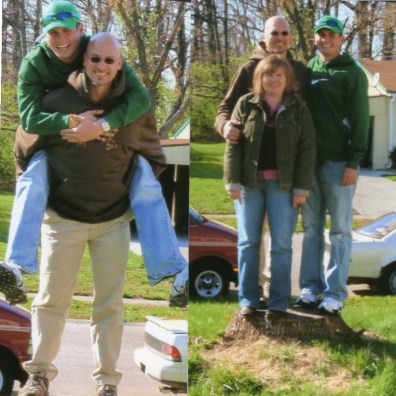
img08202017_017_002But guess what? No amount of procrastination could stop that date from coming. No amount of denial could stop me from thinking about what this day represents. This day would come—and yes, it would eventually pass—but the second it did, the clock just begin counting down towards another unfortunate milestone. The next Christmas. The next birthday. The next Father’s Day.

Time is relentless. It is unforgiving and cruel and unabating.

And then, ironically, time also heals. Never fully, and never without first inflicting severe pain, but it does heal partially. Time builds up scars to help us avoid certain elements of the pain we feel, but the scars are always there. We stare at them. We obsess over them. And yes, we feel them.

This has been my life after losing my Father to suicide. A life full of complexity—feeling everything, and at the same time feeling nothing. Wanting time to stop one moment, and then wanting it to speed up the next. Even though I try to do it through writing, it oftentimes feels impossible for me to explain my grief. But in this post, I want to tell you how I feel—honestly, authentically, and without much polishing. I want to tell you about some of the feelings I’ve felt over the past five years. Unlike how I usually write, I don’t have a central theme or focus for this post, other than giving you some insight into what the emotional experience has been like for me. I just want you to know what I’m feeling—mainly because I wish I had known more of how my Dad was feeling.

It’s important that we talk about our feelings, even if there isn’t any other point in doing it than to lift the burdens they have on our lives. I’ve felt a lot of different things over these five years. And more than anything, I just want you to know that although time might change some feelings, there is one that will never change; and that is the unconditional love that I feel for my Father.


I feel shock. At least every day, although at different points throughout the day, I have to face the truth of my Dad’s death. At some point every single day, I have to tell myself, “He’s gone.”

I hate facing that moment head on. I absolutely hate it, but I live with it. And I know I have to do it.

In the immediate aftermath of Dad’s death, this happened almost instantaneously every morning. I would wake up, and the first thing I would think about is the fact that Dad had died. “Dad’s dead,” I would hear over and over again in my head, almost like someone was taunting me. My mind would lock in and obsess over this. It was hard to let that thought go—or maybe it’s hard to get that thought to let go of me. Some days it never did.

Time wears on. And some years down the road, it was still the first thought I had. But on other days, it would sneak up on me. On those other days, I might go for an entire hour before the thought of Dad’s death would cross into my mind.

And I’ll admit that this made me feel unbelievably guilty.

On those days when I was able to live for an entire hour or two and not think about Dad’s death, I felt guilty because there was something inside of me telling me I needed to obsess over it. There was an evil voice inside my head saying “See, he’s only been gone for a few months and you’re already forgetting about him. You’re pathetic.” Unfortunately, I started to believe that voice. How was it possible that I could go for a period of hours without thinking about the man who had given me so much? I knew that I shouldn’t beat myself up over this—that not obsessing over his death was not a reflection of my love for my Father. But our feelings are often very difficult to interpret, and sometimes we listen to the voices we shouldn’t. For a long time, I let that guilt eat me alive. And some days, I’m still living it.

There’s only one type of day that’s worse than this one, however. It’s the days when the shock and truth of Dad’s death completely blindsides me. Five years removed from his death, there will be the occasional day where the busyness of my life distracts me from the reality of Dad’s death. But then, something great will happen. And I’ll reach into my phone, pull it out, and go to dial Dad’s number.

And when it hits me that he’s gone, I completely crumble.

I beat myself up for not thinking of him earlier. I accuse myself of being so focused on myself that I can’t focus on others. I feel guilty and horrible, as if not thinking of my Dad’s death is a sign that his life didn’t matter. I tell myself that I’m not living life the way I should, that somehow I’m not “grieving enough,” as if that were even a thing. I dwell in the self-doubt and accusatory guilt that keeps me from being the man I know God wants me to be.

Eventually, I escape from that prison; but even five years removed from Dad’s death, I still have a really hard time coming to terms with the fact that I am a survivor of a family suicide. Before losing Dad, suicide was always something that happened to other people. Not me, not us. My family was “normal.” My family was “perfect.” My family was the American Dream. Suicide and mental illness couldn’t touch my family.

But it did. And I am one of those people left behind in the aftermath. And no amount of denial will ever change that fact. I still have a hard time telling people that my Dad was a victim of suicide because I don’t know how they will react. I know how judgmental I would have been when receiving that kind of news prior to my Dad’s death, and I don’t want those folks to make false and unfair assumptions about the man he was.

I am staring suicide and my Dad’s death in the face every single day. Some days I deal with it better than others. Some days I don’t deal with it well at all and I have to completely disconnect and disengage. But it’s always there—hovering overhead, continuing to send shockwaves through my system. I wonder if that shock will ever fade entirely.


I feel terror. I’m yelling, even though the rest of the house is quiet.

It’s happened again.

I roll over and look at the time on the clock. 3:26 AM. This was a particular night, but it could have been any night. I know that I’ve just been yelling—likely something inaudible. I’m in a cold sweat, but my face is wet from tears, not perspiration. I can feel how tense my body is, and my limbs are shaking. It’s happened again. I’ve just had to relive everything.

I didn’t want to. In fact, I never want to relive the pain of that day again. But in my dreams, the same memory often invades me. The flashback and vivid memories of the day I lost my Dad.

It’s those dreams—nightmares really—that you wish would never occur which often plague you most frequently. The day I lost my Dad was the most consequential day of my entire life to this point. Horrible? Yes. But also consequential? Unfortunately.

I don’t ever think I’ll stop seeing it, reliving it, and experiencing it in my head—no matter how hard I try.

Honestly, it’s happened less and less over time. When Dad first died, I was waking up in the middle of the night on a fairly regular basis. I was worried that I might never get another full night of rest ever again, because those early nights were so painful.

As farfetched as some dreams can be, it’s amazing how lifelike others are. They can throw you in the midst of a sensory whirlwind that places you back into a particular moment in time. Dreams of my Father have often been like this. I hate to say that I rarely have dreams about all the great times we shared together. Instead, the dream I experience most often is the dream of that horrible day.

When I have this dream, my stomach still turns just like it did on that morning when I heard the news that there’d been an accident involving my Dad. I can feel things and hear things and smell things that don’t even matter to the end result of the story, but I experience them nonetheless. But it’s that horrific 20-second vignette that constantly replays in my mind. I can see my Grandpa walking out of the house. I can feel his strong arms pull my Mom and I into a hug as my Mom sobs. I can hear my Grandpa’s breaking voice when he looks at us, hopelessly, and says “He’s gone.” For as long as I live, I’ll never be able to escape the sound of my Mother’s anguished scream. I feel myself falling to the ground in the front yard, and I feel that familiar sensation of being thrown into the depths of a deep ocean and sinking under the weight of the waves. I can sense a feeling of evil hovering above me. And in my dreams, I feel this all again—just as strongly as I did on the day it happened.

Some memories fade after five years—and the ones you want to fade often don’t.

On this particular night, I rest on the edge of my bed, closing and squinting my eyes so hard, trying to shut out the memory and the pain of that experience. I grab my ears, trying to get the sound of my Mother’s cry to stop. It’s like I’m trying to physically shake this memory free from my consciousness.

But I can’t. At least not immediately.

Before I know it, I’m in a completely inconsolable position and unable to control my own physical movements. I know why this memory continues to haunt me. I know that the trauma of this life-altering experience has burned and branded the sights and sounds of that moment onto my brain forever. Painfully, I know that I’ll always experience these moments to a certain extent.

But I just want it to stop. I don’t ever want to forget my Dad, but I want to forget the moment I lost him. I want to be able to escape the pain this moment causes me, but I wonder if I could ever escape it without forgetting how much I loved my Dad. I’m sure there will be a day at some point in my life when the flashback of losing him is easier to manage. But it won’t make that memory any less intense. It won’t make that memory any less severe. It will just be different. I know I’ll feel different at some point, but on a night like this one, I feel scared. Scared by the ghosts of a past image continuously haunting me, and scared by when the flashback might occur again.


I feel exhausted. “I’m sorry man,” I type. “I know we had plans, but I just don’t think I can do it tonight.”

I can’t even begin to think how many times I had to send this message to friends and family members and coworkers in the aftermath of Dad’s death. Especially after Dad died, there were many people—well-intentioned people—who tried to get me out of the house. They wanted me to get out and do things to try and get my mind off of losing my Dad, and I’ll always appreciate those moments of normalcy I had with them after losing Dad.

But there were some days—many days—when I just couldn’t. My grief kept me in bed. My grief kept me locked in the house, unwilling to face the world around me. My grief kept me disconnected and wrapped within my own darkness.

There were some days when I just couldn’t go to work, because everything at work felt so trivial in the aftermath of losing my Dad to suicide. I would actually grow angry towards my job—a job I loved—because it felt like nothing else mattered anymore. It was weird to, for the first time, feel a lack of desire and passion for my work. I had never experienced this before, and I wondered if I’d ever find pleasure and satisfaction in any activity that didn’t involve grieving my Dad’s death.

Social activities felt that way, too. I knew that my Dad’s death had taught me the need to love those in the world around me, but I just couldn’t bring myself to put that into action. It felt like I should be doing something more important, even if I didn’t know what that “something more important” should have been.

Those nights when I would bail on plans were usually very difficult and isolating. I would lock myself in the house with blinds drawn and lights dimmed, and I would wallow in the grief I felt. I wouldn’t eat, and I’d retreat to sleeping hours and hours on end.

Some of the nights when I did go out, however, were just as bad. It sounds insane to say this, but I often felt like I was wearing this sign around my neck everywhere I went that read “My Dad Died from Suicide.” It was like everyone was staring at me, even though they weren’t. It was like I was the center of attention for all the wrong reasons. I’ve never been claustrophobic, but if there’s such a thing as social claustrophobia, I felt it then.

And there are many days, even five years down the road, when I still have to scrap what’s planned to deal with unplanned grief. I’m learning to be okay with it. I’m learning that grief, just like mental illness, is unplanned and impossible to predict. Unfortunately, I finally understood what it meant for grief to take a physical toll on someone. It sapped and eroded every ounce of energy I had.

If I stayed at home, I was emotionally exhausted. And if I went out, I was emotionally exhausted. It felt like, no matter what I did, I was going to be perpetually worn out from my grief. I worried that it would never end, and to a certain extent, it hasn’t. These days are fewer and far between, but when they occur, it’s like I’m right back where it all started.


I feel angry. “Okay. I’ll be praying for you. And if there’s anything I can do for you or your family, please make sure you let me know.”

I end the phone call with undeniable sorrow. A phone call I’ve had all too often since losing Dad.

It’s a phone call with another individual who has just lost someone they love to suicide.

When I started speaking and writing publicly about my Dad’s death, I had two overarching goals: (1) to try and prevent suicide from happening to anyone else, and (2) to minister to people who are affected by suicide in the scenario that we can’t prevent it. I knew that part of my ministry would be to do something that makes me completely uncomfortable. I would need to talk with people who are grieving and distraught and try to help them make sense of their new world, their new and darkened reality. Prior to losing Dad, I didn’t even like to attend funerals because of how uncomfortable they made me. Now, I wasn’t just watching the storm from the shore; I was driving straight into it. I was saying that I would walk alongside people in their grief, no matter how uncomfortable it made me.

I’ve learned how to be more compassionate. And I’ve learned how to identify with the sorrow of others by feeling it myself. But shortly after that sorrow begins to fade, I get angry.

Not at my Dad. Never at my Dad. In fact, I can say with 100% certainty that I’ve never once been mad at my Dad. I’ve never once held him responsible for his death. My Dad was a victim of suicide, and that’s more than just fancy phrasing. My Dad was attacked by a mental illness—depression. Had he died from cancer, I wouldn’t be made at my Dad. I’d be mad at the cancer. Or I’d be mad at the heart attack. Or whatever other illness might have taken him away. Not at him—and I can’t be mad at him in this scenario either. Yes, my Dad died from suicide; but the root cause was depression. In his right mind, my Dad would have never left us. He wanted to be here to love us, and I firmly believe that. An illness warped his mind into thinking he didn’t matter.

But I do get mad at other things. I get mad at a society and culture that portrays mental illness as a personal weakness. I get mad at a culture that says that to seek help in the form of counseling or treatment is a sign of weakness. I get mad at the culture of comparison that we’ve created that says we must do more, be more, and earn more to matter, when God tells us that none of these things are actually important. I get mad at the unfair pressures that were put on my Dad and everyone else impacted by suicide. And yes, I even get mad at individuals who, I think, contributed to my Dad’s death by putting unfair pressures on him. But more than anything, I get mad at a disease that we can’t seem to figure out. I get mad because I have questions. I get angry because I want to drive down the rates of suicide in our country, and because I know that there is more we can do.

I feel angry because I feel like I’ve been robbed. I’ve told this to God many, many times. He knows how I feel, so why would I ever try to hide those feelings from him? I feel like my happiness was stolen from me on July 24, 2013, even though I’ve been able to experience it in the aftermath of losing him. I feel like a thief came and stole away the promises of all the wonderful things that were to come in my Dad’s life and life of our family. It was completely unnecessary that my Dad was gone so soon, and I feel angry that we didn’t get to have the moments together that we should have had.

As much as I hate feeling this anger, I know that it motivates me. I know that it pushes me do more to try and prevent this story from replicating itself throughout my community. I don’t care to spend hours on the phone talking to people or meeting with them for dinner when they’ve been hurt just like we have. That anger towards my enemy—mental illness—is unrelenting, but I’m channeling it into something that I hope will help others who are hurting.

But I’ve never been angry at my Dad. And I know I never will be.


Even after feeling all of this, I still feel redeemed. “Wow, I had no idea that Dad did that…” I find myself saying this all the time, because I find myself learning new things about him. The fact that I can smile while hearing these stories, even if I might simultaneously shed a tear or two, is a sign that God is guiding his hand over the ashes of my life to bring something good out of it.

It’s strange to say that I feel hopeful, because there were moments after my Dad died when I never thought I’d be hopeful about anything ever again. Those moments when life felt empty could be paralyzing.

And then, a little victory would occur. And I would start to see the redemptive power of God’s love and his work.

There were moments when I would talk with people and they would tell me a story about something my Dad had done to positively shape their lives. People he had talked to—and boy, did he talk to a lot of them. Money he had given to help people when they were down on their luck. Money he had given to causes simply because he was charitable. Tools he had lent, knowing that he would never get them back. Things he had repaired for people even when he had no idea how to repair them until he got in the thick of the job.

I’m ashamed to say this, but it took my Dad’s death for me to learn about him because there were so many good things that he did which he would have never wanted credit for. And when I hear these new stories about my Dad, it’s like he’s still alive. When I learn new things about him, it’s like new life is breathed into his memory.

Sometimes, the victories have been seemingly insignificant; but to me, they’ve held tremendous power. There was the time I went into one of my Dad’s favorite restaurants for the first time without losing him. I was actually able to focus on the great memories we had shared there together rather than obsessing over losing him. Moments when I could drive by his work without breaking down. Times when I could see his writing or go to a softball game and think positively about his life.

Those little victories began to build—one after the next, one on top of the other.

It showed me that God has been working.

Don’t get me wrong—I’ve still got lots of questions for God that I plan to ask him. Why did this happen? Why did it happen to my Dad? Why did it happen to us and our family?

In spite of all my questions, I know this. I know that God didn’t cause this pain, but I do know that He’s building up the broken pieces of my life. I know that he’s bringing lots of people into my life who each take up a mantle of my Dad’s role in my life. He’ll never be replaced, but different people can live out some of his best qualities. I’ll latch onto those people, and I’ll cling closer to Jesus Christ. I’ll listen to His direction, and I’ll celebrate in the calm or in the storm. But as hard as it is for me to celebrate in the midst of a bad situation, I’ll keep searching for those little victories. Dad would have wanted it that way.


I hate this post. I hate it because it’s messy and unfocused and at times confusing.

Which is exactly why I’m leaving it the way it is. The control-freak inside of me who wants order and perfection wants to change it, but I’m letting that go. I’m letting that go because that’s the way our feelings work. Feelings are messy. Feelings are hard to control. Feelings are difficult to interpret and almost impossible to manufacture. Feelings are complicated and sometimes competing, conflicting, and contradictory.

But our feelings are real. And even when they are irrational, they are still very real.

I also hate this post because I could have written for twenty more pages about hundreds of other feelings and still never finish. I used to be a believe that we could classify or typify grief into stages; but now that I’ve had to experience it and live it, I know how fruitless any attempt is. Five stages to grief, you say? It’s not that simple. Sometimes, I experience all fives stages in twenty minutes. On any given day, I feel a hundred different feelings, and they are impossible to escape.

And all of these feelings—every single one of them—are rooted in a deep and never-failing love for my Dad. I can’t even begin to quantify how much I’ve missed him over these past five years. At Christmas, I miss being around the tree with him opening gifts. I miss having dinner with him in the evenings around our family dinner table. I miss watching him get excited about UFC fights and making fun of him for actually liking to watch them. I miss going to Kings Island with him and hearing his familiar scream of “Yeehaw!” as we rode each and every ride in the park. I miss sitting on the couch and watching episodes of The Office with him. I really, really miss those little moments.

I miss the big moments as well. There is no phrase that will capture how much I missed him on the day I proposed to Paige. I can’t even type that sentence without wanting to break down entirely. Gosh, he should have been there. He would have wanted to be there. He would have been smiling from ear to ear and talking about how Paige was too good for me (and he would have been absolutely correct). I think about how much he and Paige would have loved each other, and it bothers me every single day that I never got to introduce them. He would have loved having a daughter, and she would have been the perfect one for him.

I missed him when I graduated with my Master’s degree from Miami. My entire family was there, and it was wonderful—but I couldn’t help but gaze back in the bleachers at Yager Stadium in Oxford to see a gaping hole right next to my Mom where he should have been. I know she felt it too. Throughout all of those festivities, it hurt not having my Dad there. He was always so proud of the work I did in school from the time I was little. It made me believe I could do anything. I miss that reassurance from him.

And I obsess over the moments to come that I know he won’t be around to enjoy. For any of you who knew my Dad, you know that this is the understatement of the century: He would have made an amazing Grandpa. He was already bald and silly and loved naps—which is like half of what you need to make a great Grandpa! But my Dad loved children, primarily because he never let his inner child die. I often think about what it’s going to be like when I have children of my own. I’ll tell them about their Grandpa, but I don’t know that I’ll ever be able to paint an accurate portrait of the man he was. I hope they’ll love his memory as much as I loved him. But it’s unfair, because they deserved him. And he deserved them.

I feel love. And loss. And despair. And temporary relief. And sadness. And anger. And shock.

But all of these feelings—the good and the bad—are rooted in love. Five years have passed, and I love my Dad more and more each day. All these feelings may come and go randomly, but a consistent foundation of love has helped me face these five years one day at a time. And it will help me to face the 50 or 60 or 70 years still to come.

As daunting as the idea of facing that grief might be, it’s what is awaiting me on the other side of that gulf that gives me hope.
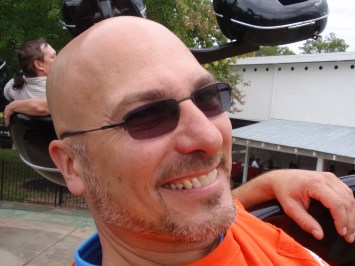
OLYMPUS DIGITAL CAMERAOn the other side of all that grief and sadness, there will be an everlasting love made whole again. On the other side of that grief, there will be a man whom I recognize, smiling and welcoming me into his arms. In that moment, I’ll love never having to say “seeya, Bub” again. That day is coming, although it’s very far off.

Five years. 1,827 days. Each new day different from the last. Each day a little darker without my Dad’s bright smile and engaging charisma. He. Is. Missed. Each and every moment. And in every moment, he is loved. By me, by my family, and by everyone in the world around him that he made better.

I constantly remind myself that, although I’ve had five years of life without my Dad, I had 26 years of unconditional love that inspired a foundation that will live on forever. And Dad spent 50 wonderful years living and loving those around him in ways we should all strive to do. Sure, it wasn’t enough. Sure, there should have been more. But my Dad made a big impact in his 50 years—an impact that some people who live double the age aren’t able to make. His impact lives on in me, and I know it will live on in our world forever.

I’ve survived these five years, and I’ll survive how ever many more come my way. I’ll fight for life because of what waits on the other side of Eternity.

And no matter how long that fight is, I’ll always love my Dad.

Dad Lucy and Me with Seeya Bub LogoDad, I cry so much when I think that it’s been five years since you and I last talked. Sometimes, those tears are unstoppable. We never even went five days in this life without talking to one another. Dad, it really has felt like an eternity—but sometimes your memory is so real and so vivid that it seems like it was just yesterday when we lost you. But I know the real time. I know that it’s been five whole years since we’ve been able to be in your presence. And life simply isn’t the same without you. We all cling to your memory. We marvel at the things you built and the way you provided for our family. We laugh about the funny things you did to make life more fun. But I also weep when I think about how much life you had left to live. Dad, I’m so sorry that you were sick. I feel horrible that we couldn’t do more to help you find the cure you deserved. I’m sorry that you were robbed of the life you deserved to enjoy. I’ve felt so much guilt in losing you Dad. I know that you don’t want me to feel this way, but I just wish there was more I could have done. You deserved that, Dad. You deserved more, because you gave everything. As painful as these five years have been, Dad, I find peace in the truth of Eternity. I find comfort knowing that you are enjoying God’s eternal glory in a paradise that I can’t even begin to fathom. Dad, thank you for watching over me for these past five years. Thank you for never giving up on me—both in this life, and in the next. Thank you for giving me a lifetime of memories and an example of what fatherhood should be. I love you, Dad. I always did, and I always will. Thank you for loving me back. Until I see you again, seeya Bub.

“I give them eternal life, and they shall never perish; no one will snatch them out of my hand. My Father, who has given them to me, is greater than all; no one can snatch them out of my Father’s hand. I and the Father are one.” John 10:28-30 (NIV)

Dad’s Rules: Last One Up

Dad's Rules Banner

(This is the newest feature in “Dad’s Rules”, a recurring series at SeeyaBub.com. To learn more about the “Dad’s Rules” series, check out my first installment.)

Dad’s Rule #143: The last one up at the end of a beach day wins.

I have a lot of visual images of my Dad that will randomly pop into my head from time to time. Whenever I think of him, I get recall visual snapshots of him playing with our dog in the family room floor. I can picture him kicking a playground ball high into the air and watching him laugh as I would frantically (and unathletically) attempt to catch it. I can picture the sweat dripping off his brow as he worked in the yard wearing a gray work t-shirt, his infamous navy-blue workpants, and steel-toed boots. I can see his silhouette surrounded by the orange glow of backyard fire.

Nearly everywhere I look, I see my Dad.

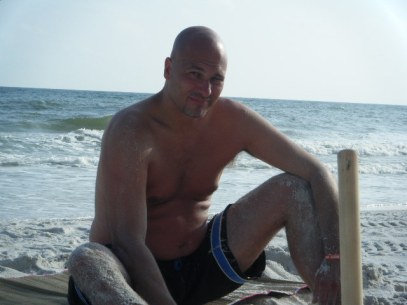
But the first picture that always comes to mind when I think of my Dad is an image of him in a beach chair, watching the waves roll in across the shoreline. I’ll never quit seeing that image—and I’m so thankful for that.

Dad on the BeachWhen I was extremely young, my family never took beach vacations. To this day, I’m not sure why because we all loved the beach so much. My very first time seeing the ocean was on a family trip to Panama City, Florida as an eighth grader. Our entire family (grandparents and cousins included) spent a wonderful week on the Gulf Coast, and I remember the momentous nature of that trip, even as a middle schooler. A 12-hour, multi-day car ride had finally concluded, and my Mom and Dad walked me out towards the ocean once we arrived. With my parents, I saw the ocean for the very first time and I got to experience its magnitude. I got to touch sand, and taste saltwater, and splash in the world’s largest pool. Even as a young kid, I appreciated the significance of this experience.

And from that point on, the hook was set.

Each year, I would dream of going on a beach vacation. And, for the most part, my family tried to make that a regular occurrence. We had fun at Panama City, but dreamt that there was probably something better out there. As all good Ohioans will do, we made a trip to Myrtle Beach…and as we spent an hour on the main drag trying to get to dinner one evening, we vowed to find another beach for our family trips.

I ended up finding that beach when I asked my Mom if we could go to Gulf Shores, Alabama.

“Alabama?” I remember her saying to me. “Is there even a beach in Alabama?”

Truth be told, I didn’t know either. But, I had seen a commercial that talked about a beach in Alabama, and I desperately wanted to go. (For those of you who work in the marketing and branding fields, this should be undeniable proof that commercials still work on some people.)

We talked about it as a family, and Dad seemed excited. So Mom and I spent some time locating a condo in Orange Beach (which runs along the Gulf strip in Alabama), and just like that, our vacation had been booked!

Dad Mom and I at San Roc CayAfter a really, really long drive, my family finally arrived to our condo in Gulf Shores. Shortly after arriving, I think we all knew then that we had found our family vacation spot. There was something about it that made us feel like we were home.

And when it came to being by the beach, Dad was never more at home.

The beach was where my Dad belonged. It was the perfect culmination of awe-inducing nature, relaxation, and playfulness that my Dad deserved to experience. I got to spend many wonderful beach vacations with Dad over the years, and they are always so memorable because of the joy I saw my Dad experience every day. Dad always worked so hard, and I remember thinking how much he deserved every vacation we took. He enjoyed those vacations so much for so many different reasons, and I’m glad I have so many cherished memories of Dad near the beach.

He was the king of the beach walk. Dad could kick off his flip flops and walk for miles along the coastline. Sometimes he would walk with me, sometimes he would walk with Mom, and sometimes we would all walk together; but no matter who he was walking with, Dad was always talking. He would look out into the waves and point out things he saw in the distance: dolphins, oil rigs, sandbars. He would look down and grab shells before the tide pulled them back into the ocean. He would take those shells and turn them over and over with his rugged hands, marveling at the beauty of a small piece of God’s creation. He would stare up at the sky and take in the clouds, predicting what the weather would be like for the rest of the day.

And always the talker, it seemed that Dad would inevitably find someone along the shoreline and strike up a conversation with them. He made friends everywhere he went, and the beach was the prime breeding ground for finding new friends. Dad would often spot something unique about someone through his darkened glasses: a team’s logo on a beach tent, a nifty device that helped someone scoop up shells, a crafty beach sculpture, or just a friendly smile and wave from a stranger. I even saw him start a conversation with someone who was fishing on the shore once—and my Dad did not fish regularly! Dad would use those seemingly mundane things to get to know people. He would find out about where they came from, what they did for a living, their families, and what they loved about the beach.

On the beach, as he talked with complete strangers, Dad taught me that people love talking. And I think his mission in life, even when he was on vacation, was to listen to them and get to know them.

Although Dad could nap with the best narcoleptic, he rarely used his time at the beach to nap. “Why would I want to close my eyes and sleep when I’ve got all this to look at?!” he said to me once. Sure, he might nod off every now and then, but most of his time was spent having fun and doing playful things. And I’m thankful that no matter how old he got, Dad never lost that sense of playful whimsy when he went to the beach together.

Dad Throwing a Frisbee at BeachAs I’ve written before, Dad was a tremendous athlete. And also as I’ve written before, I was a horrible one. But Dad never let my lack of athleticism curb an opportunity to play. At the beach, Dad and I could throw a frisbee for hours—as long as the wind cooperated. We would warm up close to one another and gradually step back as we threw until we would finally hit a point where we had to wind our torsos like a corkscrew to get the frisbee to sail over the white sand. Dad and I would leap and dive into the sand to catch a frisbee—his leaps and dives always significantly more graceful than mine—and we would yell at each other for not being able to properly hit our target. “Did you actually expect me to catch that?!” we would yell across the beach at one another. “You’re gonna kill a kid with that thing if you don’t learn how to throw it!”
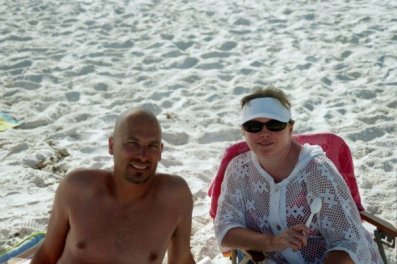
And of all the essentials that needed to be packed for a beach vacation, our gloves and a baseball were at the top of the list. In fact, Dad and I never had a single beach vacation together without our gloves in tow. We loved standing in the sand and tossing back and forth, even though Dad’s arm was always a bit stronger than mine. Okay, more than a bit. It was so peaceful, and so rhythmic. The beach, in my mind, is the perfect place to throw a baseball. On occasion, I’ll still shake my glove out and feel grains of sand fall out of the leather. It reminds me of all those wonderful hours we would spend near the ocean tossing a baseball back and forth.

But Dad’s fun was never limited to what people “his age” should be doing because he never let adult expectations overshadow his inner youngster. Dad would dig holes in the sand for absolutely no reason other than to see how deep he could dig. Sweat would drip from his bald head and sand would stick to his arms, and just like a child he would constantly beckon Mom and I to see how deep he was able to dig. “See that water down there?” he’d say with the excitement of a young boy eager to show off his accomplishments. And Dad didn’t have time for cheap, plastic, inefficient beach-store shovels. Dad started bringing his own shovels from the barn back home, attempting to beat his own personal record year after year.

He would build sand castles. And he would make silly sunscreen patterns on his tanned head. And he would feed seagulls, and I would yell at him that birds were created by Satan and that I hoped they would peck his eyes out after he ran out of Cheez-Its just to teach him a lesson.

And Dad, as he always did, would laugh about everything. And on the beach, he always taught me that you’re never too old to be a kid again. He taught me that in order to make memories, you have to make life fun.

Mom and Dad at BeachAnd at the beach, Dad never played it safe. More than anything, I think Dad and I probably got the most enjoyment of our daily game of “See Who Can Swim the Furthest Out from the Shore and Make Mom Freak Out the Most” (catchy, no?). Much to my Mom’s displeasure, Dad and I were notorious for jumping into the water and swimming straight ahead until our arms gave out. The water would grow colder and colder the further we would swim, and periodically Dad would stick his arms high above his head and straight-dive down to see if he could still touch the bottom. If he could, we still weren’t out far enough. All the while, my poor Mother would sit anxiously in her beach chair watching our bobbing heads grow smaller and smaller in the waves. The best version of the game was on the beaches where there were life guards on duty, and in those scenarios, we tried to see how loud we could get them to blow their whistles at us! We knew we were really killing the game if we could swim far enough to encounter a deeper sandbar, and if we did, we would sit out on the sandbar and rest until it was time to swim back in. Dad would wave to Mom on occasion from the depths of the mighty ocean, and it was amazing how peaceful the deep ocean water can be. All the ambient noises of the beach fade away when you’re that far out (you especially can’t hear life guard whistles or motherly-shrieks).
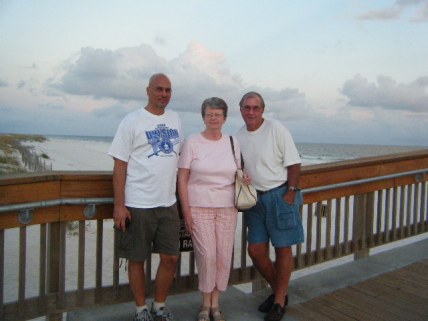
I loved it. And I miss it to this day.

Dad found fun things to do when he was at the beach, even if those fun things could’ve risked personal injury. He would usually find a day to rent a wave runner and skip across the glistening waves, going entirely too fast. And he only ran that wave runner onto a hidden sandbar that one time. He went parasailing once with my Grandfather, and they joked about whose weight would create more drag, making it harder to get the sail in the air. At the urging of my Grandpa on a full-family vacation, Dad was one of the four brave individuals who took a ride on the infamous Banana Boat. If you’ve ever ridden a Banana Boat, you know that the goal of any Banana Boat driver is to mercilessly throw the passengers into the ocean as many times as possible. My Dad, Grandpa, Uncle, and Aunt were only flung into the ocean about six times, and my Uncle Lee only threatened to remove himself from the family once. Dad laughed every single time he retold the story of being on the Banana Boat and Lee’s raging anger at my Grandpa for making him do it in the first place, and Dad never let go of the wild and uncontrolled joy he felt any time he was doing something fun near the ocean.

On the beach, Dad taught me that sometimes, in order to do something fun, you’ve also got to do something that might have an element of danger to it. As a kid who was pretty risk-averse, Dad knew I needed that reminder.

And although he was busy with hole-digging projects and shell-collecting expeditions, Dad never let the busyness of home invade his vacations. Unlike some Dads I watched on the beach, my Dad was rarely on his phone. He didn’t see the need to take phone calls—the world back home would function just fine without him, and he had more important things to focus on. He was there to love his family and make our lives more enjoyable. He was there to create lasting memories with all of us. We were on vacation, which meant home could wait.

But Dad had one rule at the beach that trumped all others. One central rule that was most important, and one rule that he lived out every single day that he was shoreside:

He would always, always, be the last one up.

My family’s routine at the beach has always been very simple, very consistent. Each day we are at the beach, our schedule always looks the same.

Morning: Go to the beach.

Afternoon: Enjoy the beach. And eat lunch at the beach so you don’t lose valuable beach time.

Late Afternoon: Stay at the beach.

Evening: Go out to dinner.

Late Evening: Go to sleep so you can wake up and do it all over again.

“Beach, Eat, Repeat” has always been the mantra of our family vacations, and none of us would have had it any other way. There is too much to witness at the beach to even think about doing anything else.

But around 4 or 5 o’clock, the stomach begins to growl. And all of the wonderful seafood restaurants of Gulf Shores begin to beckon the hungry Bradshaw’s. So, reluctantly, we would pack up our beachside oasis and make our way back up to the condo.

Mom was always first, because she took the longest to get ready. I would follow next. And Dad was always last.

And it wasn’t even close.

Getting Dad to leave the beach each day was like trying to pull a lion out of a freezer of fresh Kobe steaks. Dad loved everything about the beach, but he especially loved the beach at dusk. Always the nature buff, Dad enjoyed watching the sun set into the ocean. He loved watching the orange glow dance off the tops of the unrelenting waves. But even though he was a people-person to the millionth degree, I think the thing he liked most about the beach at dusk was that he felt like he had it all to himself. All those suckers who went up to their rooms at 4 or 5 were missing out on having solitude along the shore. Dad would sit there with his chair in the shallow water, digging his toes into the sand and staring out across the Gulf.

Dad Grandma and Grandpa at BeachMy Grandpa even told a story at Dad’s funeral about his love for always being the last one up. On occasion, my family would take vacations with our extended family, which included my Grandpa Vern, Grandma Sharon, my Uncle Lee, my Aunt Beth, and my two cousins Jake and Megan. Those were always wonderful vacations, and every day, my Grandpa and my Dad were always the last ones up to the condo. But even my Grandpa couldn’t hang with my Dad.

“Scott,” he’d say, “I think I’m going to head on up so we can head out for dinner. You coming?”

“Okay. Yeah, I’ll be up in a minute,” Dad would respond.

And 45 minutes later, he’d still be sitting there, camped on the shore looking out over the blue water.

And had it not been for my impatience, he probably never would have left.

As Mom and I grew hungrier and hungrier, I would pace on the balcony and look down at my Dad. From a distance, all I could spot was the back of his shiny bald head, and I would grow angrier and angrier that he wasn’t coming up to get ready. Didn’t he know all the families of 18 with annoying kids went to dinner at 6?! If we didn’t get in the truck within the next 10 minutes, there was a good chance that the entire slew of restaurants in Gulf Shores would simultaneously run out of seafood and we’d be stuck eating lunchmeat and peanuts in the condo for dinner?!

So, I would do what all impatient sons do; I annoyed the bajeezus out of my Dad. I would call his cell phone repeatedly, and he would rarely pick up. On the times he did, I would tell him that Mom and I were tired of waiting and that if he didn’t get up here within the next ten minutes we were going to leave without him. Hearing my threat, Dad would laugh and tell me that he was very, very scared, and he would sit back down in his chair as I fumed from my balcony overlook. If he waited long enough, I would even begin yelling from the balcony—which is a really mature thing to do, by the way.

Eventually, although never quick enough, Dad would come up. And he would take way too long in the shower (how does a guy with no hair still take a thirty minute shower?!). And all the while, my stomach would slowly eat away at itself. And then, we’d go out to dinner, and they’d still have seafood, and my hangriness would fade, and I’d feel bad that I had treated my Dad that way.

And now that he’s gone, I feel horrible for the way I acted. And I wish I could apologize. But more than that, I wish I could just sit next to him again and not worry about the clock.

I feel bad because I think, deep down, my Dad understood how precious his time at the beach was. No matter how long he lived, he would never be able to spend enough days at the beach. He would never be able to get enough of God’s most beautiful creation. And no matter how long he stayed there, I think he knew that he would only have a limited number of those sunsets in his life. So, he stayed there as long as he could to soak them all up.

I’m glad he was always the last one up, because it made him happy. And I’d do anything to stare down from the condo balcony and see him parked in a beach chair again.

Most people don’t know, but my family was actually scheduled to go on a beach vacation at the end of July 2013—the week after my Dad’s death. We had the trip booked for months. In fact, the night before he died, Dad was shopping online for a cap for his truck bed to protect all of our luggage. After he passed away, some people told Mom and I that we should have went on the vacation anyway to get our mind off things, but how do you get your mind off of losing an immediate family member? And do you even want to get your mind off of that? Mom and I didn’t even entertain the idea of going to the beach without Dad. His absence was palpable, but it would have been magnified and exacerbated in unbelievable ways had we gone to the beach without him.

Mom and I decided to stay home, and secretly I wondered in my head whether or not I’d ever be able to go back to the beach again. The grief I felt in that moment scared me. I was afraid that every time I went to the beach without my Dad, I’d feel that same sense of pain and despair. The thought alone was debilitating.

About two years after losing Dad, my good friend Steve asked me if I wanted to go to the beach for a week as a Christmas gift (talk about having good friends!). I had wanted to go, but I was still worried about going. I was worried that, emotionally, the trip might be too much. I was worried that I hadn’t given myself enough time or space to grieve properly. And in the back of my mind, I still worried that I might not ever be able to go to the beach without thinking of Dad and picturing him there.

And guess what? I was right. I was right about the fact that I would never, never go to the beach without thinking of my Dad and conjuring up images of us there together. But I was wrong in assuming that those reflections would always be grief-inducing. Yes, there would be plenty of sadness, but there were also so many wonderful positive memories of Dad at the beach that brought a smile to my face even while I was upset. Going to the beach had the effect of flipping through a photo album after losing a loved one; yes, there would be tears as you turned each page, but it would also remind you of happy moments that you tend to forget in the midst of your loss.

I took Steve up on that offer, and I remember seeing the ocean for the first time after Dad’s death. When we grieve a loss, we tend to divide every aspect of our lives into before and after chapters. Instead of having the “first time” with any given activity, you have two first times. There’s the real first time, and then the first time after the tragedy. The first time after life changes permanently. Standing on the shore for the first time and touching my toes in the Gulf for the first time in my life on Earth without Dad was a pretty monumental and overwhelming experience. I remember standing there and thinking about Dad, and I began to tear up as I watched the sunset—a sunset that Dad certainly would have loved.

Dad and I At the BeachStanding there at the beach, I told Steve how much I missed my Dad. I really didn’t have to say anything, because Steve knew—and he was experiencing the grief himself. Steve had been tremendously close with my entire family, and my Dad treated him just like he would treat his own son. Instead of only crying, though, I was able to share tremendous memories and stories of my Dad, telling Steve all about the funny things he had done at the beach on our family vacations. I shared stories about Dad’s Banana Boat expedition, his wave-runner sandbar collision, and how he was always the last one up for dinner. Little by little, the tears were slowly replaced with a smile and laughter. I didn’t miss him any less; I just had a different focus. Instead of focusing on the loss, I was able to focus on his life. Instead of focusing on the time we didn’t have together, I focused on all the wonderful times we did.
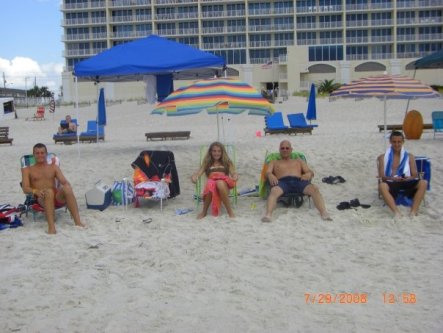
I’ve been to the beach a few times since losing Dad, and whenever I go, memories of Dad are always in tow with me. There will never be a day when I go to the beach and don’t think about my Dad. But instead of just thinking about him, I try my best to live by his beach rules. I get up extra early so I can watch the sun rise. I swim out as far as I possibly can into the ocean—much to Paige’s dismay—and once I’m far enough out, I talk to my Dad and tell him how much I miss him. I talk with complete strangers on the beach and get to know them because that’s what Dad would have done.

And of course, I’ve taken up Dad’s throne of being the last one up.

Megan Jake Ty and Dad at BeachI spend a lot of time on the beach during dusk as many of the families on the shore will begin to retreat to their condos. And I do this for a simple reason: that’s what Dad would have done. I’ve learned why he loved it so much. As the beach starts to quiet down from a busy day of frivolity and fun, there’s a quiet stillness that begins to wash across the shore. That stillness is enticing and comforting, and it’s in those moments that I often feel closest to God. And I think about how peaceful those moments must have been to a man who struggled with depression. Dad treasured that peace. And now, I treasure the memory of his life during those peaceful moments, and I try to live it out every chance I get.

So, when everyone else starts to pack up their chairs, I plant mine a little closer to the water to honor my Dad. I let the waves wash across my sand-worn feet. I look out across the beach, and I smile. And in my heart, I thank my Dad for all those wonderful summer vacations. And I thank him for showing me the beauty of being the last one up.

Dad Burying My Head in Sand with SB LogoDad, there has never been a time when I’ve gone to the beach without thinking of you—and there never will be. You made our time at the beach together so memorable, but more than that, you taught me so many important life lessons while we were there. You taught me to slow down and relax. You taught me to soak in God’s beautiful creation. You taught me to be kind to people and get to know them, because God created them, too. You taught me to let go of all the busy things from back home and simply enjoy the life that was in front of me in that moment. I take these lessons with me everywhere I go, but especially when I go to the beach. Even though I’m still able to have fun when I go, it just isn’t the same without you. I miss our throwing sessions, and sometimes I’ll just carry a baseball in my backpack to turn over and over in my hands and think of the time we spent together. I miss trying to see who could swim the furthest out, and watching you beckon me further even when I felt like I couldn’t keep swimming. I miss walking along the shoreline with you and listening to your stories about oil rigs in the distance or planes flying overhead. You had an inquisitive, appreciative spirit for all life had to offer. And more than anything, I miss watching you enjoy those moments on the shore by yourself being the last one up. It’s strange, but sometimes it’s like I look down from the balcony and I can still see you sitting there. Dad, I know you’re still with me. I know that you’re guiding me and watching over me in everything that I do. Thank you for always being my best teacher. Thank you for being a Dad unlike any other. And thank you for always teaching me that the last one up wins. I love you, Dad. I miss you tremendously. I sure hope there are beaches in heaven, because if there are, I promise I’m going to swim further out than you. Until that day when we can be beachside together again, seeya Bub.

“O Lord, how manifold are Your works! In wisdom You have made them all. The earth is full of Your possessions—This great and wide sea, in which are innumerable teeming things, Living things both small and great. There the ships sail about; There is that Leviathan which you have made to play there…You send forth Your Spirit, they are created; and You renew the face of the earth.” Psalm 104:24-26, 30 (NKJV)

“Selfish”

As I was driving into work this morning (I began writing this post on June 8), I received an alert from my phone from CNN. Just a day prior, I had received a similar alert regarding the Center for Disease Control’s (CDC) recent study release, which found that suicide rates have increased by 25% over the past two decades in the United States.[1] It hit home in ways I never predicted it would.

On that next morning, I looked down at my phone, and I really couldn’t believe what I saw. Television star Anthony Bourdain was dead at the age of 61 from an apparent suicide. Just earlier in the week, fashion designer Kate Spade also died from an apparent suicide.

Before I write any further, I want to first say a few things about my context in regards to these two situations. During his life, I don’t want to claim I was a fan of Bourdain’s work. I never watched his shows (not out of hostility, more just a lack of interest). In the same vein, I don’t want to portend that I was a huge fan of Kate Spade either. I’ve never carried a Kate Spade bag…or any bag for that matter. I don’t want to posthumously conflate any feelings I had towards these two individuals while they were alive. I also don’t claim to know much about their lives (other than the few things I’ve seen in the news), and I don’t claim to know all of the things they were dealing with in their lives. Unfortunately, I don’t know much about either of their lives, other than the sad, untimely ways in which they ended.

Nonetheless, it doesn’t lessen the sadness I feel when I read about these two talented individuals who are gone too soon and unnecessarily. Just because Bourdain and Spade were celebrities doesn’t make their death any more tragic than anyone else who dies from suicide. It also doesn’t make it less tragic. Behind the celebrity façade are family members, friends, colleagues, and neighbors that are left behind with questions—questions they will have for their entire lives.

What I’m writing about, however, is not Bourdain’s death, but a reaction to it. An unfortunate reaction that I think pervades most of our society when issues related to suicide arise. A reaction that is all too common. And a reaction that we must discourage in order to remove the stigma behind mental illness and suicide. Let me tell you the story.

A local radio personality in Cincinnati who I follow on Facebook (and won’t name here) reacted to the news. This individual posted the news of Bourdain’s death along with a short comment:

“So sad. Such a talent. We all have our demons. #anthonybourdain”

Shortly thereafter, a woman I’ll call Jean responded:

“I agree, but I am also ragingly ANGRY. He leaves a daughter. HOW SELFISH can someone be?!? I hope she [his daughter] is shielded from the publicity…”

And, the radio personality wrote back:

“I can’t disagree.”

He can, and he should. He should disagree. Dear friends, we need to talk about this type of reaction because it’s ill-informed, harmful, and ignorant.

First, let me say this. Although social media has many wonderful benefits, I largely despise it for what it has created in our lives. It creates an unbelievable sense of competition because it falsely projects the image that “everyone but me is living the perfect life.” In fact, I have no doubt that the increase in suicide rates in our country is largely influenced by the prevalence of social media in our lives. In many cases, I think social media disconnects people more than it actually connects them.

Along those same lines, I don’t often see the value of litigating every single comment made on Facebook or Twitter or Instagram or any other network. I sure hope that every single comment I ever made on Facebook isn’t brought back to vilify me years after I wrote it. I’m not writing this post to vilify the radio host or Jean (neither of whom I’ve ever met) or anyone else. I’m writing this post as a contemplation on the larger societal attitudes towards suicide as a “selfish” act.

However, I do think it’s important to recognize that this type of attitude and speech surrounding suicide is common. I hear it often—mostly from people who don’t yet know that my own life has been darkly wounded by suicide.

Search the web for “suicide is selfish” and you’ll find any host of authors or commentators who agree with this sentiment. You’ll find articles written by people like Lesly Salazar that read “I still think suicide is selfish and no, I’m not ignorant for believing so.”

Again, my goal is not to vilify these individuals. I vehemently disagree with them. I disagree with everything they believe about suicide and mental illness. I think their positions and their statements are ill-founded, ill-conceived, hurtful, damaging, and dangerous. I think that, had their lives been touched by suicide like mine was (and I’m glad theirs hasn’t been), they might think differently and more compassionately. I write this not to tear them down as human beings. I write this to hopefully educate them. I write this post to hopefully share with them a different understanding of suicide—from an individual who lives with the pain it creates each and every day.

Suicide is not selfish, because mental illness is not selfish. It’s as simple as that.

Those of us who have lived with and loved individuals who suffer from mental illnesses like depression, anxiety, bipolar disorder, schizophrenia, or any other host of illnesses know that those individuals do not consciously choose their illness. People do not choose to be depressed. People do not choose to be anxious. People do not choose to hear voices in their head that tell them they aren’t enough and never will be. People do not choose to be mentally ill.

We know that we don’t choose to be mentally ill because we can’t explain why we feel the way we do in regards to mental illnesses. And although we don’t have an extremely thorough understanding of the physical factors and mechanisms behind mental illness, we do know that there are often biological mechanisms at play. We know that there are regulating chemicals within our brain that can change over time, and the incorrect balance of those neurochemicals and transmitters can create or prolong a mental illness. And if we know that mental illnesses can have a biological root, why in God’s name would we ever, ever accuse someone of being selfish if they die as a result of their illness?

If you’ve ever had a family member die from cancer, would you ever call that person’s death “selfish”? If you’ve ever had a friend die from heart failure, would you ever call them “selfish” for their weak heart? If you have ever had anyone in your life die from an inexplicable physical illness, would you ever dare insult that person’s memory by calling their death “selfish”?

No, you wouldn’t.

And no, we shouldn’t.

I can already anticipate the retort from individuals who disagree with me: “But if we don’t say that suicide is a selfish act, it will encourage other people to do it. There will be no penalty against it. The belief that suicide is selfish actually keeps people from attempting suicide.”

Tell that to the CDC. If that’s the case, why hasn’t the stigma worked up to this point? If most of society thinks this way (and I believe they do), why have suicide rates risen by 25% in just two decades? The belief that suicide is selfish doesn’t discourage people from attempting suicide; it actually exacerbates their feelings of inadequacy, self-doubt, and unworthiness.

Dad and Grandma Bradshaw
My Dad with my Great-Grandma Lucille Bradshaw.

My Dad’s story is the perfect example. My father was the most selfless man who ever walked the planet. He did nothing for personal gain, notoriety, or ambition. My Dad was a giver. My Dad was the man who would take an entire Saturday to help someone build a porch on their back deck. When my Grandfather had a stroke that left him largely immobile, my Dad was the man who spent weeks completely redesigning his home bathroom so my Grandpa could easily navigate his wheelchair into the shower. My Dad drove a truck, and I can’t even begin to count the multitude of times that people would need my Dad’s truck to haul something. And every single time, they got the truck—and they got my Dad to help. He gave money to those in his life who needed it, even when prudence likely told him he would never see a dime of that money again. But more than anything, my Dad gave of his most precious resource—time. There was no such thing as a conversation going too long. My Dad could (and did) talk with anyone he came in contact with. His conversations were never about him, but making others around him feel loved.

Dad Mom and I After All Star GameAnd my Dad was a completely selfless Father. As a child, he spent every minute he had making sure I was entertained and happy in life, even on days when he was likely tired and exhausted from work. When I was in high school, my Mom and Dad took an entire weekend to redo my bedroom to make it more appropriate for a young man in adolescence (the motif went from childhood baseball to vintage baseball—and I loved it!). If my truck broke down in high school (which was a semi-regular occurrence), my Dad was the first person there to help me. And although I’m sure there were many other exciting places he would have rather been, he was always in the stands anytime I announced a basketball or baseball game.

He was selfless. Not selfish. And the mechanism of his death doesn’t change this.

It wouldn’t make sense for someone who has lived their entire life with a code of honor that embodies selflessness to all of a sudden abandon that. My Dad’s death was out of character because, on that morning, he was not himself. His depression had so deeply overtaken his mind that his proper thought processes were disabled. I was there that morning. I saw my Dad before he died. And I can tell you, he wasn’t acting selfish. He was acting hurt, and scared, and completely debilitated.

And here’s the key. As crazy as this may sound, the truth is that it was actually my Dad’s misguided selflessness, not selfishness, that ended his life.

Let me be clear: None of this makes my Dad’s death right, acceptable, or just. None of it. It also doesn’t make it selfish.

My Dad was such a giver that he couldn’t imagine letting those around him down. He couldn’t imagine admitting failure to those he loved and took care of. He couldn’t imagine not being able to help himself after his entire life had been dedicated to helping others. Again, none of this is an excuse. None of this justifies his death. None of this makes his death right because his death isn’t right. It was unnecessary, and premature, and unwanted.

But it wasn’t selfish.

I don’t place the blame at my Dad’s feet—nor should anyone else. Are there things I would do differently? Yes. Are there things I wish my Dad had done differently? Absolutely. Do I wish my Dad’s story wouldn’t have ended on that fateful July morning? I pray this every single night.

But his death wasn’t selfish. And no one has the right to condemn his character (or anyone else’s) with such unjustifiable certainty. They do damage to that person’s legacy; but they also do significant damage to all of those left behind.

It’s not just the person who dies from suicide that is disgraced and discouraged by a “suicide is selfish” attitude—it’s the survivors left behind to grapple with their grief that are just as negatively impacted by this type of attitude.

I want you to imagine this scenario as you read and feel the intensity of the moment I’m describing. Your Father, the man you loved with every fiber of your being, has just died. From suicide. A vibrant, enthusiastic life has just been ripped away without warning. One minute, you’re hugging the broad shoulders that have carried the burdens of your entire family for a generation, and the next you’re standing next to his casket. You look down at that casket and the hundreds of people who have gathered to say goodbye, and you wish more than anything that your Dad would just get up—but he won’t. He’ll never come home again. You’ve cried more tears in a few days than you ever have in your entire life combined, and your pain and grief are inexplicable and inescapable. You’ve had many sleepless nights, and you’ll continue to have them for as long as you live. Just when you think life is establishing a new normal, you’ll wake up in the middle of the night screaming in terror as the horror of those moments replays over and over and over again. All of this is ahead of you as you stand at that funeral, and the weight is crushing.

And then, someone comes up to the casket. They shake your hand, express their condolences, and then say this:

“What a selfish act.”

How do you feel? Did it help?

No, it doesn’t—and it never will.

I’m thankful that this type of reaction never happened to me directly, but reading comments filled with a self-righteous fervor that accuse a suicide victim of being selfish from people I don’t even know is just as hurtful. I’ll return to Jean’s comment and ask you this: If she was so concerned with the well-being of Anthony Bourdain’s daughter, why would she immediately castigate his memory by completely minimizing his suffering? If Jean was so concerned about Anthony Bourdain’s daughter, why would she make a comment that will do absolutely nothing to help this young woman grieve? I have no doubt that Anthony Bourdain’s daughter, like me, loved her Father. By calling his unfortunate death “selfish,” Jean’s comment doesn’t help the grieving—it hurts and wounds them.

I go to bed every single night wishing that my Dad was still around. If people, like Jean, think that somehow letting me know that my Dad’s death was selfish will heal me from my grief, I’m here to tell them it won’t.

Suicide is not selfish, but that doesn’t automatically make it selfless either. An act can be neither selfless or selfish, and we shouldn’t be tricked into the fallacy of outright-certainty in an area as delicate as this.

But suicide is devastating. And it’s life-altering. Suicide is debilitating. It’s irreversible. It’s awful. And terrible. And it’s never, ever okay.

But it’s not selfish. And it’s not selfless. It’s just awful.

I don’t believe individuals who die from suicide are selfish at their core. They are suffering. Suffering from a disease that is awful and confusing. A disease we don’t understand.

So, when we don’t understand the complexities of this life, we shouldn’t self-righteously claim that we do.

I don’t know Jean’s story, but based on her attitude, I highly doubt that her life has ever been touched by suicide. And guess what? I’m really, really thankful for that. I don’t want anyone to ever have to live through the pain my family has endured after losing my Dad. But because we’ve lived through it, and because we knew the man my Dad was, we don’t talk about suicide like she does. We don’t say my Dad’s death was selfish because it wasn’t. Don’t get me wrong—we pray and wish every single day that it hadn’t happened. But it wasn’t selfish.

I’ve written this before, but I’ll say it again: Your words matter. The words you choose each and every day have tremendous power—power to heal pain, but also to inflict it. But words are more than just words. They reveal an attitude. They reveal beliefs. They reveal core values. When self-righteous individuals scream with certainty that suicide is selfish, it causes the survivors of suicide to question everything about our loved ones. Did they really love us? Did they really mean it when they said they cared? Were they selfish?

Survivors of suicide have enough to deal with when it comes to grief. We don’t need the haughty judgement of individuals who claim to have all the answers to explain why our loved ones are no longer here. We feel that pain every single day, and it’s actually selfish for others to minimize our loved ones’ suffering.

My faith in Jesus Christ teaches me that I’m not meant to have all the answers in this life. I shouldn’t claim to be all-knowing, because when I do, I’m claiming to be God. I don’t know why suicide happens. I don’t know why God allows mental illness to persist. So, I don’t claim to have all the answers. Corrie ten Boom said it best: “A religion that is small enough for our understanding would not be big enough for our needs.” 

So, unlike all the people shouting about the selfishness of suicide, I won’t stand on the mountaintop and claim to completely understand the suffering in the world around me. Instead, I’ll attempt to be compassionate. Instead, I’ll try and realize that individuals—selfless individuals—are hurting without being able to explain why.

And as hard as it might be, I won’t give up on people like Jean. Or anyone who currently believes that suicide is selfish. Even though their words cut through my heart like a knife, I’ll still believe that they can learn and grow. Because as hard as it is for me to admit, there was probably a time in my life before my Dad died from suicide where I thought just like they did. I’m ashamed to admit it, but I’ve changed and I’ve grown—and they can, too. I’ll still believe that Jesus is not quite done with them yet, just as he’s not yet done with me. I’ll still believe that they will someday realize that suicide isn’t a willing act, but one that occurs when the body and mind are in a frenetic, uncontrollable, irrational state. Because I’m still a work in progress, I’ll believe they are too.

But more than anything, I’ll just keep loving my Dad because he selflessly loved me.

Dad and I on Scrambler at Kings Island with SB LogoDad, It hurts my heart tremendously when I think that there are people out there who think your death is selfish. It pains me when I hear individuals say that death from suicide is selfish because they didn’t understand your pain. They didn’t see the despair in your eyes on that last day. They didn’t see the years that you suffered. They didn’t see how badly you wanted to be healthy. They didn’t live with the unnecessary shame that you lived with for so long. Dad, none of this makes your death and absence any easier. None of this makes the pain of losing you any less real. And yes, I wish things had gone differently on the morning of July 24, 2013—for you, for me, and for all of us. But you suffered from a disease that you didn’t understand. A disease that not even medical professionals completely understand. You died because this disease took over your brain, and I hope you know that I understand this. It doesn’t make your death right, and more than anything I wish you were still here, living the life you always lived to the fullest. But I’ve never been angry with you for your death. I’ve never loved you any less—and I never will. Dad, you are not defined by your death, but by the tremendously selfless life you led. I’m so sorry if you ever felt like you weren’t enough for us, Dad. You were always enough. You lived a completely selfless life, and I wish I was able to remind you of that. Until that day, I’ll keep fighting for your legacy. I’ll keep fighting, alongside God, to redeem the pain of losing you in an effort to try and prevent this pain in the lives of others. And until that day when I can tell you just how selfless you were, seeya Bub.

“Those who think they know something still have a lot to learn.” 1 Corinthians 8:2 (GW)

[1]https://www.cdc.gov/vitalsigns/suicide/

The Trap of Silent Depression: Guest Blog by Rev. Dan Walters

Ty: I was standing at the pulpit of my family’s darkened church, looking out over the dark-wood casket that held my Father’s body into the eyes of hundreds of people. Family, friends, coworkers, and neighbors had gathered on July 29, 2013 to say goodbye to my Dad—and none of us had expected to be there. All outwardly appearances would have said that my Dad was unbelievably healthy. It was that inward battle—the tearing of the soul from the anguish caused by depression—that drove him to this point. It was that destruction that brought us there to that moment.

As I looked out into the eyes of those who had gathered, I saw hurt. And I saw anguish. But I also saw love. I saw the faces of all the people that my Dad had loved—and all the people who loved him back. There were people from different phases and chapters of my Dad’s life that had made him the great man he was. There were people who knew my Dad deeply, and others who knew him through association. There were people he saw every day, and others that he hadn’t seen in years.

And then, as I scanned the crowd, I saw him. I immediately noticed the familiar white hair, rosy cheeks, and kind eyes of a man I had admired for many years.

Reverend Dan Walters.

Dan Walters Headshot
Rev. Dan Walters and his wife, Darlene

Pastor Walters was the pastor at Tri-County Church of the Nazarene, a church that my Uncle Lee’s family had belonged to for many years. On occasion, our entire family would visit their church, and even has a child who was a novice in the Christian faith, I was always impressed by Pastor Walters. There was just something about him that embodied kindness and gentleness. There was a grace that surpassed understanding. Even as visitors in a very big church, Pastor Walters and his entire family always made us feel at home. He always made us feel loved.

And now, I know why.

Recently, Reverend Walters has done one of the bravest things I could have ever imagined. As a man of the faith and a leader in the Christian church, he is publicly sharing his decades-long battle with mental illness and the silent suffering he underwent for many years. Reverend Walters has written an amazing book: The Trap of Silent Depression: My Untold Story of Rejection, Depression, and Deliverance. I immediately ordered the book, and as I read through each page, it brought to life how cruel and confining depression truly is. With amazing vulnerability and a raw honesty, Reverend Walters shares what it’s like to be a pastor suffering from mental illness—and how difficult it is to cope with your own struggles while also serving those who are struggling. (If you’re interested in Reverend Walters’ book, check out the Library section of Seeya Bub.)

After finishing the book, I picked up the phone and called Reverend Walters to thank him personally. I know how difficult it was for my Dad to even admit to his closest family that he was struggling with mental illness. I can’t imagine what courage it takes to take your deepest pain and share it with the entire world—but that’s exactly what Reverend Walters has done. I felt God calling me to offer him a platform at Seeya Bub to share his story with you, and I’m so very thankful that he enthusiastically accepted. His words provide a strong spiritual perspective on the trap of silent depression.


Reverend Dan Walters: Depression is one of the greatest problems in the world today. It has been called the “common cold of mental illnesses.” Everybody gets depressed at times. The National Institute of Mental Health states: Nearly 1 in 5 adults in U.S., over 20 percent of children, and more than 450 million people around the world live with mental illnesses, which means that most of us, even if we haven’t suffered ourselves, know of someone who has. Look at the people you brush shoulders with each day; if it is not one of them, it may be you!

Mental illness is one of the major health problems of today’s modern society. The World Health Organization (WHO) predicts that by 2020, mental illness will go from the 20th to the 2nd largest illness worldwide. The WHO declared that 5 of the 10 leading causes of disabilities in the world are mental conditions. The 5 conditions they listed were: Major Depression, Schizophrenia, Bipolar Disorders, Alcohol along with Substance Abuse, and Obsessive Compulsive Disorder. I have personally been diagnosed with three of the five mental conditions in my own life.

Even in 2018, there is a stigma about admitting you struggle with depression or any other mental illness. The WHO estimates that depression (by bringing down life expectancy) will be the second leading cause of death in the world by 2020. We all probably know of a family member, a friend or acquaintance who has suffered death by depression, and usually the news comes as a surprise.

Depression is a common mental disorder that can go undetected in someone for an extended period of time. Some characteristics are readily identified, such as loss of sleep, loss of appetite, loss of energy and the inability to concentrate. Other characteristics not so easily identified include feelings of hopelessness and guilty thoughts, shame, and even thoughts of suicide. These are some of the mental battles that go on within a person and a disorder which often leads to Death by Depression.

It must be noted that some personalities are more susceptible to depression than others, particularly the Melancholic Personality Type – (also known as melancholic personality disorder). According to experts, human traits and tendencies are greatly influenced by the four temperaments, which can either be melancholic, sanguine, choleric and phlegmatic. Of the four temperaments, the Melancholic Personality Type is the conscientious, thinker, pessimistic and negative attitude, skeptical, too sensitive, suspicious, critical, moody and by nature often depressed. Often these traits are hidden underneath a cheerful, optimistic, self-reliant and confident outward facade.

The Bible records great men of God who suffered depression.

The prophet Elijah was such a man whose story ended well. In I Kings 19:1-4, we read about Elijah who was a great prophet of God, and he was a spokesman for God and a great miracle worker to the nation of Israel. He was at the top of his game when he met on Mount Carmel and defeated 450 of King Ahaz’s false prophets. But King Ahaz told his wife Jezebel what Elijah had done, and Jezebel sent a message to Elijah saying “May the gods do to me and more also, if I do not make your life as the life of one of them by this time tomorrow.” This great prophet named Elijah became so frightened that he ran for his life. Think of it, he had just defeated 450 false prophets, and now we see him running for his life from just one woman. He ran for a whole day and then sat down under a tree and asked the Lord that he might die! Depression set in. He was physically tired. He was emotionally exhausted. He was disappointed how things had turned out, and now Jezebel threatened his life. He was an emotional wreck with all kinds of emotional problems: fear, resentment, guilt, anger, loneliness, and worry. He was human with all kinds of human emotions and he became depressed. Elijah was so depressed that he was ready to die. In fact, he had asked God to take his life.

The good news is God reached Elijah who was hiding in a dark cave, and rescued him from a death by depression. Thankfully, this story had a good ending.

Every story does not have a good ending. Take my good friend John, for example. He was the superintendent and the overseer of a Kentucky district of 65 churches. He was a man of high honor and above reproach. He loved people and was loved by those who served under him. He was an inspiration to pastors, and he was full of life and encouragement. No one could point a finger against his life. Can you imagine how the news shocked the district when we pastors received word that our beloved John had just taken his own life? Without notice, without a goodbye note, and without an explanation to anyone, he simply walked out the back door of his home into the back yard and self-inflicted a gunshot wound ending his life! His precious, faithful wife was crushed. There was no logical reason. It was beyond understanding. It left us speechless and confounded. It certainly was not a good earthly ending to the story. But the rest of the story has not yet been told. All the details will be revealed to us when we who are called Christians see John again in our heavenly home far beyond this valley of tears.

Where does this kind of depression come from anyway?

In Ephesians 6:12 we read that “we do not wrestle against flesh and blood, but against the rulers, against the authorities, against the cosmic powers over this present darkness, against the spiritual forces of evil in the heavenly places.” In other words, a person fighting continual dark depression is fighting a spiritual war against spiritual forces that more often than not we cannot even see. In addition to these spiritual forces of evil, God’s word warns us in Revelations 12:10 that the enemy of our soul (Satan) accuses us day and night before God. Satan is relentless in his accusations—he accuses God’s children continually. He hates God and all that God is, which means he also hates God’s mercy and forgiveness extended to sinful humanity.

It’s true, Depression does not have a single cause, and can be triggered spontaneously by a life crisis, a physical illness or something else. There are many different treatments for a depressive disorder once assessment has ruled out medical and other causes. I am a victim of the mental disorder called silent depression. I suffered silently for twelve consecutive years, and finally in 1984 it surfaced in a raging way. I know the pain of trying to hide my schizophrenia involving erratic thought, emotion, behavior and inappropriate actions and feelings. I know what it is to withdraw from friends and family, and descend into a dark place where reality gives way to evil fantasies and imaginations. I remember well sitting next to a bright lamp light in the middle of the day trying to get relief from the darkness. I was ashamed of the effects my depression had upon my wife and the inability to do anything about it. Thankfully, her love and patience were stronger than my sickness.

I know the powerful emotions of shame and guilt (false and otherwise) that drives a person to do anything to be free from the pain and dense darkness of evil where even suicide appears to be a friend. And, to add more pain to pain, my enemy Satan was always there to falsely accuse me, driving me even further down into the black pit of silent depression. Many times, I, like the Palmist in 38:6, cried out “I am troubled; I am bowed down greatly; I go mourning all the day long.” Or like the Apostle Paul in Romans 7:24 “O wretched man that I am! Who shall deliver me from the body of this death?” Then he answered his own question in 7:25 “I thank God through Jesus Christ our Lord.”

After seeking professional help, we traced the root cause of my silent depression back to when I was 19 years old and I was answering the call of God to ministry. I made the pronouncement with excitement and joy, but my elation was met with unseemly rejection from my significant others, my friends, and those who I looked up to for my own well-being. It had such a devastating effect on my life as a teenager. That day, I vowed that I would never put myself out there again to be rejected. Thus began the long journey of my silent depression.

My story has a good ending – Yours can too! The good news is this: In spite of Satan’s accusations and deceptions, God will not change His mind about those He has called to salvation. Romans 8:38–39 tells us that nothing shall separate us from God–not angels nor rulers, not things present, not things to come, not powers, nor anything else in all creation, not even death itself will be able to separate us from the love of God in Christ Jesus our Lord. He came to me in my darkest hour when I was unable mentally and emotionally to go to Him, and snatched me like a brand from the burning, and instantly and miraculously set me free from the dark prison and trap of silent depression!

If you are suffering from this common mental disorder called depression remember this: no matter how great your problem is today, understand that our Lord and Savior is greater than your problem. As a friend of mine once said “He is bigger than what’s the matter.” Jesus said in Luke 4:18 “The Spirit of the Lord is upon me, because he hath anointed me to preach the gospel to the poor; he hath sent me to heal the brokenhearted, to preach deliverance to the captives, and recovering of sight to the blind, to set at liberty them that are bruised.” There’s no problem He can’t solve. There’s no need He can’t supply. And, there’s no misery He can’t relieve. I am a witness.


Ty: One of my heroes, Mister Fred Rogers, always kept a saying on his desk from Saint Exupery’s book The Little Prince that read: “L’essentiel est invisible pour les yeux.” Or, “What is essential is invisible to the eye.”

The message that Mister Rogers’ favorite quote promotes is the same message that Reverend Walters is sharing with the world. Depression and all mental illnesses are rendered powerless when they are exposed. Half the battle of overcoming depression’s silent trap is not allowing ourselves to suffer in silence. We can share our hurt and our pain with our God and those who love us, and when we do that, we find the remedy for a mental condition that falsely tells us we aren’t worthy.

Believe that you are worthy, dear friends. Believe that your story is worth redemption.

And believe that you can overcome. Because one of the things that is so often invisible is bravery—just like the bravery Reverend Walters is showing by telling his story.

I encourage each and every one of you reading to pick up a copy of Reverend Walters’ book, because it will change your perspective on mental illness. It’s done that for me.

When my Father died, I was honestly worried about how the Christian church might react. I had heard horror stories of churches who refused to host funerals for those who died from suicide because they viewed it as an “unpardonable sin.” I worried, deep down, that I might have Christian pastors try and tell me that my Father wasn’t in Heaven because of the mechanism of his death.

Graciously, God made sure that every Christian leader in my life, including men like Reverend Walters, had a Christ-centered perspective on mental illness and suicide. God made sure that I was surrounded by men and women who would radiate love, not erroneous judgement. Just like Reverend Walters says, our God is bigger than any of the problems we may face. I never thought I would be able to function after losing my Dad, but God has been bigger. He has given me a path for redemption, just like He’s done for Reverend Walters. What love!

I am thankful for the man that Dan Walters is. I am thankful for the work he is doing to help the hurting find their voice. And we are both thankful for a God whose love stretches beyond anything we could ever understand.

Dad Sitting at Beach with SB LogoDad, I wish you could have read Reverend Walters’ book and heard his story, because I think you felt many of the things he did. I know you struggled with how to share your hurt and your pain because you didn’t want to appear weak. You didn’t want people to think you were a failure. Dad, you never failed any of us—ever. You had an illness that you couldn’t understand, and I wish we had done more to help you escape the trap that forced you into silent suffering. But Dad, I know that our Heavenly Father has welcome you into His loving arms. I know that He is redeeming your story day by day with each individual who loves you and learns from you. Dad, I will never stop loving you. I will never stop trying to find ways to help those who are hurting like you were. Keep watching over me, because I can feel it. Until I can tell you how much you are loved face-to-face, seeya Bub.

“And I will give you pastors according to mine heart, which shall feed you with knowledge and understanding.” Jeremiah 3:15 (KJV)

Dan Walters HeadshotReverend Dan Walters

Dan Walters answered the call to preach in 1977 at age 31. He left secular employment in 1979 after fourteen years with the Ford Motor Company to enter full-time ministry. In 1982 Dan was ordained as an elder in the Church of the Nazarene and graduated from Mount Vernon Nazarene College that same year. He pastored churches in eastern Kentucky and southwestern Ohio. He retired in 2017 after almost 33 years as senior pastor of Tri-County Church of the Nazarene in West Chester, Ohio. Dan has been married to his childhood sweetheart, Darlene, for 53 years. They have three grown sons, Danny Scot and his wife Jenny; Darren Joel and his wife, Jody; and Devon Paul. They also have two wonderful grandchildren, Makenzie and Silas, who round out the Walters family. The family still resides in West Chester. Dan is co-author, with the late Stan Toler and Dan Casey, of an all-church discipleship program titled Growing Disciples. He has also developed a church leadership and growth program called “The G.R.E.A.T. Church.” Reverend Walters’ first book The Trap of Silent Depression: My Untold Story of Rejection, Depression, and Deliverance was published in 2018 and is currently available at Amazon.

Paige

This past weekend, something magical and miraculous happened.

I asked the love of my life, Paige Marie Garber, to become my wife.

IMG_0336The greatest miracle? She said yes! And I’m the luckiest man alive to know that I’ll get to spend the rest of my life loving her.

Paige came into my life unexpectedly to say the least. There were so many times and moments where I was cornered by doubt and skepticism when it came to finding love. After searching and searching for the woman that God wanted for me, I was honestly starting to wonder whether or not the gift of a significant other would ever happen for me. I would hear people say over and over again that true love would happen when I least expected it. True love, they said, would come about when I wasn’t searching for it. Every time I heard this, I would laugh and roll my eyes, and nervously curse those people who thought that was helpful for me to hear.

And just like they said, that’s exactly what happened.

IMG_3449I cherish the unexpected when it comes to the way our paths crossed with one another. I know that God has been orchestrating little life moments all throughout my 31 years with the knowledge of eventually bringing us together. I know that God had a master plan, slowly but surely fitting all the puzzle pieces together at exactly the right moment.

Paige has supported me in ways that I can’t even begin to articulate. Life is more exciting and more adventurous because she is in it. She makes me laugh (sometimes unintentionally), and she can put a smile on my face like no one else can. When life has broken me down, she builds me back up and strengthens my confidence. She is the companion I’ve longed for my entire adult life, and being able to propose to her was the greatest honor of my lifetime. Saturday was a day I’ll remember as long as I live.

Saturday’s engagement was full of tremendous happiness—just as the past two years have been filled with happiness since Paige came into my life. When I knew that I wanted to ask Paige to be my wife, I felt that excitement and happiness, but I also felt a tremendous sense of sadness and longing desperation.

Because more than anything, I desperately wanted my Dad to be there. For me, for Paige, and for us.

For those of you who know Paige and knew my Dad, you probably know that they would have been two peas in a pod. They are alike in so many ways, and at times I’m reminded that this is likely one of the reasons that God put her into my life—to fill a portion of the void in my heart that my Dad’s loss left behind.

I often think about what it would have been like to introduce Paige to my Dad. He would have been his usual, gleeful self when he met her. I can see him smiling from ear to ear with that familiar twinkle in his eye when he saw her. I would bet my next paycheck on the joke he would have delivered—“Well, I see you are way out of his league!” He’s definitely right about that. She’s a blessing that I don’t deserve, but that’s what makes it special.

I think about what it would have been like to watch Paige get to know my Dad over time. He would have given her one of his ridiculous nicknames. In all likelihood, he would have called her Paigey-Waigey. And, in all likelihood, I would have rolled my eyes at him every single time he said it and begged him to stop. I can picture the two of them cracking jokes at my expense—likely in regards to my lack of athletic ability—and laughing hysterically with one another. Paige is also a tremendous athlete, as was my Dad. I am a tremendously horrible athlete. They definitely would have done anything they could to rub this in my face. Paige is a cryer when she laughs, and I can guarantee she would have been in tears (good ones) around my Dad all of the time. Whether it was jokes at my expense or ridiculously stupid Dad-humor that my Dad would have expensed, it would have been a life full of laughter around the two of them.

IMG_0253Both Paige and my Dad have a mutual love and appreciation for all things nature. From parks to puppies, Paige has always loved being surrounded by God’s creation. Secretly, I have a fear that I am going to be that husband who comes home and finds that his wife has picked up six puppies on her way home from work because she “just couldn’t say no to them!” (Note to Paige: Mentioning this on the blog is not an endorsement for you to actually do this.) My Dad had a way with animals that I’ve never seen before. Our family dogs always looked to my Dad as their favorite human. My Dad was able to befriend dogs in our neighborhood, horses on nearby farms, and I even have one picture of him petting—yes petting—a baby deer in the park close to our family home. Both Paige and my Dad just loved being in nature. My third date with Paige was at Sharon Woods, and I remember watching an indescribable sense of peace wash over her as we navigated the trails, creeks, and waterfalls (I tell myself it was my presence, not the natural surroundings, that provided this peace, but I digress…). My Dad had that same sense of calm and wonder any time he was in nature—which was often. My Dad would find any excuse to be outdoors, even if his son would claim it was “too hot” or “too sticky” or “too-not-television”. I think my Dad, and Paige, both feel that they are at their best when they are taking in God’s creation—and I’m thankful that they both remind me to slow down, look around, and join in the wonder.
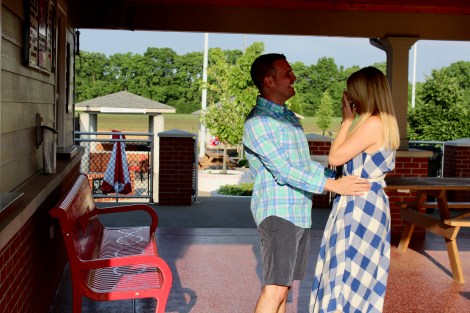
My Dad loved life, and he loved injecting fun into his life and the lives of others in any way he could. Paige has that same fun-loving attitude. It’s one of the many things I love about her, and I love that she’s able to reflect my Dad’s spirit having never even met him. The journey through life with my Dad was always full of fun and laughter, which has taught me to value the wonderful moments in life I’ve been able to share with Paige. It made my decision to ask for her hand in marriage an easy one, but my Dad’s death also made the emotional tumult of this unique season of life even more intense.

IMG_0343All throughout this journey, from the moment I decided I wanted to marry Paige to the moment she said yes, I felt tremendous joy; but it was a joy accompanied by sadness because I really, really wanted to have my Dad there for everything. In each and every moment, I wanted him there right alongside me. In moments like this, a boy needs his father. My Dad deserved to be there for all of it.
There are so many things that a boy relies on his Dad for throughout this life. When my Dad passed away, I knew there were going to be many, many moments throughout my life when I needed his guidance, wisdom, and help. After he died, I felt the shock of his being gone rather quickly. When things would go wrong at my house, I wanted to call him to get his advice…and likely talk him into doing the repairs. When I finished my graduate school studies in 2014, I wanted my Dad to be there to join in the celebration; but he wasn’t there. I wanted his career guidance and advice when job opportunities started to become available, but I couldn’t call him. Every time I had a new announcing opportunity come my way, I wanted to share the great news with my Dad because I knew how happy he would have been.

But he wasn’t there, and he’s not here. He’s not here for any of that. I would obsess over this fact, and every day, no matter how much time may pass, I constantly have to remind myself, painfully, of his absence.

I’ve felt his absence in every moment, but I don’t think I’ve ever felt the weight of his absence as severely as I have throughout my decision to marry Paige.

I knew early on that Paige was the woman God had promised me. I could sense that she was my person—the person meant to compliment my shortcomings, build me into a better man, and journey with me throughout the ups and downs of this world. It didn’t take long for Paige to show me that she was a treasure greater than any other, and although I knew this in the deepest crevices of my heart, I still wanted to be able to talk with someone about how I felt.

I desperately wanted to talk with my Dad.

Don’t get me wrong—I had plenty of wonderful people to talk to about my love for Paige. I remember telling my Mom about Paige on a trip we took to Gulf Shores. I shared how special she was on that night, and in all those nights to come, and she’s loved Paige just like she would a daughter. I was able to talk with other relatives and close friends about my love for this amazing, spectacular woman. I had lots of amazing people who were willing to talk with me and listen to me and help me feel loved. I’ll always appreciate their wise counsel.

But sometimes, a boy just needs to talk to his Father. There is a connection between a father and a son that is unlike any other—not any better, just different and unique. When that void is there, the emotional pain can be very distressing. It’s helpful for young males to get guidance from older males, just like it’s helpful for young females to have guidance from older females. Our trajectories have similarities because men and women are different, and there’s a sense of safety in that similarity. This is why I needed to talk to my Dad. I needed to tell him that after many years of searching, doubt, and questions, God had answered my prayers and given me a wonderful woman that I wanted to marry.

I also wanted my Dad’s advice on how to navigate this journey because he had done it so well himself. I’ll be honest—I don’t know as much as I should about how my Dad came to know that my Mom, Becky, was the perfect woman for him. We never really talked about that in our time together, but had he been around when I decided to propose to Paige, I’m sure he would have shared his story. My Father found the perfect woman for him—a woman who complimented him wonderfully, encouraged him, and served as a faithful partner for nearly 30 wonderful years. My Mom deserved my Dad, and my Dad deserved my Mom. They were two Godly influences in my life they were built to serve one another in very unique ways. They taught me the value of hard work, the absolute necessity of kindness, and the importance of service and compassion. I know that they couldn’t have done this individually. These messages only could have wrung true had they come from both of my parents. It’s no easy feat to pick a mate in this life. In fact, it’s probably the biggest decision one could ever make. I would have loved to pick my Dad’s brain about how he knew my Mom was the woman God had sent for him. We never got to have that conversation, but I’m sure it would have given me solace, peace, and comfort throughout my own journey. Dad would have reassured me with his enthusiasm, kind heart, and unique sense of humor. He would have been the Father to me that I needed as I made that important decision.

But he couldn’t be there, and I hate it.

I vividly remember the night that I bought Paige’s ring. It was the night before Valentine’s Day, and with my chief-negotiator Chris Beatty at my side, we perused diamonds and settings and learned more about precious gems than I could have ever imagined.

The first diamond they showed me was the diamond I bought for Paige. It sparkled beautifully, just like her smile has done since the moment I first met her in 2016. The diamond was flawless, just like I see her. It was a stone worthy of only the most perfect woman, and I wanted to give it to her as a promise that she deserves only the best of me and all the things that this world can provide. That diamond ring, as beautiful as it may be, is still not enough to tell her how I feel about her.

After buying that ring, I remember getting in the truck and driving home. And I remember crying forcefully on that ride home, because I just wanted to call my Dad and tell him all about it. My Dad had been through the process of looking at rings and buying one for my Mom. It would have been so reassuring to hear his story. In fact, had he been alive, I probably would have had my Dad right next to my side as I picked out the ring. Those of you who knew my Dad know that anything he bought was always of the highest quality. From home improvement gadgets to clothes and gifts, my Dad was a man obsessed with quality.

Even though I never got to show it to him, I think my Dad would have been proud of the ring that I bought. He would have looked it over and asked ridiculously annoying questions about the materials to the salespeople, but ultimately he would have been excited to see me, his only son, buy a ring for the girl I love. And he would have done all this because he loved me, and because I know he would have loved Paige.

Shortly after buying the ring, I knew that I wanted my Mom to be the first person that I told about it. Over lunch at High Street Café in Hamilton just a few days later, I shared the good news with my Mom. I told her that Paige was the woman I wanted to marry, and that I had bought a ring to show her my love. We were both extremely happy, but we were also very, very sad in that moment as we thought about how badly we wanted my Dad to be there.

We were sad because we were sitting at a table for two, when we should have been sitting at a table for three.

Yes, the happiness was there in that moment. The happiness for a bright future filled with love and excitement. But you can’t experience that happiness after losing a loved one without simultaneously feeling sadness at their absence. And this, dear friends, was that double-edged moment. This was that complicated moment of undeniable happiness and inescapable heartache, grief, and longing.

And then, of course, there was the proposal. I’ve always appreciated theatrics, and I wanted to do something big and romantic that would show Paige just how special she is to me.

I proposed at the Joe Nuxhall Miracle League Fields (JNMLF), a place that is very special to me, and also a place that Paige has come to know and love throughout our relationship. I serve on the Board of Directors for the JNMLF’s, and Paige has accompanied me there for numerous events. I’ve seen the goodness of her heart as she watches individuals with physical and developmental disabilities play the game of baseball with a smile on her face and a tear in her eye. Watching her there the first time we visited was also one of those cornerstone moments in our relationship when I knew that she had a heart for those who are less fortunate.

So, I orchestrated what I hoped would be a miraculous (and hopefully surprising) night for her at the fields.

After an Oscar-worthy phone call from Kim Nuxhall, I convinced Paige that we needed to stop down at the fields and reset the security system before we went to a graduation party that evening. I had to grip the steering wheel of my truck tighter than I’ve ever gripped it before so she couldn’t see how bad my hands were shaking.

As we approached the fields, Paige and I got out of the truck as I slipped a small, black box into my left pocket. We slowly walked up the stairs to the concession stand under the main pavilion as the sun was setting to our left. Feigning confusion, I looked at the old-school concession board on the wall and said to Paige, “Something looks off on that board…”

Slowly, Paige scanned the board until she saw the message:

TODAY’S SPECIAL

DIAMOND RING

JUST SAY YES

5-26-2018

IMG_0326“Why does it say diamond ring?” she said to me nervously, and then, I placed my hands on her shoulders, and I told her how I felt about her. As I did this, photos of us together began to scroll on the video boards at the fields. Then, I got down on one knee (one very nervous, shaky knee) and asked her to marry me. She said yes, and all the promise of the next chapter of my life overwhelmed me with earth-shattering joy. I was able to envision our life together and see years into the future—and I absolutely loved what I saw.

After we embraced and held one another crying (don’t let her fool you, she definitely cried more than I did…), I rapped my knuckles on the walls of the concession stand. The concession windows flew open, and our families and friends greeted us with a cheer. Even if she knew I was going to propose, I don’t think she saw this part coming! I love Paige for a number of reasons, but her love of family and those around her has always been unbelievably impressive to me. The way she loves my Dad, even though she has never met him and never will in this life, is indescribable. Watching her eyes light up as she hugged each of our family members brought me tremendous joy.

And in my head, as I stood behind her, I pictured what it would have been like to watch her hug my Dad.

IMG_0358As our family members started to trickle out to the after-party, our dear friend Megan took some amazing pictures of us at the fields. As we smiled and posed for shot after shot, Megan asked us if there were any other pictures we would like to get before we left.
“There is one more, if you don’t care…” I said to Megan nervously.

Paige, Megan, and I walked around to the side of the concession stand towards the memorial wall, a spot at the Joe Nuxhall Miracle League Fields that is very important to me. On that red brick wall is a silver plaque graciously donated by Kim Nuxhall and the Nuxhall family that reads “In Memory of Scott Bradshaw”. They donated it shortly after my Dad died, and it makes me feel his presence each time I’m there. Every time I’m at the fields, I walk by that plaque, run my hands across the metal surface, and say a little prayer for my Dad.

On the day when I asked Paige to marry me, the most important day of my life thus far, I wanted to make sure I honored my Dad the only way I know how. With one of his handkerchiefs in my back pocket, Paige and I each put a hand on the metal plaque that bears my Dad’s name: Paige’s diamond-clad hand on the right side, and my hand on the left. I worked to hold back tears as Megan’s camera snapped away. All of the emotion of the past few months and the months and years to come were just brimming at the surface. All of the pent up feelings of loss and despair were right there with me; but so was my Dad’s spirit. I could feel him there with us. I could sense that we weren’t alone in that moment.

IMG_0406

And I could sense, more than anything, that we will never be without him in these really important moments to come throughout our life together.

On the ride home that evening after a party at Paige’s parents’ home, we talked about what a whirlwind of a day it had been. Numerous times, we just looked at each other with surprise and shock and said, “We’re engaged!” We talked about how great it was to have the privacy of the proposal but also share it with our families. Then, I shared with Paige how much I wished my Dad could have been there, and naturally began to tear up. I watched as her hand (much shinier than it previously was) slid over and gripped my forearm. I turned and saw the tears in her eyes as well, as I’m confident she knew this moment would come at some point in the evening.

And that’s another thing I love about Paige. From the moment I first shared the details of my Father’s death with her, she has shown me a compassion and care that surpasses understanding. The sense of nervousness I felt when I proposed to Paige was very similar to the night that I told her that my Father had died from suicide. Having just started to get to know one another for a few months, I didn’t know how she would react. I didn’t know how she would look at my Father, never having known him, with this revelation in mind. But on that night, just like she did in the truck after I proposed, Paige put her arms around my shoulders and comforted me. She understood that my Father was not defined by his depression or his death. She believed that my Father, the man who raised me and loved me into existence, was sick with a disease that he couldn’t understand. Watching and feeling her reaction was one of the most important moments of our entire relationship. It led us to this moment, and it will serve as the foundation of all the moments we have to come during a lifetime of happiness and unconditional love.

IMG_0412Of all the things I’m fortunate to have in this life, I’ve always said I’m most fortunate to be the son of Scott and Becky Bradshaw. Now, I can add one more title to the list. I’m the luckiest man alive because I’ll get to call Paige Garber my wife. Although she never met my Dad, I know that she still loves him—and that’s the greatest type of love anyone could ever give. It’s unconditional, Christ-centered, and life-changing. It’s the same type of love that my Dad gave to everyone he knew. It’s the love I still feel him providing from Heaven. It’s the type of love that sustains, builds up, and encourages in spite of difficult circumstances. It’s a love I wish I could have reminded my Dad of on his last day here with us.
An engagement unites individuals together, and in doing so, it’s brought Paige into my family. I wish, more than anything, that my Dad could have been a Father-in-law to Paige. They would have been a match made in heaven.

But I’m confident that my Dad, from Heaven, is telling Paige just how much he loves her. In that way, he’ll always be here with us. For these reasons, and so many more, I’m thankful for the love of my fiancée, the love of a Father, and the promise that we’ll all be together again someday.

Proposal Hands on Dad's PlaqueDad, You would have absolutely loved Paige. You are so alike in so many ways. I often think about what it would have been like to watch the two of you interact with one another—laughing at the same jokes, enjoying sitting around a bonfire together, and just generally appreciating the beauty and simplicity that life together affords. It would have been one of the greatest honors of my life to introduce her to you, but I would have felt that same honor in introducing you to her. Dad, I desperately wish that you could have been here for our relationship. I wish that you could have given me the wisdom and guidance that only a father can provide to a son when it comes to love and marriage. But even though you aren’t here with us right now, I can still feel your presence. I can still feel you prodding me along and helping me make the right moves in this life. I can imagine you would have said to me soon after meeting Paige, “You better hurry up and propose before she wises up!” And Dad, you’re exactly right. She is more than I deserve and more than I could ever hope for, and I thank God for that. On the night I proposed, and every night for that matter, I’ve wanted to have you in our life and in our relationship. You may not be here with us, but in so many ways you are here with us. Your memory lives on in everything I will do as a husband, and I’m thankful that I could watch your patient, kind example over the many years that you loved Mom and me. You are here with me, and you always will be. I promise that no matter how life might change, I’ll never, ever let your memory go. Thanks for loving me from afar, Dad. Thanks for loving us—all of us. I love you, and wish we were here together. Until that day when we are united again, seeya Bub.

“He who finds a wife finds what is good and receives favor from the Lord.” Proverbs 18:22 (NIV)

16 Minutes

16 minutes. Imagine how much (or how little) you can get done in 16 minutes. Imagine how quickly 16 minutes passes you by. Personally, I’m guilty of taking time for granted. I spend more time wasting time than I’d like to admit, but on some days I rush too much. 16 minutes is fast. It’s not even enough time for me to get through a full episode of my favorite game show, read a chapter of a book, take a walk through my neighborhood, or get ready in the morning.

A few days ago, I did something that I’m going to ask all of you to do for a day when you finish reading this post. I downloaded a timer on my phone that I could put on a loop for 16 minute intervals. Every 16 minutes, the timer would buzz and start over again, buzzing 16 minutes later. Then, it would keep a count of how many times that 16 minute interval had passed.

I did this for a very specific reason. I did this for an important reminder. I did this to remind myself of a statistic I wrote about in my very first post.

I wanted to remind myself that every 16 minutes, another American loses his or her life to suicide. (You can learn more by visiting DoSomething.org or through the World Health Organization.)

And I wanted to remind myself why I’m not okay with that.

16 minutes. 16 precious minutes.

That’s 90 people every day. That’s 90 individuals whose lives are ended prematurely. That’s 90 families torn apart from sorrow and grief, just like mine. That’s 90 individual circles of family members and friends and coworkers and neighbors left behind with unbelievable guilt and plaguing, persistent questions, constantly curious if they could have done more.

That’s 630 victims of suicide each week.

That’s 32,850 victims of suicide each and every year.

And I will never, ever be okay with that.

Say those numbers out loud to yourself. Try to visualize them. Try to imagine faces and families. Try to picture the hurt and experience the pain. Try, if only for a moment, to understand how in just 16 short minutes lives have been altered forever.

Try to quantify this in your own life. In the time it takes me to watch a rerun of The Office and think about the good times my Dad and I enjoyed watching it together, two other individuals lose their lives to suicide. In the time it took you to watch the Cincinnati Bengals lose a football game this past season (you had plenty of opportunities…), 12 other families will have lost a loved one when they didn’t have to. You slept for 8 hours last night? While you were asleep, roughly 32 lives were cut short unnecessarily.

Every 16 minutes, someone feels as if their life is unlivable. Every 16 minutes, someone feels as if their circumstances are so dire and so impossible to escape that suicide is the only escape. Every 16 minutes, someone who could get help doesn’t. Someone who deserves help and healing fails to find it. Every 16 minutes, a repairable situation ends irreparably.

Someone like my Dad.

If you’re feeling guilty because you didn’t know that a suicide occurred every 16 minutes in our country, don’t; because I didn’t know either. I’m not writing this post to make you feel guilty at all. I’m writing this post because I wish I would have read it before losing my Father.

Before suicide affected my family, I never would have guessed that someone lost their life to suicide every 16 minutes. In fact, I would have guessed that there was one or maybe two suicides a day in our country—which is still not okay, but my innocent mind would have found a way to minimize the pain. Any unnecessary death is a death we should aim to avoid in the future. But in the world I lived in—one that I thought was safe and secure—I could never have imagined suicide was as prevalent as it is.

That is, until it hit home. My home. My family.

A few months after my Dad died, I did what anyone who is blindsided by an enemy they didn’t know existed probably does: I tried to figure it out. I tried to learn as much as I could about mental illness and suicide. I read books, I located articles, and I listened to videos and lectures online from suicide survivors. I tried to figure out why my Dad, a fun-loving father, honest husband, caring coworker, and faithful friend to everyone he encountered could feel the way he felt. It didn’t make sense.

And the more I learned, the more baffled I became.

I distinctly remember the night when I first saw the statistic about suicide prevalence. I was sitting at home, reading information online, and I saw the number. I didn’t believe it. It couldn’t be true. There was just no way that individuals were dying from suicide at this rate. I went from site to site to site and saw roughly the same number. There might have been a little variance in the math, but the numbers were largely the same. Nearly 100 individuals each day dying from suicide.

I was mad. Mad at an illness that had robbed me of my Dad. Mad at the pressures my Dad had dealt with.

And I was mad at myself for not knowing that this was happening in the world around me.

The more I learned, the angrier I got. I couldn’t believe how naïve I had been. If suicides were occurring at this rate, it was nearly certain that there were people in my own life who had died from suicide or family members or friends who had known someone who was a victim. But I don’t remember seeing them. I don’t remember hearing their stories.

But they were there. The reality was I just wasn’t looking. I just wasn’t listening.

After my Dad passed away, however, the blinders were gone. My cloak of naivete had been removed. For the months that followed my Dad’s death, each and every day, I found myself meeting with or interacting with someone new who had been impacted by suicide. Sisters who had lost brothers. Parents who had lost children. Children who had lost parents. Individuals who had contemplated suicide themselves. Now, I find myself wanting to fight for those individuals. I find myself wanting to do something to help them. Even if by the time my life is over I am only able to push that time interval to 17 minutes or 18 minutes, it will have all been worth it. Because those are hundreds and thousands of families, over time, that won’t suffer the same heartache that mine has.

And I hope you want to do something about it to. Because allowing someone to die unnecessarily every 16 minutes is unacceptable.

Lately, I’ve been speaking publicly in classrooms and community events about suicide, and although I always share this statistic with those in the room, there is one other thing that I always do. I always, always have a picture of my Dad on the screen behind me when I speak. He will always be there with me, smiling and looking on that way; but he’s also there because my Dad is more than a statistic. My Dad was a living, breathing person who lives no more because of the mental illness that attacked him.

I am in a club that, unfortunately, continues to grow against the will of those who already belong. Each day, 90 other families come into this club of individuals impacted by suicide. We get a new member every 16 minutes. And for the first time in my life, I’m in a club that I’m trying to keep members out of. I’m trying to do what I wish had been done for me before my Dad died. I’m trying to make people aware that suicide might seem distant, but it’s real and it’s pervasive. And we are at a critical juncture where every bit of awareness could help someone who needs it.

So, I simply ask you to do what I did to help this message sink in. What do 16 minutes mean to you? Get a timer on your phone or use a kitchen timer. Set it for sixteen minutes. And when it expires, say a prayer for an individual and family impacted by suicide. Try to understand that each and every time that buzzer or timer sounds, there is one more victim of suicide in our country. Another family and circle of individuals has entered a new chapter of their life filled with pain, agony, and questioning—just like the one my family finds itself in.

Then, set the timer again. Because mental illness is relentless. And until we start to fight against it, that timer will continue to reset at the same interval.

Unless, like me, you’re not okay with it any longer.

The more we understand our enemy, the better chance we have of defeating it. I know that I’ll never take those 16 minutes for granted ever again. And for the rest of my life, I’ll do everything I can to push that clock back. My Dad would have wanted that. My Dad deserved that.

His 16 minutes will count for something. I’m sure of that.

Family Easter Photo with SB LogoDad, I wish I had known. In spite of all your struggles that you dealt with each and every day, I never, ever thought that suicide would attack you and our family. I never believed for one moment that your life was in danger, probably because you shielded us from so much of your heartache in an effort to protect us. Dad, I wish I could have done more to help you. I don’t blame myself for what happened, but I would do anything to replay those moments when I should have done something. But in your memory and because you always taught me to help people, I’m trying to keep others from suffering like you did. I’m trying to make people aware of something that I wasn’t aware of until it stole you away from us. Dad, I miss you every single day. I wish I had many more minutes to spend with you. Someday, we will have those minutes and many more. Someday, we will be able to enjoy being together again. Until then, seeya Bub.

“The righteous cry out, and the Lord hears them; He delivers them from all their troubles.” Psalm 34:17 (NIV)

Dad’s Song

“I hate that I have to ask you this so soon, but…is there a song you would like played or performed at the service for your Dad?”

My Dad had only been gone for a day. Just a few days earlier, we were making the final plans for our family vacation to the beach. Now, we were making plans to say goodbye to my Dad for the final time. Oh, how life changes in an instant. One horrible, irreversible instant.

Harville, my pastor, was sitting in a chair in the corner of my darkened bedroom. We had been talking for the past thirty minutes or so about the tragedy of the past few days. My pastor had a tender kindness that was so very important to my family in the aftermath of Dad’s death. He came into the room that day to see how I was doing and to tend to my spirit, which had been bruised and battered since that awful Wednesday morning. As tender and thoughtful as Harville was in those tumultuous few days, there were some painful questions that just couldn’t be tenderized. I knew that Harville had to ask questions like this. The reality was that my Dad was dead, and that there would be services to honor his life within the next few days—that unfortunate truth was fixed, unchanging. We couldn’t put it off for too long. We were going to have to come face to face with this horrible reality and plan a service fitting for a life well-lived.

I am still very thankful for Harville, my Mom, and my Grandpa Vern (among many others) who really took control of the funeral planning and shielded me from the heavy lifting. I had very little to do with the wonderful funeral service we were able to hold for my Dad, but when Harville asked a question about music and a song, I had an immediate answer.

“Yes,” I said to Harville, “There is a song.”


Just a few months before that fateful July morning, I found myself in the basement of my friend Steve’s home watching the Super Bowl on his jumbo projection screen. There was nowhere better to watch a football game, especially if it was the big game of all big games. Steve had engineered a projector in his basement to project the cable feed onto his entire wall. If you think you’ve watched a great game on a beautiful television, try watching it on an 8×12 foot wall projection. You’ll take your 70-inch flatscreen and chuck it out the window (don’t do that).

Even though the lights in the Superdome went out that night, it was still a fun game to watch. And, like most who tune into the Super Bowl, I kept a sideways glance at the screen when the commercials came on to make sure I didn’t miss something funny that all my friends would be talking about the next day. Per usual, there were commercials that made you chuckle or pulled at your heartstrings. The Gangnam Style guy was apparently a big fan of pistachios. There was the Budweiser baby Clydesdale. There was also a weird Dorito’s commercial about a goat that made me never want to eat Doritos again.

But there was one commercial in particular that grabbed my attention from the opening chord. As I sat in the glow of the giant wall projection, there was a beautifully-elegant, simple, and rustic guitar intro that caught my ear. It had a country-simplicity to it that I loved. This was the type of country song that existed before most of the current country artists began to ruin country music (You heard me, Rascal Flatts…).

He’s a twenty years straight get to work on time… He’s a love one woman for all his life…

I loved it already.

Then, my love for the commercial turned into complete infatuation when I saw the product that was being advertised: the Chevy Silverado.

The Silverado was the truck of all trucks, in my opinion. It was rugged. Versatile. Reliable. And my Dad always drove one. I trusted his taste in many things, but I especially trusted his taste in trucks.

As the commercial rolled on and my eyes glazed as flashy Silverado after Silverado rolled across a field of amber grain or a windy mountain road, the lyrics of the song continued to speak to me.

He’s the shirt off his back, Give ya his last dime, He’s strong.

It was unbelievably ironic to hear this song paired with this particular product. This was the exact truck that my Dad drove, but it was also a song in which every line spoke to the man he was. This was a song that told the story of my Dad and how he lived his life.

I remembered hearing the song through the first verse during the commercial and immediately getting to my phone to Google the lyrics. After a few seconds, I found the song. Strong by Will Hoge. It was a song I had never heard before, sung by an artist I had never heard of. His voice, however, made it feel like I had been listening to him sing my entire life. Mainly because he was singing about a topic that was so familiar to me. The name “Scott Bradshaw” is never mentioned once in the song, but I felt like every lyric was about him.

I listened to the song on the way home from Steve’s that night. I downloaded it from iTunes and added it to my phone. And each time I heard it or listened to it, I said the same thing to myself: One day, I’ll play this song for Dad and let him know that I think of him every time I hear it.


I had no idea that our time together was running so short. When I thought about playing that song for my Dad, I envisioned playing it many years into the future, possibly when my Dad was in an advanced age and balder than he currently was (not possible). I thought, naively, that I would have a ton of time to play that song for my Dad and share it with him, along with my feelings.

I never got a chance to play that song for my Dad and tell him what it meant to me—what he meant to me. His death from suicide shattered our lives unexpectedly, and now I would have to settle for playing the song at his funeral. I just couldn’t believe it. I am fortunate that God has blessed me more than I deserve and that I have very few regrets in my young life. This, however, is one of my greater regrets. I wish that one day, while riding around together in his Silverado, I would have taken the time and shared the song and my emotions with him. I had the opportunities, but I also thought we would have so much more time together. There were many more drives with the windows rolled down and the radio up to be had.

Alas, we didn’t.

So, the first time I was able to play that song for my Dad was in his memory. Sitting in the first pew of the dimly-lit church our family had called home, Mom and I gazed upon the cherry casket resting a few feet in front of us. As we sat there with hundreds of our family and friends sitting behind us while the clock neared 10:00am, the familiar guitar strum began to emanate from the speakers.

I ask you to place yourself in that moment. I ask you to close your eyes, imagine that day, visualize that church, and listen to the song that I chose for my Dad.

Strong

Will Hoge

He’s a twenty year straight get to work on time
He’s a love one woman for all his life
He’s a shirt off his back give you his last dime
He’s strong

He’s a need to move something you can use my truck
He’s an overtime worker when the bills pile up
Everybody knows he ain’t just tough
He’s strong

Strong

He’ll pick you up and won’t let you down
Rock solid inside out
Somebody you can trust
Steady as the sun
Ain’t nothing gonna knock him off the road he’s rollin on
He’s strong

It ain’t what he can carry what he can lift
It’s a dirt road lesson talkin to his kids
Bout how to hold your ground and how to live
Strong

He’s strong

He’ll pick you up and won’t let you down
Rock solid inside out
Somebody you can trust
Steady as the sun
Ain’t nothing gonna knock him off the road he’s rollin on
He’s strong

Strong
Like the river rollin’
Strong
Gonna keep on going
Strong
When the road runs out
They gonna keep on talkin about

How he was strong

Strong

He’ll pick you up and won’t let you down
Rock solid inside out
Somebody you can trust
Steady as the sun
Ain’t nothing gonna knock him off the road he’s rollin on
He’s strong

Everybody knows he ain’t just tough
He’s strong

Songwriters: Ashley Gorley / Miller Crowell / Will Hoge / Zach Crowell

Strong lyrics © Warner/Chappell Music, Inc, BMG Rights Management US, LLC

 I stared resolutely ahead at the casket, defiant, trying to deny the fact that my Father was gone as that song played through the sanctuary. I tried my best to hold in my emotions and remain stoic, but that weak dam eventually gave way. Every bit of pain I had felt over the last few days tore through me when I heard that song, because it was everything I wanted to be able to tell my Dad, face to face, one last time. I can vividly remember sitting there in that pew with tears streaming down my face as the song played, wishing more than anything that in that moment I could have just one more with my Dad. One more to play that song for him, look him in the eye, and tell him how strong I thought he was. To tell him that he was stronger than he ever thought he could be. To tell him that he was strong enough to beat this.

Mom wept next to me as the song played. She raised her hand towards the heavens as the second verse picked up because she realized, like I did, that although this song may have been written with some other inspiration in mind, it really was written for my Dad. The song was written for this man and this moment. The words spoke to everything he was to us.

After the funeral, I had so many people ask me about that song. It made me feel good that we had been able to pick a song that resonated with so many people and their memory of my Dad. It made me feel relief that people saw past my Dad’s mental illness and his death from suicide to see the man we saw. A man who fought courageously for so long. A man who smiled and loved those around him with beautiful abandon, even though he might not have felt smiley or lovely on the inside. A man that pushed through his own sadness to provide for his family and give them a home life full of wonderful memories. People loved the song because they loved the man whose memory it brought forth. People loved he song because they realized that my Dad’s final chapter was not a true reflection of the beautiful story he wrote in this life for himself and so many others.

Yes, my Father died from suicide. And yes, he is still the strongest man I’ve ever known.

My Dad, Scott Bradshaw, was strong. And he still is. And this song, whenever I need it, is my reminder.

On occasion, particularly when the weather is warm and the sun is shining, I’ll take a detour in my truck—which is ironically the very same Chevy Silverado that my Dad drove. I’ll find myself feeling particularly lonely on those difficult days. Although time may pass from the moment we last said goodbye, the heart never completely heals. And there are moments, tremendously painful but necessary moments, when I need to hear that song again. So, like my Dad would have done, I’ll roll down the windows, crank up the volume, and hear that old familiar chord rattle through the truck speakers. In my mind, I’ll look over towards the passenger seat and see my Dad sitting right next to me with a huge smile on his face. I’ll see him begin to bob his head as the music picks up. I’ll see him thumping his thumb on the middle console between us the way he always did when a particularly good song warmed his ears. And I’ll see his face turn towards me through his sun-darkened spectacles, beaming with that beautiful smile of his.

And I’ll look back over at him, with tears streaming down my face, and I’ll let him know that this song was for him—and that for as long as I live, it will always be his. It will always be the song that helps me remember him. As long as I live, this will be my Dad’s anthem. When my future children and grandchildren ask about my Dad, I’ll play this song for them. This will be the song that reminds me of the love I felt for an amazing Father. It resurrects tremendous pain when I hear the words of that song, but at the same time it reassures me that the man I knew and the man who raised me will never truly leave. Because his heart lives on in me. His memory will never die as long as lyrics like this tell the story of the life he lived.

And that song, a song of love for my Dad, will always play in my mind and in my heart. I’m grateful for a beautiful song and the hearts and minds who wrote it, but I’m even more thankful that I had a Father who lived out the lyrics every single day.

“When the road runs out, they’re gonna keep on talkin’ ‘bout how he was strong.” Will Hoge, truer words have never been written. I’m still talkin’. And I always will be

Dad with Baby Lucy and SB LogoDad, You have no idea how I wish I could wind back the clock and play this song for you. I wish that I could play it, watch you listen, and then say to you that whenever I hear the words I immediately think of you. I desperately wish I could see you thumping your thumb on the console of your truck like you always used to do. I’m sorry that the first time I had a chance to play this for you was at your funeral. So many people have heard the song and told me how perfect it was for you, which is the best testament to your life. It’s what you deserve. Dad, people still talk about how strong you are. People still talk about how courageous you were for fighting through your mental illness for so many years. I know you were hurting desperately, Dad. I know that your soul was troubled. But I pray that you’re able to hear this song in heaven and know that I think of you each and every time I hear it. I’ll always love you, Dad, and I’ll always admire how strong you were. I’ll try to live up to example you gave me—the example that you gave all of us—each day for as long as I live. Someday, I’ll look you in the eyes again and tell you that you were the strongest man I’ve ever known. Until that reunion when we can listen together, seeya Bub.

But he said to me, ‘My grace is sufficient for you, for my power is made perfect in weakness.’ Therefore I will boast all the more gladly about my weaknesses, so that Christ’s power may rest on me. That is why, for Christ’s sake, I delight in weaknesses, in insults, in hardships, in persecutions, in difficulties. For when I am weak, then I am strong.” 2 Corinthians 12:9-10 (NIV)

The Portrait

“Of course, Tyler. I’d be honored to do it.”

I couldn’t believe it. I simply could not believe what I was hearing.

My side-gig as a sports announcer has given me some pretty amazing opportunities, and my work with the Joe Nuxhall Miracle League Fields has taken that to a whole new level. As a result, I get to connect with some pretty amazing people. I’ve had the opportunity to become friends with some of my broadcasting idols. I’ve had chances to meet Cincinnati Reds players that I grew up cheering for….and a few that I may have booed at one point or another (I’m from Cincinnati, it’s what we do). I cherish all of the wonderful folks I’ve met over the years, but there are none more special than renowned illustrator C.F. Payne.

CF Payne PhotoWhether you know it or not, you’ve seen C.F. Payne’s work. You’ll find his art on the covers of Time MagazineReaders DigestSports IllustratedThe New York Times Book ReviewMAD MagazineU.S. News and World ReportThe Atlantic MonthlyTexas MonthlyBoys Life and more. He has illustrated popular children’s books, and his art hangs in art museums all across the country.

CF Payne Obama CoverIf you’re somebody, C.F. Payne has likely captured you in one of his illustrations. President Barack Obama, Joe Nuxhall, Magic Johnson, Albert Einstein, President Ronald Reagan, David Letterman, Secretary of State Hillary Clinton, Andy Griffith, Katie Couric, President Thomas Jefferson, the Pope…heck, he’s even done Santa!
 

CF Payne Santa

His style is beyond recognizable. I’m not an art expert, and I am probably not using the right terminology, but C.F. Payne’s work is Americana to me. He takes an image, adds emotion to it, and let’s that emotion shape his representation. He uses wonderfully bright colors, and the texture pops off the page. C.F.’s portraits have such depth and such character. There is no other artist who can do what he does. His gift is simply breathtaking.

But his heart is even greater than his gift.

I’ve come to know C.F. Payne through the work he does for the Joe Nuxhall Miracle League Fields. C.F. has done a number of wonderful illustrations for us each and every year, including portraits of Marty Brennaman, Sean Casey, Anthony Munoz, and others. Just last year, C.F. created one of my favorite pieces when he did a waving illustration of my broadcasting idol, Joe Nuxhall, that was installed on the monster wall of the Miracle League Field complex. Joe is smiling and waving as he watches over the baseball facility that bears his name. I know that Joe has been gone for ten years, but when I look at that illustration, I feel like he’s there with us. C.F.’s work warms my heart.

CF Payne Joe Nuxhall Cutout

On this particular night, though, my heart was racing. I was standing across from C.F. before our annual Miracle League benefit, and a crazy idea had just crossed into my mind.

I wanted to ask C.F. to do an illustration of my Dad.

The event was in early November, and for a few months I had been thinking frantically about a gift that I could get for my Mom that might help her remember my Dad. For a few Christmases, my Mom had given me unbelievable gifts to commemorate my Dad: the phenomenal quilt made of his old shirts, gifts with tags that he had written with his own hand and that she had saved, and ornaments that had reminded me of my Dad to grace the branches of my Christmas tree. Each and every year her gifts got more thoughtful as my heart continued to grieve. I missed him all the time, but I especially missed him at Christmas. Being able to have a gift that celebrated my Dad gave the pain a different feeling. The unbelievable hurt was still there, but there was a warm comfort in the presence of his memory that helped me cope.

I was standing across from C.F. before the event began when the idea came to me.

Tell him your Dad’s story. Tell him how much you miss him. Ask him to do a portrait.

C.F., in typical C.F. fashion, came up to me with a hearty hello and handshake and asked me how things were going. We had met numerous times at the Miracle Leagues, and it was so good to see him again. At some point, our conversation crossed the topic of the impending holiday, and I told him how hard it was to enjoy Christmas after losing my Dad. We began to talk about my Dad, and what impressed me most was how caring and sympathetic C.F. was as I told my story. He listened intently. He asked me questions about my Dad, and his sorrow was palpable. He genuinely wanted to get to know my Dad, to understand what happened, and show me that he cared. I felt a kinship with him in that moment because of the compassion he showed me. We talked about mental illness and my Dad’s suffering, and how his life had ended so unnecessarily and so prematurely, and we talked about the horrible impact of suicide on families like mine. All throughout, C.F. made me feel like my story mattered. He made me feel like my Dad mattered. He made me feel loved.

I don’t know how I ever got the courage to ask a world-renowned artist to create an illustration of my Dad, and I’m sure I did it nervously, but I told C.F. about the wonderful gifts my Mom had given me over the past couple years. As my hands began to sweat, I thought about backing out. But I wanted to do this for my Mom. I cushioned my statement by saying I wanted to ask him something, and that he could feel free to say no if he was too busy, but I wondered, just maybe, if he would be willing to do a portrait of my Father.

C.F. looked at me with the tender smile of his I’ve seen so many times before and he touched my shoulder.

“Of course, Tyler. I’d be honored to do it.”

I immediately began to tear up. This Christmas would be different. Yes, it would still be sad and emptier without Dad there, but he would be there with us in a very different way.

Over the next few weeks, I sent C.F. pictures of my Dad. I told him about the things he liked and his character so he could get a feel for the type of man he was.

I loved getting to see inside C.F.’s mind and how he approached his work. Early on when I was sending him photos, C.F. asked me to make sure I sent photos of my Dad from a variety of different settings so he could get to know his life, and he also asked me to send more than just my favorite pictures of my Dad. He asked me to send photos that were imperfect and candid because they would capture all of my Dad’s features—including his imperfections. I thought this was so fitting, because it was those very same imperfections that had made my Dad who he was. When I think of my Dad, it isn’t glamorized. It’s real, and that’s what I hoped this portrait would be. I had seen the whole picture of my Dad, and I wanted that whole picture to be captured in his portrait.

As the calendar drew closer to the end of December, I began to grow more and more anxious in anticipation of the gift C.F. would give to my Mom and my family. C.F. sent me a few of his initial sketches, and I cried each and every time I got a new message from him. In his studio, C.F. was toiling away as he tried to capture my Father’s likeness.

Then, one day, I got a message from C.F. that he had finished the portrait and couldn’t wait to show it to me. That weekend, I drove to Lebanon and C.F. invited me into his lovely and historic home to show the finished product of his hard work. We walked across the hard wood floors into his dining room, and I saw a white cardboard portrait frame sitting on his table. My heart grew tight when I saw the frame, knowing what was inside it would be so special. We approached the table together, and C.F. opened the frame, pulled back the tissue paper, and revealed his most recent creation—a piece of artwork that would breathe life back into my Father’s memory.

CF Payne Illustration of Dad

I looked at the portrait, into the bespectacled eyes of the man who had given me life and guided me through it, and I saw the smile that I had missed for so long. There, on the table in front of me, was my Dad, illustrated by the caring hands and compassionate heart of the greatest artist I’ve ever known.

I crossed my arms and raised my hand to my mouth as tears began to well up in my eyes. C.F. reached over and grabbed me by the shoulder.

“Well, did I get him?” he said.

“Yes, C.F. You got him, and more. This…this is my Dad.”

I couldn’t take my eyes off the portrait. It was stunning and captivating. My Dad felt so alive when I stared at that piece of paper. I wanted more than anything for him to be alive again. This was my way of still holding onto him. He had even taken the care to include a picture of Lucy, our dog that we had tragically lost just a year earlier, into the picture because he knew how much she meant to us and how much my Dad loved her. I looked at both of them and wished for those Christmases we had spent together as a family.

C.F. hugged me. We talked about my Dad. We talked about how this Christmas would be different. I thanked him as much as I could. And when I got in my truck, I lost it. I completely fell apart. The fact that someone as talented, busy, and important as C.F. Payne would take the time to help me and help my Mom hold onto my Dad was just overwhelming. There are so many people who are talented in this world…but how many of them are kind? Kind to the point that they will give of their talent to help hurting hearts in the world around them?

I know of at least one.

C.F. Payne is just that man. His portfolio runs deep, but his heart runs deeper. He is an inspiration and Godsend for my grieving family, and nothing proved that more than the Christmas morning that would follow a few days later.

I am horrible at keeping secrets, and I had a better chance of playing third base for the Reds than I did to keep this under wraps for those few months. By the grace of God however, I did it. I showed the portrait to only a few folks, and like me, they all cried when they saw it. But they also smiled because it reminded them of the happiness my Dad always sent out into the world. I told them the story and I told them about C.F., and they were amazed by his talent but even more impressed by his generosity.

On Christmas Eve, I hid the portrait behind the couch. I was terrified that this priceless artifact would somehow get damaged before I could give it to my Mom. I had a nightmare that Sadie, Mom’s new dog who can be a bit rambunctious and squirrely, would chew it up. Thankfully, she couldn’t fit behind the couch.

I had a great plan. I was going to wait until we had opened all of our gifts, and then miraculously pull the portrait from behind the couch pretending I didn’t know what it was. I would then hand it to my Mom with a look of complete surprise. This was a good plan. I knew I could do it.

So about halfway through our gift-opening, I’m handing the portrait to my Mom. You can’t be surprised by this if you know me.

Christmas is no time for perfect plans (ask Jesus about that whole manger deal). I just could not contain my excitement and nervousness. I wanted Mom to feel the way I felt when I saw it. I wanted her to be able to smile when she looked at Dad as he smiled back. She deserved that.

She opened the portrait, and her tears burst forth. In that special moment, I could see the pain and anguish in the heart of a grieving widow. I could feel the weight of longing for Christmases of yesteryear. In an instant, I could see how happy my Mom was to see my Dad immortalized, but how sad she was to no longer have him on the couch next to her as we basked in the glow of our family Christmas tree. There was pain in losing him, but tremendous joy in his memory.

mom-with-dads-portrait.jpgMom slowly ran her hands over the paper. “Oh, Scott…” she said. She cried as I put my hand on her shoulder, and I recounted the story of how that portrait came to be.

My Mom must have stared at the image of my Dad for so long without taking her eyes off of it. I admit I did the same. It was hard not to because the portrait had such character, such vividness.

And now, this Christmas, things will be a little different. For the past few years, the living room of our family home has always had that eerie absence. My Mom and I both know it’s there, but we try not to focus on it. We miss my Dad coming down the stairs (usually after we had been yelling at him to do so for quite some time). We miss how excited he would get watching our dog open presents (he was definitely more excited than that than watching me. I had thumbs. Dogs didn’t. Their feat is immediately more impressive). We miss how he would lounge around all day watching Ralphie almost shoot his eye out. I miss the days when I was little and he would spend all day playing with me and the toys I received. He never complained about having to put something together or install batteries. He just enjoyed the day with his family. And now that he’s gone, we desperately miss his excitement.

But in that same living room that has felt less full for the past few years, life is a little bit different. Now, when I miss my Dad, I need only look over at the wall by the window. There, in a beautiful frame, hangs a picture of my Father and his pup looking over all of us smiling with that familiar smile that we long to see again. He watches over everything we do, and you can feel his presence there with us each and every time you look at it.

In the months that have followed, I’ve told C.F. how thankful I am for the art he created for my family, because that portrait has become one of my family’s most cherished heirlooms. You could put my Dad’s portrait next to the Mona Lisa, and I would choose my Dad’s portrait each and every time…and not just because my Dad had a better smile. It’s more valuable to me than the most expensive painting or sculpture that has ever existed, because the man depicted in that illustration meant so very much to me and everyone whose life he touched.

In the time between C.F. giving me the portrait and me giving it to my Mom on Christmas morning, I would talk with people (very secretly) about what I was doing and show them a picture of the portrait on my phone. The week before Christmas at my church, I showed the portrait to my pastor, Dave. Like everyone who knew my Dad and saw the portrait, Dave began to tear up and smile simultaneously (which is a testament to C.F.’s great talent). I remember shaking my head in awe as I told Dave about C.F. and the work he did and how thoughtful he was to me all throughout, but also at my feelings of unworthiness.

“Dave,” I said, “This is a man who has illustrated Time Magazine covers. He has illustrated American presidents. Celebrities. Hall of Fame athletes…”

“And now,” Dave said without missing a beat, “He’s doing someone even more important.”

He was exactly right. My Dad was a tremendous man, and now he had a tremendously deserved commemoration on behalf of the most talented artist I’ve ever met.

The true talent of an artist resides not in his hands, but in his heart. And as valuable as C.F.’s artistic talent might be, it’s his heart that is made of pure gold. I will never, ever be able to say thank you enough to C.F. How do you say thank you to someone who gives your family such a priceless gift? You cherish their work. You appreciate the beauty they’ve given to your life. You gaze upon their art and you thank God for the talent they have, but more importantly for the talent they share.

This Christmas, I’ll look forward to seeing that portrait near the tree on Christmas morning. I’ll say a silent thank you again to C.F., and I’ll wish his family the Merry Christmas that they deserve to have. As we open presents, I’ll look over my shoulder, and I’ll see those familiar glasses. I’ll see that familiar bald head. I’ll see that familiar smile.

And in those moments, I’ll love my Dad and the artist who has helped me hold onto a little bit of him forever and ever. It’s one of the greatest gifts I’ve ever been given and had the pleasure to give, and I’ll never stop admiring that portrait.

CF Payne Illustration with SB LogoDad, Christmas mornings aren’t the same without you. We miss your smile. We miss your silly Dad humor and goofiness. We miss everything about having you there with us. But deep down, in our hearts, we know you’re there. And now, we have a beautiful portrait to remind us that you’re always there. I know what a humble guy you were here in this life, and I’m sure you would feel completely undeserving of having your own portrait done by C.F. But Dad, this is exactly what you deserved. Your life was more important and consequential for me and those whom you loved than most people could ever hope to have. Your life was incredible. Your character was impeccable. And you made people feel loved each and every day. And now, I can gaze upon a beautiful portrait of your face and remind myself that those things have never left us. Keep watching over me, Dad. I miss you terribly, and I long for another Christmas morning like the ones we used to have. I know it’s going to be a long time until we have that again, but oh what an amazing day that will be. Until our first Christmas morning together again, seeya Bub.

“Each of you should give whatever you have decided. You shouldn’t be sorry that you gave or feel forced to give, since God loves a cheerful giver.” 2 Corinthians 9:7 (GW)

CF Payne Banner

Bringing Back the Magic: Guest Blog by Christian Morrow

Ty: We were standing near a weight bench, and I couldn’t help but feel tremendous sorrow as Christian talked. He was thanking me for the blog and sharing his deeply personal story—one that I had never known in the interactions we had with one another. It broke my heart to watch him try and fight back tears. His heart was grieving intensely, and I could tell his mind desperately searched for an explanation for his grief. Like so many people I encounter, I had no idea he was carrying such pain. In all of our previous exchanges, I never knew that he had been impacted by such unfortunate trauma and loss.

Christian Morrow is one of those friends who comes into your life in a very unexpected way. One of those friends that walk into your life seemingly by happenstance, but you realize later through divine intervention. One of those friends that God knows you will need down the road when you can’t see for yourself.

And in this case, God connected me to Christian over my need for a Chrysler 200.

My job requires that I do a lot of traveling and driving, which has also led me to be a frequent customer of the local Enterprise. I get to know the local Enterprise folks pretty well…I mean, they’re the people who pick you up. I usually try to get to know the people who work at Enterprise and treat them as kindly as possible because…I really don’t want them to give me that lime green Kia Soul.

Christian knew I worked at Miami, and when he asked me how I liked my job. In the conversation that followed, he shared with me how he, too, hoped to someday work in student affairs. I handed him my business card and told him to call or e-mail if I could do anything to help, and unlike so many people, he took me up on it. It was amazing that our paths hadn’t crossed before: we graduated from the same high school, went to the same college, had the same undergraduate mentor, and lived just a few minutes away from one another.

But God connected us at the right moment. At the moment we could help each other most.

And it’s in this moment that I hope his story and his example can help you as much as it’s helped me, especially for those of us who are grieving during this holiday season.


Christian: Here I sit, at my parent’s cherry wood roll top desk, a tear-stained piece of college ruled sitting in front of me on this fall morning. As I search for the strength and courage to write this, the steam from my mom’s favorite Christmas coffee cup rises into the brisk air that inhabits the top floor of my modest Cape Cod home. This very desk is the same in which my mother built an empire, where my mom spent countless hours doing payroll for her staff of teachers at her school, paid bills and relentlessly navigated Christmas as a single mother every year.

“Thanksgiving is over and I can’t run away from the fact that Christmas is right around the corner.” I think to myself.

More than two years have passed since I lost my mom, yet every year I still have to invest every ounce of energy and focus into mentally preparing myself for this time of year. It can be anything from the simple smell of a cinnamon-scented candle at Yankee, to a cheesy rendition of a Christmas classic from The Carpenters that can send me into one of those heart-sinking, jaw tightening moments of: “Okay, don’t cry. Your daughter is watching you.” You know the kind.

Life can be hard for a single parent like my Mom, but I can only imagine it’s especially hard during the holidays. My mom lived for Christmas, and if we’re being completely honest here, I think Christmas was designed especially for her. She went all out for Christmas every year and not in a tacky, load your house up with hodgepodge decorations-kind of way. I’m talking a 12 foot tree that my sister and I ceremoniously topped off from the balcony…on the second floor, garland wrapped around every inch of the banister going upstairs, and of course the crystal angels and deer that I was never allowed to touch. If there was some sort of holiday activity happening, we were there; Christmas ranches, the zoo, the waterpark and of course, Fountain Square for the tree lighting. It was all so vibrant and cheerful, just like mom.

You never want to lose that feeling of joy and wonder when you’re staring out the car window, in awe of the millions of colorful lights. Or driving home from the grandparents’ Christmas Eve dinner and looking up, hoping to catch a glimpse of reindeer and Tim Allen…oh yeah, my childhood image of Santa was Tim Allen. Go figure.

For some time I lost that feeling. I resented Christmas and, selfishly, I grew very bitter and cold when I saw other families experiencing that same feeling that my Mom and I shared for so many years. Every time I begin to experience one of those Hallmark-induced breakdowns, a vicious series of moments play in my mind, as if they happened just yesterday. “She’s gone.” Those words are perpetually affixed into my subconscious, those two words will forever penetrate my soul and bring me to my knees.

Depression is one of those things that can’t be explained. We don’t know that it’s coming and we don’t really know how to stop it. It’s ironic to think that someone as cheerful and caring as my mom, especially during the holidays, was harboring a dark and crippling feeling of sadness and grief during the happiest time of the year. As I became a teenager, I started to pick up on my Mom’s sadness. I’ll never forget the time my I caught my Mom crying in the kitchen just after we opened our presents.

“What’s wrong, mom?” I said.

“Nothing, I’m okay. Did you have a good Christmas?”

Even in her sadness she was more worried about my happiness and whether or not I was happy with all my presents that year.

When we think about someone taking their own life, often times we think about the “whys” and the “how’s,” as in: “How could she do this to herself, she was the happiest person I’ve ever known?” or “Why did she do this?” These are two of the most common questions I get asked, two years after my mother’s death. That’s the thing about depression and mental illness, it raises many questions and offers little answers.

I’ve never been a drinker, but one night just before Christmas last year I found myself sitting in a sports bar that I had never been to before. I told myself that I would watch a little bit of the Red Wings game, have a gin and tonic and call it. After more than one, I found myself looking around at all the cheerful patrons, some in festive sweaters and others wearing Santa hats. I took note of the colorful lights around the windows of the bar and I realized, once again, that the magic was gone—she was gone. There I sat, alone and in a dark corner of some place I had no business being in. It was at that moment that I lost it, I lost it more than I had ever lost it before in my life. I sat in the dark and cried for hours. No one could see me in the dim lighting. Well, no one except for the poor waitress, who I might add was incredibly kind and even sat down at my table at one point to “talk.”

Despite my outward, stoic appearance, I’ve always been a sensitive guy. I cry at the ending of Marley & Me for Pete’s sake. But my pride gets the best of me this time of year and I’ve had ample opportunities to perfect the art of holding back the tears. I can never bring myself to just cry when I really need to. It’s easy to do when you’re alone, but it takes a brave man to do it in front of loved ones. I think that’s the danger of being sad. We never want to be judged for it so we suppress those feelings. Unfortunately for my Mom, she had suppressed them for too long and I often times blame myself for not doing more to change that.

A few months ago I decided I didn’t want to dread Christmas anymore. I certainly don’t want to forget my mom and all her wonderful traditions, but I was ready to enjoy this time of year again.

When I was younger my Mom had this one decoration that I absolutely adored; a Mr. Christmas “Rock & Roll Christmas” holiday scene. It played music and featured ice skaters circling a magnetic pond with accents of 1960’s imagery, like a diner and some old hot rods situated around the pond. I would play with that thing for hours, taking the ice skaters off and putting them back on while listening to the cheerful music coming from it. It got to the point where my mom wouldn’t even put it on an end table anymore because I would damn near drop every piece trying to relocate it to the floor. Eventually some pieces went missing and it became outdated so we donated it to Goodwill and I hadn’t seen it for about 15 years.

Out of nowhere something sparked in me, I remembered the decoration and decided I was going to have one of my own so I could share it with my daughter. After some extensive research and diligent Ebay shopping, I finally found it! I was a little disgruntled that this almost twenty-year-old decoration still had quite a hefty price tag, but I didn’t let that stop me. I would’ve paid just about anything to relive just one of those Christmas memories. When it finally came in the mail, my daughter and I ripped it open and put it together straight away. I now have to move all the little ice skaters to higher ground or Charlie introduces them to a different kind of pond (the toilet). I’ll catch her just staring intently, the same exact way I did, mesmerized by the busyness of it all and taking in the holiday joy.

Christmas is still a tough time for me, but as a father sharing those wonderful experiences the same way they were shared with me, I have something to look forward to each year. I worry less and focus more on my daughter and bringing the magic back into our home.

Christian Morrow Guest Post GraphicMom,

Thank you for giving me the warmest memories of Christmas. You managed to make it magical and exciting every year. I wish more than anything you were here to see your granddaughter’s face light up as she stares at the lights on the tree or as she watches the ice skaters dance around the pond. Thank you for teaching me how to bring home the magic of Christmas.

Love Always,

Christian


Ty: I’ve said this many times, but it’s worth saying at this moment.

Although we may grieve uniquely, we never grieve in isolation. And although I would give anything for to have my Dad back and for Christian to have his Mom, I find myself experiencing God’s grace in my friendship with this amazing man. I had no idea on that day I met Christian at Enterprise that we would both be bonded over something as tragic as the loss of a parent to suicide. Although I would give anything for both of us to escape this hurt and have our loved ones back, I am beyond grateful to have Christian as a friend as we walk this difficult journey together.

The Christmas season can feel so lonely and dim for those whose hearts are enraptured with grief and loss. The magic that once filled our hearts is replaced by a deep longing for the past. That longing can lead to desperation. To heartache. And for some, it can lead them to turn away, turn inward, or turn off the heart entirely. Christian had a choice to let his grief beat him, or to fight his grief with love. He’s winning that battle, and so can you. We all can.

Christian has given me and everyone who watches him an amazing gift this Christmas season. Christian is not oblivious to pain. He’s suffered, he still suffers, and he will have moments throughout his entire life where the pain is just as real as it was the day he heard of his Mom’s death. But Christian has persevered in spite of his suffering. He’s been able to find the gifts, to appreciate them, and thrive in spite of his pain. It hasn’t been easy, but the good stuff never is.

On that day standing near the weight bench when Christian shared that his Mom was a victim of suicide like my Dad, he thanked me for writing the blog. Now, a few years removed from the pain of that conversation, I know I am the one who should be thanking him.

I struggle at Christmas, but I am not as much afraid of the present-day Christmases as I am of the ones that will come in the future when I have children of my own (a terrifying thought for all who will come into contact with these little heck-raisers). I worry that the intensified grief I feel around this time of the year might ruin their holidays. I often wonder how I’ll explain to my future children why I’m so sad around the happiest time of year. I wonder how I’ll tell them why their Grandpa isn’t there to give them presents and read them stories and eat cookies with them. I dread that day, and I think about it every year around Christmas. My Dad loved Christmas, but I know he would have loved it even more with his grandchildren.

Watching Christian interact with his beautiful little daughter Charlie gives me every bit of inspiration I could ever hope for. It invigorates my soul in a way I have trouble describing. I see Christian, a young man with maturity far beyond his years, acknowledging his own grief while simultaneously celebrating the joy of life in his new family—celebrating the way his Mom taught him to, and preserving her memory each time he does. I see him making new memories and traditions at Christmastime, and the smile on his daughter’s face says it all. Yes, Christian is grieving. Yes, Christian is hurting. Yes, Christian is suffering. But he’s thriving in spite of it all. One of the greatest gifts I’ll receive this year is his unbelievable example in courage.

Those conversations about Christian’s desire to work in student affairs led to something great. I’m fortunate to also call Christian a colleague, as he started his higher education career in admission at Miami just a few months ago. It’s hard not to smile when I see how he’s taken the hurt in his life and refused to let it defeat him. But as much as I’m smiling at the success he’s having, I know there’s someone out there with an even bigger smile watching over him this Christmas season. I’m proud of you, Christian, and this Christmas, I know your Mom is even prouder. Thank you for teaching all of us that our pain is real, but so is the faith we have in our hearts to bring back the magic and overcome it.

“A friend is always loyal, and a brother is born to help in time of need.” Proverbs 17:17 (NLT)

Christian Morrow

Guest Blogger Bio:

Christian Morrow

Christian was born and raised in Fairfield, Ohio. Following graduation from Fairfield Senior High School, he went on to study at Miami University, obtaining his Bachelor’s degree. Christian currently works for his Alma Matter, Miami, serving as a college admission counselor. “I find immense joy and fulfillment in being on the other side of the college admittance process, advocating for student success and higher education within our community,” says Christian. He plans to pursue his master’s degree in education in the summer of 2018.  As a Fairfield Township Citizen Police Academy alum, Christian is able to remain an active and involved member of the community. “I have a one year old daughter named Charlotte “Charlie” Sue, who is a spitting image of her beautiful mother, Jacqueline and has given me incredible strength and hope in her one short year. On any given day you can find me riding my bike around downtown Hamilton/Oxford, enjoying the farmer’s market, participating in a ‘Tough Mudder Marathon’ or simply spending time with my beautiful family,” says Christian.

Of his Mother, Connie, Christian says this: “On the morning of April 10th, 2015 I was serving on a college committee when I received the news that my mother had passed away. The news was earth-shattering for me, as she was truly my best friend, role model and hero. Connie Morrow was incredibly spirited and passionate about life, she owned and operated Tiny Tots Childcare Center for 25 years and touched the lives of countless families in the Fairfield community. Despite my mom’s altruistic and warm-hearted nature, she suffered in silence for most of her life. My goal in sharing her story is to uncover the vicious and covert nature of depression and mental illness. It can manifest itself in the most vibrant, successful and seemingly positive people. I encourage you take a second look at your loved ones, recognize the signs and reach out—you could save someone’s father, daughter,  brother or mother.”

Killing a Snake

I believe that in our darkest hours, when despair surrounds us, we are put in situations that show us how courageous and brave we truly are. Even if those situations are not fun or easy to deal with.

I believe this because God has shown me that it’s true.

It was hot and I was tired. It had only been 3 days after Dad’s funeral when I set out to cut the lawns for the first time. I did not enjoy cutting the lawn as a general rule of thumb, but the idea of cutting two lawns was very, very tiring. As I’ve mentioned in previous posts, I live next to my parent’s house, our yards adjacent to one another. Compared to the newer subdivisions that offer a backyard the size of a postage stamp, our neighborhood offered very spacious and comfortable yards for each resident. But with a bigger yard comes bigger responsibility…and on a hot day comes a bigger pain in the rear end when you have to cut your grass in the stifling July heat and humidity.

My Dad did a great job of taking care of the lawn. In fact, unlike his son, he actually enjoyed yardwork (there are so many better things to enjoy in this life, but I digress…). My Dad was always planting new trees, adding new pots of flowers, building patios and firepits, and doing something to improve the essence of our backyard at my childhood home. It was a backyard paradise, and I think I often took it for granted when he was around. When I bought my own home, I definitely had a greater appreciation for his green thumb.

But now, the thought of increased yardwork combined with the trauma I felt in my heart after Dad died was difficult to bear. I couldn’t stop thinking about the fact that my Dad had finally lost his battle with depression, a victim of suicide, and the reality and weight of that truth was still setting in. I was exhausted, emotionally spent, and questioning everything—including my ability to be successful in this new chapter of my life.

I was feeling overwhelmed and very scared—how was I going to manage not one, but two huge lawns all by myself? And would I have to do it forever? It might sound like a trivial concern in the context of the larger loss we were suffering, but when you are in the midst of a family crisis, you tend to amplify all of the minor obstacles into major challenges. Life seems unbearable without your loved one, so molehills always look like mountains in the immediate aftermath of a traumatic loss.

Fortunately, some friends from our old church were buzzing around my lawn and my Mom’s lawn. They had shown up on that day to help me take care of the lawns, and I don’t know that I’ve ever been more grateful. I remember feeling so relieved when they all showed up with a trailer that hauled three riding lawnmowers. I had dispatched them to different areas of our yards, and I had taken on the unpleasant task of trimming with a weedeater.

Let me preface the rest of this story by saying this: If I hate mowing the lawn, I utterly loathe and despise trimming with a string trimmer. It is probably my least favorite lawn chore of all. I’m constantly being pelted with rocks and sticks that get caught in the whipping strings. My shins get whacked over and over again, and I usually mumble unsavory words under my breath and curse Mother Nature. And I am in a constant, ongoing battle with how to properly load string onto the head of the string trimmer without it getting tangled (I’ll gladly take any suggestions from my green-thumbed readers).

Reluctantly I took on the trimming, starting with my yard first. As I was walking through the yard, my mind would not stop racing. I felt overwhelmed without my Dad. I had cut my yard many times, but there was something about doing it knowing that I wouldn’t see my Dad smiling and waving from the yard next door. I wouldn’t get to see him stop over and chat about things I could do to improve the landscaping. My face was streaked with both sweat and tears. He had taught me how to mow the grass and how to maintain the yard, and now I had have to do it without him. I didn’t like this new reality.

Then, as I was getting ready to trim around a large boulder in my side yard, I looked down at my feet and nearly fainted.

A snake slithered its way between my feet. Right in between my legs.

I hate snakes. I hate them. I hate snakes more than string trimmers. I hate snakes more than anything. Folks, I don’t think it’s any coincidence that it was a snake that tempted Adam and Eve in the Garden of Eden causing the subsequent Fall of Man. Those animals are pure evil, and they have been since the day God created them. I haven’t liked them since I was a kid and that one snake, Kaa, tried to hypnotize poor Mowgli in The Jungle Book. I used to be attracted to Britney Spears. Then she did that thing with the snake at the MTV awards, and I could never look at her with the same admiration that I once did. They are corrupt, vile, sneaky, horrible creatures, and in my opinion are the embodiment of the devil on earth.

The snake that slithered through my legs on that day was a massive, hulking, likely-venomous son-of-a-gun that could probably swallow a small child with one gigantic gulp. Okay, I’m embellishing slightly because I think it was a common black garden snake…but that’s how they get you! They look all small and get you to let your guard down and before you know it….BAM! They’ve got their fangs in your neck and you’re a goner. I had no doubt this snake was out for the kill.

I needed a plan. I had nearly dropped the string trimmer when I saw the snake, and I was frozen, unable to move as I watched it raise its sneaky little snake head off of the grass. Suddenly, panic set in. When I thought to myself “What do I do?” the first thing that came to my mind was “Go get Dad!”

In the past, anytime I had encountered a snake, I would run to my Dad and have him catch (and hopefully kill) it. He would laugh at my fear of snakes and tell me that it wasn’t going to harm me. I would then tell him that he was not a snake mind reader and he had no idea what it was going to do to me. In most cases, my Dad would catch the snake and release it in the canal by our house, laughing and shaking his head the entire way.

But in that moment, the gravity of the situation suddenly washed over me. My Dad wasn’t going to be there to catch that snake. He would never be there again to catch that snake. To help me with anything. My Dad was gone, and he was gone forever.

I wanted to collapse. I really wanted to give up. I felt a pit in my stomach that is very hard to describe. The weight of all of my emotions was triggered by a seemingly mundane situation in the yard. If I couldn’t handle this, I thought, how would I handle all of the challenges that would face me in the aftermath of losing my Dad?

As scared as I was, I wasn’t about to let my Dad’s death defeat me. I knew that I had to use that moment to start taking a step up the mountain. I knew what Dad would want me to do.

*Note: If you are a snake lover, you might want to skip this next part of the story because it gets a little graphic.

**Note About the Note: If you are a snake lover, you should also have a psychological evaluation or an exorcism to take care of that problem.

I found an untapped source of fury and an anger that bubbled up from deep within me, and I found a courage to face my fear. Rather than run from the snake, I ran towards it. I took the string trimmer, gave it some gas, and got the strings spinning at full speed.

I hit the snake with the string trimmer. And then I hit it again. And again. And one more time, just to make sure the strings were doing their job. #MowglisRevenge

After that, I threw the string trimmer down onto the ground, and I sprinted into the greenhouse in my backyard. I grabbed a shovel and returned to the area of the attack, and just to make sure that snake was good and gone, I gave him a few nice little love taps with the shovel. His slithering days were done. His reign of terror had ended. Our long national nightmare was over.

I sat on the boulder nearby, and cried from exhaustion. For some reason, I just fell apart. There was something about not having my Dad by me to help me face one of my fears that made the situation very overwhelming.

Then, I looked to the Heavens, and I cried out with a decent sense of anger and frustration. All I could think in that moment was “God, why are you doing this to me? In my darkest hour, why would you let me see this snake which you know I fear?” I’ll admit that I felt anger towards God in that moment. “Isn’t it enough that my Dad is dead?!” I remember yelling. “Isn’t it enough that I’m hurting? Now you have to scare me, too?” It felt like God was kicking me when I was down. When everything already seemed so scary and so hard to deal with, God threw a snake into the mix.

But I sat there and thought, and I began to pray and talk with God as I tried to collect myself. In the conversation that ensued, I started to see my encounter with the snake in a new light. I started to understand that God was showing me that I was stronger than I thought. By bringing that snake into my yard, God was showing me that I could face my fears, and that I underestimate my abilities. God was showing me that I will be able to survive without my Dad. And there were many days after his passing where I thought I wouldn’t be able to. Satan wanted me to be afraid of that snake, throw in my cards, and give up in that moment. But God was helping me place a foothold on the mountain. God knew my breaking point, and he wanted me to overcome it.

By allowing me to go after that snake, I think God was not kicking me when I was down, but that He was allowing me to experience a victory when I needed it most. He was showing me that, yes, life was going to be difficult in the days and weeks and years to come. There were going to be snakes that slithered into my life and moments that seemed completely unbearable. But God was showing me that he would always be there to give me the courage and strength I needed to kill those snakes and tackle my fears.

I think God was also showing me that it’s okay to release my emotions when I feel them. I had heard so many people tell me during the funeral that I needed to “stay strong” for my Mom and my family. But I just didn’t feel strong. I wanted to cry and I wanted to yell and I wanted to throw things. God knew these emotions were real, and he knew I needed an outlet to let them escape. I think God was showing me that it’s okay to grieve, and that in my moments of desperation he actually wants me to cry out to him. I did on that day, and I’ve been doing it many days since then.

I needed God to push me to the limits so I would realize that all my weaknesses and emptiness would be completely fulfilled through Him. I am stubborn, and God has to work a little harder with me than He should have to in order to get the truth to set in. God was telling me all throughout my Dad’s death that I would get through it, and I refused to believe Him. So He showed me, in a small, seemingly simple encounter with a snake, that I would do more than just get through it. I would thrive. I would conquer. And I would win.

I sat on that rock in the yard, and the defeat I felt began to give way to a new sense of empowerment and inspiration. I began to feel a wave of bravery wash over my heart—not because of my own strength, but because of the strength of the God I believed in. When I was too afraid to chase after the snakes, God would give me the courage (and momentary insanity) to do it anyway.

As days gave way to weeks and weeks gave way to months, I continued to experience those little victories. I found little victories when I least expected them, and in moments of darkness and despair, I would find ways to put on the armor of God and fight on through the storm when I never thought I could. I constantly thought about that day after Dad’s death and my battle with the evil snake. I remembered that when I am weak, my God is strong, and that when I ask for the courage to overcome the heartache I felt, God would provide. In my Dad’s absence, my Heavenly Father would always provide. I’m still reminding myself of that each and every day. And I think I’ve been able to chase the devil away. And I’ll point out…I haven’t had a single snake in my yard since (that I know of…).

I imagine that God and my Dad are in heaven having a good laugh watching me pound on this snake with a shovel more times than I needed to. But after their laughter, I also imagine that they look at each other and say how proud they are of their son—and that gives me a really, really good feeling. I am thankful to have a Father on Earth who fought the snakes when I couldn’t, and I’m glad to have a Father in heaven who reminds me that I can.

Dad on Porch with SB LogoDad, There have been so many days when life has seemed unlivable without you in it. There have been moments when I’ve completely collapsed under the weight of my own worry and troubles, and I wish more than anything that you were here to encourage me in those moments of doubt and frustration. But in a sense, you are here with me. The lessons you taught me throughout my life were always lessons of empowerment. You taught me that I am always stronger than I think I am, and that when I am weak God is strong. You also showed me that it’s okay to have feelings and emotions and that I can express those when I feel them. You showed such bravery in your life, and I hate that in your final moments you doubted your own courage. Dad, you were the most courageous man I’ve ever known. You fought so hard for so long, and I’m glad you’re not fighting anymore because that enemy that you faced is defeated once and for all. I’m so thankful that you are completely at peace, completely healed, and completely perfected in God’s love and image. Dad, you deserve eternal rest in paradise (hopefully free of snakes), but boy do I wish you were still here with me to help me in this imperfect world. Keep giving me that courage when I need it most. And until I can thank you in person, seeya Bub.

“Finally, be strong in the Lord and in his mighty power. Put on the full armor of God, so that you can take your stand against the devil’s schemes.” Ephesians 6:10-11 (NIV)