Paige

This past weekend, something magical and miraculous happened.

I asked the love of my life, Paige Marie Garber, to become my wife.

IMG_0336The greatest miracle? She said yes! And I’m the luckiest man alive to know that I’ll get to spend the rest of my life loving her.

Paige came into my life unexpectedly to say the least. There were so many times and moments where I was cornered by doubt and skepticism when it came to finding love. After searching and searching for the woman that God wanted for me, I was honestly starting to wonder whether or not the gift of a significant other would ever happen for me. I would hear people say over and over again that true love would happen when I least expected it. True love, they said, would come about when I wasn’t searching for it. Every time I heard this, I would laugh and roll my eyes, and nervously curse those people who thought that was helpful for me to hear.

And just like they said, that’s exactly what happened.

IMG_3449I cherish the unexpected when it comes to the way our paths crossed with one another. I know that God has been orchestrating little life moments all throughout my 31 years with the knowledge of eventually bringing us together. I know that God had a master plan, slowly but surely fitting all the puzzle pieces together at exactly the right moment.

Paige has supported me in ways that I can’t even begin to articulate. Life is more exciting and more adventurous because she is in it. She makes me laugh (sometimes unintentionally), and she can put a smile on my face like no one else can. When life has broken me down, she builds me back up and strengthens my confidence. She is the companion I’ve longed for my entire adult life, and being able to propose to her was the greatest honor of my lifetime. Saturday was a day I’ll remember as long as I live.

Saturday’s engagement was full of tremendous happiness—just as the past two years have been filled with happiness since Paige came into my life. When I knew that I wanted to ask Paige to be my wife, I felt that excitement and happiness, but I also felt a tremendous sense of sadness and longing desperation.

Because more than anything, I desperately wanted my Dad to be there. For me, for Paige, and for us.

For those of you who know Paige and knew my Dad, you probably know that they would have been two peas in a pod. They are alike in so many ways, and at times I’m reminded that this is likely one of the reasons that God put her into my life—to fill a portion of the void in my heart that my Dad’s loss left behind.

I often think about what it would have been like to introduce Paige to my Dad. He would have been his usual, gleeful self when he met her. I can see him smiling from ear to ear with that familiar twinkle in his eye when he saw her. I would bet my next paycheck on the joke he would have delivered—“Well, I see you are way out of his league!” He’s definitely right about that. She’s a blessing that I don’t deserve, but that’s what makes it special.

I think about what it would have been like to watch Paige get to know my Dad over time. He would have given her one of his ridiculous nicknames. In all likelihood, he would have called her Paigey-Waigey. And, in all likelihood, I would have rolled my eyes at him every single time he said it and begged him to stop. I can picture the two of them cracking jokes at my expense—likely in regards to my lack of athletic ability—and laughing hysterically with one another. Paige is also a tremendous athlete, as was my Dad. I am a tremendously horrible athlete. They definitely would have done anything they could to rub this in my face. Paige is a cryer when she laughs, and I can guarantee she would have been in tears (good ones) around my Dad all of the time. Whether it was jokes at my expense or ridiculously stupid Dad-humor that my Dad would have expensed, it would have been a life full of laughter around the two of them.

IMG_0253Both Paige and my Dad have a mutual love and appreciation for all things nature. From parks to puppies, Paige has always loved being surrounded by God’s creation. Secretly, I have a fear that I am going to be that husband who comes home and finds that his wife has picked up six puppies on her way home from work because she “just couldn’t say no to them!” (Note to Paige: Mentioning this on the blog is not an endorsement for you to actually do this.) My Dad had a way with animals that I’ve never seen before. Our family dogs always looked to my Dad as their favorite human. My Dad was able to befriend dogs in our neighborhood, horses on nearby farms, and I even have one picture of him petting—yes petting—a baby deer in the park close to our family home. Both Paige and my Dad just loved being in nature. My third date with Paige was at Sharon Woods, and I remember watching an indescribable sense of peace wash over her as we navigated the trails, creeks, and waterfalls (I tell myself it was my presence, not the natural surroundings, that provided this peace, but I digress…). My Dad had that same sense of calm and wonder any time he was in nature—which was often. My Dad would find any excuse to be outdoors, even if his son would claim it was “too hot” or “too sticky” or “too-not-television”. I think my Dad, and Paige, both feel that they are at their best when they are taking in God’s creation—and I’m thankful that they both remind me to slow down, look around, and join in the wonder.

My Dad loved life, and he loved injecting fun into his life and the lives of others in any way he could. Paige has that same fun-loving attitude. It’s one of the many things I love about her, and I love that she’s able to reflect my Dad’s spirit having never even met him. The journey through life with my Dad was always full of fun and laughter, which has taught me to value the wonderful moments in life I’ve been able to share with Paige. It made my decision to ask for her hand in marriage an easy one, but my Dad’s death also made the emotional tumult of this unique season of life even more intense.
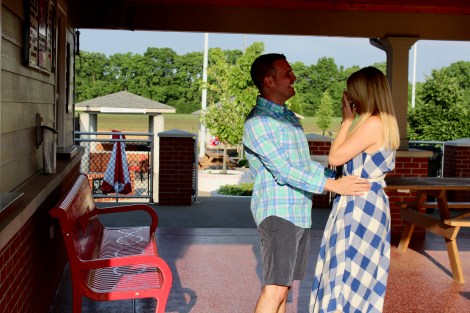
IMG_0343All throughout this journey, from the moment I decided I wanted to marry Paige to the moment she said yes, I felt tremendous joy; but it was a joy accompanied by sadness because I really, really wanted to have my Dad there for everything. In each and every moment, I wanted him there right alongside me. In moments like this, a boy needs his father. My Dad deserved to be there for all of it.

There are so many things that a boy relies on his Dad for throughout this life. When my Dad passed away, I knew there were going to be many, many moments throughout my life when I needed his guidance, wisdom, and help. After he died, I felt the shock of his being gone rather quickly. When things would go wrong at my house, I wanted to call him to get his advice…and likely talk him into doing the repairs. When I finished my graduate school studies in 2014, I wanted my Dad to be there to join in the celebration; but he wasn’t there. I wanted his career guidance and advice when job opportunities started to become available, but I couldn’t call him. Every time I had a new announcing opportunity come my way, I wanted to share the great news with my Dad because I knew how happy he would have been.

But he wasn’t there, and he’s not here. He’s not here for any of that. I would obsess over this fact, and every day, no matter how much time may pass, I constantly have to remind myself, painfully, of his absence.

I’ve felt his absence in every moment, but I don’t think I’ve ever felt the weight of his absence as severely as I have throughout my decision to marry Paige.

I knew early on that Paige was the woman God had promised me. I could sense that she was my person—the person meant to compliment my shortcomings, build me into a better man, and journey with me throughout the ups and downs of this world. It didn’t take long for Paige to show me that she was a treasure greater than any other, and although I knew this in the deepest crevices of my heart, I still wanted to be able to talk with someone about how I felt.

I desperately wanted to talk with my Dad.

Don’t get me wrong—I had plenty of wonderful people to talk to about my love for Paige. I remember telling my Mom about Paige on a trip we took to Gulf Shores. I shared how special she was on that night, and in all those nights to come, and she’s loved Paige just like she would a daughter. I was able to talk with other relatives and close friends about my love for this amazing, spectacular woman. I had lots of amazing people who were willing to talk with me and listen to me and help me feel loved. I’ll always appreciate their wise counsel.

But sometimes, a boy just needs to talk to his Father. There is a connection between a father and a son that is unlike any other—not any better, just different and unique. When that void is there, the emotional pain can be very distressing. It’s helpful for young males to get guidance from older males, just like it’s helpful for young females to have guidance from older females. Our trajectories have similarities because men and women are different, and there’s a sense of safety in that similarity. This is why I needed to talk to my Dad. I needed to tell him that after many years of searching, doubt, and questions, God had answered my prayers and given me a wonderful woman that I wanted to marry.

I also wanted my Dad’s advice on how to navigate this journey because he had done it so well himself. I’ll be honest—I don’t know as much as I should about how my Dad came to know that my Mom, Becky, was the perfect woman for him. We never really talked about that in our time together, but had he been around when I decided to propose to Paige, I’m sure he would have shared his story. My Father found the perfect woman for him—a woman who complimented him wonderfully, encouraged him, and served as a faithful partner for nearly 30 wonderful years. My Mom deserved my Dad, and my Dad deserved my Mom. They were two Godly influences in my life they were built to serve one another in very unique ways. They taught me the value of hard work, the absolute necessity of kindness, and the importance of service and compassion. I know that they couldn’t have done this individually. These messages only could have wrung true had they come from both of my parents. It’s no easy feat to pick a mate in this life. In fact, it’s probably the biggest decision one could ever make. I would have loved to pick my Dad’s brain about how he knew my Mom was the woman God had sent for him. We never got to have that conversation, but I’m sure it would have given me solace, peace, and comfort throughout my own journey. Dad would have reassured me with his enthusiasm, kind heart, and unique sense of humor. He would have been the Father to me that I needed as I made that important decision.

But he couldn’t be there, and I hate it.

I vividly remember the night that I bought Paige’s ring. It was the night before Valentine’s Day, and with my chief-negotiator Chris Beatty at my side, we perused diamonds and settings and learned more about precious gems than I could have ever imagined.

The first diamond they showed me was the diamond I bought for Paige. It sparkled beautifully, just like her smile has done since the moment I first met her in 2016. The diamond was flawless, just like I see her. It was a stone worthy of only the most perfect woman, and I wanted to give it to her as a promise that she deserves only the best of me and all the things that this world can provide. That diamond ring, as beautiful as it may be, is still not enough to tell her how I feel about her.

After buying that ring, I remember getting in the truck and driving home. And I remember crying forcefully on that ride home, because I just wanted to call my Dad and tell him all about it. My Dad had been through the process of looking at rings and buying one for my Mom. It would have been so reassuring to hear his story. In fact, had he been alive, I probably would have had my Dad right next to my side as I picked out the ring. Those of you who knew my Dad know that anything he bought was always of the highest quality. From home improvement gadgets to clothes and gifts, my Dad was a man obsessed with quality.

Even though I never got to show it to him, I think my Dad would have been proud of the ring that I bought. He would have looked it over and asked ridiculously annoying questions about the materials to the salespeople, but ultimately he would have been excited to see me, his only son, buy a ring for the girl I love. And he would have done all this because he loved me, and because I know he would have loved Paige.

Shortly after buying the ring, I knew that I wanted my Mom to be the first person that I told about it. Over lunch at High Street Café in Hamilton just a few days later, I shared the good news with my Mom. I told her that Paige was the woman I wanted to marry, and that I had bought a ring to show her my love. We were both extremely happy, but we were also very, very sad in that moment as we thought about how badly we wanted my Dad to be there.

We were sad because we were sitting at a table for two, when we should have been sitting at a table for three.

Yes, the happiness was there in that moment. The happiness for a bright future filled with love and excitement. But you can’t experience that happiness after losing a loved one without simultaneously feeling sadness at their absence. And this, dear friends, was that double-edged moment. This was that complicated moment of undeniable happiness and inescapable heartache, grief, and longing.

And then, of course, there was the proposal. I’ve always appreciated theatrics, and I wanted to do something big and romantic that would show Paige just how special she is to me.

I proposed at the Joe Nuxhall Miracle League Fields (JNMLF), a place that is very special to me, and also a place that Paige has come to know and love throughout our relationship. I serve on the Board of Directors for the JNMLF’s, and Paige has accompanied me there for numerous events. I’ve seen the goodness of her heart as she watches individuals with physical and developmental disabilities play the game of baseball with a smile on her face and a tear in her eye. Watching her there the first time we visited was also one of those cornerstone moments in our relationship when I knew that she had a heart for those who are less fortunate.

So, I orchestrated what I hoped would be a miraculous (and hopefully surprising) night for her at the fields.

After an Oscar-worthy phone call from Kim Nuxhall, I convinced Paige that we needed to stop down at the fields and reset the security system before we went to a graduation party that evening. I had to grip the steering wheel of my truck tighter than I’ve ever gripped it before so she couldn’t see how bad my hands were shaking.

As we approached the fields, Paige and I got out of the truck as I slipped a small, black box into my left pocket. We slowly walked up the stairs to the concession stand under the main pavilion as the sun was setting to our left. Feigning confusion, I looked at the old-school concession board on the wall and said to Paige, “Something looks off on that board…”

Slowly, Paige scanned the board until she saw the message:

TODAY’S SPECIAL

DIAMOND RING

JUST SAY YES

5-26-2018
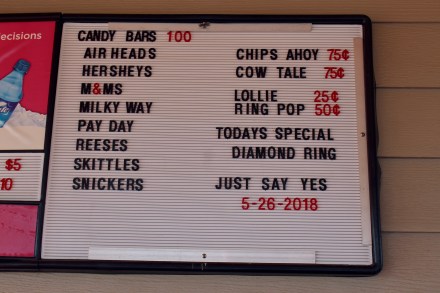
IMG_0326“Why does it say diamond ring?” she said to me nervously, and then, I placed my hands on her shoulders, and I told her how I felt about her. As I did this, photos of us together began to scroll on the video boards at the fields. Then, I got down on one knee (one very nervous, shaky knee) and asked her to marry me. She said yes, and all the promise of the next chapter of my life overwhelmed me with earth-shattering joy. I was able to envision our life together and see years into the future—and I absolutely loved what I saw.

After we embraced and held one another crying (don’t let her fool you, she definitely cried more than I did…), I rapped my knuckles on the walls of the concession stand. The concession windows flew open, and our families and friends greeted us with a cheer. Even if she knew I was going to propose, I don’t think she saw this part coming! I love Paige for a number of reasons, but her love of family and those around her has always been unbelievably impressive to me. The way she loves my Dad, even though she has never met him and never will in this life, is indescribable. Watching her eyes light up as she hugged each of our family members brought me tremendous joy.

And in my head, as I stood behind her, I pictured what it would have been like to watch her hug my Dad.

IMG_0358As our family members started to trickle out to the after-party, our dear friend Megan took some amazing pictures of us at the fields. As we smiled and posed for shot after shot, Megan asked us if there were any other pictures we would like to get before we left.

“There is one more, if you don’t care…” I said to Megan nervously.

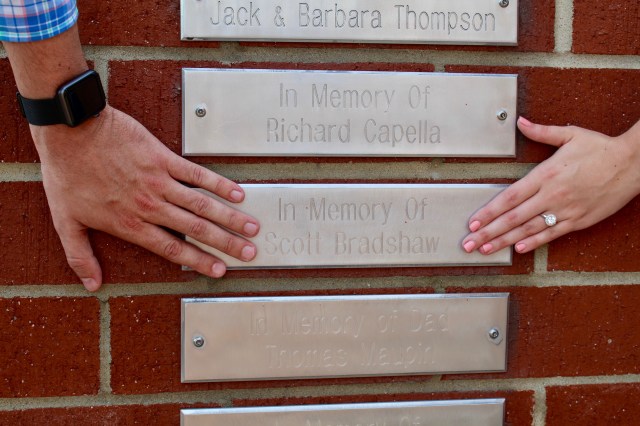
Paige, Megan, and I walked around to the side of the concession stand towards the memorial wall, a spot at the Joe Nuxhall Miracle League Fields that is very important to me. On that red brick wall is a silver plaque graciously donated by Kim Nuxhall and the Nuxhall family that reads “In Memory of Scott Bradshaw”. They donated it shortly after my Dad died, and it makes me feel his presence each time I’m there. Every time I’m at the fields, I walk by that plaque, run my hands across the metal surface, and say a little prayer for my Dad.

On the day when I asked Paige to marry me, the most important day of my life thus far, I wanted to make sure I honored my Dad the only way I know how. With one of his handkerchiefs in my back pocket, Paige and I each put a hand on the metal plaque that bears my Dad’s name: Paige’s diamond-clad hand on the right side, and my hand on the left. I worked to hold back tears as Megan’s camera snapped away. All of the emotion of the past few months and the months and years to come were just brimming at the surface. All of the pent up feelings of loss and despair were right there with me; but so was my Dad’s spirit. I could feel him there with us. I could sense that we weren’t alone in that moment.
IMG_0406

And I could sense, more than anything, that we will never be without him in these really important moments to come throughout our life together.

On the ride home that evening after a party at Paige’s parents’ home, we talked about what a whirlwind of a day it had been. Numerous times, we just looked at each other with surprise and shock and said, “We’re engaged!” We talked about how great it was to have the privacy of the proposal but also share it with our families. Then, I shared with Paige how much I wished my Dad could have been there, and naturally began to tear up. I watched as her hand (much shinier than it previously was) slid over and gripped my forearm. I turned and saw the tears in her eyes as well, as I’m confident she knew this moment would come at some point in the evening.

And that’s another thing I love about Paige. From the moment I first shared the details of my Father’s death with her, she has shown me a compassion and care that surpasses understanding. The sense of nervousness I felt when I proposed to Paige was very similar to the night that I told her that my Father had died from suicide. Having just started to get to know one another for a few months, I didn’t know how she would react. I didn’t know how she would look at my Father, never having known him, with this revelation in mind. But on that night, just like she did in the truck after I proposed, Paige put her arms around my shoulders and comforted me. She understood that my Father was not defined by his depression or his death. She believed that my Father, the man who raised me and loved me into existence, was sick with a disease that he couldn’t understand. Watching and feeling her reaction was one of the most important moments of our entire relationship. It led us to this moment, and it will serve as the foundation of all the moments we have to come during a lifetime of happiness and unconditional love.

IMG_0412Of all the things I’m fortunate to have in this life, I’ve always said I’m most fortunate to be the son of Scott and Becky Bradshaw. Now, I can add one more title to the list. I’m the luckiest man alive because I’ll get to call Paige Garber my wife. Although she never met my Dad, I know that she still loves him—and that’s the greatest type of love anyone could ever give. It’s unconditional, Christ-centered, and life-changing. It’s the same type of love that my Dad gave to everyone he knew. It’s the love I still feel him providing from Heaven. It’s the type of love that sustains, builds up, and encourages in spite of difficult circumstances. It’s a love I wish I could have reminded my Dad of on his last day here with us.

An engagement unites individuals together, and in doing so, it’s brought Paige into my family. I wish, more than anything, that my Dad could have been a Father-in-law to Paige. They would have been a match made in heaven.

But I’m confident that my Dad, from Heaven, is telling Paige just how much he loves her. In that way, he’ll always be here with us. For these reasons, and so many more, I’m thankful for the love of my fiancée, the love of a Father, and the promise that we’ll all be together again someday.
Proposal Hands on Dad's PlaqueDad, You would have absolutely loved Paige. You are so alike in so many ways. I often think about what it would have been like to watch the two of you interact with one another—laughing at the same jokes, enjoying sitting around a bonfire together, and just generally appreciating the beauty and simplicity that life together affords. It would have been one of the greatest honors of my life to introduce her to you, but I would have felt that same honor in introducing you to her. Dad, I desperately wish that you could have been here for our relationship. I wish that you could have given me the wisdom and guidance that only a father can provide to a son when it comes to love and marriage. But even though you aren’t here with us right now, I can still feel your presence. I can still feel you prodding me along and helping me make the right moves in this life. I can imagine you would have said to me soon after meeting Paige, “You better hurry up and propose before she wises up!” And Dad, you’re exactly right. She is more than I deserve and more than I could ever hope for, and I thank God for that. On the night I proposed, and every night for that matter, I’ve wanted to have you in our life and in our relationship. You may not be here with us, but in so many ways you are here with us. Your memory lives on in everything I will do as a husband, and I’m thankful that I could watch your patient, kind example over the many years that you loved Mom and me. You are here with me, and you always will be. I promise that no matter how life might change, I’ll never, ever let your memory go. Thanks for loving me from afar, Dad. Thanks for loving us—all of us. I love you, and wish we were here together. Until that day when we are united again, seeya Bub.

“He who finds a wife finds what is good and receives favor from the Lord.” Proverbs 18:22 (NIV)

16 Minutes

16 minutes. Imagine how much (or how little) you can get done in 16 minutes. Imagine how quickly 16 minutes passes you by. Personally, I’m guilty of taking time for granted. I spend more time wasting time than I’d like to admit, but on some days I rush too much. 16 minutes is fast. It’s not even enough time for me to get through a full episode of my favorite game show, read a chapter of a book, take a walk through my neighborhood, or get ready in the morning.

A few days ago, I did something that I’m going to ask all of you to do for a day when you finish reading this post. I downloaded a timer on my phone that I could put on a loop for 16 minute intervals. Every 16 minutes, the timer would buzz and start over again, buzzing 16 minutes later. Then, it would keep a count of how many times that 16 minute interval had passed.

I did this for a very specific reason. I did this for an important reminder. I did this to remind myself of a statistic I wrote about in my very first post.

I wanted to remind myself that every 16 minutes, another American loses his or her life to suicide. (You can learn more by visiting DoSomething.org or through the World Health Organization.)

And I wanted to remind myself why I’m not okay with that.

16 minutes. 16 precious minutes.

That’s 90 people every day. That’s 90 individuals whose lives are ended prematurely. That’s 90 families torn apart from sorrow and grief, just like mine. That’s 90 individual circles of family members and friends and coworkers and neighbors left behind with unbelievable guilt and plaguing, persistent questions, constantly curious if they could have done more.

That’s 630 victims of suicide each week.

That’s 32,850 victims of suicide each and every year.

And I will never, ever be okay with that.

Say those numbers out loud to yourself. Try to visualize them. Try to imagine faces and families. Try to picture the hurt and experience the pain. Try, if only for a moment, to understand how in just 16 short minutes lives have been altered forever.

Try to quantify this in your own life. In the time it takes me to watch a rerun of The Office and think about the good times my Dad and I enjoyed watching it together, two other individuals lose their lives to suicide. In the time it took you to watch the Cincinnati Bengals lose a football game this past season (you had plenty of opportunities…), 12 other families will have lost a loved one when they didn’t have to. You slept for 8 hours last night? While you were asleep, roughly 32 lives were cut short unnecessarily.

Every 16 minutes, someone feels as if their life is unlivable. Every 16 minutes, someone feels as if their circumstances are so dire and so impossible to escape that suicide is the only escape. Every 16 minutes, someone who could get help doesn’t. Someone who deserves help and healing fails to find it. Every 16 minutes, a repairable situation ends irreparably.

Someone like my Dad.

If you’re feeling guilty because you didn’t know that a suicide occurred every 16 minutes in our country, don’t; because I didn’t know either. I’m not writing this post to make you feel guilty at all. I’m writing this post because I wish I would have read it before losing my Father.

Before suicide affected my family, I never would have guessed that someone lost their life to suicide every 16 minutes. In fact, I would have guessed that there was one or maybe two suicides a day in our country—which is still not okay, but my innocent mind would have found a way to minimize the pain. Any unnecessary death is a death we should aim to avoid in the future. But in the world I lived in—one that I thought was safe and secure—I could never have imagined suicide was as prevalent as it is.

That is, until it hit home. My home. My family.

A few months after my Dad died, I did what anyone who is blindsided by an enemy they didn’t know existed probably does: I tried to figure it out. I tried to learn as much as I could about mental illness and suicide. I read books, I located articles, and I listened to videos and lectures online from suicide survivors. I tried to figure out why my Dad, a fun-loving father, honest husband, caring coworker, and faithful friend to everyone he encountered could feel the way he felt. It didn’t make sense.

And the more I learned, the more baffled I became.

I distinctly remember the night when I first saw the statistic about suicide prevalence. I was sitting at home, reading information online, and I saw the number. I didn’t believe it. It couldn’t be true. There was just no way that individuals were dying from suicide at this rate. I went from site to site to site and saw roughly the same number. There might have been a little variance in the math, but the numbers were largely the same. Nearly 100 individuals each day dying from suicide.

I was mad. Mad at an illness that had robbed me of my Dad. Mad at the pressures my Dad had dealt with.

And I was mad at myself for not knowing that this was happening in the world around me.

The more I learned, the angrier I got. I couldn’t believe how naïve I had been. If suicides were occurring at this rate, it was nearly certain that there were people in my own life who had died from suicide or family members or friends who had known someone who was a victim. But I don’t remember seeing them. I don’t remember hearing their stories.

But they were there. The reality was I just wasn’t looking. I just wasn’t listening.

After my Dad passed away, however, the blinders were gone. My cloak of naivete had been removed. For the months that followed my Dad’s death, each and every day, I found myself meeting with or interacting with someone new who had been impacted by suicide. Sisters who had lost brothers. Parents who had lost children. Children who had lost parents. Individuals who had contemplated suicide themselves. Now, I find myself wanting to fight for those individuals. I find myself wanting to do something to help them. Even if by the time my life is over I am only able to push that time interval to 17 minutes or 18 minutes, it will have all been worth it. Because those are hundreds and thousands of families, over time, that won’t suffer the same heartache that mine has.

And I hope you want to do something about it to. Because allowing someone to die unnecessarily every 16 minutes is unacceptable.

Lately, I’ve been speaking publicly in classrooms and community events about suicide, and although I always share this statistic with those in the room, there is one other thing that I always do. I always, always have a picture of my Dad on the screen behind me when I speak. He will always be there with me, smiling and looking on that way; but he’s also there because my Dad is more than a statistic. My Dad was a living, breathing person who lives no more because of the mental illness that attacked him.

I am in a club that, unfortunately, continues to grow against the will of those who already belong. Each day, 90 other families come into this club of individuals impacted by suicide. We get a new member every 16 minutes. And for the first time in my life, I’m in a club that I’m trying to keep members out of. I’m trying to do what I wish had been done for me before my Dad died. I’m trying to make people aware that suicide might seem distant, but it’s real and it’s pervasive. And we are at a critical juncture where every bit of awareness could help someone who needs it.

So, I simply ask you to do what I did to help this message sink in. What do 16 minutes mean to you? Get a timer on your phone or use a kitchen timer. Set it for sixteen minutes. And when it expires, say a prayer for an individual and family impacted by suicide. Try to understand that each and every time that buzzer or timer sounds, there is one more victim of suicide in our country. Another family and circle of individuals has entered a new chapter of their life filled with pain, agony, and questioning—just like the one my family finds itself in.

Then, set the timer again. Because mental illness is relentless. And until we start to fight against it, that timer will continue to reset at the same interval.

Unless, like me, you’re not okay with it any longer.

The more we understand our enemy, the better chance we have of defeating it. I know that I’ll never take those 16 minutes for granted ever again. And for the rest of my life, I’ll do everything I can to push that clock back. My Dad would have wanted that. My Dad deserved that.

His 16 minutes will count for something. I’m sure of that.

Family Easter Photo with SB LogoDad, I wish I had known. In spite of all your struggles that you dealt with each and every day, I never, ever thought that suicide would attack you and our family. I never believed for one moment that your life was in danger, probably because you shielded us from so much of your heartache in an effort to protect us. Dad, I wish I could have done more to help you. I don’t blame myself for what happened, but I would do anything to replay those moments when I should have done something. But in your memory and because you always taught me to help people, I’m trying to keep others from suffering like you did. I’m trying to make people aware of something that I wasn’t aware of until it stole you away from us. Dad, I miss you every single day. I wish I had many more minutes to spend with you. Someday, we will have those minutes and many more. Someday, we will be able to enjoy being together again. Until then, seeya Bub.

“The righteous cry out, and the Lord hears them; He delivers them from all their troubles.” Psalm 34:17 (NIV)

Check Please

Both my credit card statement and the ever-tightening waistbands on all of my dress pants will confirm one thing about me: I love Cracker Barrel…possibly, a little too much.

In many respects beyond my diet, I’m a 65 year old man trapped in the body of a 30 year old (although my physique is also more resembling of that elderly man than the young one…). Old men like television game shows. I’ve probably seen every episode of Family Feud that’s ever been recorded, and I definitely scream answers at the television and claim I would be a better contestant than…just about anyone. Old men hate it when kids are on their lawns. I am in a never-ending battle with the young neighborhood whippersnappers who think that my corner lot is public congregation space when they get off the bus. A privacy wall is coming.

One look around in any Cracker Barrel will show you that old men love it…and so do I.

I can get breakfast anytime of the day I want to. They have a fireplace. They have rocking chairs and a checkerboard. They have pancakes and fried chicken and hashbrown casserole and everything that is bad for you. And if that weren’t enough, I can eat all of those foods at once and still go buy a bag of old fashioned candy and some ridiculous house decoration that I don’t need right in the lobby!

I think America just needs a little more Cracker Barrel to solve all of our problems.

Just last week, I had some downtime and decided to make a stop at Cracker Barrel for breakfast with the intent of ordering something moderately healthy. An order of cinnamon streusel French toast and bacon later (I said “intent”), I found myself scanning the restaurant because Cracker Barrels are the absolute best for people watching.

My eyes settled in on the table right next to me. It was a Father and his young (probably 5 or 6 year old) son. My heart sank, but it always does that when I see a father and son. It’s happened ever since Dad died. No matter where I am, if I see a dad and a son out together by themselves, it draws me back to what I don’t have. It reminds me of what I miss most. It makes me wish my Dad was still here.

This particular young boy immediately grabbed me because he was just a cute kid. He wore a flashy Under Armour hoodie and some cool tennis shoes. He had a toothy grin, freckles, and enough gel in his hair to spike up his light brown bangs. He had a gray bubble coat draped across the back of his chair, and he smiled at me when our eyes connected.

I looked across my own table and saw an empty seat—the spot where my Dad should have been sitting. My mind went back to all the times that he and I and Mom had sat at Cracker Barrel tables together—Dad always ordering chicken and dumplings, but always making time for a quick game of checkers by the fireplace before the food came out.

I see that empty seat quite often, and it makes me nauseous. I’ll immediately feel myself tearing up, and I often have to tell myself that I need to think about something else instead to fight off the waterworks. It’s not that I don’t want to think about my Dad—believe me, I do. Mostly, I just don’t want people to stare at my while I’m getting upset at a table by myself.

So, on this particular day, I decided to focus on the boy and his Dad sitting at the table next to me. Little did I know that this would probably make me just as upset as thinking about my own Dad would have.

The boy and his Father placed their orders shortly after I did. I paid particular attention to the little boy’s order: pancakes and bacon. I knew I liked this kid.

After the waitress left, I saw something that I see way too often. The boy’s Dad, sitting at a table with just his son, given the perfect opportunity to be an engaged Father, instead decided to pull out his cell phone. Apparently, there was something more entertaining on that tiny screen than the tiny and interesting human sitting right across from him. I’ve always been bothered by sights like these, mainly because my parents always taught me that time at the dinner table was insanely precious. We always engaged with one another. Little did I know just how valuable it would be when we couldn’t have it anymore…

I watched for a few minutes, and then a few minutes more, as this Father poured every ounce of attention he had into the small phone he held in his hands. The young boy tried to engage his Dad at first, as most young boys will do, but there was no reaction. This particular Dad wanted everything to do with his phone and nothing to do with his son. Absurd.

As young boys will do, this little guy began to get restless. He would occasionally spin around and rest his chin on the back of his chair and his coat, staring at the other families around the restaurant. Before long, he jumped up from his chair and walked over to his Dad, probably to see what was so interesting on that phone of his. That’s when my fury reached a brand new level.

The Dad snapped at this cute, innocent little boy, admonishing him sharply and telling him to sit down. The look on his face was pure meanness. I have an absolutely terrible poker face, so I’m sure my jaw was dropped onto the table by this point. With a force that no young boy deserves, the Dad thrust his son back towards his chair. My heart broke as I watched the young boy’s head hanging in shame, eyes glued to the floor. He kicked his legs back and forth slowly as his face turned red, probably worried that people in the restaurant were staring at him. There are few things more uncomfortable than feeling shame as a young child. It’s debilitating. He looked like he was on the verge of tears, and so was I.

But I was more than sad at this point. I was angry. I was furious. I wanted to get up and tell this Dad off. I wanted to tell him that he had no idea how precious this time was with his son. I wanted to tell him that he should cherish every moment—every single moment—that he has with this young boy. I wanted to tell them that he won’t have these opportunities forever. I wanted to tell him that he has a God-given responsibility to instill values and character into that young boy’s mind and heart, and that he wasn’t going to do that acting like a complete and total jerk.

Somehow, I restrained myself. I clenched my fists, studied the salt shaker, and even gave the Peg game on the table a go (I’m attributing my poor score of three remaining pegs to the low blood sugar of not having yet received my French toast). I tried to ignore what was happening (or not happening) at the table next to me, but after a while, I had to look again.

There sat the little boy, chin resting on his chair back, staring at the other families in the restaurant. And there sat the father, eyes still locked-in on the mobile screen in front of him.

Finally, the Dad looked up at his son. “Finally,” I thought to myself. “It took him long enough, but he’s going to talk to the little guy. Good for him.”

“You wanna put your straw in your water?” he said.

It wasn’t profound, but I told myself it was interaction nonetheless. Baby steps.

It was amazing and a bit saddening to watch the little boy’s composure change just because his Dad recognized him. Just because his Dad finally paid a little bit of attention to him. I thought things might be looking up. With his little hands, he grabbed the paper-wrapped straw from beside his tiny cup of water. Then, he did what most youngsters will do. He began to bang the end of the straw against the table until the paper would slide off.

With a level of anger completely unwarranted by the situation, the Dad reached across the table yelling “Give me that!” from the young boy. He grabbed the straw from his little hands and opened it in a more “dignified” manner. Having opened the straw, he put it in the boy’s cup as his little eyes looked on, head hanging low once again.

Then, the Dad took things to an entirely new absurdity level. He shook his head back and forth a few times as his face began to grow red (from anger, not embarrassment) and said “I don’t understand why you do things like that.”

It took everything I had in me to not stand up from the table, bash his head with the oil lantern, and see myself expelled from every Cracker Barrel in North America. I had a few bottles of mini maple syrup, and I was pretty sure no one would have blamed me had I poured them right over this jerk’s head.

I was furious. Even more furious than this Dad was when his little boy didn’t know how to “properly” unwrap his straw.

“That’s it,” I said in my mind. “I’m saying something to this guy. He deserves it! Before I go, I’m going to tell them exactly what I think of his parenting. And he’s not that big so I can take him if he tries something funny. Or I can knock over a display of candles in the lobby and run really, really fast.”

In that moment, I looked across my own table—the empty table—and got even more upset than I had previously been. My Father was more than a father—he was a Dad. When I was little, he made me feel like I mattered. He talked to me and had conversations with me. He made me feel so important and so loved. He taught me things and was legitimately interested in me. And yes, it may have been a different time, but nothing as silly as a cell phone would have ever gotten in the way of a conversation with his son.

I got angry because my Dad was gone. I began to wallow in my own self-pity, thinking selfishly that it wasn’t fair that Dads like this still got time with their sons when Dads as deserving as mine had lost theirs way too soon. It’s a feeling I get quite often.

When the Dad and his boy finally received their food, the little boy didn’t even get any help from his Dad. He put his own syrup on the pancakes. He clumsily navigated a knife and fork to cut his pancakes into bite-size pieces. I grew even sadder watching him enjoy his little breakfast in unnecessary silence.

So, I did what I often do in moments like this. I began to talk to God. And I began to talk to Dad.

I don’t pride myself on being a theological expert, and I don’t know whether or not it’s even realistic, but when I think of what’s happening in Heaven while I’m down here on Earth, I will often picture my Dad and God standing right next to one another. Their elbows rest on a shelf of clouds, and they are looking down at me, watching over me, and encouraging me. They talk with one another. They roll their eyes when I do something foolish (there’s lots of eye rolling, by the way). They laugh at me. But more than anything, they send me lots of love from above.

The nice part of this visual is that, when times get tough and I don’t know what to do, I’ll often turn my face to the sky and simply ask them. I’ll cry out. I’ll say “Tell me what I should do here. I need you. I need you both.”

And that’s exactly what I did. In the middle of a Cracker Barrel, I looked upwards with my palms facing skyward on the wooden table, and mouthed the words “Tell me what you want me to do here, because I’m lost and I’m angry.”

I expected them to tell me to get courageous. To harden my resolve. That it was time for me to stand up for what I believed in. That I needed to be a man, tell this guy that he needed to be a man too, and walk out with my shoulders back and my head held high. I waited eagerly for their response, and I nearly threw up my French toast when I heard it.

“Ask for their check,” was what I heard. “Ask for their check,” was what came to my mind.

Apparently, people in Heaven are perfect but can still say crazy things.

My eyes must have been as wide as cornbread muffins as I stared across the table at the empty chair opposite me. My mouth was agape, and I was beginning to sweat a little bit. I looked at the spot where my Dad should’ve been sitting, and I told him exactly what I thought about his suggestion: “That’s probably your dumbest idea yet.”

I was angry that this was the solution that came into my mind. I was mad that this was the best solution that the Lord of all mankind and my Dad could come up with. I wasn’t about to reward bad behavior. I wasn’t going to give this guy any of my hard-earned money as he sat there and wasted the best gift he could have ever received—a relationship with his son. No way. I’m sorry, God. I’m sorry, Dad. It’s not happening. Try again.

But the phrase just kept coming back to me. “Ask for their check. Ask for their check. Ask for their check.” Over and over again I kept hearing this phrase. No matter how hard I fought it, it was like God and my Dad were telling me that there was no other way out. There was no other solution to what was happening in that moment. I knew this was a spiritual test, but I also knew it was bigger than that.

I asked God to tell me why. I asked God to explain to me why this was His solution. He didn’t tell me straight out, but He gave me some wisdom to think through this. And I knew that it was wisdom that both God and my Dad would appreciate.

First and foremost, I reminded myself that I was only seeing a snapshot of this family’s life. I hoped it didn’t get worse than this, but I had no idea what their morning had been like. I had no idea of this man’s story or anything he was dealing with at the time. I didn’t know what brought him to that table on that morning, what things were weighing on his heart, or the insecurities he might have been feeling as a father in that moment.

Then, I thought of my Dad. I thought of the types of things he would have done. My Dad was the type of man to pick up someone’s check. My Dad was the type of person to not judge people, even if he didn’t like their actions. My Dad gave people the benefit of the doubt in every circumstance, even when they upset him. My Dad was a giver, and he believed that you could teach people more through kindness as opposed to anger, retribution, and holy discipline. My Dad was a big fan of New Testament love. I was a fan of Old Testament fire and brimstone.

I also remembered something that I saw my Dad live out many, many times during his 50 years here on this Earth. Little actions of love can have big, lasting implications. Little interactions that show kindness can change a life and many more. Little moments of tenderness can spread like wildfire. Maybe, just maybe, I would pay this man’s check. And maybe, just maybe, it would put him in a good mood and change how he interacted with his son on that day. And maybe this little boy, who deserved it, would have a good day. And that good day would lead to other good days and a different relationship between these two. It was stupidly optimistic…and it was exactly the type of thing my Dad would have believed.

I did what I thought was unthinkable. I called upon the Holy Spirit to help me, and summoned some courage from my Dad. When the waitress came by, I signaled her, leaned over, and said to her… “Can I ask you for a Diet Coke to go?”

Just kidding. I said “Can I ask you for a Diet Coke to go? And, also, can you bring me their check without letting them see it?” I nodded towards their table.

“You want the check for the little boy’s table?” she responded.

“Yes, ma’am,” I said, feeling like a wimp. Feeling like I had lost the battle by not telling this man exactly what I thought of him.

“Absolutely,” she said with a huge smile across her face. She returned a few minutes later with a Diet Coke (I felt I deserved this much) and a check a few times larger than the one I had originally received.

I grabbed it, got up from the table, and walked past the man and his son.

As was expected, the Father was a bit too enamored with his chicken fried steak to notice me. But I didn’t want to look at him anyway. I looked at the boy. The little boy with the hoodie and the hair gel and the pancakes. He looked at me and I smiled and winked, walking out of the restaurant without saying a word. I paid my bill. Then I paid for their bill. I grabbed my to-go cup, walked out of the Cracker Barrel towards my car, and looked up towards the sky.

“There. Are you two happy?” I said begrudgingly.

I imagined that both God and Dad were smiling down nodding their heads yes, and laughing that I could get so frustrated showing love to someone else.

While I sat in my car, I began to cry a bit, feeling the emptiness of not having my Dad here with me. But it’s moments like these that remind me that he is always here. That his memory can live on each and every day, as long as I live my life the way he would have. His life and legacy live on in my heart. I know I’ll never be the man that my Dad was. The bar is just too high. But I’ve accepted that. I’d rather aim high and miss a little lower, though, than not try at all. It’s my duty to my Dad to do the things he would have done. If he can’t be here to do them, I need to be the one to live like my Dad. I didn’t pay the bill on that day. My Dad did.

I pray that my Dad’s gesture made that little boy’s day a little better. And I pray that it warmed that Dad’s heart. And I desperately hope that they had a wonderful day together. I mean…it started at Cracker Barrel so how could it be bad?!

I thank my Dad for inspiring me to do things in moments like that. I thank my Dad for helping to change my heart. Initially, I had hoped this man would choke a bit on his chicken fried steak, and just a few minutes later I was paying for his meal. Well played, Dad. Well played.

And, more than anything, I pray that for as long as I live, my Dad keeps guiding me. That he keeps giving me instructions. That he keeps forcing me to do things I would never, ever do on my own.

I’m a better man because my Dad was here for 26 wonderful years, and I’ll be a better man because he will always be in my mind and in my heart for as long as I live.

And next time, I’ll try a bit harder to order the fruit and yogurt.

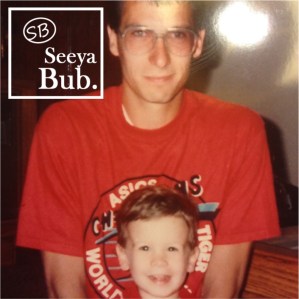
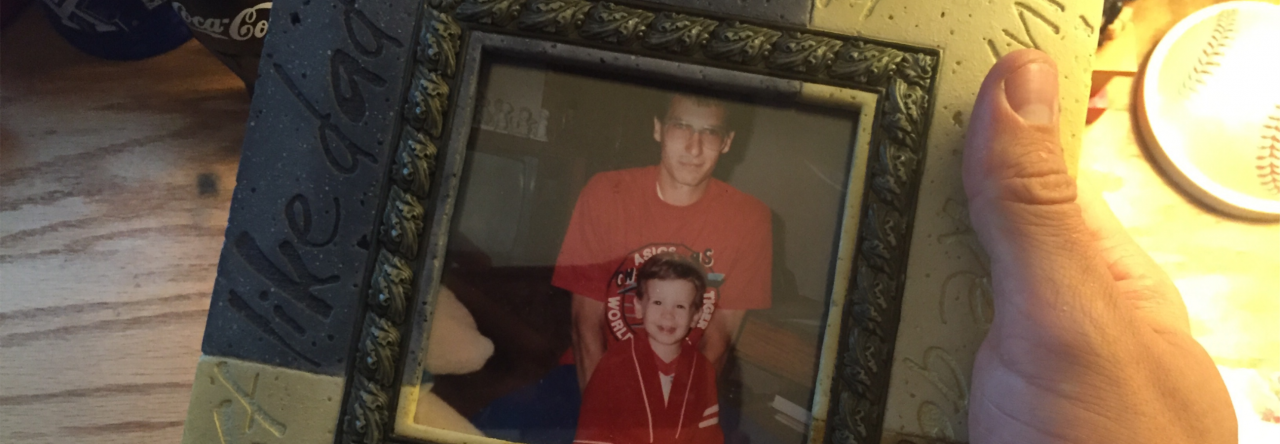
Sitting in Dad's Lap with SB LogoDad, Even though you’re not here with me, I know you’re always with me. I know you’re always watching over me and guiding me and pushing me to be a better Christian. On the days when I feel sad that you’re not around, it’s always moments like this one that remind me that you’ll never leave. Yes, we haven’t talked face to face since that horrible July day in 2013; but I feel like we’ve been talking ever since. Little things happen in my life that allow your memory to shine through, and I’m so grateful for that. Dad, you would be so proud to know that your story is inspiring people to live better lives. You have no idea how many people miss you and love you and wish you were here. Remind them, and remind me, that you’re always here as long as we live life the way you did. Remind us all that love is more important than absolutely anything. I’m reminded each and every day how much I love you. Thank you for teaching me what it means to be a Father. Thank you for giving your entire self to me. And thanks for never taking it easy on me when we played checkers. I love you Dad, and I miss you terribly. Until we can share a seat at a table even better than one at Cracker Barrel, seeya Bub.
“But love your enemies, do good to them, and lend to them without expecting to get anything back. Then your reward will be great, and you will be children of the Most High, because he is kind to the ungrateful and wicked.” Luke 6:35 (NIV)

Why I Fight

“Why do I want to do this? Why do I want to do this?”

I sat at the desk in my office at home asking myself this question over and over and over again. My Dad’s death had been weighing heavy on my heart (as it does nearly every day), but there was something that felt different at this moment of my grief. In the immediate aftermath of losing my Dad, I was just trying to survive. I was just trying to make it through the different and unexpected challenges that accompanied each day. I didn’t know how to do it, and I simply took things one day at a time.

But a few years after losing him, I wanted to do something with my grief. I wanted to make sure my Dad didn’t die in vain. I wanted to help other people.

I wanted to fight.

As I mentioned in last week’s post, September is Suicide Prevention Month, which has caused me to think more and more about the larger fight against mental illness and suicide, along with the personal implications for my own journey. Suicide Prevention Month forces me to think about my own motivations for writing and speaking and advocating for a more open and honest discourse about mental illness.

So why do I fight?

I fight because my Dad didn’t take his own life, but because his life was stolen from him. My Dad was a victim of suicide, and in an earlier post, I’ve written about why that phrasing matters. My Dad didn’t take his own life. Depression and mental illness robbed him of joy, and eventually, his existence as well.

I fight because my Dad was robbed. He was robbed of the experiences he deserved to have. He deserved to enjoy retirement. He deserved more beach vacations. He deserved to be a Grandpa and play with his children (and probably feed them way too much candy before turning them back over to their Dad). He deserved more walks with my Mom and our dog. He deserved more bike rides and miles on his truck and chances to embarrass his son with his ridiculous Dad humor.

But depression stole all of this from him, and from my family. Depression told my Dad, falsely, that he didn’t deserve these things. I wish I could have told him more that he did.

I fight because I feel robbed. There are so many things I wanted to see and do with my Dad. Naively, I thought that I had so many years to check items off of our bucket list. In the blink of an eye, all of those moments were gone. We never got to go to a country concert together. We never got to go on a kayaking trip. We never hiked the mountains like we wanted to. We never went on a diet and started working out together like we said we would (Okay, let’s be honest…that one probably wasn’t going to happen anyway). There are so many “would-be” moments that are now gone forever. My heart longs to have those days back. I wish for nothing more than the opportunity to be next to Dad. To hear his laugh. To tell him how loved he was and always will be.

I fight against mental illness because it’s mental illness that stole all these moments away.

I fight because I’m angry at the true enemy. I don’t understand the ins and outs of depression and mental illness, and although I’m trying to learn, I don’t pretend to be an expert on the nuances, causes, and neurological forces that cause people to sink into such horrible and inescapable periods of darkness.

But I can name the enemy. And I can use the talents God has given me to advocate for those who are much better equipped to research and study and develop treatments.

And I can help expose the enemy by pulling back the curtain.

People who lose their loved ones to cancer don’t get mad at their loved ones. They get mad at cancer.

People who lose their loved ones as victim of violent crimes aren’t mad at their loved ones. They get mad at the murderer.

Therefore, I get mad at depression. I get mad at mental illness. I get mad at the pressures of our society that caused my Dad to hide his hurt.

And it makes me want to fight. And to deliver a knock-out punch.

I fight because, unfortunately, my Dad’s story is only one story in a host of others that have a terrible ending. As much as I’m fighting to remember my Dad, I’m also fighting because I want to live in a world where no one else ever has to experience the heartache that I have. I’m fighting because I live in a country where 30,000 Americans lose their life to suicide each year[1]. I’m fighting because I live in a country where someone becomes a victim of suicide every 16 minutes[2]. One death by suicide is one too many. And I’ll keep fighting because these victims, like my Dad, deserved better.

I fight because I have a printed copy of an article from CNN on my desk from December 2016, and I fight because it’s the story of Brandy Vela. Brandy was an 18-year old high school student in Texas with beautiful blue eyes and a bright smile. As all too many high schoolers know, bullying can be harsh. So much so that it forced Brandy to believe that her life was unlivable.

Brandy VelaBrandy’s classmates would make up fake Facebook accounts and message her and taunt her. The teasing was relentless. With maturity far beyond her years, Brandy chose not to respond, but her classmates were relentless. Brandy even went so far as to change her phone number and report the bullying to local police, but the authorities weren’t able to help because the perpetrators used an app that couldn’t be traced. The police told Brandy and her family that they couldn’t do anything until there was an actual fight or physical altercation.

On a seemingly usual Tuesday, Brandy sent a very unusual text to her family members from the bedroom of her home. “I love you so much,” the text read. “Please remember that, and I’m sorry for everything.”

Her family rushed to her bedroom and found Brandy with a gun to her chest. They begged and pleaded for Brandy to see that her life mattered. That her life was worth living.

“I can’t do this anymore,” Brandy responded. “I’m tired. I’ve come too far not to do it.”

Brandy’s life ended in front of the family members that loved her most.

Fortunately, two individuals have been arrested in connection with Brandy’s death. I can only hope that the individuals who invested their time in tormenting a fellow classmate will receive swift justice, but I hope the guilt for their actions feels worse than any punishment.

This is not normal. This is not acceptable. This is not an acceptable end for any man, woman, or child, period. If we value life, we will do everything we can to eliminate the forces that cause individuals to think that life isn’t worth living.

Our world and our society are both full of unbelievable and unnecessary pressures. These are pressures that drive people to think they aren’t enough. Pressures that drive people to think that the hurt and pain they feel will last forever.

Every death by suicide is unique and completely different, and there are contributing factors that make each case unique. The pressures facing Brandy Vela and her feelings were very different from those that hastened my Dad’s death, but there is one unfortunate commonality: left behind is a family full of grief, questions, and unending pain.

Like Brandy Vela’s family, I am left wondering “what if.” What if I had done more to try and help my Dad? What if I had forced him to seek medical attention? What if I would have stayed with him the entire day instead of leaving the house? What if my Dad was still here?

Suicide isn’t fair. It isn’t fair to those whose lives are cut unnecessarily short. It isn’t fair to the families who are left behind. Those victims and those families deserve the strength of an army to take down this enemy once and for all.

For my Dad and for every single family affected by this horrible epidemic, I ask you to join the fight.

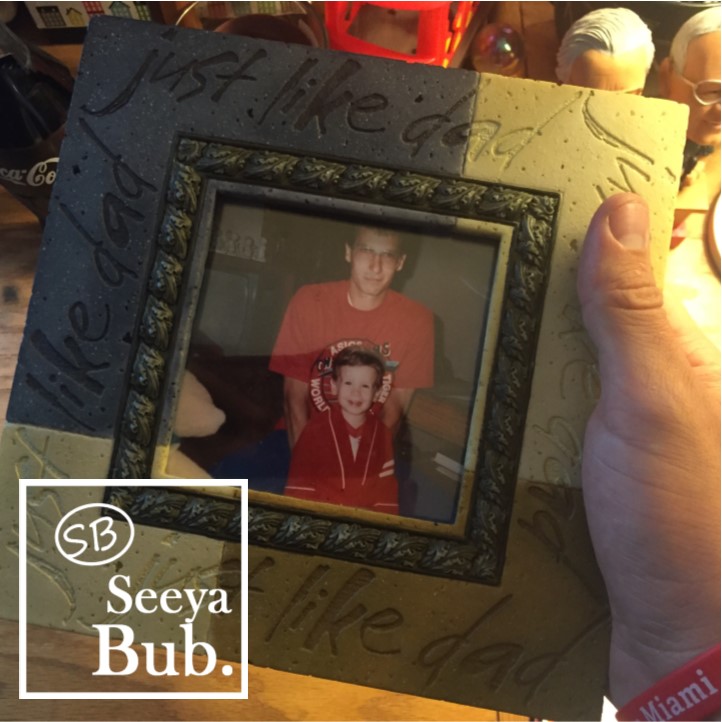
Just Like Dad Picture with SB LogoDad, I miss you every single day. I replay our last conversation, the hurt I saw in your eyes, and our last words to one another. I also replay all the moments throughout life when I knew you were hurting, and although I can’t help you any longer, I want to help other people. I don’t want any individual to experience the pain you felt. I don’t want any family to experience the loss that ours has felt without you. Dad, I hope you will continue to be my guardian angel, watching over me as I do my best to honor your memory and your story. Thank you for always teaching me that it’s important to help those who can’t help themselves. Thank you for always showing me that love can heal all wounds. I hope your story reaches those who are hurting and causes them to get the help they deserve. I promise I’ll make you proud. Until the race is done, seeya Bub.

“Therefore, my dear brothers and sisters, stand firm. Let nothing move you. Always give yourselves fully to the work of the Lord, because you know that your labor in the Lord is not in vain.” 1 Corinthians 15:58 (NIV)

[1] https://www.dosomething.org/us/facts/11-facts-about-suicide

[2] https://www.dosomething.org/us/facts/11-facts-about-suicide

The Church Must Speak (Part 2): Stigmas

This is Part 2 in a special three-part series on the Christian church and mental illness. Please make sure you check out Part 1: Silence.

Unspoken prayer requests are unspoken for a reason.

I know that not every unspoken prayer request is related to mental illness; but I do think that a large majority of those who suffer from mental illness are afraid to make it known.

And the last place they should be afraid is the Christian church.

But they are.

When I started this series, the easy part was realizing that the Christian church largely stays silent on the topic of mental illness. The difficult part was understanding why. Why would a caring, loving church stay silent on a topic that affects so many parishioners who sit in the pews week in and week out? Why would the church choose to stay silent when people are broken and hurting? When lives are being lost? When families are being torn apart?

There’s a reason why those unspoken requests continue to remain unspoken.

The stigmas that surround mental illness, although mostly untrue, are just as pervasive in the church as they are in any other institution in our society. And these stigmas are preventing people from finding the peace they deserve—and the love that Christ wants them to experience.


So what are these stigmas? What are these faulty thoughts surrounding mental illness and suicide? Why are they still alive in the modern church? How foolish are they? And what can we do to counter them? I have my ideas.

To prevent these stigmas from spreading, we’ve got to understand just how faulty they actually are. So, for the rest of this post, I’m going to ask you to engage in a bit of a metaphor with me.

I want you to imagine that a man comes to your church with a broken leg. He hobbles in on crutches. A huge, fiberglass cast holds his shattered bones into place. After some uncomfortable shuffling, he eventually finds a pew near the back of the church in an attempt to avoid the eyes of his fellow worshipers.

Now, imagine that you notice this man. And imagine that you immediately judge him negatively because of his broken leg. Or you question his walk with God. Or worse…you completely ignore him and his pain.

Crazy, right?

If someone has a broken leg in the church, we don’t ask any questions about why their leg is broken, but we offer to help. In any way we can.

If someone in the church has a brain function or thought process that is broken, however, our reaction is very, very different. And this differentiation is at the heart of the stigmas that prevent the Christian church, largely, from serving the mentally ill.

That, my friends, is the heart of my argument. Although the response and treatment for an injured leg and an injured brain are vastly different, our Christian response to each of those injuries should operate from the same exact place of love and compassion, not judgement. We must counter the stigmas; but to counter them, we have to call them out, one by one. Although there are many stigmas about mental illness that run rampant in both the church and everyday American society, I believe these three are the most particularly dangerous and damaging.

STIGMA 1: If you suffer from mental illness, your spirit is weak, your faith is low, or you are distant from God. Situate this stigma in the context of the conversation we had just a moment ago. Imagine if I had the audacity to question the physical or spiritual fortitude of the man with the broken leg. “Man, you must have some pretty weak bones there fella,” I would say to him. Or “That’s what you get for not drinking enough milk!” Or worse, imagine if I said, “Wow, what did you do to make God so mad that he broke your leg?!” If I ever responded to anyone with a broken leg with an attitude like that, everyone in the church would immediately call me a hypocrite. They would call out my lack of compassion—rightly so!

But there are believers in the Christian church each and every day who make those same judgments about their brothers and sisters who suffer from mental illness. They secretly call them crazy. They avoid interaction with these people. They question whether or not they actually believe in God at all.

This type of thinking is completely unacceptable.

I can’t speak to the root of each and every person’s own individual struggle with mental illness. I can’t say with 100% certainty that all cases of mental illness have nothing to do with a larger spiritual battle. But I can say that believing every case of mental illness stems from a person’s personal walk with Christ is foolish.

And I can also say I’ve encountered this stigma.

No, I’ve never interacted with someone after my Dad’s death who comes right out and says, “Your Father must have been mad at or distant from God,” but they don’t have to come right out and say it. I can see it in their eyes. I can tell that they don’t want to engage because they think of my Father as someone who must have had little faith in God.

But I can tell you that my Dad believed in God. He believed in the power of the Cross. He loved Jesus—and more importantly lived his life in a way that showed people how much he loved Jesus. But my Father’s mind was highjacked by a horrible, complex, and devastating disease. Just like someone who loses a family member to cancer or heart disease, I lost my Father to suicide. Suicide, a debilitating disease that clouds the mind and warps the senses stole my Father. In fact, I think my Father’s faith is probably the thing that allowed him to fight as successfully as he did for so long.

I think one of the most Christ-like things we can do is admit that sometimes, we just don’t know why certain things happen. And I’ll be the first to admit that I don’t always understand depression and mental illness. It could be spiritual, for some. It could be neurochemical and physiological for others. It could be brought on by dire circumstances or a whole host of other influences. But, like Jesus, I want to listen to people who are hurting. I want to listen to people who are suffering, hear their stories, and help them find comfort in the arms of Christ. And if I automatically assume that every battle with depression is entirely spiritual in nature, I’m missing the point of Jesus’ ministry—and so is His church.

STIGMA 2: Suicide is the unforgivable sin, and if you’ve ever entertained it or had suicidal ideations, you’ll never be forgiven. As a Christian, you should just know this isn’t an option. Somehow, we’ve come to believe in the church that suicide is a sin that is elevated above any other—and, unfortunately, we lump mental illness into this bucket of “unforgivable sins” that don’t actually exist.

Go back to the poor man I described in the previous section with a bum leg. Put yourself in his shoes (and cast). Imagine if someone told you that your struggle to stay healthy must be a punishment from God for some sin you had committed. Would it make you want to serve Him? Or would it scare you?

I don’t know about you, but I serve a loving God. I serve a compassionate, forgiving God. And I serve a God who says I have swept away your offenses like a cloud, your sins like the morning mist. Return to me, for I have redeemed you” (Isaiah 44:22, NIV).

Unfortunately, there are a whole host of people in the larger Christian church who, whether consciously or underneath the surface, believe that there is something unforgivable about mental illness and suicide. I don’t understand this, and I never will.

Charles Stanley is one of the most knowledgeable Christian speakers and scholars of our time, and I remember being given a copy of his book Emotions by my pastor, Harville, after my Dad’s death. I tore through page after page because I loved Stanley’s approach to dealing with our emotions (more on Stanley’s book in the Library section), but then my heart froze when I got to page 243 in a chapter entitled “Despair.” My eyes fixed on the word “suicide”, and I began to panic. My palms began to sweat because I was afraid of what might come next. Stanley is a Baptist minister who started his career behind the pulpit in the 1970’s, and I made assumptions about his beliefs on suicide. I worried that a man like Stanley—a studied and learned man—was going to tell me something about my Father’s eternity that my heart couldn’t bear to hear.

And then, with the tenderness I needed in just that moment, Stanley penned the words that my broken heart needed to hear. He wrote:

“Now, before we move on, let me clear up a misconception I frequently hear repeated. If you or someone you love has attempted suicide, please be assured that it is not the unpardonable sin. Some believe it is because the person does not have the opportunity to repent, but nothing in God’s Word suggests suicide will not be forgiven” (p. 246).

I put down the book, and I began crying. God knows my heart, and He knows I’m a natural skeptic, and he knew that I would need the perspective of a Biblical scholar like Charles Stanley to convince me that my Dad’s heart—and his Eternity—belonged to the Lord and Savior he served.

And it’s not just Stanley. After reading his book, I sought out more and more perspectives. And everywhere I looked I found the same thing from Christian scholars I knew I could trust—mental illness and suicide are not the unpardonable sin.

But the words of men shouldn’t be enough to convince us. Those of us in the Church should let everything we do be dictated by the Word of God, and nowhere in the Bible am I able to find evidence that those who suffer from mental illness or suicidal ideations are not welcome at the foot of the Cross.

In fact, I find example after example of broken, hurting people finding comfort in the arms of Jesus Christ.

Don’t miss what I’m saying—I don’t want to minimize the devastating impact of suicide. It’s horrible and it’s irreversible. It leaves a chaotic imprint on the hearts and minds of those who are left behind to deal with the trauma, anguish, and confusion. My Dad’s death has put questions on my heart that I know I’ll never have answers to on this side of Eternity. This one isn’t easy. We have to find a way to talk about mental illness and suicide in the Church without encouraging emotionally vulnerable and hurting people to do something they might regret. We have to let them know that even though all of our sins are forgiven, it doesn’t erase the collateral damage that a suicide might inflict. In showing God’s love, the suffering and potentially suicidal person will hopefully see the love of a fellow Christian that will encourage them to find help.

But in order to even bring those people into the conversation, we have to make them feel loved. And sending them the signal that their pain is unforgivable will immediately close off their path to the Cross.

STIGMA 3: I want to help you, but I don’t know how. In the Lifeway study that I shared last week, a large number of pastors who said they don’t regularly talk about the topic of mental health in their churches brought up a common reason for avoiding the subject: they said they aren’t prepared to help those people who are suffering. They worried that they didn’t have the knowledge or academic background or expertise to aid the mentally ill and potentially suicidal, so they avoided the topic all together.

Guess what? You’re more equipped than you think you are. We all are.

Let’s jump back to my metaphor once more. Imagine going up to the person with the broken leg in your church and saying “I would love to help you, but I’m not a doctor and I don’t know anything about how to mend bones. So best of luck!” It’s ludicrous, but it’s also what we are doing with mental health.

Pastors and church leaders, you are right. I don’t expect you to have the same knowledge as a trained clinical professional in the field of psychology. I also don’t expect you to have the medical knowledge of a physician, but I do expect you to talk about dealing with tragic illnesses. I don’t expect you to have the training and knowledge of a financial planner, but I do expect you to talk to Christians about their finances and God’s perspective on money and wealth. I don’t expect you to have the scientific background of Einstein, but I do expect you to talk about how Christians should treat the gift of God’s Creation.

So yes, I expect you to talk about mental illness, even if you don’t have all the answers.

You may not have the academic training or credentials, but you do have the wherewithal and perspective on the power of the Holy Spirit to direct hurting and broken people to the resources they need. No, you may not be able to fix the problem yourself—but isn’t that the point? Isn’t the true message of following Christ a desire to let the Holy Spirit work in our lives to pick us up when we can stand no longer? Isn’t the point of the Church to bring together people with different talents and functions and backgrounds to serve God and serve one another? You might not be able to solve the problem for that person, but you can pray for a solution. You can pray over their problem with them and pray for answers from above. Those answers may come in the form of a Christian counselor, a medical physician, or a clinical psychologist or therapist who can help that suffering person find the treatment they deserve.

I’ll say it as clearly as I know how: A lack of knowledge is not an excuse for a lack of empathy.

And that help is exactly why I write. I don’t point out the faults of the Christian church’s approach to mental illness purely as a critic. I come to the table desperately seeking solutions. I come to this conversation with a positive and optimistic belief that, together, God’s people can unite as a strong army in the fight against mental illness, depression, and suicide. I believe that we can counter these stigmas head on in our congregations and communities, and I believe we can change the world, just like our Father calls us to do.

I recognize the silence. I know there are stigmas.

What do we to counter all of this?

I’ll offer those solutions in next week’s conclusion.

Dad, I’m ashamed to say that it took your struggle and your death for me to realize just how hard the struggle to overcome mental illness really is. And it took losing you to soften my heart for other people who are hurting. It took watching you suffer to realize that mental illness is complex and hard to understand. It took your hurt for me to understand that mental illness is unpredictable and so very difficult to counter. It took losing you for me to understand how the judgement of mental illness weighs on an already heavy heart. It took losing you for me to realize that there are simple ways to help hurting people that might make all the difference. Dad, I think about you each and every day, and I think what more I could have done as a son and as a fellow follower of Jesus Christ to help you find the comfort and peace that you deserved. But I know, deep down, you’ve found an abundant and everlasting peace in Heaven. I would do anything I could to have you back here with me, but for now I’ll fight to help others who, like you, are hurting and fearful that they will never find acceptance. I love you, Dad, and I miss you dearly. Until my fight is complete, seeya Bub.

“The Lord is close to the brokenhearted and saves those who are crushed in spirit.” Psalm 34:18 (NIV)

Killing a Snake

I believe that in our darkest hours, when despair surrounds us, we are put in situations that show us how courageous and brave we truly are. Even if those situations are not fun or easy to deal with.

I believe this because God has shown me that it’s true.

It was hot and I was tired. It had only been 3 days after Dad’s funeral when I set out to cut the lawns for the first time. I did not enjoy cutting the lawn as a general rule of thumb, but the idea of cutting two lawns was very, very tiring. As I’ve mentioned in previous posts, I live next to my parent’s house, our yards adjacent to one another. Compared to the newer subdivisions that offer a backyard the size of a postage stamp, our neighborhood offered very spacious and comfortable yards for each resident. But with a bigger yard comes bigger responsibility…and on a hot day comes a bigger pain in the rear end when you have to cut your grass in the stifling July heat and humidity.

My Dad did a great job of taking care of the lawn. In fact, unlike his son, he actually enjoyed yardwork (there are so many better things to enjoy in this life, but I digress…). My Dad was always planting new trees, adding new pots of flowers, building patios and firepits, and doing something to improve the essence of our backyard at my childhood home. It was a backyard paradise, and I think I often took it for granted when he was around. When I bought my own home, I definitely had a greater appreciation for his green thumb.

But now, the thought of increased yardwork combined with the trauma I felt in my heart after Dad died was difficult to bear. I couldn’t stop thinking about the fact that my Dad had finally lost his battle with depression, a victim of suicide, and the reality and weight of that truth was still setting in. I was exhausted, emotionally spent, and questioning everything—including my ability to be successful in this new chapter of my life.

I was feeling overwhelmed and very scared—how was I going to manage not one, but two huge lawns all by myself? And would I have to do it forever? It might sound like a trivial concern in the context of the larger loss we were suffering, but when you are in the midst of a family crisis, you tend to amplify all of the minor obstacles into major challenges. Life seems unbearable without your loved one, so molehills always look like mountains in the immediate aftermath of a traumatic loss.

Fortunately, some friends from our old church were buzzing around my lawn and my Mom’s lawn. They had shown up on that day to help me take care of the lawns, and I don’t know that I’ve ever been more grateful. I remember feeling so relieved when they all showed up with a trailer that hauled three riding lawnmowers. I had dispatched them to different areas of our yards, and I had taken on the unpleasant task of trimming with a weedeater.

Let me preface the rest of this story by saying this: If I hate mowing the lawn, I utterly loathe and despise trimming with a string trimmer. It is probably my least favorite lawn chore of all. I’m constantly being pelted with rocks and sticks that get caught in the whipping strings. My shins get whacked over and over again, and I usually mumble unsavory words under my breath and curse Mother Nature. And I am in a constant, ongoing battle with how to properly load string onto the head of the string trimmer without it getting tangled (I’ll gladly take any suggestions from my green-thumbed readers).

Reluctantly I took on the trimming, starting with my yard first. As I was walking through the yard, my mind would not stop racing. I felt overwhelmed without my Dad. I had cut my yard many times, but there was something about doing it knowing that I wouldn’t see my Dad smiling and waving from the yard next door. I wouldn’t get to see him stop over and chat about things I could do to improve the landscaping. My face was streaked with both sweat and tears. He had taught me how to mow the grass and how to maintain the yard, and now I had have to do it without him. I didn’t like this new reality.

Then, as I was getting ready to trim around a large boulder in my side yard, I looked down at my feet and nearly fainted.

A snake slithered its way between my feet. Right in between my legs.

I hate snakes. I hate them. I hate snakes more than string trimmers. I hate snakes more than anything. Folks, I don’t think it’s any coincidence that it was a snake that tempted Adam and Eve in the Garden of Eden causing the subsequent Fall of Man. Those animals are pure evil, and they have been since the day God created them. I haven’t liked them since I was a kid and that one snake, Kaa, tried to hypnotize poor Mowgli in The Jungle Book. I used to be attracted to Britney Spears. Then she did that thing with the snake at the MTV awards, and I could never look at her with the same admiration that I once did. They are corrupt, vile, sneaky, horrible creatures, and in my opinion are the embodiment of the devil on earth.

The snake that slithered through my legs on that day was a massive, hulking, likely-venomous son-of-a-gun that could probably swallow a small child with one gigantic gulp. Okay, I’m embellishing slightly because I think it was a common black garden snake…but that’s how they get you! They look all small and get you to let your guard down and before you know it….BAM! They’ve got their fangs in your neck and you’re a goner. I had no doubt this snake was out for the kill.

I needed a plan. I had nearly dropped the string trimmer when I saw the snake, and I was frozen, unable to move as I watched it raise its sneaky little snake head off of the grass. Suddenly, panic set in. When I thought to myself “What do I do?” the first thing that came to my mind was “Go get Dad!”

In the past, anytime I had encountered a snake, I would run to my Dad and have him catch (and hopefully kill) it. He would laugh at my fear of snakes and tell me that it wasn’t going to harm me. I would then tell him that he was not a snake mind reader and he had no idea what it was going to do to me. In most cases, my Dad would catch the snake and release it in the canal by our house, laughing and shaking his head the entire way.

But in that moment, the gravity of the situation suddenly washed over me. My Dad wasn’t going to be there to catch that snake. He would never be there again to catch that snake. To help me with anything. My Dad was gone, and he was gone forever.

I wanted to collapse. I really wanted to give up. I felt a pit in my stomach that is very hard to describe. The weight of all of my emotions was triggered by a seemingly mundane situation in the yard. If I couldn’t handle this, I thought, how would I handle all of the challenges that would face me in the aftermath of losing my Dad?

As scared as I was, I wasn’t about to let my Dad’s death defeat me. I knew that I had to use that moment to start taking a step up the mountain. I knew what Dad would want me to do.

*Note: If you are a snake lover, you might want to skip this next part of the story because it gets a little graphic.

**Note About the Note: If you are a snake lover, you should also have a psychological evaluation or an exorcism to take care of that problem.

I found an untapped source of fury and an anger that bubbled up from deep within me, and I found a courage to face my fear. Rather than run from the snake, I ran towards it. I took the string trimmer, gave it some gas, and got the strings spinning at full speed.

I hit the snake with the string trimmer. And then I hit it again. And again. And one more time, just to make sure the strings were doing their job. #MowglisRevenge

After that, I threw the string trimmer down onto the ground, and I sprinted into the greenhouse in my backyard. I grabbed a shovel and returned to the area of the attack, and just to make sure that snake was good and gone, I gave him a few nice little love taps with the shovel. His slithering days were done. His reign of terror had ended. Our long national nightmare was over.

I sat on the boulder nearby, and cried from exhaustion. For some reason, I just fell apart. There was something about not having my Dad by me to help me face one of my fears that made the situation very overwhelming.

Then, I looked to the Heavens, and I cried out with a decent sense of anger and frustration. All I could think in that moment was “God, why are you doing this to me? In my darkest hour, why would you let me see this snake which you know I fear?” I’ll admit that I felt anger towards God in that moment. “Isn’t it enough that my Dad is dead?!” I remember yelling. “Isn’t it enough that I’m hurting? Now you have to scare me, too?” It felt like God was kicking me when I was down. When everything already seemed so scary and so hard to deal with, God threw a snake into the mix.

But I sat there and thought, and I began to pray and talk with God as I tried to collect myself. In the conversation that ensued, I started to see my encounter with the snake in a new light. I started to understand that God was showing me that I was stronger than I thought. By bringing that snake into my yard, God was showing me that I could face my fears, and that I underestimate my abilities. God was showing me that I will be able to survive without my Dad. And there were many days after his passing where I thought I wouldn’t be able to. Satan wanted me to be afraid of that snake, throw in my cards, and give up in that moment. But God was helping me place a foothold on the mountain. God knew my breaking point, and he wanted me to overcome it.

By allowing me to go after that snake, I think God was not kicking me when I was down, but that He was allowing me to experience a victory when I needed it most. He was showing me that, yes, life was going to be difficult in the days and weeks and years to come. There were going to be snakes that slithered into my life and moments that seemed completely unbearable. But God was showing me that he would always be there to give me the courage and strength I needed to kill those snakes and tackle my fears.

I think God was also showing me that it’s okay to release my emotions when I feel them. I had heard so many people tell me during the funeral that I needed to “stay strong” for my Mom and my family. But I just didn’t feel strong. I wanted to cry and I wanted to yell and I wanted to throw things. God knew these emotions were real, and he knew I needed an outlet to let them escape. I think God was showing me that it’s okay to grieve, and that in my moments of desperation he actually wants me to cry out to him. I did on that day, and I’ve been doing it many days since then.

I needed God to push me to the limits so I would realize that all my weaknesses and emptiness would be completely fulfilled through Him. I am stubborn, and God has to work a little harder with me than He should have to in order to get the truth to set in. God was telling me all throughout my Dad’s death that I would get through it, and I refused to believe Him. So He showed me, in a small, seemingly simple encounter with a snake, that I would do more than just get through it. I would thrive. I would conquer. And I would win.

I sat on that rock in the yard, and the defeat I felt began to give way to a new sense of empowerment and inspiration. I began to feel a wave of bravery wash over my heart—not because of my own strength, but because of the strength of the God I believed in. When I was too afraid to chase after the snakes, God would give me the courage (and momentary insanity) to do it anyway.

As days gave way to weeks and weeks gave way to months, I continued to experience those little victories. I found little victories when I least expected them, and in moments of darkness and despair, I would find ways to put on the armor of God and fight on through the storm when I never thought I could. I constantly thought about that day after Dad’s death and my battle with the evil snake. I remembered that when I am weak, my God is strong, and that when I ask for the courage to overcome the heartache I felt, God would provide. In my Dad’s absence, my Heavenly Father would always provide. I’m still reminding myself of that each and every day. And I think I’ve been able to chase the devil away. And I’ll point out…I haven’t had a single snake in my yard since (that I know of…).

I imagine that God and my Dad are in heaven having a good laugh watching me pound on this snake with a shovel more times than I needed to. But after their laughter, I also imagine that they look at each other and say how proud they are of their son—and that gives me a really, really good feeling. I am thankful to have a Father on Earth who fought the snakes when I couldn’t, and I’m glad to have a Father in heaven who reminds me that I can.

Dad on Porch with SB LogoDad, There have been so many days when life has seemed unlivable without you in it. There have been moments when I’ve completely collapsed under the weight of my own worry and troubles, and I wish more than anything that you were here to encourage me in those moments of doubt and frustration. But in a sense, you are here with me. The lessons you taught me throughout my life were always lessons of empowerment. You taught me that I am always stronger than I think I am, and that when I am weak God is strong. You also showed me that it’s okay to have feelings and emotions and that I can express those when I feel them. You showed such bravery in your life, and I hate that in your final moments you doubted your own courage. Dad, you were the most courageous man I’ve ever known. You fought so hard for so long, and I’m glad you’re not fighting anymore because that enemy that you faced is defeated once and for all. I’m so thankful that you are completely at peace, completely healed, and completely perfected in God’s love and image. Dad, you deserve eternal rest in paradise (hopefully free of snakes), but boy do I wish you were still here with me to help me in this imperfect world. Keep giving me that courage when I need it most. And until I can thank you in person, seeya Bub.

“Finally, be strong in the Lord and in his mighty power. Put on the full armor of God, so that you can take your stand against the devil’s schemes.” Ephesians 6:10-11 (NIV)

Words Matter

“How do you tell people…how your Dad died?”

I sat across the table at a Panera from a good friend of mine. Unfortunately, we sat at that table together as victims of a similar tragedy, having each lost a parent to suicide. We talked that night about many things, especially the difficulties we encountered as grief stayed constant while life moved on.

I closed my eyes and nodded my head, because I remember asking myself this same question. I remember struggling to find the words when people asked why my Dad died so young. When I looked across that table, I saw a man walking through the same horrible questions and doubt that I had been dealing with. I would have done anything in that moment to take his pain away, because living a life after suicide makes even the most simple moments ridiculously complex. It’s hard to find the words to describe the death of a loved one when suicide enters the picture.

I thank God that, although eventually and painfully, I found the words I needed.


“My Dad committed suicide.”

“My Dad took his own life.”

“My Dad died from a suicide.”

I just didn’t know how to say it.

In the week or so after my Dad died, as crazy as this might sound, I would stand in front of my mirror at home and I would practice saying these things aloud. I would look at my own eyes, often swollen and tear-stained, and say these words to myself. Each and every time, they would break my heart.

No matter what variation I came up with, however, I just couldn’t find a way to do this. I couldn’t bring myself to say these words, mainly because they felt so unnatural. I never, never convicted my Dad of his death. I never, at any moment, held my Dad responsible for what happened to him in his battle with depression. I know that every survivor of suicide can’t say this (and that’s completely okay), but I was never at any moment mad at my Dad for what happened to him. He was not responsible for his death—depression was. Depression, a horrible and difficult to comprehend illness, stole him from his family and everything he loved. My Dad didn’t “commit” anything.

During my years in graduate school, I learned many things about life that extended far beyond the training I was receiving for a career as a college educator. One of the lessons that our faculty members constantly tried to drive home is a rather simple one: words matter. The words we choose to use each day matter. The words we use to define other people and their identities are important. It seems like a simple lesson, but I don’t think I realized just how meaningful this truth was until it hit home with my Dad’s death.

Now, in the midst of the greatest turmoil of my life, I found myself struggling each and every day to tell people how my Dad died.

I didn’t want people who didn’t know my Dad to have a wrong impression of the man he was. I didn’t want all the negative stereotypes and stigmas typically associated with suicide to discolor my Dad’s memory and legacy. If anything, I wanted people to know that even the strongest amongst our midst still suffer and still succumb. I wanted to convey this in a simple phrase—and like I do in so many areas of my life, I turned to a good book to help.

The gift of a good book is one of the most precious things you can give someone, in my opinion. I’m thankful that members of my family feel the same way. My grandmother, Pat, is an avid reader like me, and a thoughtful reader at that. Pat was my Dad’s step-mother, and in the aftermath of my Dad’s passing, Pat was extremely gracious and loving as my Mom and I continued to grieve. At the same time that she was suffering, she made sure to watch over my Mom and I, helping any way she could.

Grieving a Suicide BookOne of her most thoughtful gestures during that time came in the form of a book that has helped me in more ways than I’ll ever be able to thank her for. In an attempt to cope with her own sadness after losing my Dad, Pat came across an amazing book written by Albert Y. Hsu called Grieving a Suicide: A Loved One’s Search for Comfort, Answers & Hope. Pat was kind enough to read the book and recognize how helpful it was, and she bought two more copies: one for me, and one for my Mom. (For this book and others that helped me cope with my Dad’s death, visit the “Library” section of Seeya Bub.)

As soon as I received the book, I stopped reading what I currently had on the docket and made this my priority—and I’m so thankful that I did. This book was sent from Pat, but I know that it was also sent from God. I received the book from Grandma Pat right in the midst of my struggle to verbalize my Dad’s death. Like all good books, it came at just the right time.

In the understatement of the century, I’ll say this: Albert Hsu’s book is a real blessing and an inspiration—especially for everything I do on this blog. Hsu lost his father, Terry, to suicide. On an everyday Thursday morning, Albert received a call from his mother that is all too familiar for so many families in our country. Albert’s Mom had discovered Terry’s body, cold and lifeless, in their family home. In such a perfect way in the pages that follow, Albert describes each and every emotion that he felt and still feels and all the unique struggles he encounters as a survivor of suicide. His story is one of the most helpful things I encountered in the aftermath of my Dad’s death, for so many reasons.

And just as I was struggling with how to describe my Dad’s death, I came across a section in the book titled “How To Talk About Suicide”. It was like a message sent directly from God through another loyal follower. It was exactly, exactly what I needed in that exact moment.

Forgive the long passage, but understand how vitally important these words were for me in my struggle to grieve. Hsu wrote:

Survivors are hypersensitive to the topic of suicide. It punches us in the gut if someone jokes, “If this doesn’t work out, I’m going to kill myself!” One survivor told me that she challenges coworkers who say things like that, asking them if they’ve ever considered how painful those flip comments might be to others. Suicide is no laughing matter.

How should people describe the act of suicide? This has been an ongoing debate for some years. The traditional phrase has been to say that someone “committed suicide.” Survivors reacted against this, saying that it implies criminality, as one would commit murder. Is suicide a crime that is committed, like a burglary? In some cases, perhaps, but in many cases, no.

In the past few decades, psychologists and suicide survivor groups have moved toward saying that someone “completed suicide.” In this parlance, suicide is not a single act but the final episode in what may have been a period of self-destructive tendencies.

The problem is that in many cases, suicide is a single act, not one of a series of attempts or part of a larger pattern. Furthermore, to say that someone “completed” suicide sounds like noting a laudatory accomplishment, like completing a term paper or college degree. It also comes across as somewhat clinical and cold.

So more recently, grief organizations and counselors have suggested that we use more neutral terms: for example, someone “died of suicide” or “died by suicide.” The Compassionate Friends, an organization dedicated to helping families who have lost children, officially changed its language in 199 so that all its materials reflect this. Executive Director Diana Cunningham said, “Both expressions [‘committed suicide’ and ‘completed suicide’] perpetuate a stigma that is neither accurate nor relevant in today’s society.”

I resonate with this. I find it difficult to form the phrase “My dad committed suicide.” And it seems wholly unnatural to say that “my dad completed suicide.” It is somewhat easier to tell someone that “my dad died from suicide”… (Hsu, 2002, pp. 145-146)

I put the book down, and in that very moment I knew that I would never say the phrase “committed suicide” when describing my Dad or other people who suffered the same fate he did. I just couldn’t do it, because it didn’t accurately describe what happened to my Dad. “Committed” gave the impression that my Dad did what he did willingly and with a sound mind. That he welcomed death, even though I knew he fought against it each and every day of his life. Even though I have many questions about his death, I knew this was not the case.

I wanted to find language that reflected the fact that my Dad’s life was stolen. Stolen by a terrible disease that attacked his mind and his well-being. People don’t commit death by cancer. They don’t commit death via car accidents or strange and inexplicable illnesses. And they don’t commit suicide either. They suffer, and there’s no guilt to be felt by those who suffer from diseases that we don’t quite understand—whether physical or mental. I liked these phrases that Hsu suggested, but I still found myself searching for the perfect phrase.

And then, in the midst of all these thoughts, I heard someone say it for the first time. I don’t remember where, and I don’t even remember who said, but I heard someone refer to their loved one as a “victim of suicide.” Their loved one was a victim. A victim of a horrible illness that attacks and hijacks our thought processes to make life appear unlivable.

I knew, in that moment, that would be the phrase I used to describe my Dad’s death. I knew that that particular phrase captured the way I felt about my Dad’s death. It would send the most accurate message about my Dad’s death—that his life was cut short by a terrible disease and illness that stole his life prematurely. That I didn’t hold him responsible for that July morning in 2013. That I never, in any moment, blamed him for what happened.

So, whenever I would speak publicly about my Dad or talk to someone who asked why he died, my phrasing was always consistent and purposeful. My Dad, a strong, sturdy, and stable man was a victim. A victim of suicide. It didn’t remove the tears or the hurt, but using that phrase helped me honor my Dad each time I shared his story.


Sitting in Panera a few years after my Dad’s death, I found myself speaking passionately and purposefully to another young suicide survivor about this very topic. And I realized, in that moment, that God led me down that journey to describe my Dad’s death for a reason. I realized that words, no matter how innocuous or mundane, matter more than anything.

I admit, both selfishly and with regret, that before suicide impacted my life I never gave a second thought to how this language might bother or hurt those who were suffering. Before Dad’s death, I had a very different understanding of suicide. I would have willingly and readily used the phrase “commit suicide” without giving it a second thought.

But now, in this new life of mine, just hearing the word “suicide” causes me to stop dead in my tracks. I get goosebumps, still, every time I hear it. Because suicide has touched my life. And now, those words are personal.

To some people, this is nothing more than semantics and mental gymnastics. A meaningless attempt for someone who is hurting to cover their wounds with a bandage until the next wound surfaces. But to me, it’s everything. I believe words hold a unique power, because both the richest and poorest people in our world, separated by miles of inequality, still have stories and still have words to describe them. The psychologist Sigmund Freud said “Words have a magical power. They can bring either the greatest happiness or deepest despair; they can transfer knowledge from teacher to student; words enable the orator to sway his audience and dictate its decisions. Words are capable of arousing the strongest emotions and prompting all men’s actions.”

And I hope, with the words I choose, that I can sway someone else from meeting the same unfortunate end that my Dad found. I hope that the words I use, even those so seemingly simple as the way in which I describe his death, will cause someone to think differently about suicide, mental illness, and the need to fight against depression with everything we have.

This may sound simple, but the fight begins with the words we choose regarding suicide and mental illness. Our biggest obstacle in this battle, one that I hope you’ll join me in, is helping fight the shame and stigma of mental illness—and in order to get people to talk about how they feel, we have to make them feel that it’s okay to talk.

My words, your words, the words of hurting people—our words matter.

Dad and Lucy at Pumpkin PatchDad, Each day I wrestle with telling your story and making sure people who never knew you know the type of man you were. I want them to know you were strong. I want them to know you were thoughtful. I want them to know you were caring and loving and everything a Father should be. I hope that the words I choose to use convey the love I have for you and the love you gave to all of us each and every day here on Earth. You never inflicted pain with the words you chose. You built people up by telling them and showing them how important they were to you. You and I had many wonderful conversations together, and we shared so many words. I’m sorry for the moments that my words may have hurt you. I wish I had spent more time telling you the words you deserved to hear—that I loved you, that I was proud of you, and that I was always there to listen when you were hurting. I know that we will have these conversations again. I wait longingly for that day. But until our words meet each other’s ears again, seeya Bub.

“May these words of my mouth and this meditation of my heart be pleasing in your sight, Lord, my Rock and my Redeemer.” Psalm 19:14 (NIV)

Happy Birthday, Dad

On Sunday May 21, 2017, my Dad would have celebrated his 54th birthday.

It tears me up inside to have to say “would have”.

My Dad never made a big deal out of his birthday. He was always happy if Mom made one of his favorite home cooked meals and a tasty dessert. We would all get him a few gifts, and we would usually spend the night at home together. We would usually get one of his favorites—a Graeter’s black raspberry chip ice cream cake—and he would eat one big piece. And then another. And then usually another before bed. My Dad enjoyed the simple moments in his life, and a birthday didn’t need to have a bunch of extravagance to enjoy the day any more. A good meal, good family, and good cake and ice cream. I love that my Dad loved life’s simplicity. I strive to be more like him in this way.

Now that those moments are gone forever, I would give anything to go back to those days and make a ridiculously big deal out of his birthday. I would give anything to have another birthday to celebrate with him. I don’t know if it’s even what he would have wanted, because he really enjoyed life at a low-key pace and volume. Extravagant to Dad would have been two Graeter’s cakes instead of one. No matter what we did, I would have wished we had a huge blowout on his birthday. Looking back, that’s probably more about me than it is about him, and I’m ashamed to say that, but it’s all about the love I feel for him.

I’m sure this is a common sentiment to anyone who has lost a loved one, and it probably isn’t relegated to just birthdays. Christmas feels emptier. Thanksgiving feels emptier. Mother’s or Father’s days feel emptier. Yes, every day will feel a certain level of emptiness, but that emptiness is really magnified on those “big days”.

Losing a loved one to suicide (or losing a loved one prematurely) also brings on a new layer of feeling: the feeling of being robbed. The feeling of having one of life’s greatest treasures stolen prematurely.

My Dad deserved more birthdays. He deserved birthdays into his eighties and nineties and triple-digits. He deserved to celebrate his birthdays not just with me and Mom, but with his grandkids and maybe even great grandkids. He deserved more.

I experience a whole host of emotions on my Dad’s birthday, and it’s hard to predict what I might feel in any given moment throughout the day.

I feel sadness. Sadness that I can no longer say “Happy Birthday” to my Dad face to face. Or give him a gift or buy him a card. Sadness that I’ll never get to see the smile on his face or hear his familiar chuckle when he opens up a birthday card that I bought to poke fun at his age. Sadness that I’ll never be able to eat another birthday meal with him. Sadness that I’ll never be able to rub his bald head and make a joke about him having nothing else to lose since his hair was already gone years before. There’s so much sadness now on a day that was once all about being happy. It’s difficult to fathom.

I also feel distance. As each year passes by, I feel more and more distance from my Dad—and it scares me. Instead of celebrating his 52nd or 53rd or 54th birthday, I find myself celebrating the second, or third, or fourth birthday since he’s gone. I find myself dividing my life into Before Dad and After Dad, and there’s a pain that invades my heart as I accumulate more birthdays and big days without him. I feel like the further away I get from the last conversation he and I shared, the more of him I’m losing. I feel like the more years that rack up since he’s been gone, the more I will forget. I don’t want my Dad to become a memory, but I’m worried that all I have left of him are memories which I’m bound to someday forget. The distance between then and now scares me tremendously.

I feel guilt. Tremendous guilt. Guilt for all of his birthdays that I took for granted. Guilt for all the birthdays of his that I likely treated as just another day. Guilt for all the birthdays where I scrambled at the last minute for a gift when I should have spent more time being thoughtful and considerate. Guilt for all the birthdays where I had something on my calendar other than spending time with the man who deserved it. I know, I know. It’s easy to be a Monday Morning Quarterback. It’s easy to have these feelings in retrospect, and I’d likely have them regardless of how I acted while he was here. I would always want more. But that doesn’t negate those feelings. That will never erase them. They are there, and they likely always will be.

I feel, oddly enough, like the victim of a robbery. Because my Dad died when he was only 50, I feel like something irreplaceable has been stolen from me. I never, ever, imagined that my Dad would be so overcome by his depression that it would threaten the existence of his life. I never thought that my family would join the unfortunate group of millions of Americans who are affected and impacted by suicide. My Dad’s life and my family’s life were not on course for this. This was not meant for us. But it happened anyway. And now, I’m left dealing with the repercussions of not having him here. I’m not trying to make this about me. It’s about my Dad’s life being stolen by a terrible disease—not mine. And that’s what I feel was stolen.

And yes, I feel anger. Immense anger. Not at my Dad—never at my Dad. I feel anger at the pressures that caused him to think life wasn’t worth living. I’m angry at depression, a disease that stole my Dad. I’m angry at all the things that shortened my Dad’s life unnecessarily. I’ve never felt anger at my Dad—something that not every survivor of suicide can say honestly. I’m not saying they shouldn’t be angry at the victim in their situation—I’m just sharing that I’ve never felt that way. Every situation is just so unique and so different. I’m fortunate that I can say this honestly, but I do have anger. Anger at the things that caused my Dad’s life to end and mine to change so dramatically. But I’ll never, ever be mad at my Dad.

I’ll admit—I haven’t yet found a good way to deal with losing my Dad on his birthday. I’ve tried different things every single year. I’ve tried writing him a letter. I’ve thought about visiting his grave site. I’ve thought about trying to do something he would have enjoyed, like eating a great meal or spending time outdoors in the park. Or eating an entire Graeter’s ice cream cake by myself—I think he would have advocated for this option. I’ve tried to ignore the magnitude of the date entirely (unsuccessfully I might add).

It’s a day on the calendar that will always be there for me, regardless of whether my Dad is here to celebrate or not. And honestly, I don’t know that these emotions that I feel today will ever subside. I will always miss my Dad, and that date will always be there. As a result, I think I’ll always experience all of these emotions—some years more, and other years less. I’ll always long to spend just one more birthday with him—knowing darn well that at the end of that birthday I would have still been asking for more. I’ll always dream of how he would have looked on his 60th, 70th, 80th, and 90th birthday. I’ll always long for the moments that were stolen from our family—the moments he should have had but never will.

But, I guess, there’s an alternative that I don’t wish for either. I could have lived a life without a father like the one I had. I could have been free from the pain of losing him, but that would have meant I would have had to been free of the love and joy that it was to spend 26 years with him here in this world. It’s so hard and so difficult to say goodbye to those we love, but it’s only hard and difficult if those people made a tremendous impact on our lives before they left. And I would choose the pain any day over if it means I can have the joy and love.

And boy, did my Dad do that. Not just on birthdays, but each and every day. He made me feel loved. He told me he was proud of me. He spent time with me when his busy workload and schedule offered him thousands of other alternatives. He did everything a Father should do, each and every day.

I wish I could give him more birthdays. I wish I could go back and redo the birthdays I did give him. I wish I had the perspective then that I do now so I could show my Dad how much he meant to me while he was here to experience it.

But, as I have to remind myself, he is experiencing it—just from a distance. Although I don’t always live this way, I know that my Dad is watching over me in heaven. I know that he knows my heart and that he doesn’t want me to experience any of these feelings I’m feeling on his birthday. I know that he’s watching over me, saying gently, “Bub, we will have plenty more birthdays to celebrate in Eternity—and they’ll be even better than anything we’ve ever had before.”

I don’t know what I’ll do this year. I don’t know how I’ll remember my Dad, and I don’t know what feelings I will feel.

But I can guarantee this. Even if it’s clouded in sadness, I will feel love. And appreciation. Love and appreciation for a Father who deserves it. Love and appreciation for a Father who gave everything he had, each and every day, to make people feel valued. Love and appreciation for a Dad whose absence brings a pain I never thought I could feel.

And love and appreciation for a man who had great taste in ice cream cakes.

Dad Smiling Against StairsDad, It still doesn’t seem right that this is the fourth birthday that’s passed since you left us. It doesn’t feel right that life is going on without you. There are times when my heart feels so much pain that I can’t imagine ever celebrating anything without you again. But, in a weird way, I’m thankful for this pain because it reminds me how special you made life feel while you were here. You brought a vivid color and energy to my life each and every day that I don’t know I’ll ever be able to experience until I see you again. But I will see you again. I’ll make up for all those birthdays that I wished I could do over. You and I will, one day, celebrate our new birthdays in heaven. And fortunately, we will never, ever, see those birthdays come to an end. Happy birthday, Bub. You live on in my heart each and every day. Until I can tell you this face to face once again, seeya Bub.

“I tell you the truth, anyone who believes has eternal life.” John 6:47 (NLT)

More Than Four Wheels (Part 2)

*Last week, I told you about one of my favorite memories of my Dad: the day of my college graduation party when he gave me a car as a graduation gift. Check out Part 1 of More Than Four Wheels here before you read on!

When you’re fresh out of college and you’re driving around in a nearly-new car gifted to you by your parents, you drive with an extra sense of caution because of the sentimentality of the vehicle. When you park in a lot, you park a little bit further (and at least three miles away from the nearest cart corral at any Wal-Mart). You take a little extra time at a stop sign. You drive even slower on a snowy day. You drive with a purpose, because it was purpose that gave you the vehicle you drive.

But even the most careful driving style leaves a car vulnerable to the wear and tear of the open road. Math is math, and miles add up. Engine parts give out. And no matter where you park at Wal-Mart, a cart from a careless shopper is almost guaranteed to bang into your bumper causing a disproportionate amount of damage (just another reason not to shop at Wal-Mart, I guess…)

In the blink of an eye, and definitely before I was ready to let go, my precious Envoy started to see the effect of both age and my rather aggressive driving style. For those of you who knew my Dad, you knew he was a tried and true parishioner in the Church of Offensive Driving. He had passed on this impatience, frustration, and love of the accelerator to his son. God bless him.

Over the years I had toyed with the idea of selling my Envoy, but I learned to deal with the occasional vehicle repair or failure on the side of the road. I was willing to put up with a slightly dirty interior, the minor rip in the leather interior, or the all too frequent inability of the air conditioner to actually condition the air.

And then, in the summer of 2013, my Dad passed away.

In that moment, in spite of the Envoy’s miles, scratches, or lack of reliability, I knew that I never wanted to let that car go. Along with many of my other physical possessions that my Dad had given me throughout the years, the Envoy became a tangible and lasting testament of my Dad’s love. Every time I got into it, I would think of him. My mind would go back to the day when he gave me that car as a gift for my college graduation. All I had to do was look at the Envoy and I could see him standing in the driveway again equipped with a camera and a huge smile. I can remember the feel of the hug he gave me. I can picture him tossing me the keys, and I can relive that first drive as a proud new car owner. To let go of the Envoy would be like letting go of all those memories and special moments. I couldn’t bring myself to do it.

When Dad Gave Me My Car

But at some point, you don’t have the choice to get a new car—you’re forced to, and I feared that day was approaching. Without my Dad to help me change the oil and take care of minor repairs, the Envoy started to become quite a financial burden. Every three months I seemed to be on the receiving end of a four-figure bill from the auto shop.

I slowly watched the odometer creep up and up the more I drove. 140,000. 150,000. 175,000. And I remembered taking a picture of the odometer when it hit 190,000 miles. I had made so many great memories putting those miles on the meter, but now when I thought about the impending problems that would be associated with increased mileage, I wished I would have taken my friends up on their offers to drive to dinner a few more times than I had.

I pledged that I was going to drive the Envoy until I couldn’t drive it anymore. It was a senseless decision fueled by love and memory, but it was something I felt that I needed to do to hold onto my Dad. I prayed that I could at least get the Envoy to 200,000 miles. I didn’t know what I would do with the Envoy once she sputtered across the finish line, but I would find a way to preserve her memory…and my Dad’s in turn.

But as soon as I started formulating this game plan, I heard a noise. No, not the voice of God or the trumpeting of an angelic chorus. It was a knocking from one of the rear wheels. This was a new one. I had heard many, many noises over the years from this particular vehicle. The squealing of brake pads. The hissing of parts unknown under the hood. And I swear, for all the great things my Envoy offered, I went through more squeaky serpentine belts than any care owner I knew. There are few things more embarrassing and annoying than puttering down the road as people turn their heads to look at your car because it sounds like a small woodlands creature is being tortured underneath your hood. If I ever did sell the car, the perfect customer would need to be an elderly person with severe hearing complications.

I pulled into my parking spot at work, worried and terrified that the knocking noise was something severe. Something I wouldn’t be able to repair. Something that my Dad would have been able to fix had he been here to help me. But he wasn’t.

And neither was his truck. The truck that I should have bought but didn’t…


My Dad was a truck man. It’s as simple and plain as that.

In fact, for my entire life my Dad drove trucks. It all started with a blue pick-up that I remembered from my childhood. And then a 1992 gray GMC Sierra with a single bench seat, manual windows and locks, an air conditioner that wasn’t very reliable, and a built-to-last gray toolbox in the bed. That Sierra became my very first ride when I turned 16. I drove it for one year in high school, and I had more problems with it than I would have thought any single vehicle could have in its entire lifetime. But I drove it and envied my Dad as he cruised around in his new, sleek Silverado.

Yes, a Silverado. The envy of any Chevrolet man with a desire to own their own “most dependable, longest-lasting full-size pickups on the road” (Chevrolet’s words…and probably my Dad’s too). The dark grey Silverado he chose blew my mind on the day he brought it home. It was a four-door truck, which I had rarely seen. The leather interior was spotless. The truck ran smoother than any vehicle I had ever been in—especially at high speeds. And I knew that because my Dad loved high speeds. He would take me out on backroads near our home, and my Dad and I came from the same school of thought in regards to speed limits. (Sorry, Mom.) Speed limits are merely suggestions. This truck allowed us to test that out.

Dad drove that truck for a long time, putting many miles and many memories into it. Aside from a few minor problems, it was a great vehicle. But not as great as the one he would buy next.

In 2012, unbeknownst to my Mom and me, Dad started to shop around for a new ride—and boy did he find a good one. Dad always bought his trucks from Rose Chevrolet (now Rose Automotive), a local family-owned dealer with a tremendous reputation. He liked the dealership owner, Ed Larkin, and Dad always tried to buy things from people he liked.

Ed called my Dad in 2012 with a surprise. He had an almost new 2012 Chevy Silverado on the lot, and he knew my Dad would just love it. And he was right—Dad absolutely adored it, probably drooling a bit the first time he saw it. It was a lighter gray than his previous truck, but much, much newer. The previous driver had bought it, and after adding only about 1,000 miles to it, decided he wasn’t happy with it and wanted something else. His loss was my Dad’s gain, and Dad left Rose Automotive that day as a happy man in a new truck. He came home with a big smile on his face. I’m sure that smile faded a bit when he and my Mom had to have a “discussion” about his proclivity for expensive things, but Dad eventually charmed her into accepting the purchase. It only took one ride in the truck to realize why he bought it. It was spotless, beautiful, sleek, and perfect. And Dad was really happy.


I was sitting in the driver’s seat of that parked truck, alone and feeling very different from the first day I had sat in it.

My Dad wasn’t there to drive that truck anymore.

We had just had Dad’s funeral a few days earlier, and I was coming to terms with the face that he would never drive this truck again. His work-worn hands would never again feel that steering wheel. His heavy foot would never use that accelerator to defy another speed limit. His 20 ounce bottles of Mountain Dew would never rest in that cup holder ever again. His favorite country albums would never blare through the speakers with the windows down on a warm summer afternoon as he rode home from work.

He would never drive it again…but I could still feel him there.

When I sat in the seat of that truck, I could hear that familiar laugh of his. I could see that same familiar smile. I could feel his presence there with me.

I just sat in his truck in my parent’s driveway, slowly running my fingers over the same buttons and switches that he had once touched. I flipped through the loose items he had accumulated in the middle console: pens, scratchpads, hand sanitizer, the floss picks that he often drove my Mom and I crazy with as we drove home from dinner. I laughed at the memories, and I was upset that they were now only memories.

My Dad had worked so very, very hard to get that truck. Weekend shifts. Overtime calls. Side jobs. Whatever it was, my Dad had always taken extra opportunities to earn money to provide for our family. Thanks to the hard work of both of my parents, we had always led a comfortable life. Not extravagant, but comfortable.

I was mad and I felt robbed because this truck was, finally, my Dad’s opportunity to be extravagant. And he had only been able to enjoy it for a few months. I’m sure those few months were great for him, but Dad deserved years, maybe decades, of driving around in this truck. He would have taken care of it like it was his own child. He would have changed the oil before it needed it. He would have spent weekends performing routine and preventative maintenance to make sure that his truck would look newer and newer as it grew older and older. Dad deserved this truck. He deserved more than what he got. It was the first time I felt angry after Dad’s death. But I wasn’t angry at Dad. As much as I hate to admit it, I think I was angry at God for taking him away from all of us too soon. He had so much more life ahead of him, and so many more miles to drive.

I knew that I would only be able to sit in his truck and get angry for a little while longer, because my Mom had a tough but inevitable decision ahead of her. Dad had just purchased the truck a few months earlier, and we knew regardless of the emotional connection to it, there was no way we could keep it. The payments were just too high, and my Mom and I couldn’t let our hearts outweigh the reality of dollars and cents.

Although we had tried. Mom had asked me if I wanted to buy the truck, saying how much my Dad would have wanted me to have it. I knew she was right, but I also knew that even with a “family discount” there was no way I could afford it. Working in education is rewarding, but not so much on the “monetary reward” side of the scale. Working in an entry-level job and attending graduate school simultaneously while paying for my own house was too much some months. I couldn’t add a truck payment on top of that, even though my heart told me I should. My Mom knew the answer, but she needed to ask—for me and for her. My heart broke, but I knew what she would have to do.

We would have to sell my Dad’s truck. And I would always regret not buying it.


A few weeks later, my Mom called me in tears, which wasn’t unusual at this point in our lives. She would call me crying some days, and I would call her crying on others. But this one was different.

“Ty, I wanted to call you and let you know that Ed found someone to buy your Dad’s truck.”

It hit me like a ton of bricks, but I tried not to let it show because I didn’t want my Mom to be any more upset than she already was. I knew that I needed to be strong for her. I knew that this was just as difficult for her as it was for me. I knew that she was hurting, suffering, and having a hard time letting go of the pieces of my Dad’s life. Letting go of his truck made this all too real, all too final.

We talked for a little while through tears about how much Dad had loved that truck and how it wasn’t fair that he didn’t get to enjoy it more than he did. We talked about how much we missed him, and how we would give anything to see him pull into the driveway in that gray Silverado one last time.

Mom asked me if I wanted to see the truck again, one last time, before the new owner bought it from the dealership.

“I can’t. I just can’t.”

She understood. And just like that, my Dad’s truck was gone.


Two years down the road, I had put many, many more miles on the Envoy that my Dad had given me. With every thousand miles there came new, nerve-inducing noises. Knocks in the rear wheel wells. A haunting creak when you opened the door. Every day, I prayed that my plan to drive the Envoy “until the wheels fall off” wouldn’t involve them literally being blown off by an explosion.

I hated to admit it, but I didn’t know how much longer I would be able to hold onto the Envoy. I was starting to think I needed to cut my losses. I should get a couple thousand bucks out of it before I had to turn it in for scrap metal and parts. Each and every morning, I would say a quick prayer on my way out to the garage, and then I’d gamble. I’d turn the key in the ignition and pray that it started—and that there were no new noises. Some mornings I won, and other mornings I lost terribly. And, just like a casino, my wallet felt considerably lighter every time I lost.

But no matter how much it cost, how could I just let this car go? It was a gift from my Dad. It was a piece of him. And I had had to let so many pieces of him go over the past two years. Letting go of another one, especially one this significant, would hurt too much. I wasn’t prepared for the pain. I wasn’t prepared to say goodbye.

I prayed, a lot. I asked God for guidance. I told him that He knew the ins and outs better than anyone. I asked Him to give me the wisdom to make the right decision.

And one night, randomly, I was at the gym and I decided to send a text message that would change everything.

I was fortunate that a previous coworker happened to be a relative of Ed Larkin, the owner of Rose Automotive where my Dad had purchased all of his vehicles. Ed had been kind enough to sell the truck for my Mom after Dad had died, and he had also made sure that she received any of the profits that were made on the sale. He was one of a kind, and I knew that if I needed to buy a truck, Ed had earned my loyalty.

So, I sent the text to my old coworker, Karen, and explained the situation. “Karen, I think it might be time to sell my vehicle, and I’m hoping you can get Ed to help me. I’m having a really hard time thinking about selling my Envoy because it was a gift from my Dad, but I know that it’s time to start looking. I would love to get a truck, but I’ve never bought a car before and I don’t really know what I’m doing. My Dad always used to help me with this kind of stuff. Can you have Ed get in touch with me?”

Karen, always helpful, certainly agreed and said she would send Ed a text message and let him know all about the situation. I was shocked when I looked down at my phone about fifteen minutes later and saw her name on an inbound call.

Karen and I quickly exchanged hellos, and then we exchanged one of the most heartfelt conversations I’ve ever had in my entire life.

“Tyler, I really can’t believe this, but the person who bought your Dad’s truck returned it to the lot today,” she said. “He traded it in because he just wanted something new and it’s in spectacular shape. I talked to Ed, and he said the truck is yours if you want to buy it.”

Right there, in the middle of the gym, I fell onto my knees and started to cry. I couldn’t believe it. My Dad’s truck. It was coming home.

Karen was still on the phone, and said “Ed didn’t know how you would feel about it, and he completely understands if it’s too emotional for you…”

“I want it,” I interjected. “I’ll be at the lot tomorrow morning.”


“Mom,” I said, sitting on a bench at LA Fitness a few moments later, “You’re not going to believe this.”

“What’s going on?” she said nervously through the phone.

“I don’t even know how to tell you this, but the person who bought Dad’s truck traded it in today. Ed wants to know if I want to buy it.”

My Mom’s voice broke. “What?” and she started to cry. We couldn’t even talk to one another. We just sat on the phone, tears falling on both ends of the line.

“Ty, your Dad wants you to have this truck,” she said.

We just sat on the phone and cried together for a long while before she could ask me questions. And before I knew it, our conversation had steered from the truck to the reason that it had such sentimental value for us.

“I miss him so much, Ty,” my Mom said, a heartbroken wife opening up to her son.

“I do too, Mom.” And with that, I knew I had to buy the truck and bring it home.


I pulled into the lot at Rose Automotive the next morning, and although it was a gloomy day outside, my heart was full and bright. I was excited, but I was also nervous. I didn’t know how I would react. Would I be excited to see the truck again? Would it have changed too drastically to remind me of my Dad? Would it be too emotional for me to even drive it?

I didn’t have much time to collect my thoughts, because when I pulled in I saw it right away. And the tears immediately began to fall.

There it was. My Dad’s truck. Just as I had remembered it, but absent its familiar driver. I tried to contain both my excitement and my raw emotion, but was unsuccessful holding in either one.

Ed Larkin, the owner of Rose Automotive, was there to meet me with a smile and a handshake. “Ed, I just can’t believe this,” I said to him through budding tears.

“Tyler, I’m the one who can’t believe it,” Ed responded, as shell shocked as I was to be standing in front of the truck again. “The last person who owned it took tremendous care of it, and it looks just as good as the day we sold it to him. I was contemplating whether or not to call you and tell you that your Dad’s truck was back if you wanted it, and that’s the exact moment that Karen called me and told me you were looking for a car.

“I’m not just saying this as a car dealer trying to sell a vehicle, but Tyler there’s someone bigger at work here in this,” Ed said.

“I couldn’t agree more,” I responded.

And just as my Dad had done many times before, Ed tossed me the keys to the Silverado and told me to take it for a spin. I hopped in, drove away, and although he wasn’t there, I could feel Dad in the passenger seat with me.


It’s been a little over a year since that day, and I’m fortunate that my test drive didn’t end on that day. I’ve been driving my Dad’s truck since December 2015, and owning his truck is one of the greatest honors of my life.

Dad's Truck

I was fortunate that in my Dad’s absence, God positioned so many people in my life to help make this dream come true. He put Karen there to help connect me with Ed. He put Ed there, an honest and caring individual, to think more about the emotional value of the truck than its monetary worth. He put my Mom there to encourage me to buy it and help me with the down-payment. He put her there to encourage me and love me, and although it always feels a little emptier than either one of us would like, we ride together in that truck frequently and remember the happy days we shared with Dad in it. I was thankful to have my friend, Chris, to consult with when I thought the truck might be out of my price range. I remember Chris telling me “Don’t let a little extra money on the payment steal this away. This is your Dad’s truck, and you’ll find a way to make it happen.” God put all these wonderful people in my life to make sure that my Dad’s truck came home with me. And it’s been bringing me home every day ever since.

I know that God doesn’t always concern Himself with material things, but I know that He concerns Himself with things of the heart. God was able to use this material thing, a truck, to provide me with another connection to and memory of my Dad. He was able to use a truck as more than just four wheels. He was able to use that truck to help me grieve—and ultimately draw closer to Him.

I feel like I was able to hold on to a very important piece of my Dad by buying his truck—and not just any piece, but one of the most valuable and most memorable. My Dad loved his truck. He loved all the trucks he drove over the years. He took care of them and maintained them. He kept them clean and often criticized me when I hadn’t been to the car wash in weeks (or likely months). To my Dad, the truck was a symbol of pride. It said something about his character.

Anyone who drives a truck knows that you instantly become very popular with any of your friends who are moving or who need to haul heavy items or landscaping supplies. It’s fitting that my Dad drove a truck because he was always, always willing to lend a helping hand to anyone who needed it. My Dad would frequently sacrifice his personal time to help other people, from hauling items around town in his truck to extensive home repairs. It makes so much sense that my Dad always drove vehicles that would allow him to help other people, because my Dad truly had a servant’s heart.

When I sit behind the wheel of that truck, I can feel my Dad there with me. My mind flashes back to a happier day—the day my Dad brought that truck home and the first time he let me drive it. I remember that he let me drive as he sat in the passenger seat, probably anxious that his son was behind the wheel of a very new (and very expensive Silverado). Always trusting, however, Dad and I rode around in the truck for a few minutes, rolling down the windows on a cool Fall day, letting the sunshine and the open road renew our spirits.

2015Holidays-298

Although he isn’t here anymore, I still see him in that passenger seat every time I look over. I can picture it as clear as any real passenger that’s ever been in that seat. I can envision him with his harm hanging out the window. I can see him bobbing his head and thumping his thumb against the door to his favorite country song as it plays through the speakers. I can see him running his hand over his bald head after a hard day at work. I can see him leaning the seat back to relax his work-worn muscles. I can see him grabbing a bottle of Mountain Dew from the cup holder and taking a big swig on a hot summer day.

But more than anything, I see that smile of his. I see him smiling at the fact that his boy is driving his truck again, the way it should be. I see him proud that the truck found its way home.

And occasionally, I’ll see him in that passenger seat when he turns his head towards me and says, “Nice ride, huh Bub?”

“The greatest, Dad,” I’ll respond with love. “The absolute best.”

Dad, I don’t think I could ever accurately describe the joy I felt in my heart when I heard that your truck was back at the car lot and for sale. I had been so anxious about getting rid of my Envoy, and I couldn’t have dreamed for a blessing as miraculous and perfect as the one God provided. I try to make you proud and honor your memory each and every day, but I think your truck is a daily reminder of that call. You’ll be happy to know that the interior is still spotless, and I wash the truck weekly—just like you taught me. I take care of that truck because, although the title might have my name on it, I know that it’s really still yours. You gave it to me, Dad. Just like you and Mom gave me the Envoy at graduation, you gifted me another car—but this time you did it from Heaven. I can’t wait for the day when I can hug you and thank you in person. Every mile I add on that truck is one mile that I’m closer to seeing you again. But until that day, I’ll take good care of the Silverado. And until that day, seeya Bub.

P.S. You’ll be happy to know the Silverado is still out there breaking speed limits, in your honor…

“So with you: Now is your time of grief, but I will see you again and you will rejoice, and no one will take away your joy.” John 16:22 (NIV)

Think to Feel: Guest Blog by Jeff Yetter

Ty: I can say this with the utmost certainty: I have never once blamed my Dad for his death.

I have never once been mad at my Dad for leaving us earlier than he should have.

I have never once been angry at my Dad since his death.

But that doesn’t mean there are things I wouldn’t change about my Dad’s struggle. 

When I look back at my Dad’s experience with depression and his eventual suicide, there are definitely moments of “Monday Morning Quarterbacking” that I would return to and reverse if I had the capability. I think back to my first response to learning of my Dad’s depression, and how I wish I would have treated him with more love and compassion (read more about his in an earlier post). I think back to all the moments where I told him I didn’t have the energy to go on a bike ride or toss in the yard, and given the opportunity to change it, I would have put down the television remote and spent more time with him. I would have never left him alone that morning that he died. I would have prayed with him.

But if there is one thing above all that I wish my Dad would have done differently, it’s this: I wish my Dad would have gone to see a professional counselor.

Let me reiterate: I’m not blaming my Dad for his untimely end. I’m not even saying that this would have definitely changed the final chapter of his life, because that’s for God to know—not me.

What I am trying to do is understand the things that went wrong in our story in an attempt to prevent these same situations from happening to other fathers, other sons, and other families.

I’m trying to understand the reasons why my Dad wouldn’t go see a professional counselor, and they are reasons that aren’t unique to his situation. As a culture, we are often afraid of the stigma or stereotype that comes along with going to see a mental health professional. We are afraid that it makes us look weak. We are afraid to admit that we have a problem. This, coupled with a masculine cultural reinforcement that we simply need to buck up and hide our feelings kept my Dad (and plenty of others) from getting the help they need.

But there’s one more reason worthy of our exploration together: the fear of the unknown.

I know this fear all too well. The first time I decided to go to a counseling session, I didn’t quite know what to expect. I had seen depictions of therapists in movies and on television, and I worried that it was all hokum designed to make a quick buck.

I’m so glad that my counselor proved all of these stereotypes wrong.

If my Dad knew what counseling really was, he would have gone. If he knew what actually happened in those sessions, he would have gone. If he knew that getting help was not a sign of a weakness but was, instead, one of the boldest, bravest decisions an individual can make, he would have gone—if not for himself, for my Mom and I.

Which leads us to this post. Welcome back my friend (and I hope yours) Jeff Yetter—Licensed Professional Clinical Counselor, and the man who has walked with me “arm in arm” through so many struggles. He is the counselor who helped me realize the power and potential of going to see someone who can provide help. Jeff is a sincere, authentic, man of God who has provided so much brightness in the face of the evil that has invaded my life. Jeff’s first post detailed how we came to know each other and how we’ve come to walk together through the trials of my life. Now, I’ve asked him to provide a description of his unique counseling style—a theory he created called “Think to Feel”—in an effort to destigmatize the counseling profession.

So, if you find yourself needing help but are too afraid to pick up the phone and schedule that first appointment, I hope this message provides the ultimate encouragement you need.


Jeff: I am so humbled and grateful to have been asked by Tyler to contribute, again, to this amazing blog. What an incredible ministry this is for Tyler, and for all who come here to read, and share, and learn, and love! It is an honor to be with you all once again…

For this post, Tyler has asked that I share with you all the way that I “do counseling”. He has asked that I share my primary method of working with the folks who come to see me, because he believes this has been helpful on “our walk”.  I sincerely hope you find it valuable as well.

A Little History…

As a first-semester graduate student in counseling studies, way back when, my earliest recollection was being directed by department faculty to decide what theory of counseling I was going to practice when I completed my degree. In other words, I needed to decide what I believed about human beings and their behavior, in order to know exactly how I was going to do counseling when I got out in the “real world”. Sure, there were courses on counseling theories and techniques, and I learned about the greats in the field, like Freud, Jung, Adler, Rogers, Skinner, and Ellis (to name a few). But where did I fit in this picture? I knew I wasn’t going to be a “clone” of one of these theorists, and I had an inkling that I believed in Cognitive Behavioralism (“thinking” as it relates to behavior), but I was pretty uncertain as to which direction I was going to go as a practitioner. So, I left grad school with three wonderful gifts: excellent grades (all grad students do well, academically), a beautiful diploma (fit for framing), and infinite confusion with regard to theory and effective techniques of counseling practice. So…

The Birth of a Theory

I entered the counseling profession determined to help people. True, the notion of “helping people” emanates from the minds and hearts of nearly every recent graduate in the health care field, but I really believed it was possible – I just didn’t know exactly how to go about it. I needed to think about what I believed about human beings, their behavior, and what, if anything, produces change in human behavior. So, I started to actually practice counseling. I was nice. I listened well. I could paraphrase and re-state what I heard with the best of them. But this wasn’t enough to me. Not to mention, I was placing an incredible amount of pressure on myself to heal my patients. This was not going to work well for me, if I wanted to be in the field for very long. So, I began to consider, “What makes me feel?” Seemed like a logical place to start. And that was it – “makes me feel”. I realized that NOTHING “makes” me feel. Things, people, songs, movies, situations, the weather, do NOT “make” us feel. We actually “make ourselves feel” by the way we THINK about these things. And a theory was born. My “theory”. Simply put, we “Think to Feel”.

Think to Feel

Ok, Jeff, what are you talking about? We think to feel? What?? Like I said above, nothing “makes” us feel. People come into my office every day with the belief that things, people, situations, movies, music, etc. “make” them feel. Have you ever said, “a sunny day makes me happy”? Or, “that movie made me cry”? Or, “he really makes me mad”? Well, that’s not true. Any of it. And believe me when I say this, that’s GOOD NEWS! Allow me to explain…

If a sunny day “made” people happy, EVERYBODY would be happy on sunny days. If movies “made” people cry, EVERYONE watching the same movie, at the same time, would be crying. The entire audience. All of them. This simply does not bear out. There is always variation in an individual’s response to his/her environment. Different people “feel” differently, because they “think” differently. In other words, it is the way we “think” about the sunny day that produces the way we feel about it. For instance, I may look out the window and say, “thank you Lord, for this day. I have my twins (9 year old son and daughter), my health, and I’m doin’ ok”. So I feel ok. Someone else may look out the window and say, “yeah it’s sunny, but it’s still too cold out there”. So, he/she may feel less than enthused with the weather, and therefore he/she does not allow for a positive impact on his/her mood. Similarly, when watching a movie, it is what we are thinking when we are watching that produces how we feel about the film. We may be engrossed in the story, identify with a character, or relate it to something in our own life, and ultimately shed a tear. Someone else may be watching the movie, thinking of all he/she needs to do at work tomorrow, and has no feelings about the movie, whatsoever. Thoughts “produce” feelings. Things do not “make” us feel. Let’s continue…

Powerful

The foundation of my theory is one of “empowerment”. I want people to feel strong and empowered. I want people to know they actually have a choice in how they feel about the things they encounter in their lives. And this is the crux of “Think to Feel”: THE ONLY PERSON IN THIS WOLRD YOU CAN CONTROL IS YOU. Think about this for a second. “I can only control me”. Pretty cool, right? Also happens to be true. We can only control ourselves. Consider this: God gave us Free Will. He made us, He created us, and yet, He doesn’t “control” us. He allows for us to make choices. His will, yes. His plan, absolutely. But our choice. Free will. I figure if this logic was good enough for the Lord, it probably makes sense for us as well. Therefore, we cannot control what another person says, does, thinks, or feels. And conversely, no one controls what we say, do, think, or feel. Pretty powerful, if you allow for it to be. The only person who can “make you feel”, is you.

Feelings are choices. Not like choosing a flavor of ice cream, but choices nevertheless. Because “choice is power”. Think of this example: if I say “Joe Blow makes me mad”, who has my power? Joe does. Now, I am mad, but powerless to do anything productive about it, because my power resides with “Joe”. However, if I say, “I’m mad at Joe”, I am mad, but my power still resides with me. May sound like “semantics”, but rest assured, it is not. Two very different and distinct subjective experiences. One: you are mad and powerless. The other: you are mad and “in charge” of your feelings. You have “chosen” to be angry. And that’s fine. Feelings aren’t always pleasant, but they are always a choice.

To further this “power” example, I use the sport of football. Many years ago, I was a quarterback, and in the huddle, when I would call a “hand-off”, I would kindly remind the running back to “hold the ball”. Meaning, don’t fumble. Don’t put the ball on the ground. Don’t toss it up in the stands to your friends. And don’t hand it to the linebacker trying to tackle you. Seems logical. But my point is, the football represents the team’s power. Without it, you can’t score. For metaphorical purposes, I refer to “holding the ball” in life. Don’t give it away. It’s your power. Don’t give your power to the weather, to a movie, or to another person. That “ball” is yours. It’s your power. Hold onto it. Hold the ball!

Positive Thoughts: That’s It?

Ok, now some of you might be thinking, “Alright Jeff, if we “Think to Feel”, all we need to do is just ‘think happy thoughts’, right?”  We just need to “look on the bright side, and all will be well?”  Nope. Believe me, if thinking happy thoughts worked, I would be unemployed. Everyone would simply walk around thinking positively, and all would be well. But of course, that is not how life works. Bad things happen. Sadness and depression are part of life. People get anxious. Sometimes we feel lousy. Negative feelings occur all the time. See, even though we “think to feel”, and feelings are a choice, sometimes the appropriate or even necessary way to feel, is to feel “bad”. “Thinking to feel” is not a “cure” for feeling bad. It simply allows for the “ownership” of those feelings. “I feel bad”, versus “it makes me feel bad”. A choice. Therefore, empowered to do something about it. It’s the difference between “having bad feelings”, and “bad feelings having us”. The difference between “having depression” and “depression having you”, etc.

Although life doesn’t “make us feel”, we are still very much “affected” and “impacted” by life. I always say, “if you jump in a lake, you get wet”. Life “affects” us. We are “impacted” by things people do and say. It’s just that those things don’t “make us feel”. We get to “hold the ball”. Keep our power. And now, life becomes a little more manageable. And in essence, that’s what I do each and every day. I teach people how to “hold the ball”, keep their power, and learn how to “think” in ways that allow them to “feel” better than they did with their old way of thinking. So, each day, each session, each person who comes to see me, learns that we “Think to Feel”.

Always Help

Like I mentioned in my first post, we all have hurt, confusion, pain, and issues. But it’s important to remember: you’re not alone. Because we “think to feel”, it’s important to remember that we are never alone. It is times when people believe they are “alone”, or no one understands, that they feel hopeless. That “thought” of being “alone”, produces the “feeling” of hopelessness. But as I said, we are never alone. There is always “someone”. Whether a family member, a friend, a clergy person, a coworker, or even a professional. There is someone. Let’s all find that “someone”, and maybe even be that “someone” to others. The thought that there is someone out there, produces hope. And that’s the goal of “Think to Feel”. To offer hope…

Bless you all. Until we speak again.

– Jeff

“For as he thinks in his heart, so is he…” Proverbs 23:7


Dad Smiling Against StairsTy: Dad, you would have loved spending time with Jeff, and more importantly I’m confident that he would have been able to help you find a level of peace and comfort in the midst of your depression. I have many regrets in this life, but one of my biggest is that I didn’t encourage you to go seek professional help more vigorously. I know that his style of counseling is something that would have resonated with you. I know that you would have been comfortable talking to him, and I have no doubt that you would have befriended him, just like you did with nearly everyone you crossed paths with. I wish that, as a family, we could have found a way to make you more comfortable with the idea of counseling. But, I find peace in the fact that you are now in a place where you no longer experience the pain of depression. You are living in a beautiful paradise with our Maker in a land where the trials of this world are long forgotten. I long to see you experience this peace, but until then, seeya Bub.

“Ask and it will be given to you; seek and you will find; knock and the door will be opened to you. For everyone who asks receives; the one who seeks finds; and to the one who knocks, the door will be opened.” Matthew 7:7-8 (NIV)

jeff-yetter-headshotJeffrey Yetter, M.Ed., LPCC
Licensed Professional Clinical Counselor

Jeff Yetter has practiced in the field of counseling and psychotherapy for the past 24 years. He has worked in both the public and private sector, and is currently in Private Practice in Middletown, Ohio. Jeff has also been an Adjunct Professor in the Graduate School of Counseling at Xavier University. Academically, Jeff completed his undergraduate study at the College of Mount Saint Joseph (now, MSJ University) in Cincinnati, Ohio, where he graduated Magna Cum Laude. He completed his Master’s Degree in Agency and Community Counseling at Xavier University. He completed his Post-Master’s Endorsement in Clinical Counseling at Xavier University as well.